
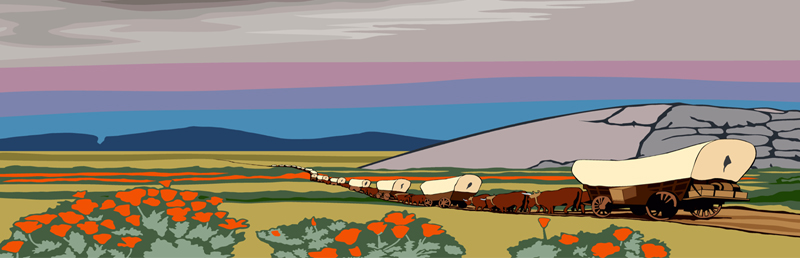
The Mormon Trail by the Bureau of Land Management.
The Mormons used many trails to cross the Great Plains and through the Rocky Mountains to their haven by the inland Great Salt Lake. When the first settlers came to present-day Utah, the States of Iowa, Missouri, Kansas, Nebraska, and Wyoming were gutted and rutted, with many different trails of wheel marks made by their caravans.
While several well-defined, well-traveled trails led from the Missouri River through the mountains, the Mormons seemed inclined to use different routes that paralleled or intersected the regular trails. Perhaps this stemmed mainly from their differences with the general public.
All histories of the Mormons during these times say that there existed deep hatred, coupled with fear, between them and the Gentiles, that eventually led up to an armed insurrection by the Mormons in 1857, following the “Mountain Meadows Massacre,” which caused the sending of 5,000 soldiers under General Albert Sidney Johnston to Utah in 1857-58, to quell and subjugate them.
All early travelers of the trails were inclined to be just as watchful of the Mormons as they were of the Indians, and perhaps rightly too, for records show that they committed many depredations under the guise of Indians.
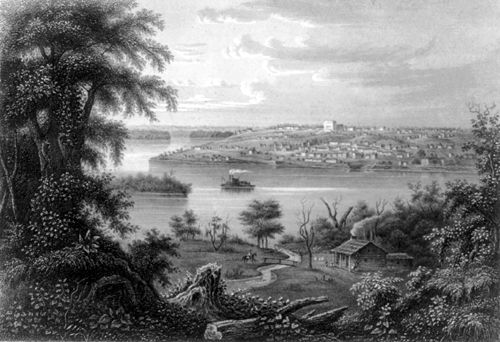
Nauvoo, Illinois, by Hermann J. Meyer, 1855.
Notwithstanding all the evidence to the contrary, this author believes that subsequent investigation will prove that the Mormons traveled more South of the Platte River than North of it. Some 15,000 Mormons wintered at Florence and Council Bluffs, Iowa, the first year of their migration from Nauvoo, Illinois, and thousands of them annually traveled across Iowa through these portals over the northern trail up the North Valley of the Platte River to their destination.
Mormon converts from England primarily traveled to St. Louis and Independence, Missouri, where they began their overland journey by wagon to Salt Lake City.
Embarking at different seaports in England, they took passage on ships that sailed to ports with rail or steamboat connections to the eastern terminus of some trail that led to their promised land. St. Louis, Missouri, had railroads long before Omaha or Council Bluffs, and steamboats could run from there to Independence, Missouri, with regular, well-established service. However, traveling upriver presented many difficulties. Independence was the best outfitting point on the Missouri River at the time, so it was naturally the best place for the Mormons to launch from. Later, the railroads reached St. Joseph, Missouri, and Atchison, Kansas. These, in turn, became the ends of the railroad journey for the Mormon pilgrims from England. Thus, by way of New Orleans, Louisiana, up the Mississippi and Missouri Rivers by boat to Independence, Atchison, and St. Joseph, and by train from New York to these points, thousands of Mormons annually arrived and departed overland westward after 1846. The Great Migration of Missouri Mormons was also added to this.
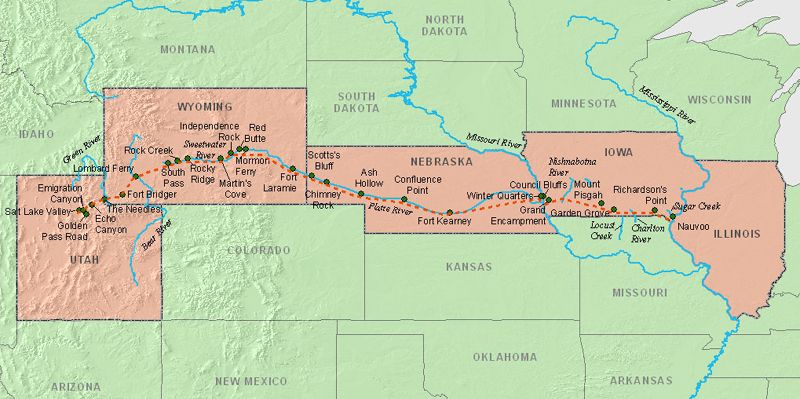
Mormon Trail Map.
The first groups of Mormons cut many trails across the plains, while the Mormons of the late 1860s seemed content to use the regular trails. It is challenging to determine which trail or route the original Mormon Trail traversed across the plains, as they utilized numerous branches and varied routes, extending as far as the mountains, where most of them converged into the Oregon Trail.
Many of them continued down the Santa Fe Trail, eventually pointing North in New Mexico. Even those who went by way of Omaha did not follow the old California Trail up the North side of the Platte River. Thousands kept north of the Elkhorn or Loup Rivers and finally converged on the Oregon Trail somewhere in Wyoming. Many followed the South banks of the Platte River, reaching the Oregon Trail near Fort Kearny.
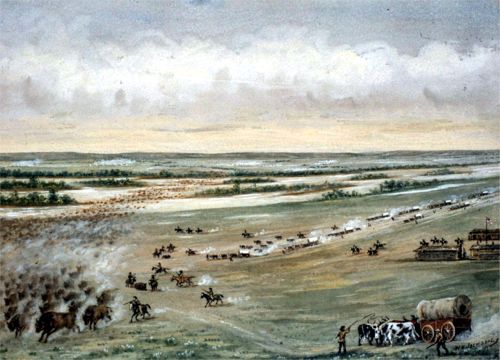
Fort Kearny, Nebraska.
The Mormon Trails of northern Kansas and southern Nebraska started mainly from Independence, St. Joseph, Missouri, Leavenworth, and Atchison, Kansas. Several crossed the Missouri River at Brownsville and Nebraska City.
To outline and find their many trails, follow the most direct and best routes to a common point on the Platte River near the site of Fort Kearny. Thus, those that diverged northward from the Santa Fe Trail after passing the point where the Oregon Trail diverged to cross the Kansas River near the present city of Topeka traveled on down to a point a few miles South of the present town of Eskridge, in Wabaunsee County, where they turned to the northwest, passing through Wabaunsee County into Geary County, reaching the Kansas River at a point about halfway between the present Fort Riley and Junction City, Kansas.
There, they crossed the stream and bore to the North, passing near the present town of Ogden, then North to the Big Blue River, following up the West side of this stream past Garrison’s Crossing and Randolph, crossing Fancy Creek near the latter place. Then, they went northward across the prairies to the Little Blue River, near the present site of Waterville, and joined with another branch that had left the old Oregon Trail somewhere in the northeast corner of Pottawatomie County after crossing Vermillion Creek and had borne almost directly West to the junction of the Blue River, crossing below and going northwest past Waterville into Washington County, towards its northwest corner. On Ash Creek, about three miles South of the present-day town of Washington, was a spring near a high sand-rock wall upon which many Mormons carved their names. This was called “Mormon Springs” by the early pioneers.
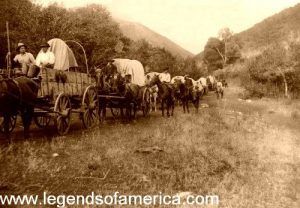
Wagon Train in Utah.
This trail entered Nebraska about three miles East of the Southwest corner of Jefferson County and followed a ridge down to Rose Creek Valley, where they built a crude log bridge across this stream, about half a mile below the present town of Reynolds. The early settlers of Rose Creek Valley found the bridge pilings still in place when they arrived in 1862, and they used this trail to travel to Waterville, Blue Rapids, and points on the Missouri River for supplies.
Old settlers also allege that the Mormons sometimes crossed the Kansas River near Manhattan and struck this trail near Waterville; also that there was another Mormon Trail that followed up the Republican River on the North side from their upper crossing at Junction City or “Whisky Point” past the present towns of Clay Center, Clyde, Scandia, and Republic City, leaving the stream when it bent to the West in the State of Nebraska, going northward across the prairies of Nuckolls County to the Little Blue River, in Adams County, where it converged with the old Oregon Trail.
After crossing Rose Creek, the main branch continued North and West, entered Thayer County, and joined the old Oregon Trail near Hebron on the Little Blue River.
In later years, Mormons from Atchison, Kansas, and St. Joseph, Missouri, generally used the regular trails from these points, connecting with the old Oregon Trail. A few miles from the present-day city of Atchison was a widely used camping place called “Mormon Grove.” During the 1850s and 1860s, thousands of Mormons paused for a brief rest before embarking on their journey across what was then known as the “Great American Desert,” now referred to as the “Kingdoms of Alfalfa and Agriculture” — Kansas and Nebraska.
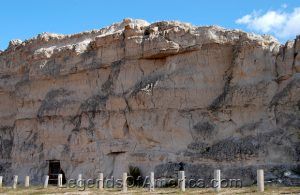
Register Cliff near Guernsey, Wyoming, Kathy Alexander.
The few Mormons who crossed the Missouri River at Brownville and Nebraska City followed the trails other travelers had established over the prairies: the lower one joined the Oregon Trail on the Big Sandy River in Jefferson County, and the Nebraska City Trail joined it a few miles East of Fort Kearny. Although these Mormon Trails have not been located, the above information is probably sufficient to record their existence. Accurately tracing them would be a stupendous task, perhaps impossible, for nearly all of the rutted and scarred evidence of their travel has been effaced by nature and agriculture. Only here and there can be found some unmistakable old-time road descending or ascending some hill, pasture, or meadowlands that have not been disturbed by the plow.
Many of these marks, especially across the smooth prairies or bottomlands, had been effaced even when the country was surveyed in the late 1850s and early 1860s. On the original surveys of many counties in Kansas and Nebraska, through which these trails were allegedly to have passed, there appear marks and notations indicating that such roads were designated as the “Mormon Trail”; however, they are disconnected and somewhat confusing.
A whole volume might be written of this great religious exodus, unparalleled in American History, which reached from the banks of the Missouri River to the Great Salt Lake in an endless procession, toiling with their wagons and handcarts loaded with provisions and material for their new homes. Thousands did not survive the journey’s hardships and suffering. Hostile Indians and blizzards wiped out whole caravans. Mormons continued to use the Oregon Trail from Independence through the 1850s and ’60s. General Albert Sidney Johnston also used this trail during 1857-58 for dispatching various detachments and the supplies for over 5,000 soldiers with which he had been ordered to subjugate the Mormons, who had defied the authority of the National Government.
By Charles Dawson in 1912.
***
From 1846 to 1869, roughly 70,000 Mormons traveled along the Mormon Trail to escape religious persecution. The Pioneer Company of 1846-1847 established a route from Nauvoo, Illinois, to Salt Lake City, Utah, covering about 1,300 miles. They constructed new ferries and bridges and placed markers for others to follow.
In November 1978, Congress established the Mormon Pioneer National Historic Trail as part of the National Trails System to commemorate the 1846-47 journey of the Mormon people from Illinois to the Great Salt Lake Valley. The almost 1,300-mile-long trail is managed as a cooperative effort among private landowners, trail associations, state and local agencies, the National Park Service, the Bureau of Land Management, and the U.S. Forest Service. Although much of the trail is no longer visible, long stretches can still be seen in Wyoming, and several sites remain that can be visited. Some of these include the Nauvoo Temple in Illinois, the Carthage Jail in Illinois, the Florence Mill in Nebraska, one of the last remaining structures built at Winter Quarters by the 5,000-plus Mormons who spent a cold, dreary Winter after their exodus from Nauvoo; Devil’s Gate and Register Cliff in Wyoming, and more.
***
Mormon Trail Facts:
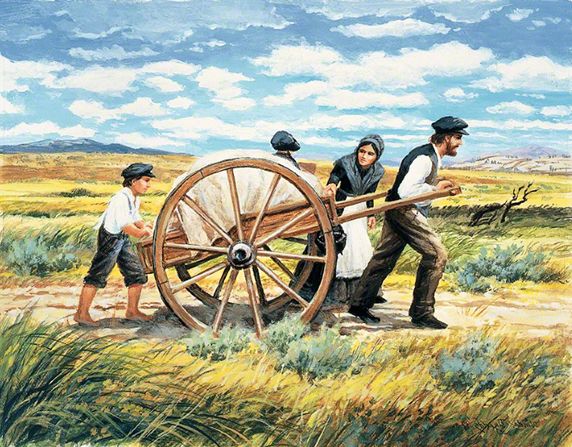
Mormon Handcart Family.
Between 1846 and 1869, some 70,000 Mormons traveled West on the trail. Some 3,000 of them pulled handcarts.
The trail crossed parts of five states: Illinois, Iowa, Nebraska, Wyoming, and Utah.
Brigham Young’s 1847 Vanguard company made the longest Mormon wagon-train trip. The group traveled from Winter Quarters, Nebraska, to the Salt Lake Valley in about three months and one week.
Beehives were among the first items transported to the Salt Lake Valley, along with seeds and tools carried in the wagons. At least 13 apiaries began the journey across the Plains.
The most common causes of death on the trail were trail accidents, disease, and accidental shootings. Accidental shootings, including self-inflicted, were so common that many train leaders banned carrying loaded weapons close to camps.
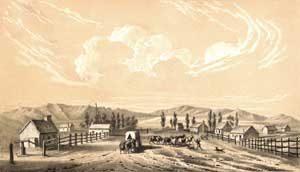
Salt Lake City, Utah, by James Ackerman, 1851.
Orson Pratt and Erastus Snow joined the scouting party and became the first Mormon pioneers to enter the Salt Lake Valley. July 24 celebrates the day Brigham Young arrived with the main party. Young looked over the barren desert and declared, “This is the right place.”
While the pioneers demonstrated an admirable attitude, they weren’t free from complaining. To cut down on it, Brigham Young jokingly appointed a “Chief Grumbler,” the only one in camp with the legal authority to complain about the conditions.
The Mormon pioneers were illegal immigrants. When they entered Salt Lake Valley, it was part of Mexico, and no one had asked permission. However, within a year, the United States ceded it in the Treaty of Guadalupe Hidalgo.
The Mormons eventually formed the State of Deseret, which later became the Utah Territory, and ultimately the state of Utah.
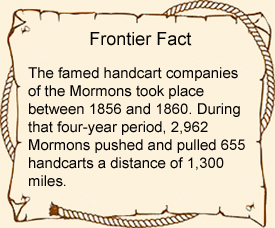 Handcarts were the least typical way to arrive in the valley. Ten total handcart companies migrated between 1856 and 1860, bringing around 3,000 Mormons, about 5% of the overall migration. Tragedy struck in the fall of 1856 when the Willie and Martin handcart companies departed late in the season with approximately 1,000 people between them. Both companies were plagued by a lack of supplies and hardships, including an early snowstorm that became one of the century’s worst storms. The exhausted companies set up camp in deep snow on the Wyoming plains, where more than 200 people died from starvation and cold. A massive rescue effort was launched immediately when word of their plight reached Salt Lake City.
Contact Information:
Mormon Pioneer National Historic Trail
National Park Service
324 South State Street, Suite 200
Salt Lake City, Utah 84111
801-741-1012.
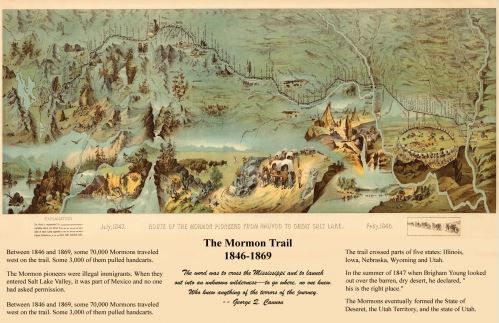
Mormon Trail Map.
Compiled & edited by Kathy Alexander/Legends of America, updated October 2026.
About the Author: The top portion of this article was excerpted from Charles Dawson’s book Pioneer Tales from the Oregon Trail and Jefferson County, published in 1912. Dawson lived in Jefferson County, Nebraska, for more than 40 years and knew many pioneers who traveled along the Oregon Trail. Note: As it appears here, the article is not verbatim. It has been edited for clarity, truncated, and updated for the modern reader.
Also See:
Brigham Young – Leading the Mormons
Mormon Handcart Tragedy of 1856
Sources:
LDS. net
Mormon Iconoclast
Mormon Newsroom
Salt Lake Tribune