
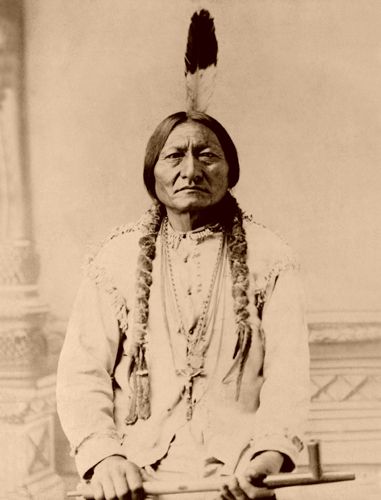
Sitting Bull, D.F. Barry, 1885.
By Charles A. Eastman (Ohiyesa) in 1918
“I am a red man. If the Great Spirit had desired me to be a white man, he would have made me so in the first place. He put certain wishes and plans in your heart, and in my heart, he put other and different desires. Each man is good in his sight. Eagles don’t need to be Crows. We are poor… but we are free. No white man controls our footsteps. If we must die…we die defending our rights.”
— Sitting Bull Hunkpapa Sioux (Tatanka Iyotake)
It is not easy to characterize Sitting Bull, of all Sioux chiefs, most generally known to the American people. There are few to whom his name is not familiar, and still fewer who have learned to connect it with anything more than the conventional notion of a bloodthirsty savage. The man was an enigma at best. He was neither impulsive nor phlegmatic. He was most serious when he seemed to be joking. He was gifted with the power of sarcasm, and few have used it more artfully than he.
His father was one of the best-known members of the Unkpapa band of Sioux. The manner of this man’s death was characteristic. One day, when a large war party of Crow attacked the Unkpapa, he fell upon the enemy’s war leader with his knife. In a hand-to-hand combat of this sort, we count the victor as entitled to a war bonnet of trailing plumes. It means certain death to one or both of them. In this case, both men dealt a mortal stroke, and Jumping Buffalo, the father of Sitting Bull, fell from his saddle and died in a few minutes. The other died later from the effects of the wound.
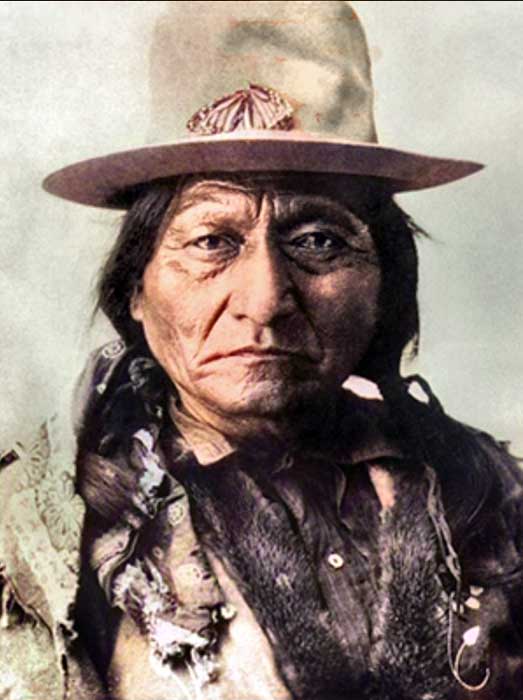
Sitting Bull, Photo likely from the early 1880s.
Sitting Bull’s boyhood must have been a happy one. It was long after the day of the dog-travaux, and his father owned many ponies of variegated colors. It was said of him in a joking way that his legs were bowed like the ribs of the ponies that he rode constantly from childhood. He also had a common nickname that was to the point. It was “Hunkeshnee”, which means “Slow,” referring to his inability to run fast, or more probably, to the fact that he seldom appeared on foot. In their boyish games, he was wont to take the part of the “old man”, but this does not mean that he was not active and brave. It is said that after a buffalo hunt, the boys were enjoying a mimic hunt with the calves that had been left behind. A large calf turned viciously on Sitting Bull, whose pony had thrown him, but the alert youth got hold of both ears and struggled until the calf was pushed back into a buffalo wallow in a sitting posture. The boys shouted: “He has subdued the buffalo calf! He made it sit down!” And from this incident, he derived his familiar name, Sitting Bull.
It is a mistake to suppose that Sitting Bull or any other Indian warrior was of a murderous disposition. Savage warfare had indeed grown more and more harsh and cruel since the coming of white traders among them, bringing guns, knives, and whiskey. Yet it was still mainly regarded as a sort of game, undertaken in order to develop the manly qualities of their youth. It was the degree of risk which brought honor, rather than the number slain, and a brave must mourn thirty days, with blackened face and loosened hair, for the enemy whose life he had taken. While the spoils of war were allowed, this did not extend to territorial aggrandizement, nor was there any wish to overthrow another nation and enslave its people.
It was a point of honor in the old days to treat a captive with kindness. The common impression that the Indian is naturally cruel and revengeful is entirely opposed to his philosophy and training. The white man aroused the revengeful tendencies of the Indians. It is not the natural Indian who is mean and tricky; not Massasoit but King Philip; not Attackullakulla but Weatherford; not Wabashaw but Little Crow; not Jumping Buffalo but Sitting Bull!
These men lifted their hands against the white man, while their fathers held theirs out to him with gifts.
Remember that there were councils which gave their decisions in accordance with the highest ideal of human justice before there were any cities on this continent; before there were bridges to span the Mississippi; before this network of railroads was dreamed of!
There were primitive communities upon the very spot where Chicago or New York City now stands, where men were as children, innocent of all the crimes now committed there daily and nightly. True morality is more easily maintained in connection with the simple life. You must accept the truth that you demoralize any race that you have subjugated.
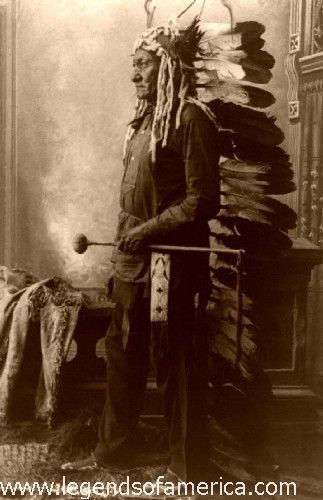
Sitting Bull, 1888.
From this perspective, we will consider Sitting Bull’s career. We say he is an untutored man: that is true so far as learning of a literary type is concerned, but he was not an untutored man when you view him from the standpoint of his nation. To be sure, he did not learn his lessons from books. This is second-hand information at best. All that he learned, he verified for himself and put it into daily practice. In terms of personal appearance, he was relatively unremarkable and made no immediate impression, but as he spoke, he seemed to take hold of his hearers more and more. He was bull-headed; quick to grasp a situation, and not readily induced to change his mind. He was not suspicious until he was forced to be so. All his more mean-spirited traits were inevitably developed through the events of his later career.
Sitting Bull’s history has been written many times by newspapermen and army officers, but I have found no account of him that is entirely accurate. I met him personally in 1884, and since his death, I have gone thoroughly into the details of his life with his relatives and contemporaries. It has often been said that he was a physical coward and not a warrior. Judge of this for yourselves from the deed which first gave him fame in his own tribe, when he was about twenty-eight years old.
In an attack upon a band of Crow Indians, one of the enemy took his stand, after the rest had fled, in a deep ditch from which it seemed impossible to dislodge him. The situation had already cost the lives of several warriors, but they could not let him go to repeat such a boast over the Sioux!
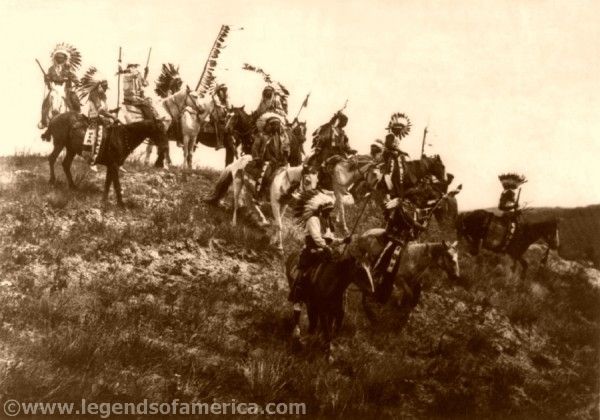
Ogalala War Party 1907.
“Follow me!” Sitting Bull said and charged. He raced his horse to the brim of the ditch and struck at the enemy with his coup-staff, thus compelling him to expose himself to the fire of the others while shooting his assailant. But the Crow merely poked his empty gun into his face and dodged back undercover. Then Sitting Bull stopped; he saw that no one had followed him, and he also perceived that the enemy had no more ammunition left. He rode deliberately up to the barrier and threw his loaded gun over it; then he went back to his party and told them what he thought of them.
“Now,” said he, “I have armed him, for I will not see a brave man killed unarmed. I will strike him again with my coup-staff to count the first feather; who will count the second?”
Again, he led the charge, and this time they all followed him. Sitting Bull was severely wounded by his own gun in the hands of the enemy, who was killed by those who came after him. This is a record that, so far as I know, was never made by any other warrior.
The second incident that made him well-known was his capture of a boy in battle with the Assiniboine. He saved this boy’s life and adopted him as his brother. Hohay, as he was called, was devoted to Sitting Bull and helped much in later years to spread his fame. Sitting Bull was a born diplomat, a ready speaker, and in middle life, he ceased to go upon the warpath to become the councilor of his people. From this time on, this man represented him in all important battles, and upon every brave deed done was wont to exclaim aloud: “I, Sitting Bull’s boy, do this in his name!”
He had a nephew, now living, who resembles him strongly, and who also represented him personally upon the field; and so far as there is any remnant left of his immediate band, they look upon this man, One Bull, as their chief.
When Sitting Bull was a boy, there was no thought of trouble with the whites. He was acquainted with many of the early traders, including Picotte, Choteau, Primeau, Larpenteur, and others, and liked them, as did most of his people at that time. All the early records show this friendly attitude of the Sioux, and the great fur companies for a century and a half depended upon them for the bulk of their trade. It was not until the middle of the last century that they suddenly awoke to the danger threatening their very existence. Yet at that time, many of the old chiefs had already been depraved by the whiskey and other vices of the whites. In the vicinity of the forts and trading posts at Sioux City, Saint Paul, and Cheyenne, there was general demoralization.
The drunkards and hangers-on were ready to sell almost anything they had for the favor of the trader. The better and stronger element held aloof. They would not have anything of the white man except his hatchet, gun, and knife. They utterly refused to cede their lands, and as for the rest, they were willing to let him alone as long as he did not interfere with their life and customs, which was not long.
It was not, however, the Unkpapa band of Sioux, Sitting Bull’s band, which first took up arms against the whites; and this was not because they had come less in contact with them, for they dwelt on the Missouri River, the natural highway of trade. As early as 1854, the Ogallala and Brule had trouble with the soldiers near Fort Laramie, and again in 1857, Inkpaduta massacred several families of settlers at Spirit Lake, Iowa.
Finally, in 1869, the Minnesota Sioux, goaded by many wrongs, arose and murdered many of the settlers, afterward fleeing into the country of the Unkpapa and appealing to them for help, urging that all Indians should make common cause against the invader. This brought Sitting Bull face to face with a question which was not yet fully matured in his own mind; but having satisfied himself of the justice of their cause, he joined forces with the renegades during the summer of 1863, and from this time on, he was an acknowledged leader.
In 1865 and 1866, he met the Canadian half-breed, Louis Riel, instigator of two rebellions, who had crossed the line for safety; and in fact, at this time, he harbored a number of outlaws and fugitives from justice. His conversations with these, especially with the French mixed-bloods, who inflamed his prejudices against the Americans, all had their influence in making the wily Sioux a determined enemy to the white man. While among his own people, he was always affable and genial, he became boastful and domineering in his dealings with the hated race. He once remarked that “if we wish to make any impression upon the pale-face, it is necessary to put on his mask.”
Sitting Bull joined in the attack on Fort Phil Kearny and in the subsequent hostilities, but he accepted in good faith the treaty of 1868. Soon after it was signed, he visited Washington with Red Cloud and Spotted Tail. On that occasion, the three distinguished chiefs attracted much attention and were entertained at dinner by President Grant and other notables. He considered that the life of the white man, as he saw it, was no life for his people, but hoped by close adherence to the terms of this treaty to preserve the Bighorn and Black Hills country for a permanent hunting ground. When gold was discovered and the irrepressible gold seekers made their historic dash across the plains into this forbidden paradise, then his faith in the white man’s honor was gone forever, and he took his final and most persistent stand in defense of his nation and home. His bitter and at the same time well-grounded and philosophical dislike of the conquering race is well expressed in a speech made before the purely Indian council referred to, upon the Powder River. I will give it in brief, as it has been several times repeated to me by men who were present.
“Behold, my friends, the spring is come; the earth has gladly received the embraces of the sun, and we shall soon see the results of their love! Every seed is awakened, and all animal life. It is through this mysterious power that we, too, have our being, and we therefore yield to our neighbors, even to our animal neighbors, the same right as ourselves to inhabit this vast land.
“Yet hear me, friends! We now have to deal with other people, small and feeble when our forefathers first met with them, but now great and overbearing. Strangely enough, they have a mind to till the soil, and the love of possessions is a disease in them. These people have made many rules that the rich may break, but the poor may not! They have a religion in which the poor worship, but the rich will not! They even take tithes of the poor and weak to support the rich and those who rule.
They claim this mother of ours, the Earth, for their own use, and fence their neighbors away from her, and deface her with their buildings and their refuse. They compel her to produce out of season, and when sterile, she is made to take medicine in order to produce again. All this is sacrilege.”
“This nation is like a spring freshet; it overruns its banks and destroys all who are in its path. We cannot dwell side by side. Only seven years ago, we made a treaty by which we were assured that the buffalo country should be left to us forever. Now they threaten to take that away from us as well. My brothers, shall we submit? or shall we say to them: ‘First kill me, before you can take possession of my fatherland!”
As Sitting Bull spoke, so he felt, and he dared to stand by his words. Crazy Horse led his forces in the field; as for him, he applied his energies to state affairs, and by his strong and aggressive personality contributed much to holding the hostiles together.
It may be said without fear of contradiction that Sitting Bull never killed any women or children. He was a fair fighter, and although not prominent in battle after his youth, he was the brains behind the Sioux resistance. He has been called a “medicine man” and a “dreamer.” Strictly speaking, he was neither of these, and the white historians are prone to confuse the two. A medicine man is a doctor or healer; a dreamer is an active war prophet who leads his war party according to his dream or prophecy. What is called by whites “making medicine” in wartime is again a wrong conception. Every warrior carries a bag of sacred or lucky charms, supposed to protect the wearer alone, but it has nothing to do with the success or safety of the party as a whole. No one can make any “medicine” to affect the result of a battle, although it has been said that Sitting Bull did this at the Battle of the Little Bighorn.
When Custer and Reno attacked the camp at both ends, the chief was caught napping. The village was in danger of surprise, and the women and children must be placed in safety. Like other men of his age, Sitting Bull got his family together for flight, and then joined the warriors on the Reno side of the attack. Thus, he was not in the famous charge against Custer; nevertheless, his voice was heard exhorting the warriors throughout that day.
During the autumn of 1876, after the fall of Custer, Sitting Bull was hunted all through the Yellowstone region by the military. The following characteristic letter, doubtless written at his dictation by a half-breed interpreter, was sent to Colonel Otis immediately after a daring attack upon his wagon train.
“I want to know what you are doing, traveling on this road. You scare all the buffalo away. I want to hunt here. I want you to turn back from here. If you don’t, I will fight you again. I want you to leave what you have got here and turn back from here.
I am your friend,
— Sitting Bull.
“I mean all the rations you have got and some powder. Wish you would write me as soon as you can.”
Otis, however, kept on and joined Colonel Miles, who followed Sitting Bull with about four hundred soldiers. He overtook him at last on Cedar Creek, near the Yellowstone, and the two met midway between the lines for a parley.
The army report says: “Sitting Bull wanted peace in his own way.” The truth was that he wanted nothing more than had been guaranteed to them by the treaty of 1868 — the exclusive possession of their last hunting ground. The government was not now prepared to grant this, as it had been decided to place all the Indians under military control on the various reservations.
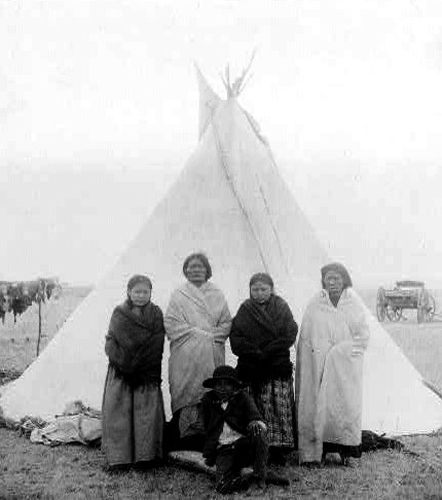
Sitting Bull’s Family
Since it was impossible to reconcile two such conflicting demands, the hostilities were driven about from pillar to post for several more years. Finally, they took refuge across the line in Canada, where Sitting Bull had placed his last hope of justice and freedom for his race.
Here, he was joined from time to time by parties of malcontents from the reservation, primarily driven by starvation and ill-treatment, to seek another home. Here, too, they were followed by United States commissioners, headed by General Terry, who endeavored to persuade him to return, promising an abundance of food and fair treatment, despite the fact that the exiles were well aware of the miserable condition of the “good Indians” upon the reservations. He first refused to meet them at all, and only did so when advised to do so by Major Walsh of the Canadian mounted police. This was his characteristic remark: “If you have one honest man in Washington, send him here and I will talk to him.”
Sitting Bull was not moved by fair words; but when he found that if they had liberty on that side, they had little else, that the Canadian government would give them protection but no food; that the buffalo had been all but exterminated and his starving people were already beginning to desert him, he was compelled at last, in 1881, to report at Fort Buford, North Dakota, with his band of hungry, homeless, and discouraged refugees. It was, after all, to hunger and not to the strong arm of the military that he surrendered in the end.
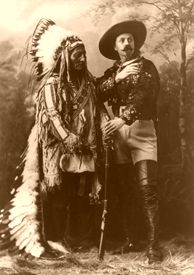
Sitting Bull and Buffalo Bill, 1885.
In spite of the invitation that had been extended to him in the name of the “Great Father” at Washington, he was immediately thrown into a military prison, and afterward handed over to Colonel Cody (“Buffalo Bill”) as an advertisement for his “Wild West Show.”
After traveling for several years with the famous showman, thus increasing his knowledge of the weaknesses as well as the strengths of the white man, the deposed and humiliated chief settled down quietly with his people upon the Standing Rock Agency in North Dakota, where his immediate band occupied the Grand River district and set to raising cattle and horses.
They made good progress; in fact, much better than that of the “coffee-coolers” or “loafer” Indians, who received the missionaries kindly and were soon a church-going people.
When the Commissions of 1888 and 1889 came to negotiate with the Sioux for a further cession of land and a reduction of their reservations, nearly all were opposed to consenting to any terms. Nevertheless, by hook or by crook, enough signatures were finally obtained to carry the measure through, although it is said that many were those of women and the so-called “squaw-men”, who had no rights in the land. At the same time, rations were reduced, and there was widespread hardship and dissatisfaction. Crazy Horse was long since dead; Spotted Tail had fallen at the hands of one of his own tribe; Red Cloud had become a feeble old man, and the disaffected among the Sioux began once more to look to Sitting Bull for leadership.
At this crisis, a strange thing happened. A half-breed Indian in Nevada promulgated the news that the Messiah had appeared to him upon a peak in the Rockies, dressed in rabbit skins, and bringing a message to the red race. The message was to the effect that since his first coming had been in vain, since the white people had doubted and reviled him, had nailed him to the cross, and trampled upon his doctrines, he had come again in pity to save the Indian. He declared that he would cause the earth to shake and to overthrow the cities of the whites and destroy them, that the buffalo would return, and the land belongs to the red race forever! These events were to come to pass within two years, and meanwhile, they were to prepare for his coming by the ceremonies and dances which he commanded.
This curious story spread like wildfire and met with eager acceptance among the suffering and discontented people. The teachings of Christian missionaries had prepared them to believe in a Messiah, and the prescribed ceremonial was much more in accord with their traditions than the conventional worship of the churches. Chiefs of many tribes sent delegations to the Indian prophet; Short Bull, Kicking Bear, and others went from among the Sioux, and on their return, all inaugurated the dances at once.
There was an initial attempt to keep the matter secret. Still, it soon became generally known and seriously disconcerted the Indian agents and others, who were quick to suspect a hostile conspiracy under all this religious enthusiasm. In fact, there was no thought of an uprising; the dancing was innocent enough, and pathetic enough, their despairing hope in a pitiful Saviour who should overwhelm their oppressors and bring back their golden age.
When the Indians refused to give up the “Ghost Dance” at the bidding of the authorities, the growing suspicion and alarm focused on Sitting Bull, who, in spirit, had never been too submissive, and it was determined to order his arrest. At the special request of Major McLaughlin, the agent at Standing Rock, forty of his Indian police were sent out to Sitting Bull’s home on Grand River to secure his person (followed at some little distance by a body of United States troops for reinforcement, in case of trouble).
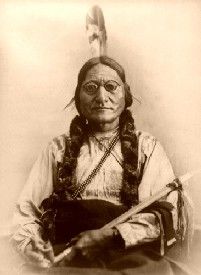
Chief Sitting Bull holding calumet, by Orlando S. Goff, 1881.
These police are enlisted from among the tribesmen at each agency and have proved uniformly brave and faithful. They entered the cabin at daybreak, aroused the chief from a sound slumber, helped him to dress, and led him unresisting from the house. Still, when he came out in the gray dawn of that December morning in 1890, to find his cabin surrounded by armed men and himself led away to he knew not what fate, he cried out loudly: “They have taken me: what say you to it?”
Men poured out of the neighboring houses, and in a few minutes, the police were themselves surrounded with an excited and rapidly increasing throng. They harangued the crowd in vain; Sitting Bull’s blood was up, and he again appealed to his men. His adopted brother, the Assiniboine captive whose life he had saved so many years before, was the first to fire. His shot killed Lieutenant Bull Head, who held Sitting Bull by the arm. Then there was a short but sharp conflict, in which Sitting Bull and six of his defenders and six of the Indian police were slain, with many more wounded. The chief’s young son, Crow Foot, and his devoted “brother” died with him. When all was over, and the terrified people had fled precipitately across the river, the soldiers appeared upon the brow of the long hill and fired their Hotchkiss guns into the deserted camp.
Thus ended the life of a natural strategist of no mean courage and ability. The great chief was buried without honors outside the cemetery at the post, and for some years the grave was marked by a mere board at its head. Recently, some women have built a cairn of rocks there in token of respect and remembrance.
By Charles A. Eastman (Ohiyesa) in 1918, compiled and edited by Kathy Alexander/Legends of America, updated September 2025.
Editor’s Note:
Sitting Bull was killed on December 15, 1890, and his body was taken to Fort Yates, where he was buried. However, in 1953, Sitting Bull’s remains were moved to Mobridge, South Dakota, where he is honored with an appropriate monument. Overlooking the Missouri River near his home, he is remembered among the Lakota not only as an inspirational leader and fearless warrior, but also as a loving father, a spiritual man, and always a person who was friendly to others.
Update: On October 27, 2021, it was published in Science Advances that fragments of DNA solidified that Ernie LaPointe is a living great-grandson. LaPointe requested the test to bolster his argument on moving the Lakota Leader’s remains from Mobridge, SD, to a location he said has more cultural relevance to his great-grandfather.
About the Author: Excerpted from the book Indian Heroes and Great Chieftains, by Charles A. Eastman, 1918. Note, the text is not verbatim as editing has occurred. Charles A. Eastman earned a medical degree from Boston University School of Medicine in 1890 and then began working for the Office of Indian Affairs later that year. He worked at the Pine Ridge Agency, South Dakota, and was an eyewitness to both events leading up to and following the Wounded Knee Massacre of December 29, 1890. Part-Sioux himself knew many of the people about whom he wrote.
Also See: