
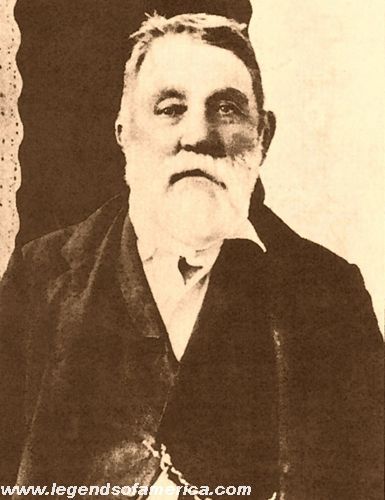
Judge Roy Bean.
Judge Roy Bean was a Justice of the Peace in Val Verde County, in southwest Texas. He also owned a saloon in Langtry, where he held court and referred to himself as “The Law West of the Pecos.”
Phantly Roy Bean, Jr. was born in Mason County, Kentucky, around 1825 to Phantly Roy and Anna Henderson Gore Bean. The youngest of three sons, the Kentucky family was impoverished.
At the age of 15, he left Kentucky to follow his two older brothers west. With his brother, Sam, he joined a wagon train bound for New Mexico, then crossed the Rio Grande and established a trading post in Chihuahua, Mexico, in 1848. After killing a local man, Roy fled to San Diego, California, where Joshua, his brother.
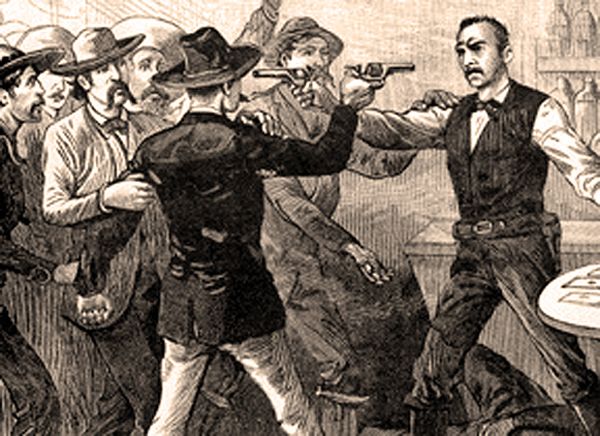
Saloon Gunfight.
On February 24, 1852, Bean was in a duel on horseback with a Scotsman named Collins. In the gunfight, Collins was shot in his right arm, and both men were arrested for assault with intent to murder. Bean, who was considered brave and handsome by the local women, received numerous visits and gifts during his six-week stay in jail. When one of his admirers slipped him knives hidden in some tamales, Bean used them to dig through the cell wall and escaped on April 17.
Next, he ended up in San Gabriel, California, where his brother Joshua owned the Headquarters saloon. When Joshua was killed in November 1852, Bean inherited the saloon and took over its operation.
While there, Bean killed a Mexican official during an argument over a woman. Friends of the official soon hauled Bean off, lynched him, and left him to die. However, he was saved by the young woman who had been the cause of the dispute. He sported a permanent rope burn on his neck for the rest of his life, constantly feeling stiff.

Old San Antonio, Texas.
Before long, he was back in New Mexico, where he again lived with his brother Sam, who had become the sheriff in Mesilla.
The Texas army invaded New Mexico during the Civil War, and Bean soon joined them, hauling supplies for the Confederates and living in San Antonio. On October 28, 1866, he married 18-year-old Virginia Chavez, but he was unhappy. A year into the marriage, Bean was arrested for aggravated assault on his wife. However, despite their differences, the couple would eventually have four children. For the next decade, the family lived in a Mexican slum area on South Flores Street in San Antonio, which soon earned the nickname of Beanville. During these years, he worked in several professions, including teamster, saloon operator, and ran a dairy business, as well as other entrepreneurial enterprises that were not very successful. He became known for circumventing creditors, business rivals, and the law.
By the early 1880s, Bean and his wife were separated. He sold all his possessions and left San Antonio, wandering among the railroad camps before finally settling in west Texas near the Pecos River. In the early 1880s, the Southern Pacific Railroad worked hard to overcome its final obstacle in completing its transcontinental route — crossing the Pecos River. A construction camp was formed near the railroad bridge site, called Vinegarroon, named for a type of scorpion found in the area that emits a vinegar-like odor when alarmed. The community was founded in 1881, serving as a temporary home for thousands of railroad workers, and Roy Bean quickly established a small saloon in the tent city.
On July 5, 1882, Texas Ranger Captain T. L. Oglesby penned a note to his commanding officer, General King, describing the area:
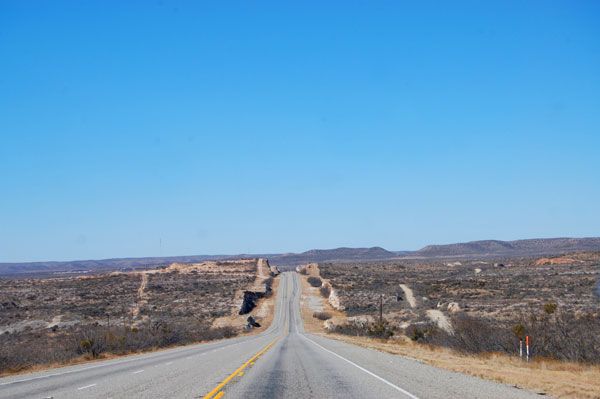
Pecos Trail between Comstock and Langtry, Texas by Kathy Alexander.
Eagle Nest, Pecos County, Texas – July 5, 1882
Upon my arrival here on June 29, I visited all the railroad camps and thoroughly scouted the country. There is the worst lot of roughs, gamblers, robbers, and pickpockets, collected here I ever saw, and without the immediate presence of the state troops, this class would prove a great detriment towards the completion of the road.
There is nothing for Rangers to do but hold this rough element in subjection and control them. The majority of the railroad camps are in Pecos County. This immediate section is 200 miles from Fort Stockton, the nearest jurisdiction of the Court of Justice, and the consequent minor offenses go unpunished; but, I hope to remedy that in a few days by having a Magistrate appointed for the precinct.
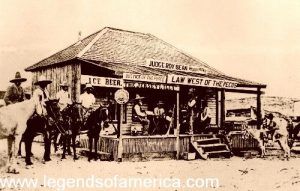
Judge Roy Bean’s Jersey Lilly Saloon in Langtry, Texas.
When it became known that a Justice of the Peace was wanted for the area, Roy Bean was quick to volunteer, and on August 2, 1882, he became the only “legal authority” in the area. He first operated his “justice” out of his tent saloon in Vinegarroon. With the nearest court 200 miles away at Fort Stockton, he quickly became the self-proclaimed “Only Law West of the Pecos.”
An unusual sort of “judge” from the beginning, one of his first judicial acts was to shoot up the saloon of a Jewish competitor. Holding court in his saloon, he utilized a single law book — the 1879 edition of the Revised Statutes of Texas. His justice methods, carried out in his combination saloon/courtroom, were somewhat odd and always final. During the construction of the bridge at Vinegarroon, a structure collapsed, resulting in ten workers falling. Judge Roy Bean was called to the site to hold an inquest. Riding on a mule to the accident, he pronounced all ten men dead; however, only seven had been killed. When questioned on this point, the judge reasoned that the others would soon die and that he did not want to make the trip twice. Fortunately for the three men, he was wrong, and they survived to tell the tale.
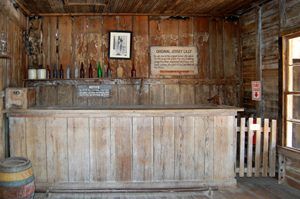
Jersey Lilly Saloon Interior in Langtry, Texas by Kathy Alexander.
By December 1882, railroad construction on the bridge had been completed, and Vinegarroon was abandoned. Bean then headed northwest to the railroad camp of Eagle Nest (later called Langtry). There, he quickly set up another tent saloon on railroad land, to the chagrin of Cezario Torres, who owned most of the land beside the railroad right-of-way. He later built a wooden structure for his saloon, which he called the “Jersey Lillie” after the well-known British stage actress Lillie Langtry. Her real last name was Emilie Le Breton, and she was not related to George Langtry, of whom the town was named. Bean used the saloon as his headquarters and courtroom, continuing his eccentric judicial antics.
On one occasion, when the body of a dead cowboy was found in the area, which held $40 and a six-gun, he charged the corpse with carrying a concealed weapon and fined it $40. In another case, when an Irishman named Paddy O’Rourke was going to be tried for shooting a Chinese laborer, a mob of 200 angry Irishmen surrounded the courtroom and threatened to lynch Bean if O’Rourke was not freed. In response, Bean ruled that “homicide was the killing of a human being; however, he could find no law against killing a Chinaman,” The case was dismissed.
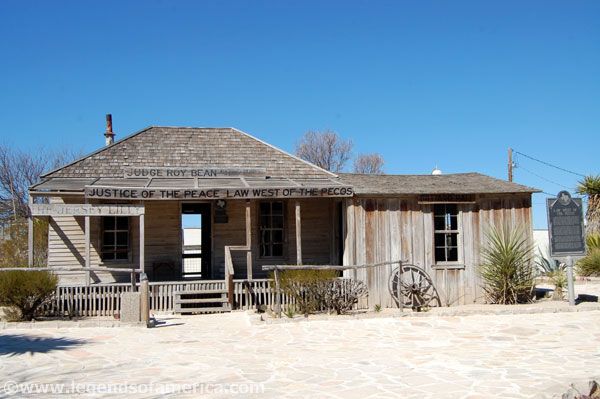
Judge Roy Bean’s Jersey Lilly Saloon by Kathy Alexander.
Despite the protest of the Texas Rangers, Bean thought it preposterous to forbid a man to carry a weapon. Bean released one man who was arrested and accused of carrying a concealed weapon with the following logic.
“That charge won’t stick,” pronounced the judge. “If he was standing still when he was arrested, he wasn’t carrying weapons because he wasn’t going anywhere. And, if he was not standing still, he was traveling, and it’s legal for travelers to carry weapons. Case dismissed.”
Jurors for his cases were chosen from his best bar customers, and Bean allowed no hung juries or appeals. Because Langtry had no jail, all cases were settled by fines, most of which were typically the amount the accused had on their person. Of these fines collected, he was never known to have sent any money to the state; instead, he pocketed the cash.
Though later portrayed in Western films and books as a “hanging judge,” Bean only sentenced two men to hang, one of whom escaped. And when it came to horse thieves, who were often sentenced to hang, they would be let go under Judge Bean if they returned the horses and, of course, paid a fine. Bean also made money by granting divorces, which he lacked the jurisdiction to do, and married numerous couples, always concluding the wedding ceremonies with the words, “and may God have mercy on your souls.”

Eagle Nest Canyon, where Roy Bean held his boxing matches, by Kathy Alexander.
Bean was defeated in the 1886 election, but the following year, a new precinct was created after Langtry had become part of Val Verde County, and he was appointed as the new justice of the peace once again. He continued to be elected until 1896, when he was finally defeated. However, in typical “Bean” fashion, he refused to surrender his seal and law book and continued to try all cases north of the railroad tracks.
In 1896, Judge Roy Bean made national headlines by setting up a boxing match in Langtry. Because Texas had outlawed boxing, he scheduled the heavyweight fight between Robert James Fitzsimmons and Peter Maher on a sandbar on Mexico’s side of the Rio Grande, just south of Langtry. Bean then arranged for the press, spectators, and Texas Rangers to travel by train from El Paso to Langtry. Fitzsimmons knocked Maher out in 95 seconds, winning the heavyweight title.
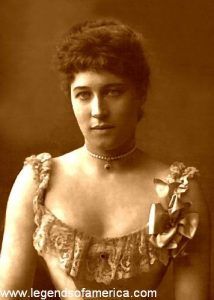
Lillie Langtry.
For years, he boasted of his “acquaintance with Miss Langtry,” telling anyone and everyone that he would one day meet her. When he built a home for himself behind the saloon, he even called it the “Opera House” in anticipation of a visit by the famous actress. Although he never met Lillie Langtry, he often wrote to her, and she allegedly wrote back to him, sending him two pistols, which he cherished for the rest of his life. He also claimed credit for naming the town after her. Although it was not the case, as mentioned earlier, it was named after railroad man George Langtry.
As he aged, Bean spent much of his time on his porch with a shotgun in his arms, drinking and boasting. However, he was also known to help the poor in the area.
After a heavy bout of drinking, Bean died in his saloon on March 16, 1903, of lung and heart ailments without ever meeting his fantasy woman, Lillie Langtry. He was initially buried in Westlawn Cemetery in Del Rio, Texas. Still, due to the numerous visitors to his grave, he and his son, Samuel, were later re-interred behind the Whitehead Memorial Museum.
Almost a year after his death, Lillie Langtry finally visited his old home. En route from New Orleans to Los Angeles, she stopped to listen to the townspeople tell the stories of Judge Roy Bean. She would later write, “It was a short visit, but an unforgettable one.”
Today, the Jersey Lilly Saloon, his home, and a museum still stand in Langtry, Texas.
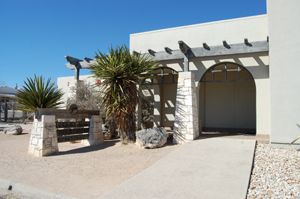
Roy Bean Visitor Center in Langtry, Texas by Kathy Alexander.
©Kathy Alexander/Legends of America, updated August 2025.
Also See:
Del Rio to Sanderson on the Pecos Trail
Langtry – Home to the Only Law West of the Pecos
Texas Rangers – Order out of Chaos
Val Verde County, Texas Photo Gallery
See Sources.