
A land of extremes, Death Valley is one of the hottest, driest, and lowest places on earth. The valley is aptly named, with summer temperatures averaging well over 100 degrees and a long history of human suffering in the vast desert. However, this place of eroded badlands, sand dunes, and golden hills also has a haunting sense of beauty. Continue reading, or see one of our many related articles.
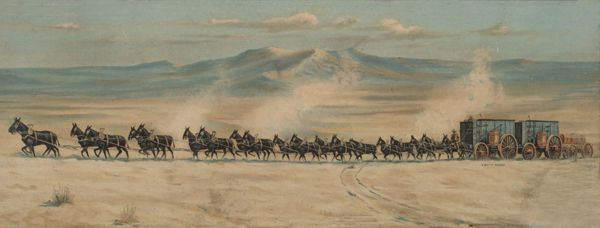
20-Mule Team hauling Borax in Death Valley.
Pete Aguereberry – Mining Death Valley
Ashford Mine and Mill in Death Valley
Ballarat – Death Valley Ghost Town
William F. “Alkali Bill” Brong & the Death Valley Chug Line
Characters of Early Death Valley
William T. Coleman – Shipping to Borax
Desert Steamers in Death Valley
The Hidden City of Death Valley
Albert Johnson – Owner of Scotty’s Castle
Walter Scott, Better Known as Death Valley Scotty
Francis “Borax” Marion Smith – The Borax King of Death Valley
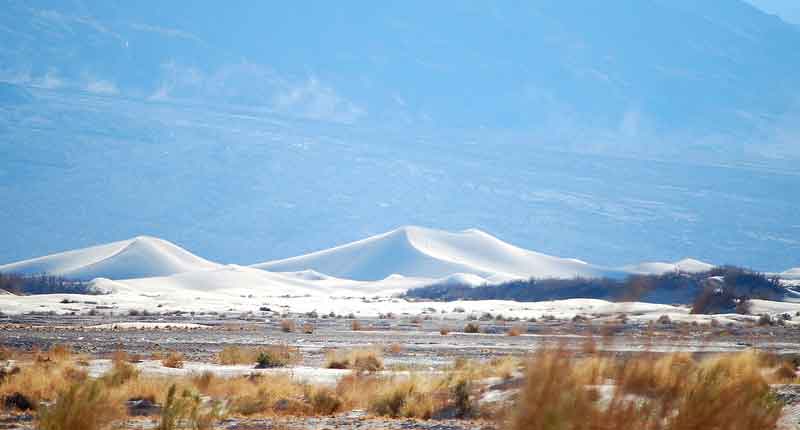
Sand dunes near Old Stovepipe Wells in Death Valley National Park, California. Photo by Dave Alexander.
Long before white settlers came upon the valley, four groups of Native Americans inhabited these desolate lands. Some 9,000 years ago, the Nevares Spring People, a group of primitive hunters and seed gatherers, lived in the valley when lakes still existed, the climate was mild, and the game was plentiful.
Four thousand years later, the Mesquite Flat People occupied the valley; the Saratoga Spring People arrived about 2000 years later. By then, the basin had become a hot, dry desert. About 1,000 years ago, the Desert Shoshone camped near water sources in the valley during the winter but moved to the cooler mountains in the summer.
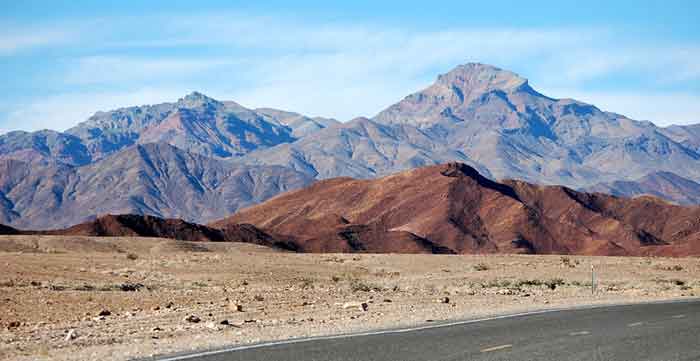
Corkscrew Peak in Death Valley. Photo by Dave Alexander.
The nomadic Shoshone enjoyed the valley for centuries until the first groups of emigrants began to enter the area on their way to the California goldfields.
The first white pioneers to come to the valley were a group of California-bound emigrants who split off from a wagon train leaving Utah in 1849. They could save time by cutting across the valley; the group became known as the “Lost 49ers.” Lost and out of food, the group finally made their way out of the desert, giving its name when they declared, “Goodbye, Death Valley.” During their hellish trip across, one of the miners found silver ore and would later fashion it into a gun sight. The ore found in the desert was nicknamed the Lost Gunsight Mine, which sparked a mining boom that lasted over a century.
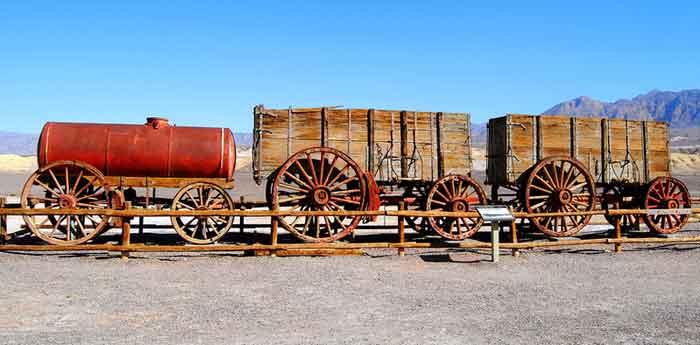
20 Mule Team Wagon, Harmony Borax Works, Death Valley, California, Kathy Alexander.
From the 1880s to the turn of the century, mining in the Death Valley region was limited and sporadic, with many mining districts meeting with notable success. This was primarily due to a lack of water and fuel, transportation difficulties, and inefficient technology. However, one long-term profitable ore mined in the area was borax, a mineral used to make soap and other industrial compounds. The Harmony Borax Works was one of the earliest successful mining operations, operating from 1883 to 1888. The mine was famous for its rich borax deposits, and the Twenty Mule Team wagons were used to transport the partially refined mineral.
Advances in technology, machinery, and transportation renewed interest in gold and silver mining in Death Valley after the turn of the century. Before long, mines sprang up at Skidoo, Rhyolite, and Keane Wonder, becoming large-scale operations. Flourishing during the first decade of the 20th century, the mines began to slow, and by 1915, large-scale metal mining had ended in Death Valley.
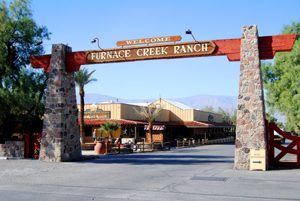
Furnace Creek Ranch entry in Death Valley National Park, California. Photo by Kathy Alexander.
In the 1920s, the first tourist facilities in the valley were housed in tent houses at Stovepipe Wells. Seven years later, one of the borax companies turned its crew quarters at Furnace Creek Ranch into a resort and built the Furnace Creek Inn. The valley quickly became popular as a winter destination, and in February 1933, President Herbert Hoover signed the proclamation creating Death Valley National Monument, encompassing almost 3,000 square miles.
Other facilities that started as private getaways were later opened to the public. Most notable among these was the Death Valley Ranch, better known as Scotty’s Castle. This large ranch home, built in the Spanish-ranchero style by retired millionaire businessman Albert Johnson, became a hotel in the late 1930s. The site soon became a tourist attraction mainly due to the fame of an eccentric man named Death Valley Scotty.
The creation of the National Monument led to a temporary closure of the lands to prospecting and mining in February 1933. However, by an agreement made before the monument’s establishment, the valley was reopened to mining in June of the same year. As improvements in mining technology enabled the processing of lower-grade ore, open-pit and strip mines began to scar the landscape. Finally, the public outcry increased protection for all national parks and monument areas in the United States.
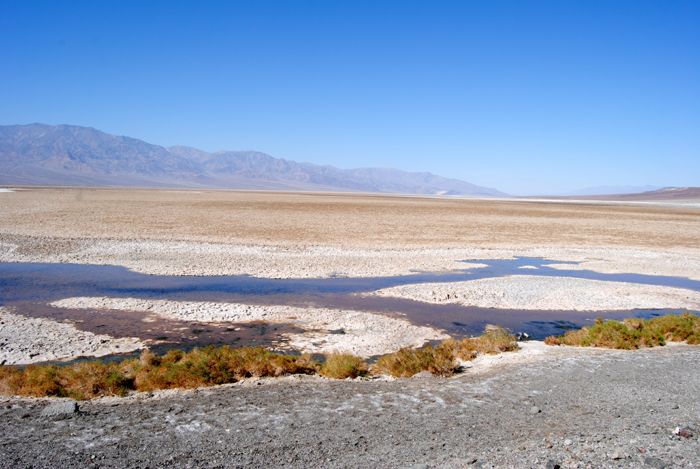
Badwater Basin in Death Valley by Kathy Alexander.
In 1976, Congress passed the Mining in the Parks Act, which closed Death Valley to filing new mining claims, banned open-pit mining, and required the National Park Service to examine the validity of tens of thousands of pre-1976 mining claims. Mining was allowed to resume on a limited basis in 1980 with stricter environmental standards. The park monitors nearly 150 mining claims today, although only one active mine remains in operation.
In 1994, the Monument was designated a National Park. It was substantially expanded by about 1.3 million acres, making it the largest national park in the contiguous United States.
Located east of the Sierra Nevada in Inyo County, California, the 5,219-square-mile park extends slightly into western Nevada.
Activities in the park include sightseeing, driving personal automobiles, 4-wheel-drive vehicles, bicycling, hiking, and camping. Park Rangers provide interpretive programs from November through April, and tours are provided at Scotty’s Castle for a fee.
Death Valley is also filled with ghost towns, including Ballarat, Leadfield, Panamint City, Rhyolite, and Chloride City in California and Nevada, and dozens more.
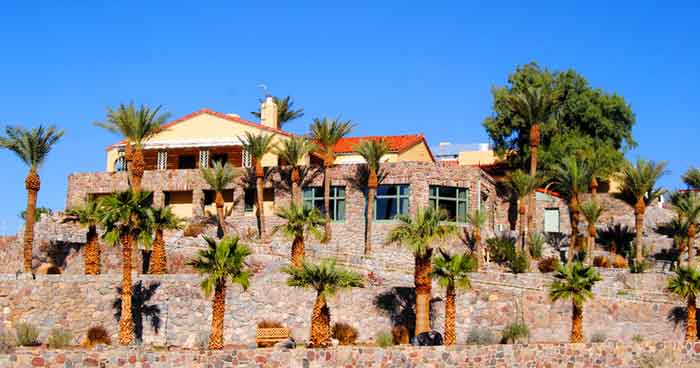
Furnace Creek Inn, by Kathy Alexander.
The visitor center is in the Furnace Creek resort area on California State Route 190. The Visitor’s Center offers displays on geology, climate, wildlife, and the park’s human history, and it also features a fully staffed information desk. Here is also the Furnace Creek Inn, a first-class private resort.
More Information:
Death Valley National Park
P.O. Box 579
Death Valley, California 92328
760-786-3200
Compiled and edited by Kathy Alexander/Legends of America, updated December 2025.
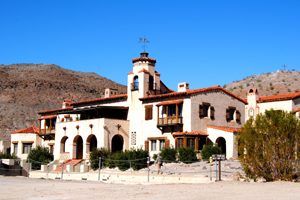
Scotty’s Castle, Death Valley, California, Kathy Alexander.
Also See:
Source: National Park Service