
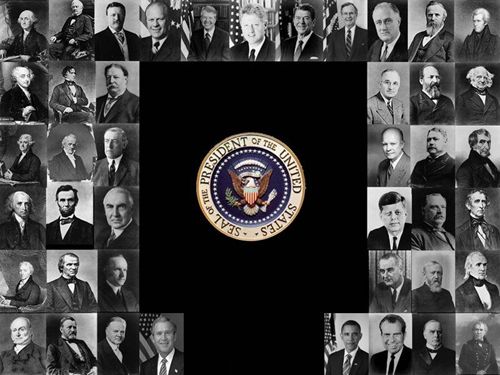
“The presidency has made every man who occupied it, no matter how small, bigger than he was; and no matter how big, not big enough for its demands.”
— Lyndon B. Johnson
Presidents (See Below)
President Abraham Lincoln’s Gettysburg Address
President Franklin D. Roosevelt’s “Infamy Speech”
The Presidential Election of 1800
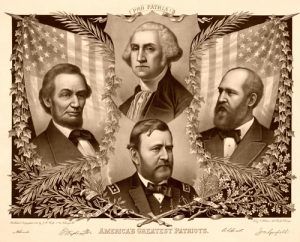
America’s Greatest Patriots – Presidents George Washington, Abraham Lincoln, William McKinley, and James Garfield, by Kurz and Allison, 1890.
Presidents:
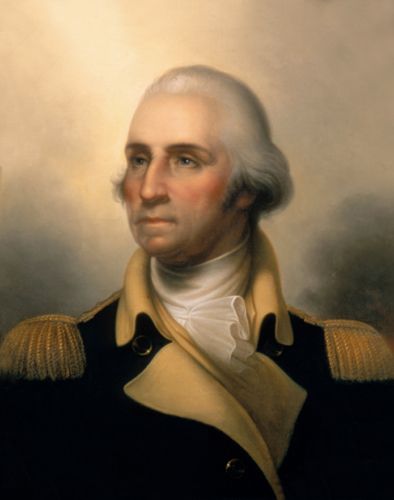
George Washington in military uniform, by Rembrandt Peale.
George Washington – Father of Our Country – (1732-1799)
Term (1789-1797) Vice President – John Adams (1789-1797)
First President of the United States, Founding Father, and Commander of the Continental Army in the American Revolution. He presided over the writing of the Constitution in 1787.
John Adams – Founding Father & 2nd U.S. President (1735-1826) –
Term (1797-1801) Vice President –Thomas Jefferson (1797-1801)
Vice President to George Washington, 2nd U.S. President, and Founding Father of the United States.
Thomas Jefferson — The Sage of Monticello (1743-1826)
Term (1801-1809) Vice President(s) Aaron Burr (1801-1805), George Clinton (1805-1809)
The third President of the United States and a principal author of the Declaration of Independence, he is known for promoting the ideals of republicanism. He is considered one of the most influential Founding Fathers.
Also See: Thomas Jefferson – The True Father of American History
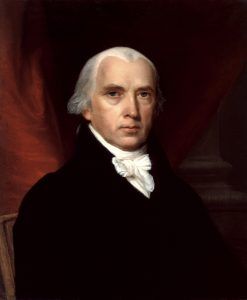
President James Madison by John Vanderlyn.
James Madison (1751-1836)
Term (1809-1817) Vice President(s) George Clinton (1809-1812) None (1812-1813) Elbridge Gerry (1813-1814) None (1814-1817)
Politician, political philosopher, 4th President of the United States, and one of the country’s Founding Fathers. He was instrumental in writing the Constitution and wrote the Bill of Rights. As a leader in the House of Representatives, Madison worked closely with President George Washington to organize the new federal government. As Thomas Jefferson’s Secretary of State (1801–1809), he supervised the Louisiana Purchase, which doubled the nation’s size. A series of disasters at the beginning of the War of 1812 damaged his reputation, but by 1814–15, American forces repulsed major British invasions, and he recovered.
James Monroe (1758-1831)
Term (1817-1825) Vice President Daniel D. Tompkins (1817-1825)
The 5th President of the United States and the last Founding Father to become a U.S. President. He is most noted for his 1823 proclamation of the Monroe Doctrine, which stated that the United States would not tolerate further European intervention in the Americas.
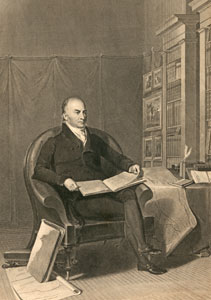
John Quincy Adams by Thomas Sully, 1826.
John Quincy Adams (1767-1848)
Term (1825-1829) Vice President John C. Calhoun (1825-1829)
The son of Founding Father John Adams, he was a politician, diplomat, and the 6th President of the United States. Historians agree he was one of the great diplomats in American History. Adams had previously served as an ambassador to several European countries and a U.S. senator from Massachusetts. He is the only president in history to serve in the U.S. House of Representatives after leaving the presidency. Adams’s fierce sense of independent judgment meant that he never completely fit the mold of any political party, and he was undoubtedly the only president to have a pet alligator in the White House!
Andrew Jackson – (1767-1845)
Term (1829-1837) Vice President(s) John C. Calhoun (1829-1832), None (1832-1833), Martin Van Buren (1833-1837)
The 7th President of the United States also served as the military governor of pre-admission Florida and as the commander of American forces at the Battle of New Orleans in the War of 1812. He dominated American politics in the 1820s and 1830s, helping to shape the Democratic Party.
Martin Van Buren (1782-1862)
Term (1837-1841) Vice President Richard M. Johnson (1837-1841)
The 8th President of the United States, he also served as Vice President to Andrew Jackson. He was a key organizer of the Democratic Party and the first president to be born an American citizen. As the descendant of Dutch immigrants, he was also the first president whose ethnic background wasn’t mainly from the British Isles. He was best known for his shrewd political skills. He considered himself a follower of Thomas Jefferson and was one of the founders of the Democratic Party.
William Henry Harrison (1773-1841)
Term 1841 Vice President John Tyler (1841)
The 9th President of the United States, a military officer and politician, he was the first president to die in office. He had the shortest tenure in presidential history. As an Army officer and governor of the territory that would later become Indiana and Illinois, he fought against the Indians. He made harsh treaties with them, clearing the way for more westward settlement by whites. His military victories against the Indians made him a hero to white Americans. Harrison’s father, Benjamin Harrison, signed the Declaration of Independence. William Henry Harrison’s grandson, Benjamin Harrison, became the 23rd president.
John Tyler (1790-1862)
Term (1841-1845) Vice President –None
The 10th President of the United States, he was the first to succeed in office following the death of a predecessor. As president, he opposed his party’s platform and vetoed several of its proposals, leading most of his cabinet to resign and the Whigs to expel him from the party. His most notable achievement was annexing the Republic of Texas in 1845. Tyler had other “firsts” as president: His first wife was the first wife to die while her husband was still president, and he was the first president to marry while in office. Tyler was the last of the Virginia aristocrats in the White House. He was a Southerner until his death, even being elected to the Confederate Congress after unsuccessfully trying to keep the Union from dissolving and entering the Civil War. He was the only president who also allied himself with the Confederacy.
The best years of your life are the ones in which you decide your problems are your own. You do not blame them on your mother, the ecology, or the president. You realize that you control your own destiny.
— Albert Ellis
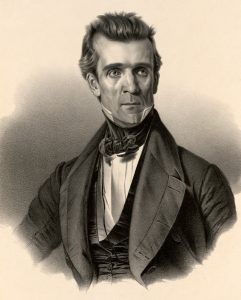
President James Polk by Charles Fenderich, 1845
James K. Polk (1795-1849)
Term (1845-1849) Vice President George M. Dallas (1845-1849)
The 11th President of the United States, Polk, also served as Speaker of the House and Governor of Tennessee. Polk was the last strong pre-Civil War president, noted for his successes in foreign policy. Scholars have ranked him favorably on lists of the greatest presidents for his ability to set and achieve an agenda. Polk was too sick as a child to attend formal schooling, yet he graduated at the top of his class from the University of North Carolina at 22. He was nicknamed “Napoleon of the Stump” for his excellent speaking skills. Polk was a highly diligent chief executive and one of the most productive presidents in American history. He greatly expanded the U.S. territory and re-established the independent treasury system, among many other accomplishments. Upon election, he vowed to serve only one term, a promise he kept when he declined to run in 1848.
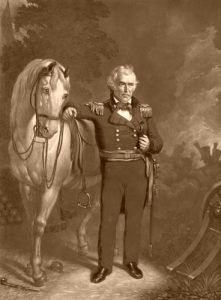
General Zachary Taylor, by John Sartain, 1848.
Zachary Taylor (1784-1850)
Term (1849-1850) Vice President
Distinguished general and 12th President of the United States, Taylor served in the War of 1812 and the Mexican-American War, earning the nickname “Old Rough and Ready.” He was elected president in 1848, the first to have never held any previous elected office. He was also the last President to hold slaves while in office. Just two years into his presidency, he died.
Millard Fillmore (1800-1874)
Term (1850-1853) Vice President – None
The 13th President of the United States, he assumed the presidency after the death of Zachary Taylor. After serving out Taylor’s term, he failed to gain the nomination for re-election.
Franklin Pierce (1804-1869)
Term (1853-1857) Vice President William King (1853), None (1853-1857)
Politician, lawyer, soldier, and 14th U.S. President Pierce was a brigadier general in the Mexican-American War. As president, he made many divisive decisions that were widely criticized, earning him a reputation as one of the worst presidents in U.S. history. His popularity fell after he came out in favor of the Kansas-Nebraska Act, repealing the Missouri Compromise, and renewing the debate over expanding slavery in the West. He lost the nomination for re-election.
James Buchanan (1791-1868)
Term (1857-1861) Vice President John C. Breckinridge (1857-1861)
The 15th U.S. President, politician, and attorney was often called a “doughface,” meaning a Northerner with Southern sympathies. Buchanan’s efforts to maintain peace between the North and the South alienated both sides, and the Southern states seceded. His inability to impose peace on sharply divided partisans on the brink of the Civil War has led historians to consistently rank him among the worst Presidents.
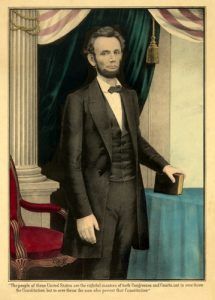
Abraham Lincoln.
Abraham Lincoln (1809-1865)
Term (1861-1865) Vice President(s) Hannibal Hamlin (1861-1865), Andrew Johnson (1865)
Pioneer, attorney, and 16th U.S. President, he guided the country through its most devastating national experience —the Civil War. He was assassinated on April 14, 1865, and died the next day. Many historians consider him the greatest American president.
More reading…
The Assassination of President Abraham Lincoln
President Abraham Lincoln’s Gettysburg Address
John Wilkes Booth – Actor to Assassin
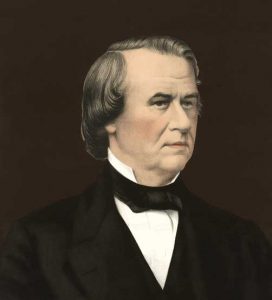
Andrew Johnson by Bingham & Dodd, 1866.
Andrew Johnson (1808-1875)
Term (1865-1869) Vice President None
The 17th U.S. President, following the assassination of President Abraham Lincoln, Johnson presided over the Reconstruction era for four years after the American Civil War. His position favoring the white South came under heavy political attack, and his vetoes of civil rights bills embroiled him in a bitter dispute with Radical Republicans. He was impeached in 1868 but was acquitted by a single vote in the Senate. Historians commonly rank him as being among the worst U.S. presidents.

Ulysses S. Grant and his family, by Pach Brothers, 1870.
Ulysses S. Grant (1822-1885)
Term (1869-1877) Vice President(s) Schuyler Colfax (1869-1873) Henry Wilson (1873-1875) None (1875-1877)
He was the American General and the 18th President of the United States. He achieved international fame as the leading Union general in the Civil War. However, he wasn’t rated well as an American president.
Rutherford B. Hayes (1822-1893)
Term (1877-1881) Vice President William Wheeler (1877-1881)
A lawyer, major general in the Civil War, and 19th U.S. President, Hayes also served as the Governor of Ohio twice and in Congress. During his presidency, Hayes ordered federal troops to suppress the Great Railroad Strike of 1877 and ended Reconstruction by removing troops from the South. After the removal of the troops, all southern states soon returned to Democratic control and the start of the Jim Crow South.
James A. Garfield (1831-1881)
Term (1881) Vice President Chester Arthur (1881)
A lawyer, Major General during the Civil War, and 20th U.S. President, he served only 200 days in office. Shot by Charles J. Guiteau on July 2, 1881, who was disgruntled by failed efforts to secure a federal post, one bullet grazed Garfield’s arm, while another lodged in his spine. Due to the infection, Garfield became increasingly ill over the next few weeks, causing his heart to weaken. He died of a massive heart attack on September 19, 1881.
Chester Arthur (1829-1886)
Term (1881-1885) Vice President None
Lawyer, politician, and 21st U.S. President, he assumed the role after the death of James Garfield. His primary achievement was the passage of the Pendleton Civil Service Reform Act, which earned him the moniker “The Father of Civil Service” and a favorable reputation among historians. However, he was not nominated for re-election.
Grover Cleveland (1837-1908)
Term (1885-1889) Vice President Thomas Hendricks (1885) None (1885-1889)
Lawyer, politician, New York Governor, and the 22nd and 24th President of the United States, Cleveland is the only president to serve two non-consecutive terms (1885-1889 and 1893-1897). He won praise for his honesty, independence, integrity, and commitment to classic liberalism and reform. However, his strong positions drew heavy criticism, and he was defeated in the 1888 re-election.
In America, the President reigns for four years, and Journalism governs forever and ever.
— Oscar Wilde
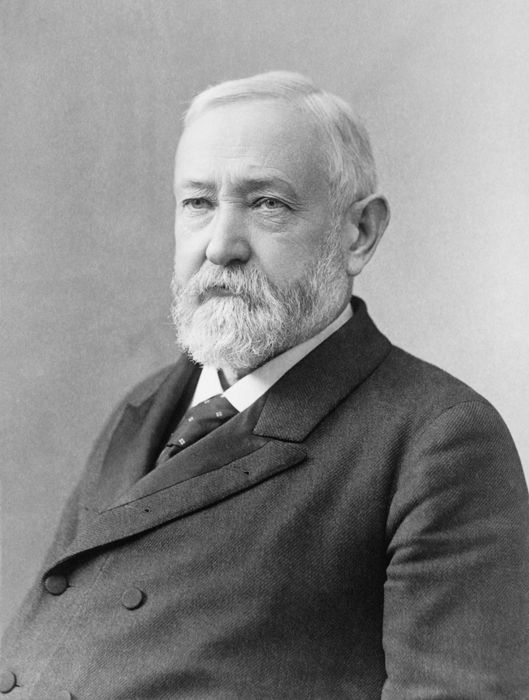
President Benjamin Harrison by the Pach Brothers, 1896.
Benjamin Harrison (1833-1901)
Term (1889-1893) Vice President Levi P. Morton (1889-1893)
The grandson of President William Harrison, Benjamin served as a Brigadier General during the Civil War and served in the U.S. Senate before becoming the 23rd U.S. President. His administration is most remembered for economic legislation, including the McKinley Tariff and the Sherman Antitrust Act, and annual federal spending reaching one billion dollars for the first time. He lost the re-election to Grover Cleveland in 1892.
Grover Cleveland (1837-1908)
Term (1893-1897) Vice President Adlai E. Stevenson (1893-1897)
Lawyer, politician, New York Governor, and the 22nd and 24th President of the United States, Cleveland is the only president to serve two non-consecutive terms. After Cleveland’s second term began, the Panic of 1893 struck the stock market, and he soon faced an acute economic depression. He declined to accept a nomination for a third term.
William McKinley, Jr. (1843-1901)
Term (1897-1901) Vice President(s) Garret Hobart (1897-1899), None (1899-1901), Theodore Roosevelt (1901)
He was the 25th President of the United States and the last American Civil War veteran to be elected to the office. He presided over a return to prosperity after the Panic of 1893 and made gold the base of the currency. He also oversaw the Spanish-American War. He was re-elected in 1900 but was assassinated by an anarchist in 1901.
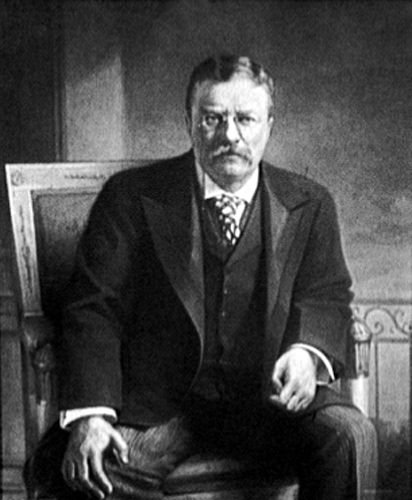
Theodore Roosevelt, 1905.
Theodore “Teddy” Roosevelt (1858-1919)
Term (1901-1909) Vice President None (1901-1905), Charles Fairbanks (1905-1909)
The 26th President of the United States, leader of the Rough Riders, naturalist, explorer, hunter, and author. Roosevelt became president after the assassination of William McKinley. He was 42 years old, the youngest U.S. President in history. He was the first American to win the Nobel Peace Prize in 1906. Scholars have consistently ranked him among the greatest U.S. Presidents.
William Howard Taft (1857-1930)
Term (1909-1913) Vice President James S. Sherman (1909-1912) None (1912-1913)
Attorney, politician, judge, and Governor-General of the Philippines, Taft became the 27th U.S. President and later served as the 10th Chief Justice of the United States. During his term, he often alienated his key constituencies and was overwhelmingly defeated in his bid for a second term in the 1912 presidential election.
Woodrow Wilson (1856-1924)
Term (1913-1921) Vice President Thomas R. Marshall (1913-1921)
Princeton University President, Governor of New Jersey, and 28th U.S. President, Wilson was a leader of the Progressive Era. In his first term, he persuaded Congress to pass several Progressive acts, and during his second term, he focused on World War I. Wilson’s idealistic internationalism, which advocates for the United States to enter the world arena to promote democracy, has been a contentious position in American foreign policy, serving as a model for “idealists” to emulate and “realists” to reject ever since.
Warren G. Harding (1865-1923)
Term (1921-1923) Vice President Calvin Coolidge (1921-1923)
He was an influential newspaper publisher, an Ohio politician, a U.S. Senator, and the 29th U.S. President. A fiscal conservative, he represented a trend in government that departed from the progressive movement that had dominated Congress since the Presidency of Theodore Roosevelt. He died suddenly in 1923 and was succeeded by his Vice President, Calvin Coolidge. Although unemployment dropped by half during Harding’s administration, it was marred by multiple scandals, leading historians to rate him among the worst U.S. Presidents.
Calvin Coolidge (1872-1933)
Term (1923-1929) Vice President None (1923-1925), Charles Dawes (1925-1929)
A lawyer, politician, Governor of Massachusetts, and the 30th U.S. President after the death of Warren Harding. Elected in his own right in 1924, he gained a reputation as a small-government conservative and restored public confidence in the White House after scandals marred his predecessor’s administration. He left office with considerable popularity. Today, assessments of his presidency are divided between those who approve of his reduction in government programs and those who believe the federal government should be more involved in regulating and controlling the economy.
Herbert Hoover (1874-1964)
Term (1929-1933) Vice President Charles Curtis (1929-1933)
A professional mining engineer, author, Secretary of Commerce, and 31st U.S. President, he was elected despite having no prior electoral or high-ranking military experience. He sincerely believed in the Efficiency Movement, which held that government and the economy were riddled with inefficiency and waste, and could be improved by experts. However, Wall Street crashed eight months after he took office, and he was unable to produce an economic recovery during his term, resulting in his failure to be re-elected and his poor ranking among U.S. Presidents.
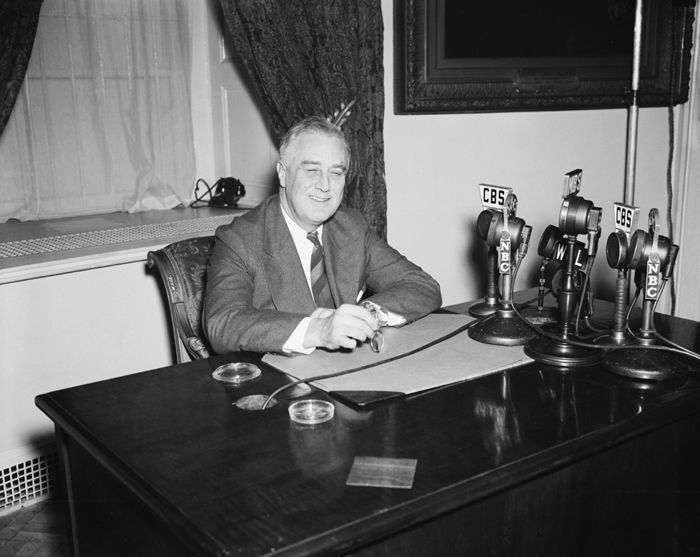
President Franklin Roosevelt, by Harris & Ewing, 1938.
Franklin D. Roosevelt (1882-1945)
Term (1933-1945) Vice President(s) John Nance Garner (1933-1941), Henry A. Wallace (1941-1945), Harry S Truman (1945)
The 32nd U.S. President was a central figure in world events during the mid-20th century, leading the United States during a worldwide economic crisis and World War II. He was the only American president elected to more than two terms and would oversee the creation of the FSA under his “New Deal.” Roosevelt forged a durable coalition that realigned American politics for decades. Scholars have consistently ranked him among the greatest U.S. Presidents. (Also see “Day of Infamy” speech).

President Harry S. Truman.
Harry S Truman (1884-1972)
Term (1945-1953) Vice President None (1945-1949), Alben Barkley (1949-1953)
Artillery officer in World War I, Senator, Vice President under Franklin D. Roosevelt, and 33rd President of the United States. Most American historians consider Truman one of the greatest U.S. Presidents.
Dwight David “Ike” Eisenhower (1890-1969)
Term (1953-1961) Vice President Richard Nixon (1953-1961)
A five-star general in the United States Army and the 34th President of the United States. Eisenhower ranks highly among former U.S. presidents in terms of approval rating. He was an inspiring military leader, a best-selling author, the head of Columbia University, and the president of the United States. As the top American general and later Allied Supreme Commander in the European Theater, he directed Allied forces to victories in North Africa and Italy, and coordinated France’s massive and successful D-Day invasion. Extraordinarily popular with both his soldiers and the American public, Eisenhower was twice elected president. He led the United States with determination and purpose during the difficult early years of the Cold War. After he retired from public life in 1961, Eisenhower continued to serve his country as an advisor to Presidents Kennedy and Johnson.
A wise and frugal government, which shall leave men free to regulate their own pursuits of industry and improvement and shall not take from the Mouth of labor the bread it has earned — this is the sum of good government.
— Thomas Jefferson
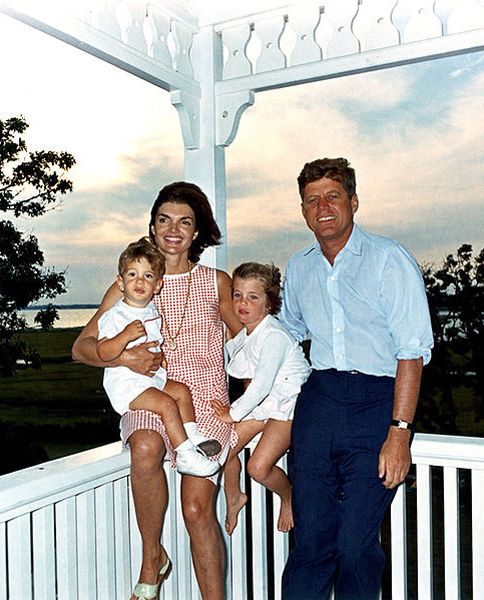
John F. Kennedy and family in Hyannis Port, Massachusetts, by Cecil W. Stoughon, 1962.
John F. Kennedy (1917-1963)
Term (1961-1963) Vice President Lyndon B. Johnson (1961-1963)
A commander during World War II, a Massachusetts politician, a U.S. Senator, and the 35th President of the United States. He was assassinated in 1963. He is the first and only Catholic President, and the second-youngest after Theodore Roosevelt. Events during his administration include the Bay of Pigs Invasion, the Cuban Missile Crisis, the building of the Berlin Wall, the Space Race, the African American Civil Rights Movement, and the early stages of the Vietnam War. He was assassinated on November 22, 1963, in Dallas, Texas.
Lyndon B. Johnson (1908-1973)
Term (1963-1969) Vice President None (1963-1965), Hubert Humphrey (1965-1969)
Having served as a Congressman, Senator, and Vice President, Johnson became the 36th President after the assassination of John F. Kennedy. He was re-elected the next year and was responsible for designing the “Great Society” legislation, which included measures to uphold civil rights and establish social welfare programs. He also significantly escalated direct American involvement in the Vietnam War. His popularity declined during the war, and his 1968 re-election bid was unsuccessful. Despite the failures of his foreign policy, Johnson is ranked favorably by some historians for his domestic policies.
Richard Nixon (1913-1994)
Term (1969-1974) Vice President(s) Spiro Agnew (1969-1973), None (1973), Gerald Ford (1973-1974)
Attorney, Lieutenant Commander during World War II, Congressman, Vice President, and 37th U.S. President. President Nixon’s most immediate task was resolving the Vietnam War, and he successfully negotiated a ceasefire with North Vietnam in 1973. His foreign, economic, and environmental policies were largely successful, and he was re-elected in a landslide in 1972. Facing likely impeachment for his role in the Watergate scandal, he resigned on August 9, 1974. He was the only President to resign from office.
Gerald Ford (1913-2006)
Term (1974-1977) Vice President None (1974), Nelson Rockefeller (1974-1977)
A career politician, Vice President, and the 38th U.S. President, he assumed office after Nixon’s resignation in 1974. He presided over what was then the worst economy since the Great Depression. He lost the re-election in 1976 to Jimmy Carter.
Jimmy Carter (1924-2024)
Term (1977-1981) Vice President Walter Mondale (1977-1981)
Peanut farmer, naval officer, Georgia Governor, and 39th U.S. President, Carter took office during international stagflation, which persisted throughout his term. Throughout his career, Carter strongly emphasized human rights. By 1980, his popularity had eroded, and he lost his re-election bid.
On October 1, 2024, Jimmy Carter turned 100, making him the longest-living president in U.S. History. The former president died on December 29, 2024, after two years in hospice.
Ronald Reagan (1911- 2004)
Term (1981-1989) Vice President George H. W. Bush (1981-1989)
40th President of the United States and 33rd Governor of California. He ranks highly among former U.S. presidents regarding approval rating and presidential surveys.
George H. W. Bush (1924-2018)
Term (1989-1993) Vice President Dan Quayle (1989-1993)
Naval officer in World War II, oil businessman, Congressman, Vice President, and 41st U.S. President. Foreign policy drove the Bush presidency, and amid economic concerns, he lost the 1992 presidential election to Democrat Bill Clinton.
Bill Clinton (1946-Present)
Term (1993-2001) Vice President Al Gore (1993-2001)
Attorney, Arkansas Governor, and 42nd U.S. President, he presided over continued economic expansion and a budget surplus in his second term. He was impeached for perjury and obstruction of justice in connection with a scandal involving a White House intern, but was subsequently acquitted. He left office with the highest end-of-office approval rating of any U.S. president since World War II.

The White House in Washington, D.C., is administered by the National Park Service.
George W. Bush (1946-Present)
Term (2001-2009) Vice President Dick Cheney (2001-2009)
The son of George H.W. Bush, an oil businessman, Texas Governor, and 43rd U.S. President. During his first year in office, on September 11, 2001, terrorist attacks occurred, and Bush declared a global War on Terrorism, leading to Afghanistan’s invasion in 2001 and Iraq’s invasion in 2003. His domestic economic, healthcare, education, and social security reform policies helped him get re-elected in 2004. President Bush leads a significant push for U.S. funds to purchase medicine for millions in Africa suffering from AIDS, a deadly health condition, which has been largely successful. His second term was marred with criticism as the nation entered “The Great Recession,” the worst economic downturn since the Great Depression.
Barack Obama (1961-Present)
Term (2009-2017) Vice President Joe Biden (2009-2017)
Attorney, U.S. Senator, and 44th U.S. President, he is the first African American to hold office. One of President Obama’s key achievements was passing the Affordable Care Act through Congress, which dramatically overhauled the U.S. healthcare system. He also oversaw the capture and killing of Osama Bin Laden, mastermind of the September 11, 2001, attack that started America’s Global War on Terrorism.
Donald J. Trump (June 14, 1946 – Present)
Term (2017 – 2021) Vice President Mike Pence (2017 – 2021)
A divisive atmosphere in American Politics led to one of the most contentious Presidential campaigns in American History. It resulted in the election of the first president who never held public office or had a military background. Businessman Donald Trump ran on the promise to shake up Washington, D.C., as an outsider and disruptor. He became the only U.S. President to be impeached by the House of Representatives twice. First, in December 2019, two articles of impeachment were filed: one for abuse of power and one for obstruction of Congress. The Senate acquitted President Trump in January 2020. The COVID-19 pandemic, a heated campaign, rising political tensions, and riots led up to an election that Trump disputed from November into early January. Heated rhetoric after a Trump rally boiled over on January 6, 2021, resulting in an attack on the U.S. Capitol as lawmakers started to approve the electoral votes. The incident resulted in five deaths, including a Capitol Police officer. The House voted the second time to Impeach on January 16 on one article, “incitement of an insurrection”.
Joseph R. Biden Jr. (November 20, 1942 – Present)
Term (2021-2025) Vice President Kamala Harris (2021-2025)
Kamala Harris is the nation’s first female vice president, the highest-ranking female elected official in U.S. history, and the first African American and first Asian American vice president. Joe Biden begins his term as President by focusing on the pandemic and unity. His ability to run for re-election came into focus in the summer of 2024, when he announced his support for Vice-President Harris as the Democratic Party’s nominee for president on the November 2024 ballot. Harris lost to President Donald Trump.
Donald J. Trump (June 14, 1946 – Present)
Term (2025- *) Vice President James David (JD) Vance (2025- *)
Donald J. Trump became the oldest President to enter the office after a decisive 2024 election. He shares the distinction of having been elected to two non-consecutive terms with only one other, Grover Cleveland, who was elected as the 22nd and 24th presidents.
History is writing the next chapter.
All men having power ought to be distrusted to a certain degree.
— James Madison
Compiled and edited by Kathy Alexander/Legends of America, updated February 2026.
Also See:
Presidential Trivia & Fun Facts
See Sources.