
By Henry Howe, 1857
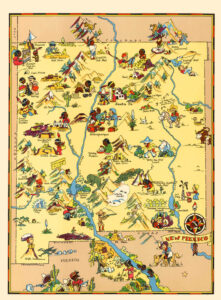
New Mexico Map by Gay Geography, 1935.
New Mexico, of which Santa Fe, the capital, ranks among the earliest settlements in North America. The name Mexico, in the Aztec Indian language, signifies the habitation of the God of War.
Tradition mentions that a small band of adventurers proceeded thus far north shortly after the conquest of Mexico by Hernán Cortés, but this is highly doubtful. In 1595, Don Juan de Onate, at the head of a band of 200 soldiers, established the first legal colony in the province, over which he was established as Governor. He took with him a number of Catholic priests to establish missions among the Indians, with power sufficient to promulgate the gospel at the point of the bayonet and administer baptism by the force of arms. The colony progressed rapidly, settlements extended in every quarter, and, as tradition relates, many valuable mines were discovered and worked. The poor Indians were enslaved and, under the lash, were forced to the most laborious tasks in the mines until goaded to desperation. In the summer of 1680, a general insurrection of all the tribes and Pueblos took place throughout the province. General hostilities having commenced, and a large number of Spaniards massacred all over the province, the Indians laid siege to the capital, Santa Fe, which the Governor was obliged to evacuate and retreat south 320 miles, where the refugees founded the town of El Paso del Norte. For 40 years, the country remained under Indian control until the Spaniards reconquered it. In 1698, the Indians rose, but the insurrection was soon quelled. After this, they were treated with more humanity, each Pueblo being allowed a league or two of land and permitted to govern themselves. Their rancorous hatred for their conquerors, however, never entirely subsided, yet no further outbreak occurred until 1837.
That year, a revolution took place, by which the government of the country was utterly overthrown, and the insurgents, including the Pueblo Indians, committed most atrocious barbarities. The Governor, Albino Perez, was savagely put to death, his head cut off and used as a football, by the insurgents in their camp. The Ex-Governor, Santiago Abrew, was butchered in a more barbarous manner. His hands were cut off, his tongue and eyes were pulled out, and his enemies, at the same time, taunted him with opprobrious epithets.
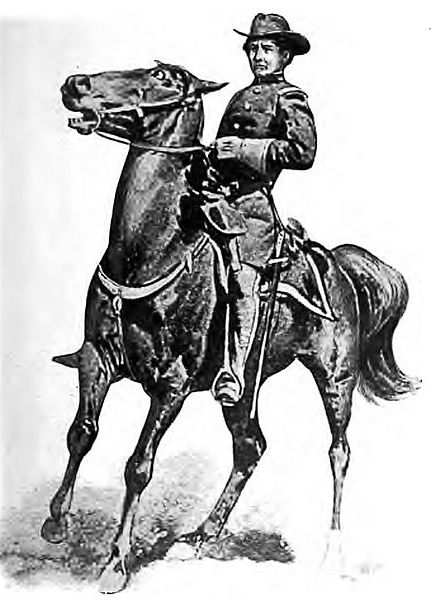
General Stephen W. Kearney.
The following season, Mexican authority was again established over the province. At the commencement of the Mexican-American War in 1846, the President took measures to organize an “Army of the West,” the object of which was to conquer New Mexico and California. This army was composed of one mounted regiment of volunteers from Missouri and a battalion of light infantry, dragoons, and light artillery. Having sent forward their baggage by a caravan of Santa Fe traders, the armada left Fort Leavenworth, Kansas, in late June, on the usual caravan route. They crossed the prairies without any marked incidents and entered and took peaceable possession of Santa Fe on August 18, after a 50-day march of nearly 900 miles. On their arrival, the American commander, General Stephen Kearney, in accordance with his orders, proclaimed himself Governor of New Mexico. “You are now,” said he, “American citizens; you no longer owe allegiance to the Mexican Government.” The principal men then took the oath of allegiance to the United States, and whoever was false to this allegiance, the people were told, would be punished as traitors. It was questioned whether the Administration had not transcended its powers in thus annexing a territory to the Union without the permission of Congress.
General Stephen Kearney, having appointed Charles Bent Governor of New Mexico on September 25, took a small force with him and proceeded overland to California. Colonel Sterling Price arrived at Santa Fe soon after with recruits. The Navajo Indians, having commenced hostilities against the New Mexicans, “new inhabitants of the United States,” Colonel Alexander Doniphan, who had been left in command, set out westward with the Missouri regiment to make peace with them. Winter was fast approaching, and after suffering incredible hardships in crossing the heights and chasms of unexplored mountains, having lost several of their men to frostbite, poorly clad as they were among snows and mountain storms, they finally accomplished their objective. Captain Reid, of one of the divisions of 30 men, volunteered to accompany Sandoval, a Navajo chief, for five days through mountain heights to a grand gathering of the men and women of the tribe. They were entirely in the power of the Indians, but they won their hearts by their gaiety and confidence. Most of them had never seen a white man. Reid and his companions joined the dance, sang their country’s songs, and, what pleased the Navajo most, interchanged their costumes with theirs.
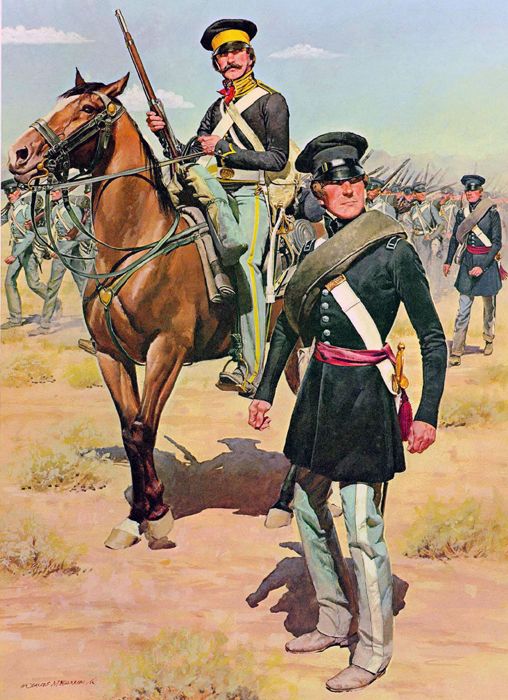
U.S. Soldiers in the Mexican-American War.
On November 22, the three parties — Americans, New Mexicans, and Navajo — agreed informally to live in perpetual peace. By the middle of December, Colonel Doniphan, leaving Colonel Price in command at Santa Fe, commenced his march with his regiments south to Chihuahua, and, on his route, met and defeated superior forces of the enemy at Bracito and at the Sacramento Pass. In the meantime, the New Mexicans secretly conspired to throw off the yoke. Simultaneously, on January 19, in the valley of Taos, massacres occurred at Fernandez, when were cruelly murdered, Governor Bent, Sheriff Lee, and four others were cruelly murdered; at Arroyo Hondo, five Americans were killed, and a few others in the vicinity. Colonel Price, on receiving the intelligence, marched from Santa Fe, met and defeated the insurrectionists in several engagements in the valley, with a loss of about 300. The Americans lost about 60 killed and wounded. Fifteen of the insurrectionists were executed.
The territory of New Mexico contained about 220,000 square miles. It was appropriately divided into two parts: that west of the Rocky Mountain range, the new part, and that east, the old part. The first was annexed to the last by an Act of Congress in 1850, and includes a part of the vast territory which formerly went by the general name of California. It comprised approximately 80,000 square miles. Of it, but little was known, and it has few or no inhabitants, other than wandering tribes of Indians. Along the Gila River, which separates it on the south from Mexico, it is destitute of trees and, in significant part, of any vegetation whatever. A few feeble streams flowed in different directions from the great mountains, which, in many places, traverse this region. The portion of this territory north of the Gila River had been but imperfectly explored; it had been described by the trappers who had passed over it as being mostly covered with mountain ranges, between which are narrow and oftentimes secluded valleys, small in extent, but rich in vegetation, and fragrant with the perfume of wild flowers. The valley of the Gila River was supposed to have been the residence of the Aztec during their emigration to the south.
There is little doubt that the region extending from the Gila River to the Great Salt Lake, with that east of it, was the locality from which they emigrated. It is conjectured that many hundreds of years ago, the country was fertile and beautiful, and that volcanic eruptions drove away its ancient inhabitants. On the Gila River, it is said, were the ruins of a large city; huge ditches and irrigating canals furrow the plains in the vicinity. Pieces of broken pottery, of domestic utensils, stained with bright colors, quaintly covered idols, and women’s ornaments of agate and obsidian, it is said, have been picked up by wandering trappers. The Colorado River, the great river of this region, takes its rise in the slopes of the Rocky Mountains, near the northeastern boundary of Deseret, and then, passing in a southwest direction, crosses the western part and enters the Gulf of California. The valley was unexplored because hostile Indians inhabited it, but it is supposed to be highly fertile.
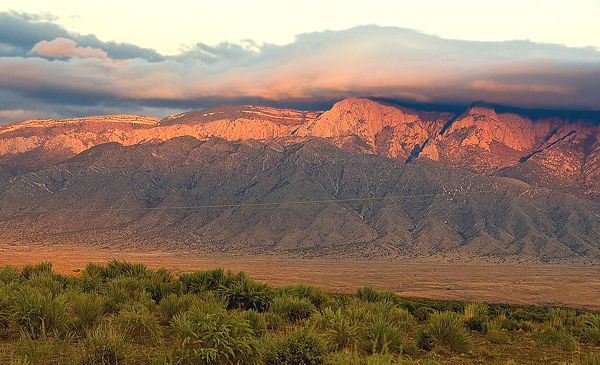
Sandia Mountains, New Mexico.
The old part of New Mexico, or that which, initially, was included in the Mexican province of the same name, was the district of country lying upon and east of the Rocky Mountains. It was the only portion settled, and to which the remainder of this article will alone allude. It possessed but a few natural advantages necessary to a rapid progress in civilization. It was surrounded by chains of mountains and prairie wilds in every direction for 500 miles or more, except in that of Chihuahua, from which it was separated by a desert country of over 400 miles. Its nominal territory, when under Mexican dominion, was about 200,000 square miles, which was much reduced by the Act of Congress in 1850, defining the boundary line of Texas.
New Mexico had no means of water communication with the rest of the world; the famous Rio Grande del Norte was full of sandbars and, at times, almost too shallow to float an Indian canoe. In the southern part, where it separated Texas from Mexico, it was navigable for steamboats drawing two feet of water to Laredo, Texas, 700 miles from its mouth. Opposite the valley of Taos, it ran pent up in a frightful chasm, through which it rushed in rapid torrents. Indeed, many of the rivers in the western part of the continent wind their way through the bottoms of chasms. About 60 miles south of Santa Fe, in the mighty range of the Sierra Blanca, is a famous gorge, some 15 miles through, called the “El Cañon Inferno,” or the Infernal Pass, where stupendous masses of rocks rose piled upon rock, until the traveler saw at the top but a narrow strip of sky. At the same time, around him all is inwrapt in chaotic gloom.

Santa Fe, New Mexico.
Santa Fe, the capital, 800 miles west of the Arkansas frontier, was its only town of any importance. It is on onthe site of an ancient Indian pueblo, some 15 miles east of the Rio Grande, at the base of a snowclad mountain, that contained a little over 3,000 souls, and, with its corporate surrounding villages, about double that number. The town was irregularly laid out and was a wretched collection of mud houses, much scattered with intervening corn fields. The only attempt at architectural compactness consisted of four tiers of buildings around the public square, comprising the Palacio, or Governor’s House, the Custom House, Barracks, & etc.
The population of New Mexico was almost exclusively confined to towns and villages, the suburbs of which are generally farms, a mode of living which has been indispensable for protection against the Indians. The principal of these settlements extended about 240 miles along the valley of the Rio del Norte, being both above and below Santa Fe. Next to the capital was the valley of Taos, there being no town of this name in New Mexico. It included several villages and settlements. This valley was rich and beautiful, and produced abundant wheat of superlative quality.
Although many of the bottomlands in New Mexico were fertile, the uplands were unproductive, partly from natural sterility, and partly from want of irrigation; hence, the settlements were, of necessity, principally confined to the valleys of the constantly flowing streams. In some places, the crops were frequently cut short by the drying up of the streams. Where water was abundant, however, art has so far superseded the offices of nature in watering the farms, that it is almost a question whether the interference of nature in the matter would not be a disadvantage. On the one hand, the husbandman need not have his grounds overflowed if he administered the water himself, much less need he permit them to suffer from drought. He was, therefore, more sure of his crop than if it were subject to the caprices of the weather in more favored agricultural regions.
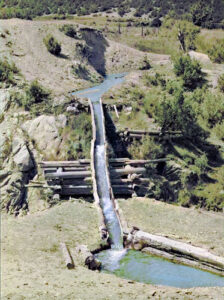
Transporting water in an irrigation ditch in Las Trampas, New Mexico, by Russell Lee, 1940.
One” mother ditch,” as it is called, generally sufficed to convey water for the irrigation of an entire valley, or, at least, for all the fields of one town or settlement. This was made and kept in repair by the public, under the supervision of the alcaldes; laborers being allotted to work upon it as with us upon our county roads. The size of this principal ditch was proportioned to the quantity of land to be watered. It was conveyed over the highest part of the valley, which, on these mountain streams, was, for the most part, next to the hills. From this, each proprietor of a farm ran a minor ditch, in like manner, over the most elevated part of his field.
Where there is not a superabundance of water, which is often the case on the smaller streams, each farmer had his day, or portion of a day, allotted to him for irrigation; and at no other time is he permitted to extract water from the mother ditch. Then the cultivator, after letting the water into his minor ditch, dammed it, first at one point and then at another, so as to overflow a section at a time, and, with his hoe, depressed eminences and filled sinks, causing the water to spread regularly over the surface. Though the operation would seem tedious, an expert irrigator would water his five- or six-acre field in one day if it were level and everything was well arranged; yet on uneven ground, he would hardly be able to get over half that amount.
The climate in New Mexico was unsurpassed in purity and health. The summer nights were cool and pleasant. The winters were long, but uniform, and the atmosphere was arid; and there is but little rain, except from July to October. The thermometer’s general range was 10 to 75 degrees Fahrenheit. Fevers were uncommon, and instances of remarkable longevity are frequent. People who had withered almost to mummies were occasionally met with, whose extraordinary age was shown by their recollection of certain notable events that had taken place in times far remote.
Excluding the wild Indians, the population of New Mexico is estimated at 70,000, including Spaniards, 1,000; Mestizos, or offspring of whites and Indians, 59,000; and Pueblos, or Christianized Indians, 10,000. In 1850, the American population was estimated at 2,000. Agriculture was in a very primitive and unimproved state, the hoe being the only tool used by a greater part of the peasantry. Wheat and Indian corn were the principal staples; cotton, flax, and tobacco, although indigenous, are not cultivated: the soil is finely adapted to the Irish potato. Fruit was scarce, and there was but little timber, except in the mountains and on the water-courses. The most important natural product of the soil was its pasture. Most of the high table-plains afforded the finest grazing in the world, while, for want of water, they were utterly useless for most other purposes. That scant moisture which sufficed to bring forth the natural vegetation was insufficient for agricultural productions without the aid of irrigation.
The high prairies of all this region differed greatly from those of our border in the general character of their vegetation. They were remarkably destitute of the gay flowering plants for which the former are so celebrated, being mostly clothed with different species of a highly nutritious grass called grama, which is of a very short and curly quality. The highlands, upon which alone this sort of grass is produced, were seldom verdant until after the rainy season sets in; the grass is only in perfection from August to October. But being rarely nipped by the frost until the rains are over, it cured upon the ground. It remained excellent hay-equal, if not superior, to that which is cut and stacked stackedfrom our western prairies. Although the winters are rigorous, the feeding of stock was almost entirely unknown in New Mexico; nevertheless, the extensive herds of the country, not only of cattle and sheep, but of mules and horses, generally maintained themselves in excellent condition upon the dry pasturage alone through the cold season, and until the rains start up the green grass again the following summer.

Navajo blanket weaver, Gallup, New Mexico.
The mechanic arts were vulgar, even sawed lumber, being absolutely unknown. The New Mexicans were celebrated for the manufacture of a beautiful sarape or blanket, woven in gorgeous, rainbow-like hues. Their domestic goods were nearly all wool, the manufacture of which was greatly embarrassed for the want of adequate machinery. The system of Peon slavery existed under the Mexicandominion. Under local law, a debtor was imprisoned for debt until it was paid, or, if the creditor chose, he took the debtor as a servant to work on his claim. This system operated with terrible severity upon the unfortunate poor, who, although they worked for fixed wages, received so small a compensation that, if the debt was of any amount, it compelled them to a perpetual servitude, as they received barely sufficient for food and clothing.
According to tradition, numerous and productive mines were in operation in New Mexico before the expulsion of the Spaniards in 1680; but these, having been the cause of the terrible oppressions they suffered, the Indians, after the second conquest, refused to disclose their location. In various quarters of the territory are vestiges of ancient excavations, and in places ruins of considerable towns, evidently reared for mining purposes. The most remarkable of these ancient ruins was that of Gran Quivira, about 100 miles south of Santa Fe, which evidently was much larger and richer at that time. The architecture was superior to anything in New Mexico. To be seen are the remains of Catholic churches and an aqueduct leading to the mountains, eight or ten miles distant. As there are no indications of the inhabitants having been engaged in agriculture, and from the deep, spacious pits found there, it is evident that this town was established for mining for the precious metals.
In the general massacre of 1680, tradition says, all the inhabitants, save one, perished. On the high table lands in that vicinity were extensive salt lakes, from which all the salt used in New Mexico was procured. Large caravans from Santa Fe arrived there annually during the dry season. The most important mine in New Mexico was El Placer, 27 miles south of Santa Fe, from which, since its discovery in 1828, $500,000 of gold had been taken, but without great profit to the owners. Gold, doubtless, existed over almost the whole of New Mexico, but it required more than native enterprise and skill to mine successfully. In the last century, no silver mines were successfully operated in New Mexico. Zinc, copper, and lead also exist.
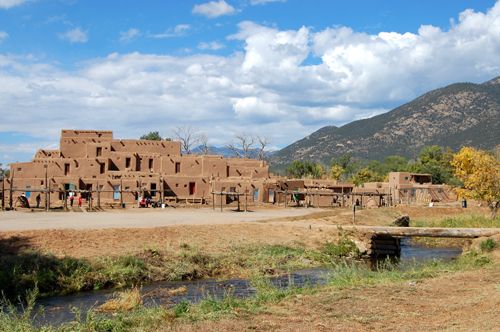
Taos Pueblo, New Mexico. Kathy Weiser-Alexander.
The term Pueblo, in Spanish, literally means the people and their towns. In New Mexico, the word is applied to the Christianized Indians, as well as to their villages. When the country was first discovered, these Indians lived in comfortable houses and cultivated the soil. Now they are the best horticulturists in New Mexico, furnishing most of the fruits and vegetables to be found in the markets. They also cultivated grapes and had extensive herds of cattle, horses, etc. They were remarkable for sobriety, honesty, morality, and industry. They were much braver than the other class of New Mexicans, and in the war with Mexico, they fought with desperation compared to those in the south. At the time of the conquest, they must have been a compelling people, numbering near 100 villages, as their ruins indicate. The population of their villages or pueblos averaged about 500 people. They claimed to be the descendants of Montezuma. They professed the Catholic faith, but this doubtless reached no farther than understanding its formalities, and at the same time, they worshiped the sun. They were only nominally under the jurisdiction of the Mexican Government, many features of their ancient customs, in both government and religion, being retained. Each Pueblo was under the control of a leader chosen by the Pueblo, who, with his council, had charge of the village’s police. One of their regulations was to appoint a secret watch to suppress vice and disorder of every description, and especially to keep an eye on the young men and women of the village.
Their villages were built of adobes and with great regularity; sometimes having but one large house, with several stories, each story divided into apartments, in which the whole village resided. Instead of doors in front, they use trap doors on the roofs of their houses, which they reach by a ladder drawn up at night for greater security. Their dress consisted of moccasins, short breeches, and woolen jackets or blankets; they generally wear their hair long. Bows and arrows, a lance, and sometimes a gun constitute their weapons. They manufactured blankets, as well as other woollen stuffs, crockery-ware, and coarse pottery. The dress of many is like the Mexican, but the majority retained their Aboriginal costume.
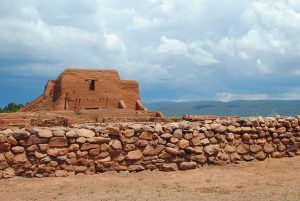
Pecos Pueblo, New Mexico Mission by Kathy Alexander.
Among the villages of the Pueblo Indians was that of the Pecos tribe, 25 miles east of Santa Fe, which gradually dwindled under the inroads of the Comanche and other causes, until about 1838, when, having been reduced to only about a dozen souls of all ages, they abandoned the place. Many tales were told of the singular habits of this ill-fated tribe, which must, no doubt, have tended to hasten its utter annihilation. A tradition was prevalent among them that Montezuma had kindled a holy fire and enjoined their ancestors not to suffer it to be extinguished until he should return to deliver his people from the yoke of the Spaniards. In pursuance of these commands, a constant watch had been maintained forages to prevent the fire from going out; and, as tradition further informed them, that Montezuma would appear with the sun, the deluded Indians were to be seen every clear morning upon the terraced roofs of theirhouses, attentively watching for the appearance of the “king of light” in hopes of seeing him accompanied by their immortal sovereign.
This consecrated fire was kept in a subterranean vault, where it silently smoldered under a covering of ashes in the basin of a small altar. Some say that they never lost hope in the final coming of Montezuma until, by some accident or other, or by a lack of sufficient warriors to watch it, the fire became extinguished; and that it was this catastrophe that induced them to abandon their village. The task of tending the sacred fire was allotted to the warriors. It was further related that they took the watch by turns for two successive days and nights, without partaking of either food, water, or sleep; while some assert that instead of being restricted to two days, each guard continued with the same unbending severity of purpose until exhaustion; and that frequently death left their places to be filled by others. A large proportion of those who came out alive were generally so completely prostrated by the want of repose and their inhalation of carbonic gas that they very soon died; when, as the vulgar story asserts, their remains were carried to the den of a monstrous serpent, which kept itself.
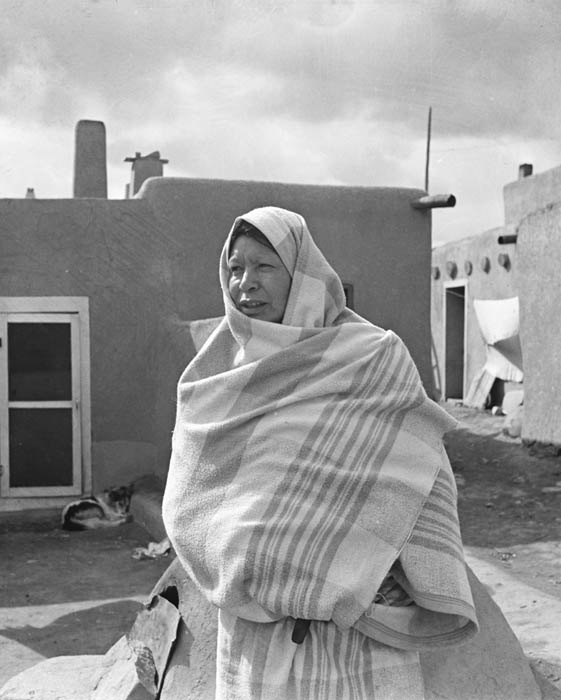
Taos Pueblo woman by Arthur Rothstein, 1936.
Even so late as 1830, when it contained a population of 50 to 100 souls, the traveler would often perceive. Still, a solitary Indian, a woman, or a child, standing here and there like so many statues upon the roofs of their houses, with their eyes fixed on the eastern horizon, or leaning against a wall or a fence, listlessly gazing at the passing stranger. At the same time, at other times, not a soul was to be seen in any direction, and the sepulchral silence of the place was only disturbed by the occasional barking of a dog, or the cackling of hens. No other Pueblo appears to have adopted this extraordinary superstition: like Pecos, however, they have all held Montezuma to be their perpetual sovereign.
It would likewise appear that they all worship the sun, for it is asserted to be their regular practice to turn their faces toward the east at sunrise. The wild tribes who inhabit or extend their incursions into New Mexico were the Navajo, Apache, Ute, Kiowa, and Comanche. The Navajo were estimated at 10,000 and reside in the main range of the Cordilleras, 200 miles west of Santa Fe, on the Colorado River, near the region from which, historians say, the Aztec emigrated to Mexico. They were supposed to be the remnants of that justly celebrated nation of antiquity that remained in the north. Although living in rudewigwams, they excelled all Indian nations in their manufactures. They were still distinguished for their exquisite cotton textures and displayed considerable ingenuity in embroidering animal skins with feathers. The serape Navajo (Navajo blanket) was of such dense texture as to be frequently waterproof, and some of the finer qualities brought $60.00 each among the Mexicans.
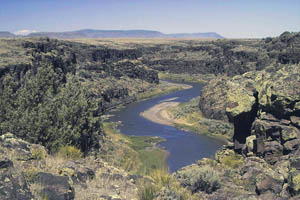
Rio Grande in Taos County, New Mexico, by the Bureau of Land Management.
Notwithstanding their wandering habits, they cultivated different grains and vegetables and possessed extensive and superior herds of horses, mules, cattle, sheep, and goats. The Apache were mainly west of the Rio Grande, and were the most powerful and vagrant of the Indian tribes of Northern Mexico. Their number, it was estimated, was 15,000 souls, of whom 2,000 are warriors. They cultivated and manufactured nothing, and appeared to depend entirely upon pillage for subsistence. The depredations of the Apache had been of so long a duration that, beyond the immediate vicinity of the towns, the whole country from New Mexico to the borders of Durango was almost entirely depopulated. The Eutaw or Yuta were scattered from the north of New Mexico to the borders of the Snake River and the Colorado River, and were estimated at 10,000 souls. These various tribes, particularly the Apache, were the terror of the Mexicans. They were considered courageous by them, but not equal to the Cherokee in this respect. At the same time, the latter, who numbered about 20,000, were perfect cowards when compared with the Shawnee, Wyandot, Seminole, and the rest of the border tribes.
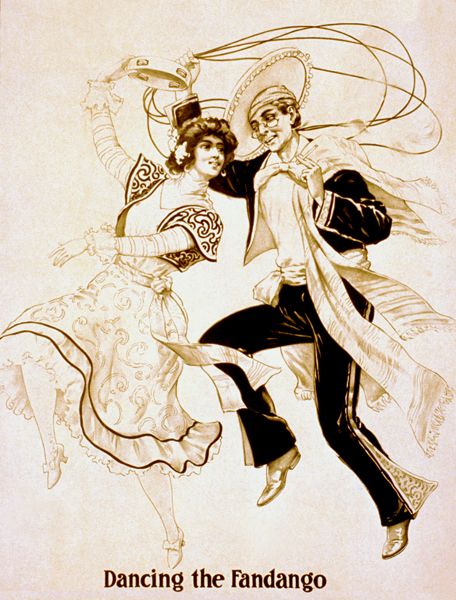
A Fandango by the U.S. Printing Company, 1900.
New Mexicans were very similar to the rest of the Spanish race across Mexico, as travelers often described. The higher classes conformed themselves more to American and European fashions; the men of the lower classes were faithful to their serapes, or colored blankets, and to their wide trowsers, ornamented with glittering buttons, and which are split from hip to ankle to display their white cotton drawers. The females of all classes were more than justified in not giving up their coquettish reboso, a small shawl drawn over the head. Both sexes enjoyed the cigarrito, or paper cigar; held their siesta after dinner; and amused themselves in the evening with monte or fandangos. Their dances are very graceful, and generally a combination of quadrille and waltz. The males were generally ill-featured, while the females were often quite handsome. Another striking singularity was the vast difference in the character of the two sexes. While the men were often censured for their indolence, mendacity, treachery, and cruelty, the women were active, affectionate, and open-hearted. Though generally not initiated in the art of reading and writing, the females possessed, nevertheless, a strong common sense and a natural sympathy for every suffering being, be it friend or foe, which compensates them, in some degree, for the want of a refined education.
By Henry Howe, 1857 – Compiled and edited by Kathy Alexander/Legends of America, updated November 2025.
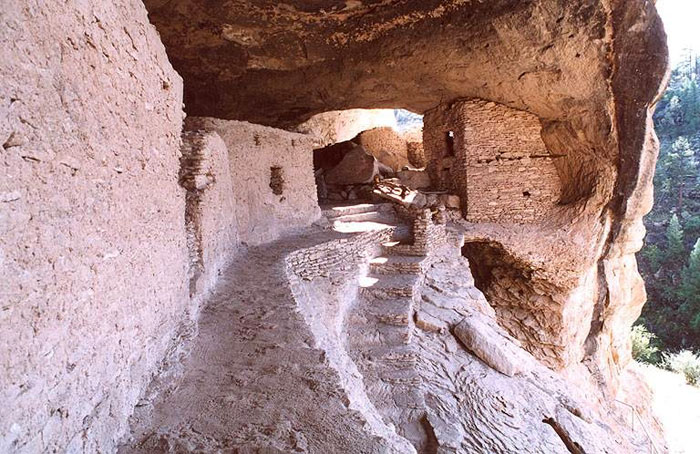
Gila Cliff Dwellings, New Mexico, courtesy National Park Service.
About the Author and Article: This article was a chapter in Henry Howe’s book Historical Collections of the Great West, published by George F. Tuttle, of New York, in 1857. Henry Howe (1816 -1893) was an author, publisher, historian, and bookseller. Born in New Haven, Connecticut, his father owned a popular bookshop and was a publisher. Henry would write histories of several states. His most famous work was the three-volume Historical Collections of Ohio. As he collected facts for his writing, he also drew sketches, which helped create interest in his work. The article, as it appears here, is not verbatim, as it has been edited for the modern reader; however, the content remains essentially the same.
Also See: