LEGENDS OF AMERICA

A Travel Site for the Nostalgic & Historic Minded


  Search


Legends Home

Site Map

What's New!!


Recommend this site


American History

Ghost Towns

Ghostly Legends

Historic People

Native Americans

The Old West

Photo Galleries

Roadside Attractions

Rocky Mtn Store

Route 66

Travel Destinations

Treasure Tales

Legends Blog


Free E-Newsletter


Legends of America's Exclusive Custom Products


P.O. Box 19423

Lenexa, KS 66285

913-708-5119


Please report broken links, missing pictures, or other problems online by clicking HERE or send us an email.  Thanks!


Old West Outlaws - Last Name Begins "E-F"

More Lists: Explorers | Gunfighters | Lawmen | Native Americans | Outlaws | Outlaw Gangs | Scoundrels | Soldiers | Trail Blazers & Cowboys | Vigilantes | Women


Shop Irv's Luggage Warehouse


Index       << Previous  A  B  C  D  E-F G  H  I-J  K  L  M  N-O  P-Q  R S T-U  V-Z  Next >>


Felipe Nerio Espinosa (1836-1863) - A member of the "Bloody Espinosa Gang," Felipe was born about 1836 in Vera Cruz, Mexico. He was a child during the Mexican-American War (1846-1848) and witnessed six family member's deaths when Vera Cruz was shelled by the U.S. Navy. Somewhere along the line, he and his brother, Jose Vivian Espinosa, along with several cousins, migrated to Colorado, where the embittered Mexicans began a reign of terror. In 1863, by their own admission, they killed more than 30 pioneers, in an extremely brutal fashion. According to local legend, Espinosa claimed to have had a vision from the Virgin Mary telling him to kill 100 anglos for every member of his family lost during the Mexican-American War. Hotly pursued by lawmen, Espinosa sent a letter to Governor John Evans, threatening to kill 600 "Gringos," including the governor, if he and the other members of the gang were not granted amnesty and some 5,000 acres in Conejos County, Colorado. The Governor soon called upon the U.S. Army to help track down the murderers in 1863. The soldiers then called upon frontiersman, Tom Tobin, to use his tracking skills to find them and bring them in dead or alive.


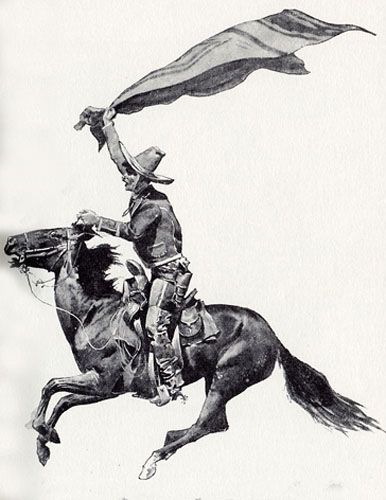
Mexican Vaquero

Mexican Vaquero by Frederick Remington.


Find an Outlaw

 
Web www.legendsofamerica.com

In September, Tobin was successful, and brought the heads of Felipe and his cousin, Julian Espinosa in a bag to Fort Garland, Colorado. Though Tobin was supposed to receive a $2,500 reward for thier deaths, he received only $1,500.


Christopher Evans, aka: Bill Powers (1847-1917) - Born in Vermont in 1847, Evans moved to Canada as a child but moved back to the states in time to serve in the Union Army during the Civil War. After the war, he served as a scout for the U.S. Cavalry. Later he moved to California with his brother Tom and after working as a prospector for a time, bought some land in Tulare County. Evans soon discovered his neighbors, George and John Sontag and when they turned to bank and train robberies, Chris joined them. In January, 1892, a posse tracked the trio down in a San Joaquin Valley barn. Following the inevitable gunfight, George Sontag was captured but Evans and John Sontag were able to get away. Law officers continued to pursue Evans and Sontag, finally catching up with them on September 13, 1893 at Sampson's Flat, California. Another gun battle took place, lasting some eight hours. When the dust had settled, John Sontag was dead, as well as two deputies. Evans was wounded several times and was dragged unconscious to jail. On December 13th, he was convicted of murder and robbery but was able to escape with another prisoner. Both were later recaptured. Evans was sent to Folsom Prison in February, 1894. After fifteen years, he was released in May, 1911 at the age of 64. He then moved to Oregon where he homesteaded until his death on February 9, 1917.


Jesse Evans (1853-??) - Thought to have been born in either Missouri or Texas in 1853, Jessie had his first brush with the law when he was arrested along with his parents on June 26, 1871 in Elk City, Kansas for passing counterfeit money. In 1872 he drifted into New Mexico , where he worked on John Chisum's ranch. Evidently, he found cowhanding too hard, as he soon became an outlaw, committing cattle rustling and armed robbery with the likes of Billy the Kid, Frank Baker, and Tom Hill. Leading a gang of other outlaws, the men roamed throughout New Mexico, often working with other gangs in their quest for easy pickings. When the Lincoln County Warr erupted, the Murphy-Dolan faction hired the Evans Gang as enforcers; interestingly, on the opposing side that Billy the Kid was supporting. Later, when a price was placed on his head, Evans fled to Southwest Texas, where he and his cohorts resumed their cattle rustling activities. However, they were finally tracked down by Texas Rangers near Presidio on July 3, 1880.


In the ultimate gunfight that occurred, Jessie Evans shot and killed Texas Ranger George Bingham, and gang member John Gross was killed by rangers. The members of the gang were finally forced to surrender. Evans was sentenced to prison in Huntsville but managed to escape from a work detail in May, 1882 and was never heard from again.  


Farrington Brothers Hilary and Levi Farrington were confederate guerillas under the command of William Quantrill when he burned and sacked Lawrence, Kansas on August 21, 1863. When the Civil War was over, the two became outlaws and robbed the Mobile and Ohio Railroad in Union City, Tennessee in 1870. With the Pinkertons hot on their trails, Hillary Farrington shot William Pinkerton in the side when the detective cornered him on a Kentucky farm.  


Though wounded, Pinkerton still managed to subdue Hillary and cuffed his wrists. However while the pair were en route to Columbus, Kentucky the next day, Hillary broke loose and grabbed Pinkerton's shotgun. Struggling over the weapon in a death fight, the gun discharged, grazing Pinkerton's skull and Hilary wrenched it free. However, before the train robber could aim, Pinkerton delivered an angry upper-cut that sent his foe spinning backwards over the paddleboat, where he landed on the paddle wheel and was chopped to pieces.  Levi was captured in Farmingdale, Illinois before being lynched by the people of Union City, Tennessee where the robbery took place. More ...


John King Fisher (1854-1884) - Born northeast of Dallas, Texas, the family moved north of Austin around 1960. When Fisher borrowed a horse without telling the owner, he was soon arrested for horse theft. He soon escaped from the posse with the help of the horse's owner, who decided not to press charges. He then made his way to Goliad, Texas where he was soon arrested for breaking into a house. He was sent to prison but pardoned just four months later. Moving on to Dimmit County, he established a ranch in a area where cattle rustling was rampant. Before long, Fisher was right in the middle of it, with his ranch serving as a haven for drifters and outlaws. He was sometimes known to ride with Mexican rustlers, sometimes making off with as many as 100 head of cattle. His outlaw activities often led to violence and he quickly gained a reputation as a skilled gunfighter. He was arrested at various times by Texas Rangers Leander McNelly and Lee Hall but always managed to avoid conviction. Evidently by 1876, Fisher had his fill of the outlaw life, married and bought a ranch near Eagle Pass.

In 1881 he was appointed deputy sheriff of Uvalde County and two years later became the sheriff. He turned out to be an efficient and popular
lawman and made plans to run for re-election in 1884. However, on the night of March 11, 1884, in the Vaudeville Variety Theater in San Antonio, Fisher and his companion, noted gunman Ben Thompson, were involved in a shootout brought on by a quarrel between Thompson and the theater's owners. Both Fisher and Thompson were killed.

Juan Flores (1834?-1857) - Bandit leader of the Flores-Daniels Gang, along with Pancho Daniel, Flores came from a prominent family but in 1855 was arrested for horse stealing and sent to San Quentin. However, he escaped in October, 1856 and soon hooked up with outlaw Pancho Daniel to form the Flores-Daniel Gang. Though seen by the white settlers as thieves and murderers, the Flores and his gang were seen by area Hispanics as folk heros, much like Jesse James would later be viewed in Missouri. Raiding white settlers in the areas of  San Luis Obispo and San Juan Capistrano, the gang quickly grew to over 50 men who rustled cattle, committed armed robbery, and murder. In January, 1857 the gang made a raid on San Juan Capistrano, looting several shops and killing a shopkeeper and an assistant. Afterwards, they continued to loot the town as they celebrated in a drinking spree. Soon, Los Angeles County Sheriff James R. Barton rounded up a posse to go after the outlaws.  However, on January 23, 1857, the posse was ambushed about 12 miles south of present-day Santa Ana, and  Sheriff James L. Barton, Constable Charles Baker, Deputy Charles Daly, and Constable William Little were shot and killed, the first lawmen in Los Angeles County to lose their lives in the line of duty. The other three men were able to escape to tell of the ambush. Within two hours, another posse was formed of some 60 men, who once again went after the outlaws. Under the leadership of James Thompson, who would later become Los Angeles County's new sheriff, the posse found the mutilated bodies of the four officers. With renewed enthusiasm, the posse continued the search for the outlaws, arresting 52 of them. Another posse, led by General Andres Pico, immediately lynched two of the most notorious of the gang when they came upon them.

Juan Flores was condemned to death and was hanged on February 14, 1857 near the top of Fort Hill with some 3,000 people gathered to watch. The 22 year-old Flores stated he was “dying justly” before his execution war carried out. However, his noose was too short, and instead of having his neck broken during the execution, he died of suffocation. His partner, Pancho Daniel, would be hanged the following year on November 30, 1858.


Charlie Ford

Charlie Ford

This image available for photographic prints HERE!


Charles “Charlie” Wilson Ford (1857-1884) – Born on July 9, 1857 in Ray County, Missouri, Charlie Ford was a member of the James Gang and participated in the Blue Cut, Missouri train robbery in September 1881. The older brother of Robert Ford, that “dirty little coward” who killed Jesse James on April 3, 1882, Charles was also involved in the conspiracy to kill James. Charged with first degree murder, Charlie was sentenced to hang but was quickly pardoned by the governor of Missouri. Afterwards, Charlie heard a rumor that Frank James was searching for both him and his brother, with plans of mortal revenge. For the next two years, Charlie moved from town to town, changing his name several times. No longer able to stand it, he committed suicide on May 4, 1884. Ironically, Frank James had surrendered to authorities and there is no indication that he actually ever pursued Charlie Ford.


Continued Next Page


Index       << Previous  A  B  C  D  E-F G  H  I-J  K  L  M  N-O  P-Q  R S T-U  V-Z  Next >>

 From the Rocky Mountain General Store

Legends Exclusive Custom Products - Legends of America and the Rocky Mountain General Store now provide a number of exclusive products that you won't find anywhere else! At our Exclusive Custom Products Store, you'll find lots of crazy bumper stickers; Old West prints, postcards, t-shirts and more; and our line of exclusive Route 66 products provides images on a number of items that you've never seen before! Click HERE to see the entire line.


Old West and cowboy products Old West custom products Route 66 Custom Products Old west prints, cards and calendars
 

                                                              Copyright © 2003-2008, www.Legends of America.com