
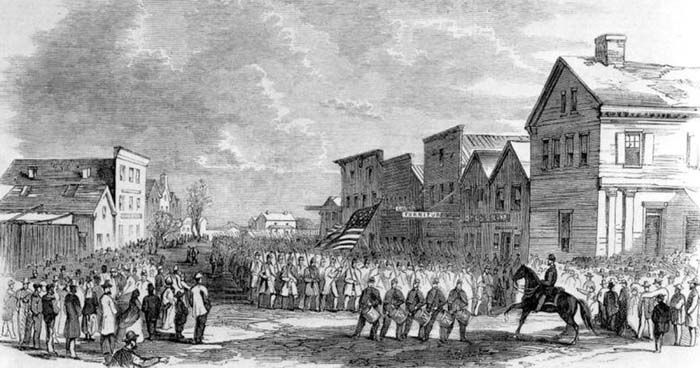
Fort Myers, Florida, in the Civil War.
When we think of forts, we often imagine a high stockade-type wall of sharpened logs surrounding several buildings. Inside these walls were hardy pioneers and soldiers, valiantly defending themselves against hostile Indians outside. Western films have perpetuated this idea, and sometimes, forts were built in a stockade-type manner. However, the purpose and style of forts varied widely, and this “typical” scenario was the exception rather than the rule.
However, many forts were erected long before the American West, or even the United States, began. The Spanish erected presidios in South Carolina, Georgia, Florida, and Louisiana; in the Southwest in Texas, New Mexico, and Arizona; and along the Pacific Coast in California.
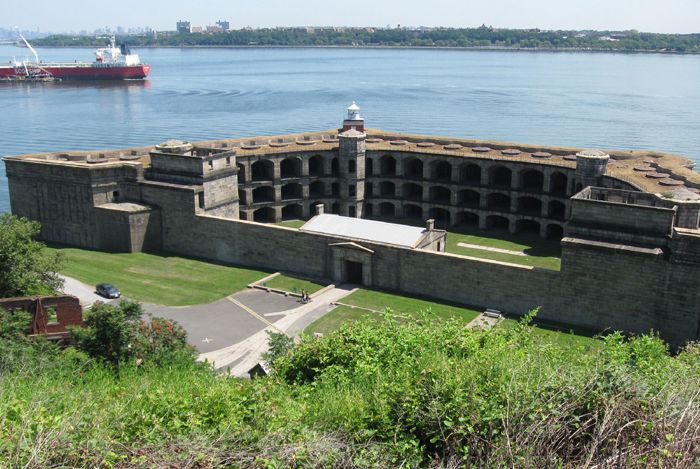
Battery Weed at Fort Wadsworth, New York.
In the East, fortifications protected the earliest colonists, the first Indian Wars, the French and Indian War, the American Revolution, and the Civil War.
These early forts seldom consisted of solidly constructed stockades with numerous permanent buildings. Sometimes, they were temporary and were little more than a couple of blockhouses. Traders constructed other fortifications, and early settlers protected their businesses and homes.
Contrary to the myths perpetuated by Western films, most military forts of the American West were not established to protect the settlers from Indians; instead, they were built to maintain peace among the tribes and between Native Americans and white emigrants.
As more settlers moved West in the 19th Century, the Army established posts based on anticipated use. Sometimes, these posts were used to prevent Indian tribes from waging war with each other and, at other times, to prevent white settlers from encroaching upon native lands.
Indians generally retaliated only when white settlers insisted on encroaching on Native lands, especially during the many gold and silver rushes. Only then did the forts’ primary purpose change to protecting the settlers. As westward expansion continued, threatening the Indian’s livelihood, the war between the whites and Indians intensified, resulting in the push of Native Americans onto reservations. Once the Indians were placed on reservations, some forts served as Indian agencies and distribution points for annuities given to tribes under treaty agreements.
As many trails opened, such as the Santa Fe Trail in the 1820s and the Oregon Trail in the 1840s, traders and pioneers often faced opposition from tribes and road agents who sought to rob them of their money or goods. In response, they established more forts to protect commerce along the trails.
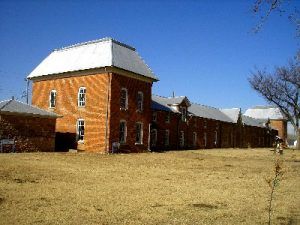
Fort El Reno, Oklahoma Commissary and Magazine by Kathy Alexander.
When establishing a new fort, soldiers sometimes occupied existing buildings, but more often, they were required to build it from materials available in the area. Wood was usually used in forested areas, adobe in the desert, and stone where available. The typical frontier fort consisted of officers’ quarters, barracks, stables, storehouses, and headquarters buildings grouped around a central parade ground. Most forts did not have walls surrounding them because attacks were generally unlikely.
Many army posts were called “camps” when only a few people were assigned to the location or the site was temporary. To be considered a “fort,” a full contingent of troops had to be permanently assigned. The U.S. Army utilized both forts and camps during the Frontier Campaigns.
In response to the rapidly changing needs of the vast West, the Army would set up a post and then abandon it when it was no longer needed.
Though the original intent was not to establish military forts to fight the Indian Wars, this changed when the U.S. government failed to protect tribal territorial rights and uphold treaties. Increasingly upset with treaty violations and travelers, settlers, and railroad crews encroaching on their lands, the Indians retaliated in full force by the mid-1800s
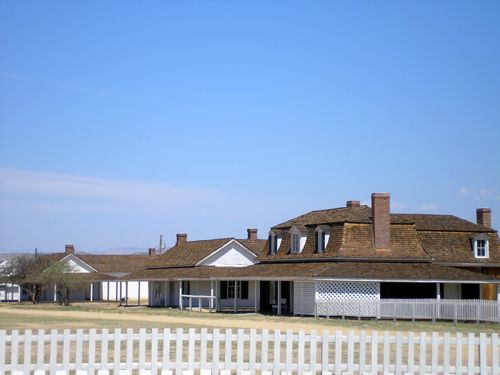
Fort Verde, Arizona, by Kathy Alexander.
As a result, the U.S. Government began a series of frontier campaigns to “tame” the Indians, force them onto reservations, and convert them to “civilized” life.
Life was difficult and often monotonous for soldiers at these many frontier outposts. Most recruits saw little or no combat and spent their time doing manual labor. Many forts were so isolated that there were no nearby towns for single enlisted men to relieve the monotony or meet women. The typical “dull existence” of frontier life was too much for many troops, and desertion rates were high.
Today, many of these forts have been preserved, restored, or rebuilt as monuments to our heritage. You can still see them as museums or national or state parks.
©Kathy Alexander/Legends of America, updated September 2026.
Also See:
Bring Civil War History to Life at These Iconic War Sites
See Sources.