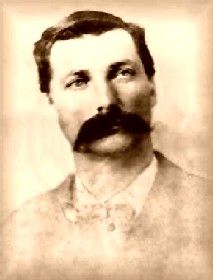
Bill Doolin.
William M. “Bill” Doolin, aka Will Barry, led an Oklahoma outlaw gang known as the Doolin-Dalton Gang, Oklahombres, and the Wild Bunch.
More than 100 years ago, in a quiet little town in the Oklahoma Territory, members of the infamous Oklahombres gang squared off against a posse of deputies in one of the deadliest confrontations in the history of the US Marshals. By the end of the gunfight, nine men lay dead or wounded, and the people of Ingalls had a vivid picture of Western lawlessness and the harsh means needed to restore justice.
William “Bill” M. Doolin was born in 1858 in Johnson County, Arkansas, to Michael Doolin and Artemina Beller Doolin. At 23, he drifted west, working odd jobs until he landed a job as a cowboy at the H-X Bar Ranch on the Cimarron River in Indian Territory in 1881. The ranch was owned by a Texan named Oscar D. Halsell, who took a liking to Doolin, teaching him to write and do simple arithmetic, and eventually making him an informal foreman on the ranch.
For the next decade, he continued to work as a cowboy at several area ranches and was considered trustworthy and capable. During these years, Doolin worked with other cowboys and outlaws of the day, including George “Bitter Creek” Newcomb, Charley Pierce, Bill Power, Dick Broadwell, Bill “Tulsa Jack” Blake, Dan “Dynamite Dick” Clifton, and Emmett Dalton.
By the 1890s, however, Doolin had joined the Dalton Gang and participated in several train and bank robberies. His first encounter with the law came in 1891 in Coffeyville, Kansas, when he and several friends celebrated the 4th of July by tapping a keg of beer. However, at that time, Kansas was a dry state, and when lawmen attempted to confiscate their alcohol, a shootout erupted, resulting in two lawmen being wounded. Doolin and his cohorts quickly fled the area. Doolin became a wanted man and began his outlaw career in earnest.
On October 5, 1892, the Dalton Gang made its fateful attempt to rob two banks in Coffeyville, Kansas. In the end, it was a total failure, with Bob and Grat Dalton, Bill Power, and Dick Broadwell killed. Only Emmett Dalton survived to spend years in prison for the attempt. On the face of it, Doolin didn’t participate in this robbery, which spared his life, at least for a little while. However, since that fateful day, some historians have alleged that there was a sixth gang member in an alley holding the horses, who escaped. Though who that sixth man was remains a mystery, many speculate it might have been Bill Doolin.
Soon afterward, Doolin founded another gang, the Oklahombres, also called the Wild Bunch and the Oklahoma Long Riders because of the long dusters they wore.
This group specialized in robbing banks, stores, stagecoaches, and trains in Arkansas, Kansas, Missouri, and Oklahoma, quickly becoming the terror of the Wild West. The gang included at various times Bill Dalton, George “Red Buck” Waightman, Little Bill Raidler, Bob Grounds, Bill “Tulsa Jack” Blake, Richard “Little Dick West”, Dan “Dynamite Dick” Clifton, Roy Daugherty, better known as “Arkansas Tom” Jones, Alf Sohn, George “Bitter Creek” Newcomb, Charley Pierce, and Oliver “Ol” Yantis. Two teenage girls, known as Little Britches and Cattle Annie, also followed the gang.
Wasting no time, Doolin and his new gang robbed the Ford County Bank in Spearville, Kansas, on November 1, 1892, taking cash and over $1,500 in treasury notes. Soon, a notice with the robbers’ descriptions was circulated. The city marshal in Stillwater, Oklahoma, recognized the description of Oliver “Ol” Yantis, and a posse was sent looking for him. He would be the first of the gang to die when he was killed in a shootout on November 29, 1892, at Orlando, Oklahoma Territory.
On March 14, 1893, Doolin married Edith Ellsworth of Ingalls, Oklahoma, in Kingfisher. Whether she knew Bill was an outlaw is unknown, but she stood by him, and the couple had a son they named Jay.
On June 11, 1893, the gang was back on the trail again, robbing a train near Cimarron, Kansas. After making off with about $1,000 in silver, a posse quickly pursued them, tracking them to a point North of Fort Supply, Oklahoma. When the guns began to blaze, Doolin was shot and wounded in the left foot. Though he was able to escape and recover, he would walk with a limp for the rest of his life.

Ingalls, Oklahoma.
In August 1893, several members of the outlaw gang, including Bill Doolin, Bill Dalton, George “Red Buck” Weightman, George “Bitter Creek” Newcomb, Charlie Pierce, “Arkansas Tom” Jones, “Tulsa Jack” Blake, and “Dynamite Dick” Clifton, were taking refuge in the small town of Ingalls, Oklahoma. Most of them had been in town for weeks, living at the city hotel and spending their time at the Ransom Saloon.
When the US Marshals used their location, Marshal Evett Dumas “E.D.” Nix formed a posse of about 27 deputy marshals and Indian Police and headed toward Ingalls. Camping out along a creek the night before, they were seen by a young boy, whom the deputies held overnight. However, the boy slipped away early the next morning and ran into Ingalls, telling the outlaws, “The marshals are coming.”
On September 1, the posse entered the outlaw town of Ingalls to capture the gang in what would be remembered as the Battle of Ingalls; three of the fourteen lawmen carrying Deputy U.S. Marshals’ commissions would die as a result of the battle. Two town citizens would also die; one was killed while protecting the outlaws. Of the Doolin Gang, Newcomb was seriously wounded but escaped, and Arkansas Tom Jones, the killer of the three deputies and one citizen, was captured. He would be sent to prison, paroled in 1910, but after robbing another bank, he was killed on August 16, 1924, in Joplin, Missouri, by police officers.
After the shootout, the gang lay low for a while but was back at it early the next year. On January 3, 1894, Charlie Pierce and George “Red Buck” Weightman held up the store and post office at Clarkson, Oklahoma. Just a few weeks later, on January 23, the gang robbed the Farmers Citizens Bank at Pawnee, Oklahoma. On March 10, the Oklahombres robbed the Santa Fe Railroad station at Woodward, Oklahoma, of over $6,000.
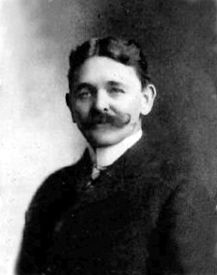
Evett Dumas Nix.
Ten days later, on March 20, Marshal Evett Nix directed his best deputies — the Three Guardsmen — Bill Tilghman, Chris Madsen, and Heck Thomas to take down the Wild Bunch, stating:
“I have selected you to do this work, placing explicit confidence in your abilities to cope with those desperadoes and bring them in — live if possible — dead if necessary.”
On April 1, gang members Bill Dalton and Bitter Creek Newcomb attempted to rob the store of retired US Deputy MarsUSl W.H. Carr at Sacred Heart, Oklahoma. The old lawman instantly recognized Bill Dalton and reached for his gun, at which point Newcomb drew his pistol and shot Carr in the wrist. However, the retired lawman wounded Newcomb in the shoulder. Dalton then shot Carr in the abdomen, but though wounded, Carr continued to shoot, chasing the fugitives outside, where they jumped on their horses and fled.
The heists continued with a bank robbery at Southwest City, Missouri, on May 10, 1894, that netted $4,000 and left one townsman dead and several wounded.
Meanwhile, Bill Dalton left the Doolin Gang to form his own gang, which robbed the First National Bank in Longview, Texas, on May 23, 1894. It would be his only robbery with his “new” gang. Just a few weeks later, on June 8, 1894, a posse of lawmen approached Bill’s home near Ardmore, Oklahoma. Bill, with a pistol in hand, jumped out of a window and ran toward the posse, ignoring orders to halt. He was killed immediately.
On December 19, 1894, Doolin was reportedly one of six men who attempted to rob the J.R. Pearce store at Texana, Oklahoma. However, they were driven off with less than $20.00 in merchandise.
On April 3, 1895, the Oklahombres, without Bill Doolin, held up a Rock Island train at Dover, Oklahoma. However, they could not open the safe containing some $50,000 destined for the army payroll. Instead, they robbed the passengers of cash and jewelry. US Deputy MaUSl Chris Madsen and a posse pursued them and picked up their trail at daybreak. Around noon, “Tulsa Jack” Blake was standing lookout when the posse came upon him. Blake was shot dead, and the gang scattered.
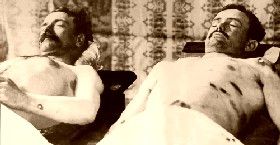
Charlie Pierce and George “Bitter Creek” Newcomb were killed on May 1, 1895.
On May 1, 1895, gang members Charlie Pierce and George “Bitter Creek” Newcomb were shot and killed by the bounty hunters known as “The Dunn Brothers”. The bounty hunter team that killed Pierce and Newcomb was the older brothers of George Newcomb’s teenage girlfriend, Rose Dunn. It was alleged that she had betrayed Newcomb, but it is more likely that her brothers trailed her to the outlaws’ hideout.
With the Three Guardsmen in hot pursuit and gang members being killed one by one, Bill Doolin and “Little Dick” West fled to New Mexico in the summer of 1895. Knowing his freedom was limited, Doolin made several offers to surrender in exchange for a light sentence, but they were rejected. Later that year, Doolin and his wife hid near Burden, Kansas. In the meantime, Little Bill Raidler was captured on September 6, 1895, by Deputy U.S. Marshal Bill Tilghman. He would be sent to prison and paroled in 1903 because of complications from wounds received when he was captured. He died the following year.

The Three Guardsmen – Bill Tilghman, Heck Thomas, and Chris Madsen
From Kansas, Bill Doolin and his wife went to Eureka Springs, Arkansas, so that Doolin could take in the medicinal waters. Evidently, his foot, which had taken a bullet some years previously, had developed rheumatism. But the tenacious Bill Tilghman tracked him to the resort, and in January 1896, the famous lawman single-handedly captured the outlaw there. Offering no resistance, Doolin was taken back to Oklahoma and jailed at Guthrie while awaiting trial.
While Doolin was in jail, another gang member was killed — Red Buck Weightman on March 4, 1896, near Arapaho, Oklahoma Territory, by a Custer County Posse.
But Bill Doolin had a plan. On July 5, 1896, he, along with “Dynamite Dick” Clifton and 12 others, escaped the Guthrie jail and fled. Doolin took refuge with his wife in Lawson, Oklahoma, and the other escapees scattered. His freedom would be brief. On August 24, 1896, Doolin was tracked down and, when he refused to surrender, was shot and killed by a shotgun blast from Deputy U.S. Marshal Heck Thomas.

Bill Doolin Dead
They displayed Doolin’s body in Guthrie, Oklahoma. A local photographer made two pictures of the dead outlaw. Mrs. Doolin and her brothers composed a poem about the outlaw, which they printed on postcards and sold with the pictures to anyone who bought them for twenty-five cents each. They used the profits for burial expenses. Still, the government actually ended up paying for the embalming and burial because of the need to preserve the body for identification purposes. He was buried in the Boot Hill section of Summit View Cemetery in Guthrie, Oklahoma. Doolin’s widow filed a $50,000 damage suit against the US Marshals for the unlawful death of her husband, but it was dismissed in February 1897.
More than a year later, Dynamite Dick Clifton was tracked down by Deputy U.S. Marshals and was killed near Checotah, Oklahoma, on November 7, 1897.
“Little Dick” West was the last remaining fugitive gang member. He, too, was killed on April 8, 1898, by Deputy U.S. Marshals in Logan County, Oklahoma Territory.
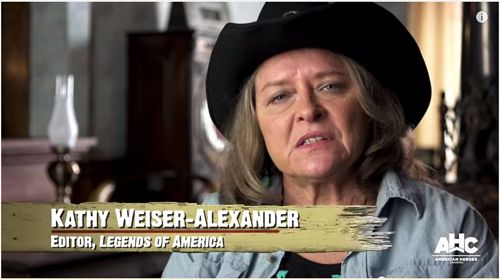
Legends of America Founder & Editor Kathy Weiser-Alexander discusses Bill Doolin & the Oklahombres on the American Heroes Channel’s “Gunslingers”
© Kathy Alexander/Legends of America, updated October 2026.
Also See:
Sources: