

Alexander Graham Bell in 1914.
Alexander Graham Bell was a scientist, a teacher, an inventor, and above all, a believer in the power of communication to change the world. Something he accomplished when inventing the Telephone.
Bell was born March 3, 1847, in Edinburgh, Scotland, into a family for whom speech and sound were more than communication… they were a calling. His father, Alexander Melville Bell, was a renowned teacher of elocution, the skill of clear and expressive speech; his mother, Eliza Grace Bell, was an accomplished musician who was nearly deaf. This combination of influences formed the foundation of Bell’s lifelong fascination with hearing, speech, and the mechanics of the human voice.
As a young man, in 1864, Bell studied at the University of Edinburgh and in 1868, at University College London. He built early “speaking machines,” tinkered with telegraphy, and immersed himself in the emerging science of acoustics. Formal degrees never held his interest as much as hands‑on experimentation. After both of his brothers died of tuberculosis, he quit his studies in 1870 without completion, joining the rest of his family in immigration to Canada for better health.
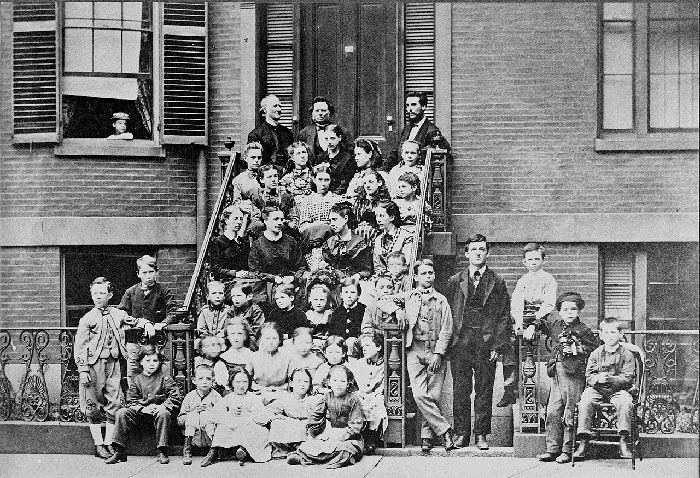
Alexander Graham Bell at the Pemberton Ave School for the Deaf, June 1871.
Bell soon moved to Boston, Massachusetts, where he taught at schools for the deaf. His work with students, especially Mabel Hubbard, who later became his wife, deepened his commitment to bridging the gap between silence and sound. It was during this period that Bell’s scientific curiosity converged with a revolutionary idea: transmitting the human voice electrically.
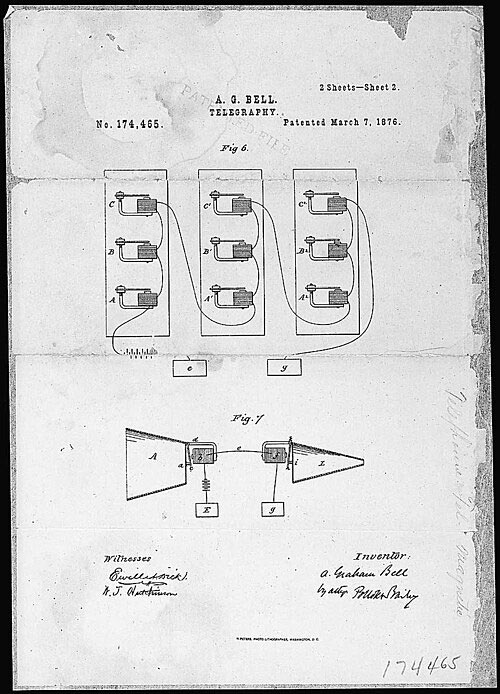
Bell’s Telephone Patent Drawing.
On March 7, 1876, Bell received the first U.S. patent for the telephone, a deceptively simple document that would alter the trajectory of human communication. The breakthrough was the culmination of years of experiments with sound, electricity, and the harmonic telegraph, work that often left Bell exhausted, ink‑stained, and surrounded by coils of wire in makeshift laboratories.
Just three days after the patent was granted, Bell and his assistant Thomas Watson achieved the moment that would enter legend. From a cluttered room in their Boston boarding house, Bell spoke the now‑famous words, “Mr. Watson, come here, I want to see you.” Watson, listening through the receiver in the adjoining room, heard the sentence clearly. It was the first time in history that the human voice had been transmitted over an electrical wire.
The invention was met with both astonishment and skepticism. Some hailed it as a marvel; others dismissed it as a novelty with no practical future. Bell himself was torn. He viewed the telephone not as an end but as a stepping stone toward deeper scientific pursuits. Yet the world quickly recognized its potential. Demonstrations at the 1876 Centennial Exposition in Philadelphia, Pennsylvania, drew massive crowds, including Emperor Pedro II of Brazil, who exclaimed, “My God, it talks!”
Within a decade, telephone lines stretched across cities and towns, and in 1885, Bell helped establish the American Telephone and Telegraph Company (AT&T) to manage the rapidly expanding network. What began as a fragile experiment between two rooms soon connected continents, reshaping business, personal relationships, and the rhythm of daily life.
As the telephone spread across continents and Bell’s name became synonymous with modern communication, he increasingly turned his attention away from telephony toward the broader frontiers of scientific possibility. Wealth and recognition gave him freedom, but it was restless and insistent curiosity that shaped his later years.

Beinn Bhreagh, Alexander Graham Bell’s residence, Cape Breton, Nova Scotia, Canada, 1915
By the 1880s, Bell and his wife Mabel had settled at Beinn Bhreagh, their sprawling estate on Cape Breton Island in Nova Scotia. The property became Bell’s sanctuary and laboratory, a place where he could think, experiment, and build without distraction. There, overlooking the Bras d’Or Lakes, he pursued ideas that ranged from the practical to the visionary.
Bell’s fascination with flight consumed much of his energy in the early 20th century. He founded the Aerial Experiment Association (AEA) in 1907, bringing together a team of young engineers and aviators, including Glenn Curtiss, to advance aviation. Under Bell’s guidance, the AEA produced several pioneering aircraft, culminating in the Silver Dart, which made the first powered flight in Canada in 1909. Though Bell never piloted an aircraft himself, his contributions to aeronautical design, especially his experiments with tetrahedral kites, left a lasting imprint on early aviation.
At the same time, Bell explored the potential of hydrofoils, envisioning boats that could skim across the water with unprecedented speed. His HD‑4 hydrofoil set a world marine speed record in 1919, reaching over 70 miles per hour, a remarkable achievement for its era and a testament to Bell’s ability to blend imagination with engineering.

Bell’s HD-4 Test Run in 1919.
His scientific curiosity also extended into optical telecommunications, where he developed the photophone, a device that transmitted sound on a beam of light. Though the technology was far ahead of its time, Bell considered it one of his most significant inventions, an early ancestor of fiber‑optic communication.
Beyond his technical pursuits, Bell remained deeply committed to education, exploration, and humanitarian work. As the second president of the National Geographic Society, he helped transform the organization from a small scholarly club into a global institution known for its vivid photography, accessible science writing, and spirit of discovery. His influence helped shape the magazine’s iconic visual style and broadened its mission to bring the world to its readers.
Bell’s later life was also marked by his continued advocacy for the deaf community, a cause rooted in his family history and early career. He supported schools, research, and organizations dedicated to improving the lives of deaf individuals, always guided by the belief that communication, however achieved, was a fundamental human right.
Even in his final years, Bell continued to experiment. Visitors to Beinn Bhreagh often found him surrounded by notebooks, prototypes, and half‑finished devices, still chasing ideas with the enthusiasm of a young inventor. When he died on August 2, 1922, at age 75, he left behind not just a single world‑changing invention but a legacy of curiosity, compassion, and relentless exploration.

Alexander Graham Bell, opening long-distance New York to Chicago, 1892.
During his funeral, telephone lines across North America were briefly silenced in tribute, a continent pausing to honor the man who had taught it to speak across distance. A fitting gesture for the man who had given the world a new way to speak and be heard.
©Dave Alexander, Legends of America, January 2026.
Also See:
Thomas Edison – The Man Who Lit the World
Hidden Figures of American History: Untold Stories from Across the States
Hidden Figures: Unsung Women Who Shaped America’s Frontier
Sources:
Alexander Graham Bell | Biography, Education, Family, Telephone
Alexander Graham Bell – Wikipedia
Alexander Graham Bell Biography.