
By Emerson Hough in 1907.
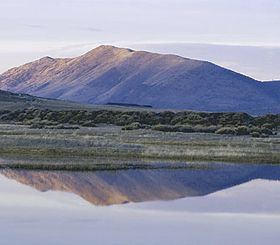
The vast West.
Once, there was a vast empire, almost unknown, west of the Mississippi River. The white civilization of this continent took 300 years to reach. We had won our independence and taken our place among the world’s nations before our hardiest men had learned anything of this Western empire. We had bought this vast region and were paying for it before knowing what we had purchased. The wise men of the East, leading men in Congress, said it would be criminal to add this territory to our already massive domain because it could never be settled. It was not dreamed that civilization would ever really subdue it. Even much later, men as able as Daniel Webster deplored the attempt to extend our lines farther to the West, saying that these territories could not be States, that the East would suffer if we widened our West, and that the latter could never be of value to the union!
So far as this great West was concerned, it was scorned, held in contempt, and had full right to take itself as an outcast. Decreed to the wilderness forever; it could have been forgiven for running wild. Denominated as unfit for the occupation of the Eastern population, it might have been expected to gather a population all its own.
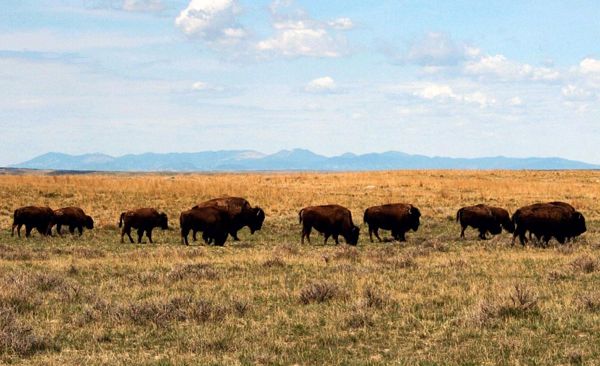
Buffalo on the Great Plains.
It gathered such a population, and in part, it was lawless. The frontier, clear across to the Pacific, has been lawless at one time or another, but this was not always the fault of the men who occupied the frontier. The latter swept Westward with such unexampled swiftness that the machinery of the law could not always keep up with them. Where there are no courts, where each man is judge and jury for himself, protecting himself and his property by his arm alone, there always have also gathered the lawless: those who do not wish the day of law to come, men who want license and not liberty, who wish crime and not lawfulness, who want to take what is not theirs and to enforce their own will in their own fashion.
There are two states of society, perhaps equally bad for promoting good morals and virtue — the densely populated city and the wilderness. In the former, a single individual loses his identity in the mass and, being unnoticed, is without the public’s view and can, to a certain extent, commit crimes with impunity. In the latter, the population is sparse, and the strong arm of the law not being extended, his crimes are, in a measure, unobserved; or, if so, power frequently wants to bring him to justice. Hence, both are the resort of desperadoes. In the early settlement of the West, the borders were infested with desperadoes flying from justice; suspected or convicted felons escaped from the grasp of the law, who sought safety. The counterfeiter and the robber found a secure retreat or a new theater for crime.
The preceding words were written in 1855 by a historian to whom the West of the trans-Missouri remained still a sealed book. Still, they cover the appeal of a wild and unknown land to a bold, a criminal, or an adventurous population very fitly. As we think of the trans-Missouri today, no one can write more accurately and understandingly than Theodore Roosevelt, President of the United States, who thus describes the land he knew and loved. The plains country lies beyond the Mississippi River, stretching from Texas to North Dakota and westward to the Rocky Mountains. This is a region of light rainfall, where the ground is clad with short grass, while cottonwood trees fringe the courses of the winding plains streams, streams that are alternately turbid torrents and mere dwindling threads of water.
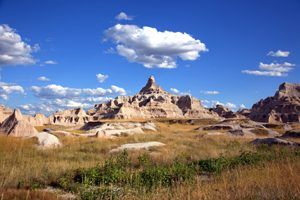
Badlands National Park by Carol Highsmith.
Gray sage-brush plains and tracts break the great stretches of natural pasture of strangely shaped and colored Badlands, sun-scorched wastes in summer, and arctic in their desolation in winter. Beyond the plains rise the Rocky Mountains, their flanks covered with coniferous woods, but the trees are small and do not ordinarily grow very close together. Toward the north, the forest becomes denser, the peaks higher, and glaciers creep down toward the valleys from the fields of everlasting snow. The brooks are brawling, trout-filled torrents; the swift rivers roam over rapids and cataracts on their way to one or other of the two great oceans.
Southwest of the Rockies, evil and terrible deserts stretch for leagues and leagues, mere waterless wastes of sandy plain and barren mountain, broken here and there by narrow strips of fertile ground. Rain rarely falls, and there are no clouds to dim the brazen sun. The rivers run in deep canyons or are swallowed by the burning sand; the smaller watercourses are dry throughout the greater part of the year.
Beyond this desert region rise the sunny Sierras of California, with their flower-clad slopes and groves of giant trees; and north of them, along the coast, the rain-shrouded mountain chains of Oregon and Washington, matted with the towering growth of the mighty evergreen forest.”
Such, then, was this Western land, so long the home of the out-dweller who foreran civilization and who sometimes took matters of the law into his own hands. For purposes of convenience, we may classify him as the bad man of the mountains and the bad man of the plains because he was usually found in and around the crude localities where raw resources in property were being developed, and because, previous to the advent of agriculture, the two vast wilderness resources were minerals and cattle. The mines of California and the Rockies; the cattle of the Great Plains — write the story of these, and you have much of the story of Western desperadoism.
For even though the ideal desperado was one who did not rob or kill for gain, the most usual form of early desperadoism had to do with attempts at unlawfully acquiring another man’s property.
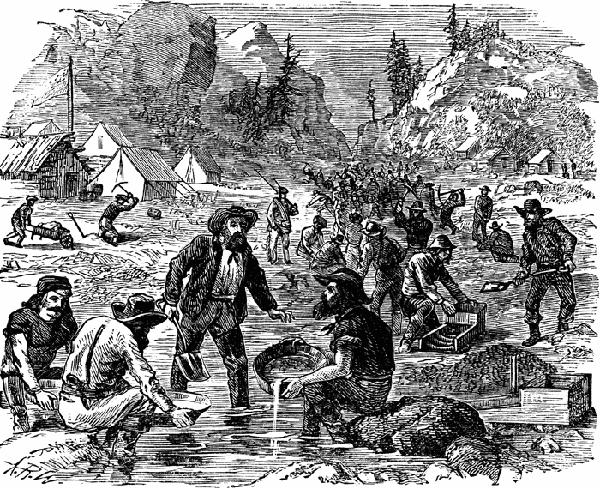
California Gold Rush Miners.
The discovery of gold in California caused a flood of bold men, good and bad, to pour into that remote region from all corners of the earth. Books could be written, and have been written, on the days of terror in California when the vigilantes took the law into their own hands. There came the time later when the rich placers of Montana and other territories were pouring out a stream of gold rivaling that of the days of ’49 and when a tide of restless and reckless characters resigning or escaping from both armies in the Civil War mingled with many others who also heard the imperious call of a land of gold, and rolled westward across the plains by every means of conveyance or locomotion then possible to man.
The next great days of the Wild West were the cattle days, which also reached their height soon after the end of the Great War, when the North was seeking new lands for its young men, and the Southwest was hunting an outlet for the cattle herds, which had enormously multiplied while their owners were off at the wars. The cattle country had been passed over unnoticed by the mining men for many years and dismissed as the Great American Desert, as it had been named by the first explorers, who were almost as ignorant about the West as Daniel Webster himself. Into this once barren land, a vast region unsettled and without law, there now came pouring up the great herds of cattle from the South, in charge of men wild as the horned kind they drove. Like a magnet, another great wildland drew wild men from all parts of the country.
This last home of the bad man, the old cattle range, is covered by a passage from an earlier work: The Story of the Cowboy.
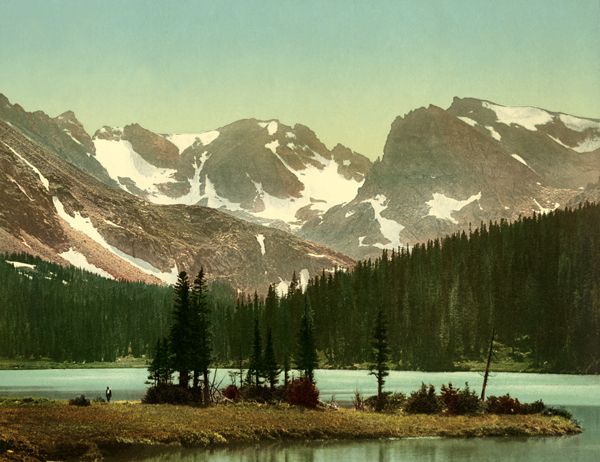
The Heart of the Rocky Mountains by the Detroit Photographic Co., 1901.
“The braiding of a hundred minor pathways, the Long Trail lay like a vast rope connecting the cattle country of the South with that of the North. Lying loose or coiling, it ran for more than two thousand miles along the eastern ridge of the Rocky Mountains, sometimes close in at their feet, again hundreds of miles away across the hard tablelands or the well-flowered prairies. It traversed in a fair line the vast land of Texas, curled over the Indian Nations, over Kansas, Colorado, Nebraska, Wyoming, and Montana, and bent in wide overlapping circles as far west as Utah and Nevada, as far east as Missouri, Iowa, Illinois, and as far north as the British possessions.
Even today, you may trace its former course from its faint beginnings in the lazy land of Mexico, the Ararat of the cattle range. It is distinct across Texas and multifold still in the Indian lands. It’s many intermingling paths still scar the iron surface of the Neutral Strip, and the plows have not buried all the old furrows in the plains of Kansas. Parts of the path remain visible in the mountain lands of the far North. You may see the ribbons banding the hillsides today along the Stillwater valley, along the Yellowstone, and toward the source of the Missouri River. The hoof marks are beyond the Musselshell, over the Badlands and the coulees and the flat prairies, and far up into the land of the long cold, you may see, today if you like, the shadow of that unparalleled pathway, the Long Trail of the cattle range. History has no other like it.”

Cowboys in Nebraska.
This was the dawning of the American cattle industry. The Long Trail now received a gradual but unmistakable extension, always to the north and along the line where the products of the Spanish and Anglo-Saxon civilizations intermingle. The thrust was always to the north. Chips and flakes of the great Southwestern herd began to be seen in the northern states. In the meantime, the Anglo-Saxon civilization was rolling swiftly toward the upper West. The Indians were being driven from the plains. A solid army was pressing behind the vanguard of the soldier, scout, and plainsman. The railroads were pushing out into a new and untracked empire. In 1871, over 600,000 cattle crossed the Red River for the Northern markets. Abilene, Newton, Wichita, Ellsworth, Great Bend, and “Dodge” flared out into a swift and sometimes evil blossoming. The Long Trail, which long ago had found the black corn lands of Illinois and Missouri, now crowded to the West until it had reached Utah and Nevada, penetrated every open park and mesa and valley of Colorado, and found all the high plains of Wyoming. Cheyenne and Laramie became common words, and drovers spoke wisely of the dangers of the Platte River as a year before, they had mentioned those of the Red River or the Arkansas River. Nor did the Trail pause in its irresistible push to the north until it had found the last of the five great transcontinental lines, far in the British provinces. The Long Trail of the cattle range was made. By magic, the cattle industry had spread over the entire West.”
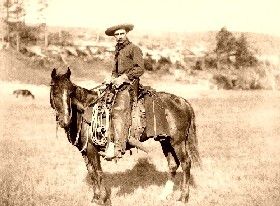
The Cow Boy, circa 1887, by John C. H. Grabill, Sturgis, Dakota Territory.
By magic, the cattle industry is also called a population unique and peculiar to itself. Here were great values to be handled and guarded. The cowboy appeared, summoned out of the shadows by the demand of evolution. With him appeared also the cattle thief, making his living on free beef, as he had once on the free buffalo of the plains. The immense domain of the West was filled with property held under no better or more obvious mark than the imprint of a hot iron on the hide. There were no fences. The owner might be a thousand miles away.
The temptation to theft was continual and urgent. It seemed easy and natural to make a living from these great herds, which no one seemed to notice or care for. The “Rustler” of the range made his appearance bold, hardy, and unprincipled, and the story of his undoing by the law is precisely that of the finish of the robbers of the mines by the vigilantes.
Now, too, came the days of transition, which have utterly changed all the West. The railroad sprang across this great middle country of the plains. The intent was to connect the two sides of this continent, but incidentally and more swiftly than was planned, a great midway empire was built on the plains, now one of the grandest portions of America.
The building of the transcontinental lines was rude and dangerous work. It took out into the West mobs of hard characters who were not afraid of hard work and hard living. These men would have a certain amount of money as wages and would assuredly spend it as they made it; hence, the gambler followed the rough settlements at the “head of the rails.” The murderer, the thief, the prostitute, the social outcast, and the fleeing criminal went with the gamblers and the toughs.
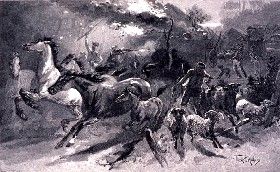
Horse Thieves.
Those days were when it was not polite to ask a man what his name had been back in the States. A substantial percentage of this population was wild and lawless, and it impressed those who joined it rather than being altered or improved by them. There were no wilder days in the West than those of the early railroad building. Such towns as Newton, Kansas, where eleven men were killed in one night; Fort Dodge, where armed encounters among cowboys and gamblers, deputies and desperadoes, were too frequent to attract attention; Caldwell, on the Indian border; Hays City, Abilene, Ellsworth — any of a dozen cow camps, where the head of the rails caught the great northern cattle drives, furnished chapters lurid enough to take volumes in telling — indeed, perhaps, gave that stamp to the West which has been so ineradicable.
These were flourishing times for the Western desperado, and he became famous, as was typical of the era. Perhaps this was partly because the railroads carried the telegraph and the newspaper, so that records and reports were made of what had gone unreported for many years. Now, too, began the influx of transients, who saw the Wild West hurriedly and wrote of it as a strange and dangerous country. In mining days, the wild citizens of California and Montana passed almost unnoticed except in fiction. The Middle Plains’ wild men began to have a record in facts, or partial facts, as brought to the notice of the reading public, which was seeking news of the new lands. A strange and turbulent day now drew swiftly on.
Compiled and edited by Kathy Alexander/Legends of America, updated April 2026.
Go To Next Chapter – The Early Outlaw
About the Author: Excerpted from the book The Story of the Outlaw: A Study of the Western Desperado, by Emerson Hough; Outing Publishing Company, New York, 1907. This story is not verbatim, as it has been edited for clerical errors and updated for the modern reader. About the Author: Emerson Hough (1857–1923).was an author and journalist who wrote factional accounts and historical novels of life in the American West. His works helped establish the Western as a popular genre in literature and motion pictures. For years, Hough wrote the feature “Out-of-Doors” for the Saturday Evening Post and contributed to other major magazines.
Other Works by Emerson Hough:
The Story of the Outlaw – A Study of the Western Desperado – Entire Text