
By Emerson Hough, 1907
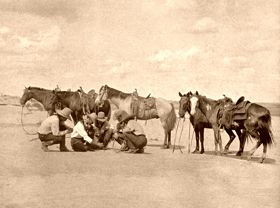
Drawing a map in the sand by Erwin E. Smith.
A review of the story of the American desperado will show that he has always been most numerous at the edge of things, where there was a frontier, a debatable ground between civilization and lawlessness, or a border between opposing nations or sections. He does not wholly pass away with the coming of the law, but his home is essentially in a new and undeveloped condition of society. The edge between East and West, between North and South, made the territory of the bad man of the American interior.
The far Southwest was the oldest and most stubborn American frontier. We have never, as a nation, been at war with any other nation whose territory has adjoined our own except in the case of Mexico. Long before we went to war as a people against Mexico, Texas had been at war with her as a state, or rather as a population and a race against another race.
The frontier of the Rio Grande is one of the bloodiest in the world, and it was long before Texas was finally admitted to the union. So vigorous and belligerent a population never settled any new territory as that which first found and defended the great empire of the Lone Star. Her early men were, without exception, fighters, and she has bred fighters ever since.
The allurement that the unsettled lands of the Southwest had for the young men of the early part of the last century lay mainly in the appeal of excitement and adventure, with a significant possibility of worldly gain. The men of the South who drifted down the old River Road across Mississippi and Louisiana were shrewd in their day and generation. They knew that eventually, Texas would be taken away from Mexico and taken by force. Her vast riches would belong to those who had earned them. Men of the South were even then hunting for another West, and here was a mighty one. The call came back that the fighting was good all along the line, and the fighting men of all the South, from Virginia to Louisiana, fathers, and sons of the boldest and bravest of Southern families, pressed on and out to take a hand. They were scattered and few in number when they united and demanded a government independent of the distant and inefficient head of Mexican law. They did not want Coahuila as their country; they wanted Texas and asked for their own government. Lawless as they were, they wanted a real law, a law of Saxon rights and justice.
Men like Crockett, Fannin, Travis, and Bowie were influenced half by political ambition and half by the love of adventure when they moved across the plains of eastern Texas and took up their abode on the firing line of the Mexican border. If you seek a historic band of bad men, fighting men of the bitterest Baresark type, look at the immortal defenders of the Alamo. In the light of calm analysis, some of them were little better than guerrillas, but every man was a hero. They all had a chance to escape, to go out and join Sam Houston farther to the east, but they refused to a man, and, plying the border weapons as none but such as themselves might, they died, full of the glory of battle; not in ranks and shoulder to shoulder, with banners and music to cheer them, but each for himself and hand to hand with his enemy, a desperate fighting man.
The early men of Texas, for generations, fought Mexicans and Indians in turn. The country was too vast for any system of law. Each man had learned to depend upon himself. Each cabin kept a rifle and pistol for each male old enough to bear them, and each boy, as he grew up, was skilled in weapons and used to the thought that the only arbiter among men was that of weapons.
Part of the population, appreciating the exemptions here to be found, was, without doubt, criminal, made up of men who had fled from older regions for their own reasons. These, in time, required the attention of the law, and the armed bodies of hard-riding Texas Rangers, a remedy born of necessity, appeared as the executives of the law.
The cattle days prolonged the wild times of the border. The buffalo range caught its quota of hard riders and hard shooters. And always the exhaustless empires of new and unsettled lands — an enormous, untracked empire of the wild — beckoned on and on; so that men in the most densely settled sections were very far apart, and so that the law as a guardian could not be depended upon.
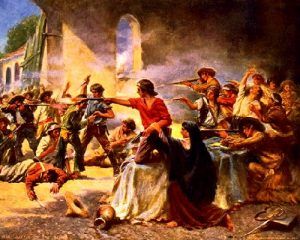
Alamo Battle.
It was not to be wondered at that the name of Texas became the synonym for savagery. For a long time, that was the wildest region within our national confines. Many men who attained fame as fighters along the Pecos, Rio Grande, Gila, and Colorado Rivers crossed the borders of Texas. Others slipped north into the Indian Nations and left their mark there. Some went to the Rocky Mountain mines or the cattle ranges from Montana to Arizona. Many stayed at home and finished their eventful lives there in the usual fashion — killing now and again, then oftener, until at length they killed once too often and got hanged, or not often enough once, and so got shot.
To undertake to give even the most superficial study to a field so vast as this would require a dozen times the space we may afford and would lead us far into matters of history other than those intended. We can only point out that the men of the Lone Star State left their stamp as horsemen and weapon-bearers clear onto the north and as far as the foot of the Arctic Circle. Their language and their methods mark the entire cattle business of the plains from the Rio Grande to the Selkirks. Theirs was a great school for frontiersmen, whose graduates gave a complete account of themselves wherever they went. Among them were bad men, as bad as the worst of any land and in numbers incapable of compass even in a broad estimate.
Some citizens of Montgomery County, Texas, were not long ago sitting in a store on an evening, and they began counting the homicides that had come to their attention in that county within recent memory. They counted 75 authenticated cases and could not claim their tally was comprehensive. Many Texas counties could do as well or better, and there are many counties. It takes you two days to ride across Texas by railway. A review of the bad man field of Texas pauses for obvious reasons!
So many bad men of Texas attained a reputation far wider than their state that it became a proverb upon the frontier that any man born on Texas soil would shoot, just as any horse born there would “buck.” There is truth in most proverbs, although today, both horses and men of Texas are losing something of their erstwhileBroncoo character. That out of such conditions, out of this hardy and indomitable population, the great state could bring order and quiet so soon and so permanently over vast unsettled regions is proof alike of the fundamental sternness and justness of the American character and the value of the American fighting man.
Yet, though peace hath her victories no less than war, it is to be doubted whether, in her own heart, Texas is more proud of her statesmen and commercial kings than of her stalwart fighting men bred to the use of arms. The beautiful city of San Antonio is busy and prosperous today, yet today, you tread their ground, which has been stained red repeatedly. The names of Crockett, Milam, Travis, and Bowie endure, while those of the captains of industry are forgotten. Out of history such as this, covering a half-century of border fighting, frontier travel and merchandising, cattle trade, and railroad building, it is impossible — given the many competitors of equal claims — to select an example of bad eminence fit to bear the title of the leading bad man of Texas.
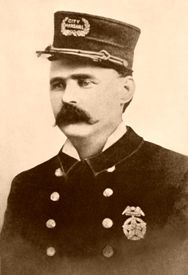
Ben Thompson.
There was one somewhat noted Texas character, however, whose life comes down to modern times and hence is susceptible to fairly accurate review — a thing always desirable, though not often practical, for no history is more distorted, not to say more garbled, than that dealing with the somewhat mythical exploits of noted gunfighters. Ben Thompson, of Austin, killer of more than 20 men and a perfect exemplar of the creed of the six-shooter, will serve as an instance good enough for a generic application. Thompson was not a hero. He did no deeds of war. He led no forlorn hope into the imminent deadly breach. His name is preserved in no history of this great commonwealth. In the opinion of certain peace officers, he was all that a citizen should not be. Yet in his way, he reached distinction, and so remarkable was his life that even today, he does not lack apologists, even as he never lacked friends. Ben Thompson was of English descent and was born near Lockhart, Texas, according to general belief, though some sources state he was born in Yorkshire, England. Later, he lived in Austin, where he spent most of his life moving from place to place.
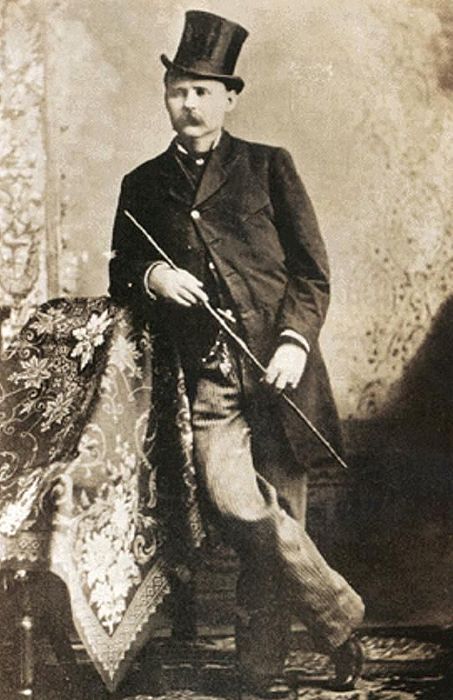
Ben Thompson Gunfighter.
Known as a bold and skillful gunman, he was looked on as good material for a hunter of bad men, and at the time of his death, was marshal of police at Austin. In personal appearance, Thompson looked the part of the typical gambler and gunfighter. His height was about five feet eight inches, and his figure was muscular and compact.
His hair was dark and wavy, his eyes gray. He was very neat in dress and always took particular pains with his footwear. His small feet were always clad in well-fitting boots of light material, a common form of foppery in a land where other dress details were apt to be carelessly regarded. He wore a dark mustache which, in his early years, he was wont to keep waxed to points. In his speech, he was quiet and unobtrusive unless he was excited by his drink. With the six-shooter, he was a peerless shot, an absolute genius, none in all his wide surroundings claiming to be his superior, and he had a ferocity of disposition that grew with years until he had, as one of his friends put it, “a craving to kill people.” Each killing seemed to make him desirous of another. He thus came to exercise that curious fascination that such characters have always commanded. Fear he did not know, or at least no test arising in his somewhat varied life, ever caused him to show fear. He passed through life as a wild animal, ungoverned by the law, rejoicing in blood; yet withal, he was held as a faithful friend and a good companion. To this day, many men repel the accusation that he was bad and maintain that each of his 20 killings was made in self-defense. His nature’s brutal phase was undoubtedly dominant, even though it was not always in evidence. He was usually considered a “good fellow,” and those who downplay or deny most of his wild deeds declare that local history has never been as fair to him as he deserved.
Thompson’s first killing was while he was a young man in New Orleans, and according to the story, it arose out of his notions of chivalry. He was passing down the street in a public conveyance in the company of several young Creoles who were going home from a dance in a somewhat exhilarated condition. One or two of the strangers made remarks to an unescorted girl, which Thompson construed to be offensive, and he took it upon himself to avenge the insult to womanhood. In the affray that followed, he killed one of the young men. He was obliged to flee to old Mexico, taking one of the boats down the river. He returned to Galveston, where he set up as a gambler and began extending his reputation as a fighting man. Most of his encounters were over cards, drink, or women, the history of many or most of the border killings.
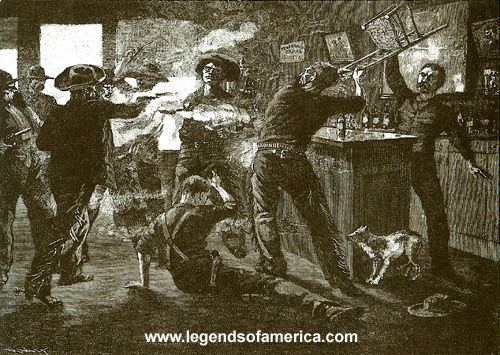
Saloon gunfight.
Thompson’s list grew steadily, and by the time he was forty years of age, he had a reputation far wider than his state. In all the main cities of Texas, he was a figure more or less familiar and always dreaded. His skill with his favorite weapon was proverbial in a state full of skilled warriors. Moreover, his disposition grew uglier, sullen, and bloodthirsty. He needed a small pretext to kill a man if, for the slightest cause, he took a dislike to him. To illustrate the ferocity of the man and his readiness to provoke a quarrel, the following story is told of him:
The proprietor of a variety show severely whipped a gambler by the name of Jim Burdette, Mark Wilson, who, after the fight, told Burdette that he had enough of men like him, who only came to his theater to raise trouble and interfere with his business, and that if either he or any of his gang ever again attempted to disturb his audiences that they would have him (Wilson) to deal with. The next day, Ben Thompson, seated in a barbershop, heard about the row and said to a negro standing by: “Mack, damn your n***er soul, you go down to that place this evening, and when the house is full, and everybody is seated, you just raise hell, and we’ll see what that is made of.” The program was carried out. The negro arose amid the audience and delivered himself of a few blood-curdling yells. Instantly, the proprietor came out of the place but caught sight of Thompson, who had drawn a pair of guns and stood ready to kill Wilson.
The latter was too quick for him and quickly disappeared behind the scenery after his shotgun. There was too much excitement that night, and the matter passed without killing. A few nights after that, Thompson procured some lamp-black, which he gave the gambler Burdette, with instructions to go to the theater, watch his chance, and dash the stuff in Wilson’s face. This was done, and when the unfortunate proprietor, who immediately went for his shotgun, came out with that weapon, Thompson fell to the ground, and the contents of the gun, badly fired at the hands of Wilson, his face full of lamp-black, passed over Thompson’s head. Thompson then arose and filled Wilson full of holes, killing him instantly.
The bartender, seeing his employer’s life in danger, fired at Thompson wildly, and as Thompson turned on him, he dodged behind the bar to receive his death wound through the counter and in his back. Thompson, at the court of last resort, managed to have a lot of testimony brought to bear, and, with a half dozen gamblers to swear to anything he needed, he was admitted to bail and later freed.
He is said to have killed these two men for no reason in the world except to show that he could “run” a place where others had failed. A variation of the story is that a saloon keeper fired at Thompson as he was walking down the street in Austin and, missing him, sprang back behind the bar, Thompson shooting him through the head, through the bar front. Another man’s life now meant little to him. He desired to be king and “chief,” just as the desperadoes’ leaders in the California and Montana mining regions sought to be “chief.” It meant recognition of their courage, skill, and willingness to take human life easily and carelessly and quickly, a singular ambition that has been so evidenced in no other part of the world than the American West. The worst bad men all over Texas were certainly afraid of Ben Thompson. He was “chief.”
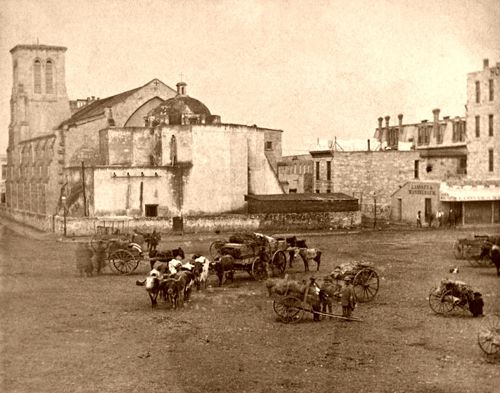
Military Plaza, San Antonio, Texas.
Ben Thompson left the staid paths of life in civilized communities. He did not commit robbery, burglary, or highway crimes, yet toiling and spinning were not for him. For the most part, he was a gambler, and after a while, he ceased even to follow that calling as a means of livelihood. Forgetting the etiquette of his chosen profession, he insisted on winning no matter how or no matter what the game. He would go into a gambling resort in some town and sit at a game if he won well. If he lost, he would become enraged and usually end by reaching out and raking in the money on the table, no matter what the cards decided. He bought drinks for the crowd with the money he thus took and scattered it right and left so that his acts found a certain sanction among those who had not been despoiled.
To know what nerve it required to perform these acts of audacity, one must know something of the frontier life, which at no corner of the world was wilder and touchier than in the same part of the country where Thompson held forth. There were hundreds of men quick with the gun all about him, men of nerve, but he did not hesitate to take all manner of chances in that sort of population. The madness of the bad man was upon him. He must have known what alone could be his fate at last, but he went on, defying and courting his own destruction, as the finished desperado always does, under the strange creed of self-reliance that he established as his code of life.
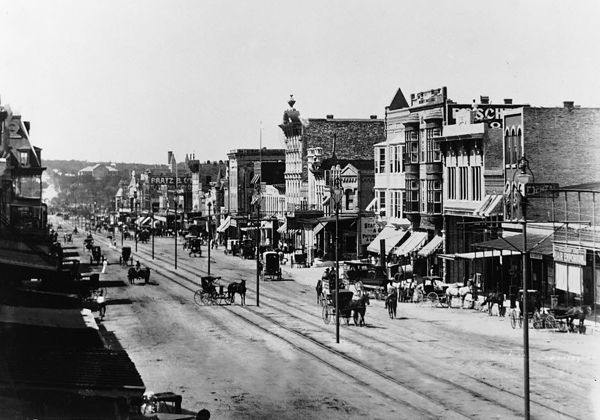
Austin, Texas, 1800s.
Thus, at a banquet of stockmen in Austin, and while the dinner was in progress, Thompson, alone, stampeded every man of them, and at that time, nearly all stockmen were game. The fear of Thompson’s pistol was such that no one would stand for a fight with him. Once, Thompson went to the worst place in Texas, the town of Luling, where Rowdy Joe was running the toughest dance house in America. He ran all the bad men out of the place, confiscated the cash he needed from the gaming tables, and generally caused trouble. He showed that he was “chief.”
In the early 1880s, in the quiet, sleepy, bloody old town of San Antonio, there was a dance hall, gambling resort, and vaudeville theater, in which the main proprietor was one Jack Harris, commonly known as Pegleg Harris. Thompson frequently patronized this place on his visits to San Antonio and received treatment, which left him with a grudge against Harris, whom he resolved to kill. He followed his man into the bar room one day and killed Harris as he stood in the semi-darkness. It was only another case of “self-defense” for Thompson, who was well used to being cleared of criminal charges or left unaccused altogether, and no doubt Harris would have killed him if he could. After killing Harris, Thompson declared that he proposed to kill Harris’s partners, Foster and Simms. He had a special grudge against Billy Simms, then a young man not yet nineteen years of age, because, so it is stated, he fancied that Simms supplanted him in the affections of a woman in Austin. He also carried his grudge against the gambling house, where Simms was now the manager. Every time Thompson got drunk, he declared his intention of killing Billy Simms, and as the latter was young and inexperienced, he trembled in his boots at this talk, which seemed sure to spell his doom. To escape Thompson’s wrath, Simms moved to Chicago, Illinois, and remained there for a time, but before long, he was summoned home to Austin, where his mother was very ill. Thompson knew of his presence in Austin, but with magnanimity, he declined to kill Simms while visiting his sick mother. “Wait till he goes over to Santone,” he said, “then I’ll step over and kill the little _______.”
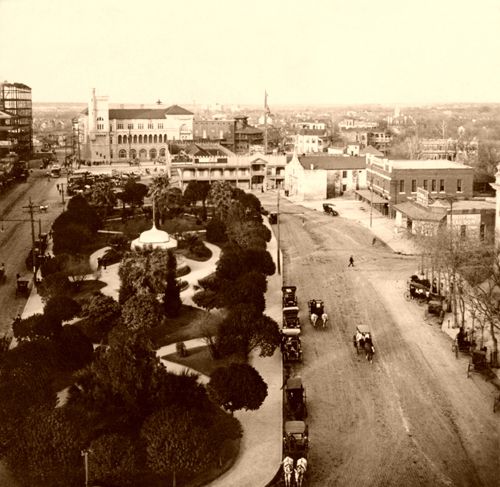
Alamo Plaza, San Antonio, Texas.
Simms called in San Antonio to settle some of Jack Harris’ estate debt. As a friend and partner of the widow, he had been appointed administrator; he went to the latter city with a heavy heart, supposing he would never leave it alive. He was told there that Thompson had been threatening him many times, and Simms received many telegrams to that effect. Some say that Thompson himself telegraphed Simms that he was coming down that day to kill him. Certainly, a friend of Simms on the same day wired him a warning: “Party who wants to destroy you on the train this day bound for San Antonio.”Thompson’s friends deny that he made such threats and insist that he went to San Antonio on a wholly peaceful errand. In any case, this guarded but perfectly plain message set Simms half-distracted. He went to the city marshal and showed him his telegram, asking for protection, but the marshal said nothing could be done until Thompson had committed some “overt act.” The sheriff and all the other officers said the same thing, not caring to meet Thompson if they could avoid it.
While telling his story, Simms would later sob at the memory of his helplessness at the time. The law gave him no protection. He was obliged to take matters into his own hands. He went to a court judge and asked him what he should do. The judge pondered for a time and said, “Under the circumstances, I should advise a shotgun.”
Simms went to one of the faro dealers at the house, a man known as bad who never sat down to deal faro without a brace of big revolvers on the table, but this dealer advised him to go and “make friends with Thompson.” He went to Foster, Harris’s old partner, and laid the matter before him. Foster said slowly, “Well, Billy, when he comes, we’ll do our best.” Simms thought that he, too, was weakening.
There was a big policeman, a Mexican named Coy, who was considered brave and a fighter, and Simms now went to him and asked for aid, saying he expected trouble that night and wanted Coy to do his duty. Coy did not become enthusiastic, though neither he nor Foster attempted to leave the place. Simms turned away, feeling that his end was near. In desperation, he got a shotgun and, for a time, stationed himself near the top of the stairs up which Thompson would probably come when entering the place. The theater was up .one flight of stairs, and at the right was the customary bar, from which “ladies” in short skirts served drinks to the crowd during the variety performance, which was one of the place’s attractions.
It was nervous work, waiting for the killer to come, and Simms could not stand it. He walked down the stairway and turned around the block before ascending the stairs to the hall again. Meanwhile, Ben Thompson, accompanied by another character, King Fisher, a man with several notches on his gun, had ascended the stairs and taken a seat on the right-hand side and beyond the bar, in the row nearest the door. When Simms stepped to the foot of the stairs on his return, he met the barkeeper, who was livid with terror. He pointed, trembling up the stairs, and whispered, “He’s there!” Ben Thompson and King Fisher had as yet made no sort of demonstration. It is said that King Fisher had decoyed Thompson into the theater, knowing that a trap was laid to kill him. It is also declared that Thompson went in merely for amusement. A friend of the author, a New Mexican sheriff who happened to be in San Antonio, saw and talked with both men that afternoon. They were both quiet and sober then.
Simms’ heart was in his mouth, but he decided to die game if he had to die. Slowly, he walked up the stairway. Thompson’s vigilance was so great that he quickly arose and advanced toward Simms, who stood at the top of the stairs, petrified and unable to move a muscle. Before Simms could think, his partner, Foster, appeared on the scene, and as he stood up, Thompson saw him, walked toward him, and said: “Hello, Foster, how are you?” Slowly and deliberately, Foster spoke: “Ben, this world is not big enough for us both. You killed poor Jack Harris like a dog, and you didn’t as much as give him a chance for his life. You and I can never be friends anymore.”
Quick as a flash and with a face like a demon, Thompson drew his pistol and jammed it into Foster’s mouth, cruelly tearing his lips and sending him reeling backward. While this was going on, Simms had retreated to the next step and drew his pistol, not having his shotgun with him then. He stepped forward as he saw Foster reel from the blow Thompson gave him and, with sudden courage, opened fire. His first shot must have taken effect; perhaps it decided the conflict. Thompson’s gun did not get into action. Simms kept on firing. Thompson reeled back against King Fisher, and the two could not fire. In the meantime, the big Mexican, Coy, showed up from somewhere, just as Foster had. Both Foster and Coy rushed in front of the line of fire of Simms’ pistol, and then, without doubt, Simms killed his own friend and preserver. Foster got his death wound in such a position that Simms admitted he must have shot him.
Nonetheless, Foster ran into Thompson as the latter reeled backward upon Fisher and, with the fury of a tiger, shoved his pistol barrel into Thompson’s mouth in turn and fired twice, completing the work Simms had begun. The giant Coy hurled his bulk into the struggling mass now crowded into the corner of the room, and some say he held Ben Thompson’s arms, though, in the melee, it was hard to tell what happened. He called out to Simms, “Don’t mind me,” meaning that Simms should keep on firing. “Kill the ________ of _______!” he cried.
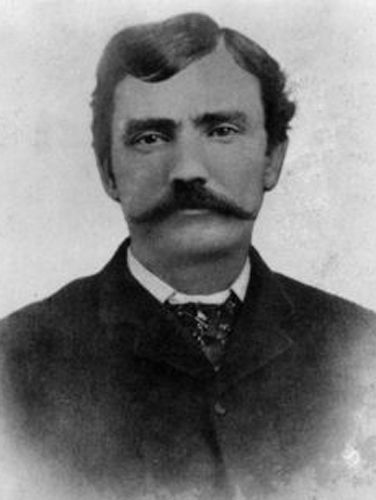
John King Fisher.
Coy, no doubt, was a factor in saving Simms’ life, for one or the other of these two worst men in the Southwest would have got a man before he fell had he been able to get his hands free in the struggle. Coy was shot in the leg, possibly by Simms, but did not drop. Simms cared for Coy until the end of his life.
One of the men engaged in this desperate fight says that Coy did not hold Thompson and that, at first, no one was shot to the floor. Thompson was staggered by Simms’ first shot, which prevented a quick return of fire. Foster killed Thompson and likely King Fisher, the latter being hemmed in the corner with Thompson in front of him. Coy rushed in on the two and handled them so roughly that they never got their guns into action, as far as is known.
Leaving the fallen men at the theater’s rear, Simms now went downstairs, carrying Foster’s pistol, with two chambers empty (the shots that killed Thompson) and his own gun. He saw Thompson’s brother Bill coming at him. He raised the gun to kill him when Phil Shardein, then city marshal, jumped on Thompson and shielded him with his body, calling out, “Don’t shoot, Billy, I’ve got him.” This saved Bill Thompson’s life. Then, several shots were heard upstairs, and upon investigation, it was found that Coy had emptied his pistol into the dead body of Thompson. He also shot Fisher to “make sure they were dead.”
Thus, they died, at last, two of the most notorious men of Texas, both with their boots on. There were no tears. Many told what they would or could have done had Ben Thompson threatened them. This closing act in the career of Ben Thompson came in the late spring of 1882. He was then about forty-three years of age.
King Fisher, who met death at the same time as Thompson, was a good disciple of desperadoism. He was a dark-haired, slender young man from Goliad county, which seems to have produced far more than its share of bad men. He had killed six men and stolen a great many horses in his time. Had he lived longer, he would have killed more. He was not of the caliber sufficient to run a large city, but much relief was felt over his death. Of course, he had many friends, and some of them deny that he intended to make trouble when he went into the theater with Ben Thompson, just as friends of the latter accuse King Fisher of treachery. There are never lacking men who regard dead desperadoes as martyrs. Indeed, it is usually the case that mixed circumstances and frequently extenuating ones are found in the history of any killer’s life.
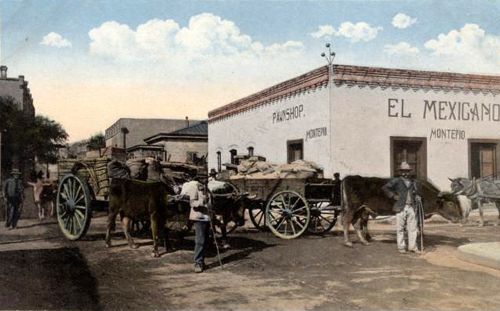
Laredo, Texas.
Another Goliad County man well-known around San Antonio was Alfred Y. Allee, a rancher a short distance back from the railway. Allee was decent when sober, but when drunk, was very dangerous and was recognized as bad and well worth watching. Liquor seemed to transform him, turning him into a bloodthirsty fiend. He had killed several men, one or two under no provocation whatever, and when they were defenseless, including a porter on a railway train. It was his habit to come to town and get drunk, then invite everyone to drink with him and take offense at any refusal. He liked to be “chief” of the drinking place, which he honored with his presence. He once ordered a peaceful citizen of San Antonio, a friend of the writer, up to drink with him, and when the latter declined, came near shooting him. The man took his drink, then slipped away and got his shotgun. Perhaps his second thought was wiser. “What’s the use?” he argued with himself. “Somebody’ll kill Allee before long, anyhow.”
This proved true, for within the week, Allee had run his course. He dropped down to Laredo and began to “hurrah” that town also. The town marshal, Joe Bartelow, was a Mexican but something of a killer himself, and he resolved to end the Allee disturbances once and for all. It is said that Allee was not armed when, at length, they met in a saloon, and it is said that Bartelow offered his hand in greeting. At once, Bartelow threw his arm around Allee’s neck and, with his free hand, cut him to death with a knife. Whether justifiable or not, that was the fashion of the homicide.
Any man who has killed more than 200 men is considered fit to qualify as bad in most countries. This test would include the little human tiger, Tumlinson, of South Texas, who was part of the time an officer of the law and part of the time an independent killer in Texas. It was said that he had more than 20 men to his credit, and his Mexican wife, smilingly, always said that “Tumlinson never counted Mexicans.” He was a genius with the revolver and as good a rifle shot as one would often find. It made no difference to him whether a man was running, for part of his pistol practice was shooting at a bottle swinging in the wind from the bough of a tree. The legend goes that Tumlinson killed his wife and then shot himself dead, taking many secrets with him. He was bad.
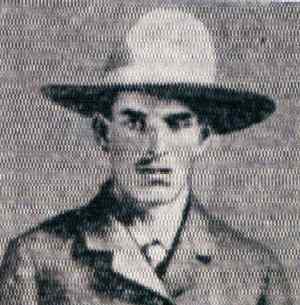
Sam Bass.
Sam Bass was a noted outlaw and killer in West Texas, accustomed to riding into town and taking charge of things when he pleased. He had many thefts and robberies to his credit and not a few murders. His finish was one not infrequent in that country. The citizens heard of his coming one day before he rode into Round Rock for a little raid. The city marshal and several others opened fire on Bass and his party and killed a man.
It was of such stuff as this that most of the bad men and indeed many of the peace officers were composed along a wide frontier in the early troublous days following the Civil War when all the border was a seething mass of armed men for whom the law had as yet gained no meaning. Telling the story of more individuals would be a departure from the purpose of this work. Were these men wrong, and were they wholly and unreservedly bad? Ignorance and bigotry will be the first to give the answer and the first to apply to them the standards of these later days.
Go To the Next Chapter – Modern Bad Men
Emerson Hough, 1907. Compiled and edited by Kathy Alexander/Legends of America, updated November 2024.
About the Author: Excerpted from the book The Story of the Outlaw: A Study of the Western Desperado, by Emerson Hough; Outing Publishing Company, New York, 1907. This story is not verbatim; it has been edited to correct clerical errors and updated for a modern reader. Emerson Hough (1857–1923).was an author and journalist who wrote factional accounts and historical novels of life in the American West. His works helped establish the Western as a popular genre in literature and motion pictures. For years, Hough wrote the feature “Out-of-Doors” for the Saturday Evening Post and contributed to other major magazines.
Other Works by Emerson Hough:
The Story of the Outlaw – A Study of the Western Desperado – Entire Text