

Creole Dancers.
Originally, “Creole” referred to any person of European (mostly French or Spanish) or African descent born in the West Indies or parts of French or Spanish America. However, the term has since been used with various meanings, often conflicting or varying from region to region.

Spanish Creole Family.
Historically, Creole referred to people born in Louisiana during the colonial period who spoke French, Spanish, and/or Creole languages and practiced the Roman Catholic faith, regardless of their ethnicity. In Spanish colonial America, Creoles were generally excluded from high office in both the church and state, although they were legally considered equals to Spaniards. Discrimination arose from the Spanish crown’s policy, which aimed to reward its favored Spanish subjects with lucrative and honorific colonial posts while excluding Creoles from such positions and severely restricting their commercial activities.
The word “Creole” derives from the Latin “creare,” meaning “to beget” or “to create.” The Portuguese used the word “crioulo”, meaning “native to the locality”, to refer to individuals of African descent born into slavery in the New World to distinguish them from those recently enslaved and transported from Africa.
Especially in the 18th century, Spanish immigrants who succeeded in business in the colonies antagonized the Creoles, who led revolutions that contributed to the expulsion of the colonial regime from Spanish America in the early 19th century. After independence in Mexico, Peru, and elsewhere, Creoles entered the ruling class. They were generally conservative and cooperated with the higher clergy, the army, large landowners, and, later, foreign investors.

Wealthy Creole from Spanish Louisiana, 1795.
Later, the term “Creole” helped distinguish the New Orleanians from Americans who arrived after Louisiana’s admission to the Union in 1812.
Before the Civil War, free people of color enjoyed considerably higher social status than enslaved Africans. In fact, many of them owned enslaved Africans. After the war, all people of color were categorized together for the first time. This amounted to a significant social demotion for many people whose families were free persons of color prior to the war. They were suddenly denied access to networks and resources, including education and capital, that had previously been available to them.
Many descendants of free people of color lived in urban areas where racial intermingling was common, which often resulted in lighter skin tones. Jim Crow laws emphasized the significance of skin color by stipulating that anyone with at least one black great-grandparent (referred to as an “octoroon”) was considered “colored.” Consequently, those with lighter skin began to identify themselves as “Creole” to differentiate themselves from the darker-skinned “colored” individuals.
Although some white southern Louisianans reject the Cajun label and continue to call themselves Creoles, the term is used today most commonly in reference to those of full or partial African heritage. Like their ancestors, these Creoles are typically French-speaking and Catholic. Significant populations of these Creoles can be found in New Orleans, the Acadiana region of southern Louisiana, the Cane River/Isle Brevelle areas near Natchitoches, and in East Texas, extending as far west as Houston. Moreover, a notable population of Creoles of African descent exists in California, the result of decades of departures during the Great Migration, which led to the growth of Creole enclaves in places such as Oakland and San Francisco.
Increasingly, however, Creoles of African ancestry, regardless of the pre-Civil War status of their enslaved or free ancestors, have put aside old animosities mainly based on skin color and social standing to work for mutual preservation. They often describe themselves simply as Creoles.
Today, as in the past, Creole goes beyond racial boundaries, connecting people to their colonial roots. Many define Creole through foodways, music, folklore, family traditions, architecture, the Catholic faith, and genealogy.
The Creole language remains in use in Louisiana, and in recent decades, it has garnered increased attention from linguists and language preservation organizations. These scholars generally regard Creole not as a dialect of French, but rather as an “autonomous language” due to “major differences in grammatical structure.”
The Cane River region of Louisiana is home to the distinctive Creole culture. The river shaped the nearly 300-year relationship between the Creoles and their homeland, which was tested by floods, droughts, wars, and numerous other obstacles. However, the Creoles’ resilience and resourcefulness have allowed the culture to endure and thrive. The Cane River National Heritage Area and the Cane River Creole National Historical Park in Natchitoches, which include the Oakland and Magnolia Plantations, offer a cultural journey into the rich, diverse heritage and vibrant living traditions of Cane River.
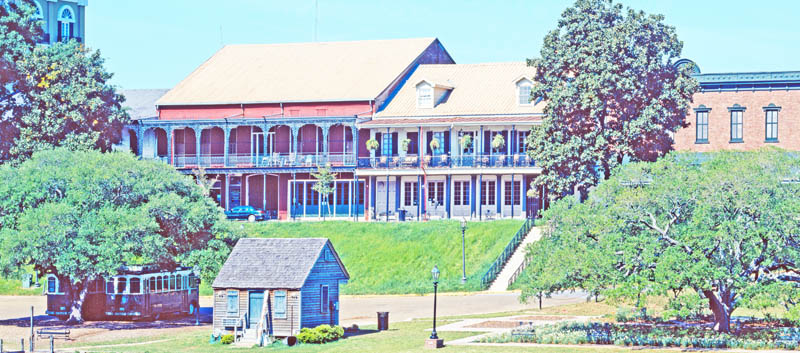
Front Street in Natchitoches, Louisiana.
In addition to serving as an ethnic label, the word Creole has been applied to various products from Louisiana, such as Creole ponies, Creole onions, and Creole tomatoes. The word is also frequently used in reference to architecture and cuisine. There is also Creole music, from Afro-Caribbean-inspired folksongs of antebellum Congo Square to the more modern, bluesy, accordion-based zydeco of rural and small-town southwestern Louisiana.

Creole Family.
©Kathy Alexander/Legends of America, updated February 2026.
Also See:
Cane River Creole National Historical Park
Sources:
64 Parishes
Data Center Research
Encylopedia Britannica
National Park Service