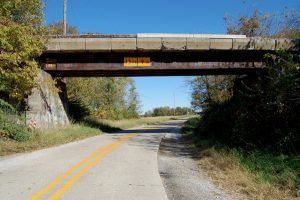
An old concrete segment and bridge north of Nilwood, Illinois. Photo by Kathy Alexander.
Upon leaving Springfield, Illinois, Route 66 travelers must decide which of the two alignments to take — the pre-1930s or the later alignment, which continued as Route 66 until 1977. Both have their unique history, interesting stops, and photo opportunities.
The pre-1930s two-lane alignment meanders through Chatham and Auburn — where you can see a piece of brick alignment — before moving on to Thayer, Virden, Girard, Nilwood, Carlinville, Gillespie, Benld, Sawyerville, and Staunton. South of Staunton, the road rejoins with the later alignment.
One of the oldest and most scenic segments of Route 66 in Illinois, this path predates the Mother Road as it follows the old Pontiac Trail. Named for Ottawa Chief Pontiac, this road was the main pathway between Chicago, Illinois, and St. Louis, Missouri, in the early 1900s.
In 1918, a bond issue was passed to construct “hard roads” in Illinois, and the old trail was designated as SBI-4 (State Bond Issue).
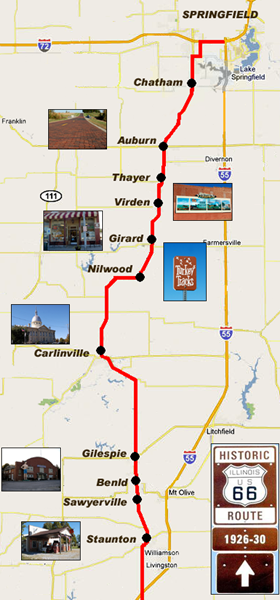
South Springfield Old Alignment Map.
It began in the western Chicago suburb of Cicero and was fully completed by 1924. Roughly paralleling the Chicago & Alton Railroad, this old chunk of pavement represents the first hard portion of the Mother Road and is a testament to the birth of the interstate highway system. In its earliest years, it was used by hundreds of soldiers returning from World War I, then by Chicago mobsters during the Prohibition era, leading to the road’s reputation as “Bloody 66” and the birth of the Illinois State Police.
In Springfield, it entered to the east of the Illinois State Fairgrounds before traveling south through the capital and meandering through downtown streets until following South Grand Street to what is now Chatham Road and exiting the city on the southwest side.
Along this route, travelers will see sections of old brick road, concrete paths, abandoned routes, old bridges, and numerous small towns where life goes by at a much slower pace. These small towns offer numerous historical sites, and the countryside is filled with interesting barns, homesteads, and farms.
Illinois Route 4, North of Auburn (1921-1932) – A bypassed portion of old Route 4 north of Auburn, Illinois, is listed in the National Register of Historic Places. This segment consists of a 1932 1.53-mile-long brick road and a 1921 Portland cement road. Both are well-preserved examples of Route 66’s early years in Illinois, illustrating early highway-era construction methods.
These sections were part of Route 66 until 1930, when the realignment south of Springfield rerouted traffic to the less-populated eastern side through Litchfield to speed up flow by avoiding as many towns as possible.
The concrete section consists of a 1,277-foot-long, 16-foot-wide Portland cement slab dating from 1921. After Route 66 was realigned in 1930, this section briefly reverted to its State Route 4 designation before being abandoned in a 1932 relocation of the State road.
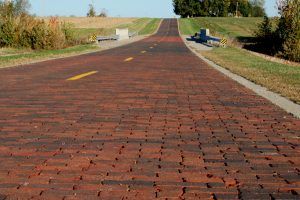
A 1932 section of Route 66 is a 1.53-mile stretch of brick road north of Auburn, Illinois. Legend has it that this portion was built of bricks because a politician in “high places” owned a brick factory. By Kathy Alexander.
The second 1.53-brick section was incorporated into the 1932 modifications and resurfaced with brick at the same time. Today known as the Auburn Brick Road, it contains two original single-span concrete bridges over Little Panther Creek, constructed in 1920 and paved with brick in 1932.
This segment was added to the National Register of Historic Places in 1998. It is located on Curran and Snell roads north of Auburn, Illinois.
To reach the concrete 1,277-foot section, travel south on Highway 4 from Chatham to Alpha Road and turn west. The segment is located on Alpha Road between Highway 4 and Curran Road. The Auburn Brick Road is between Chatham and Auburn on Snell and Curran Roads. Heading south from Chatham on Highway 4, turn west on Snell Road, curve south, and turn onto Curran Road before rejoining Highway 4.
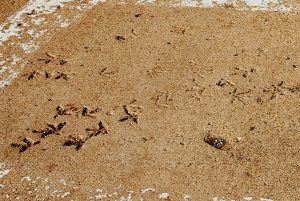
Just south of Nilwood, Illinois, turkey tracks were imprinted in the original concrete as it was poured. After more than 80 years, they can still be seen today. Kathy Alexander.
Route 66, Girard to Nilwood (1919-1931) – Underscoring the fast-paced evolution of Route 66 in Illinois, this segment was designated as a part of the Mother Road in 1926. Still, it was quickly replaced in 1930 with a major realignment to the east. Constructed in 1920 as part of old State Route 4, this short-lived section of Illinois Route 66 is typical of the engineering and construction methods of the post-World War I era. This was a time of genuine transition in road construction, often combining horses and mules with state-of-the-art trucks and machinery in World War I. The road’s cross-section included two eight-foot-wide lanes with 4- to 7-foot-wide gravel shoulders. The Portland cement slab was generally six inches thick.
Although cracked in places, its current concrete pavement is original. The road segment retains five original concrete box culverts and a 1920 single-span concrete bridge. An interesting piece of the pavement can be seen just south of Nilwood, Illinois, where turkey tracks were imprinted within the original concrete when it was poured. After more than 80 years, they can still be seen today.
Directions:
- From downtown Springfield, take MacArthur Boulevard south to Wabash Avenue and travel west.
- Turn south on Chatham Road, crossing I-72.
- Just after I-72, look for Recreation Drive to the east. At 1700 Recreation Drive stands the still active Route 66 Drive-In.
- Return to Chatham Road, continuing to travel south.
- Turn west on Woodside Road.
- Turn south onto IL-4 (Veterans Parkway)
- Follow IL-4 to Chatham – Caldwell Mansion on the north side of town, a few old buildings in the Mulberry Street business district, and the Chatham Railroad Museum at 100 N. State Street.
- Continue on IL-4 to Auburn. About two miles north of Auburn is Becky’s Barn at 5029 Snell Road, sitting right off the historic 1931 1.4-mile hand-laid brick road. Historical buildings are in Auburn’s downtown square at Jefferson and 5th Streets.
- Continue on IL-4 to Thayer.
- Continue on IL-4 to Virden – Watch for the mural.
- Continue on IL-4 to Girard – Doc’s Soda Fountain and Deck’s Pharmacy Museum, 1919-31 alignment starts here.
- Continue on IL-4 to Nilwood – Turkey tracks in concrete pavement south of town.
- Continue on IL-4 to Carlinville – Million Dollar Courthouse and 1869 Macoupin County Jail.
- Continue on IL-4 to Gillespie – Zion Church Neon Cross.
- Continue on IL-4 to Benld – Coliseum Ball Room Antique Mall.
- Continue on IL-4 to Sawyerville
-
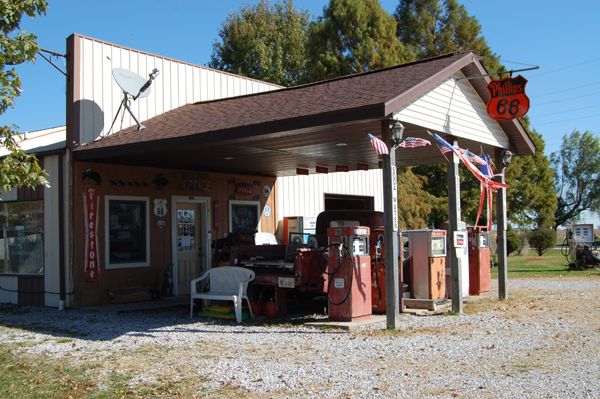
Henry’s Rabbit Ranch, Staunton, Illinois.
Continue on IL-4 to Staunton – Henry’s Ra66it Ranch, Country Classic Cars, Decamp Junction Roadhouse.
©Kathy Alexander/Legends of America, updated April 2026.
Also See:
Route 66 Alignments in Illinois
See Sources.