
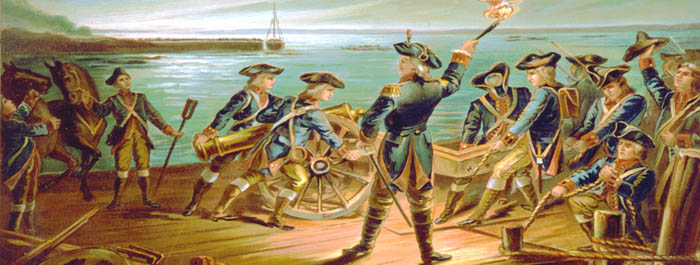
Continental Army at Long Island, New York, in 1776 by Werner Co.
By Arthur Cecil Perry and Gertrude A. Price, 1914
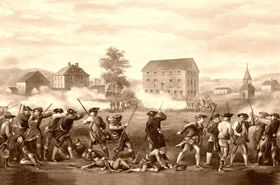
Battle of Lexington, April 19, 1775. Illustration by John H. Daniels & Son, 1903.
Despite the Battles of Lexington and Concord, the Americans amazingly still hoped that the king and Parliament would grant them the rights of Englishmen. If so, the colonists would gladly and loyally support the English government. The Second Continental Congress even sent one more petition to King George III asking for fair treatment. The king ignored it, closed American ports, and called the people rebels.
Even as they waited, hopeful of a peaceful settlement, the Americans were not neglecting the military aspects of the struggle. When Congress met, they captured Crown British stores and ammunition at Fort Ticonderoga, New York. The attack was led by Ethan Allen and a party of hardy frontiersmen, known as the Green Mountain Boys. Although the fort was equipped with 200 cannons, the attacking party, striking unexpectedly in the dead of night, easily took the startled garrison prisoners. Two days later, nearby Fort Crown Point also surrendered.
The Americans hoped to win Canada as a fourteenth colony. Whether Canada joined them or not, gaining control of the region would be to their advantage. Two expeditions, therefore, were formed to invade the region.
The first one, under Richard Montgomery, succeeded in capturing Montreal. The second, under Benedict Arnold, started in the winter of 1775 to march through the wilderness to Quebec. The soldiers endured unspeakable hardships. Food gave out, and the cold caused dreadful suffering. Many died, and others returned home carrying the sick with them. But Arnold pushed on. By the time he reached Quebec, his numbers had been so reduced that an attack was impossible. Finally, Montgomery came to his aid. With joined forces, they stormed the citadel, but without success. In six months, the Americans were compelled to leave Canada.
For the first few months after George Washington was appointed Commander-in-Chief, the people watched him to see what he would do. They likewise found fault with him because he seemed to be doing nothing. Yet, Washington was busy drilling his men and watching his chance to seize Dorchester Heights on the south side of Boston, Massachusetts, and thus compel the British to fight or retreat. English General William Howe neglected to protect this hill. As a result, the English lost Boston, for Washington succeeded in fortifying the Heights. The British dreaded meeting the fighting Americans on a hill. They had learned their lesson at Bunker Hill and were not to be caught again. Therefore, they folded their tents, boarded their ships, and sailed out of Boston on March 17, 1776.
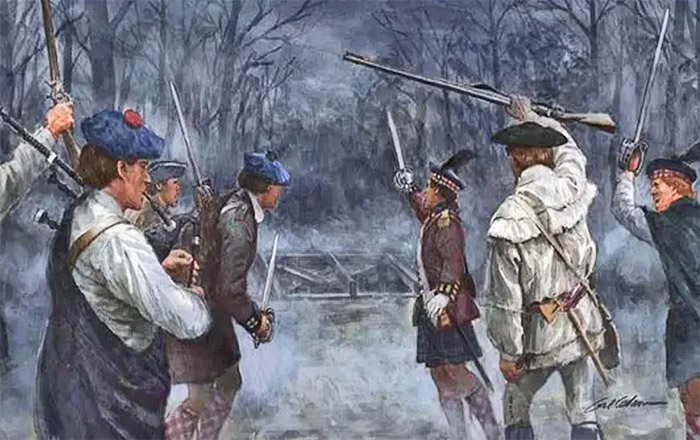
Battle of Moore’s Creek, North Carolina, by the National Park Service.
The fighting did not take place only in the north. In February, at Moore’s Creek, North Carolina, a party of Minute Men defeated a large force of colonists loyal to the king. A British force under General Henry Clinton and Lord Charles Cornwallis, together with a fleet, was sent to subdue the people of North Carolina. But 10,000 armed men were awaiting them, so they went farther south, planning to take Charleston, South Carolina. They found that the colonists had fortified an island in the harbor. Fort Moultrie was constructed of sand and logs and was well-armed with a large cannon. The British fleet bombarded the fort while the army tried to reach the island from the rear. But, both fleet and army were badly repulsed, and the British sailed away to the north.
All this while, England didn’t want a war any more than did the colonists. Her funds were low, and she needed all her strength to drive back the great nations of Europe, particularly France.
But King George was determined to show his authority. He hired 17,000 German soldiers, called Hessians, to help him subdue the colonists. This angered the Americans, who began to consider the matter of independence seriously. Some colonies had already driven away their royal governors and begun to govern themselves. In May 1776, the Continental Congress agreed that the colonies should no longer consider themselves subject to the English Crown but should govern themselves. Richard Henry Lee of Virginia put his ideas on paper as a resolution. It began: “Resolved: That these united colonies are, and of right ought to be, free and independent states.”
It was not until July 2, 1776, that Congress agreed to this resolution. The next step was to declare to the world that the United States was an independent nation. It fell to Thomas Jefferson to write one of the most famous documents in history, our Declaration of Independence. This was adopted on July 4, 1776, and changed the dependent colonies to free and independent states. Proud indeed are the families who can trace their descent from one of its signers. As he put his signature to the great paper, someone remarked, “We must all hang together.” “Yes,” answered Benjamin Franklin, “if we do not hang together, we shall hang separately.”
Within a few days, copies of the Declaration were printed and sent to each colony. A great crowd gathered to hear it read in front of the statehouse in Philadelphia, Pennsylvania, where the Declaration had been adopted. As the last words died into silence, a joyful peal came from a bell that hung in the statehouse tower and bore the words, “Proclaim liberty throughout the land unto all the inhabitants thereof.”

Writing the Declaration of Independence, by Jean Ferris.
Throughout the land, the Declaration was read to other eager groups, sometimes by the chief magistrate in the public square, sometimes by the minister from the pulpit.
Now that the war for independence had been formally declared, England realized that she must change her plans. All the colonies must be treated as if they were in rebellion. In consequence, England thought out two lines of action. If either failed, she could fall back upon the other. One of these was to begin in the south and, working northward, conquer the states one by one until all acknowledged Britain’s rule. In the other method, she would first take New York and gain control of the Hudson Valley.
For several reasons, the second way seemed better. First, England was the mistress of the seas. The Americans had no navy except for small fishing boats, whose owners, forsaking their businesses, armed their boats and went out upon the high seas. Even these made considerable trouble for the English, swooping down upon the English merchant ships and seizing their cargoes. Such private vessels were permitted by Congress to carry on this warfare and were known as privateers.
England had another advantage in that Canada was at her command. Here was a safe and easy base from which to launch an attack on New York. England also believed that the Six Nations in the Mohawk Valley would be beneficial to her due to their loyalty to Sir William Johnson, renowned for his role in the French and Indian War, and to his son. The Johnsons were loyal to the king.
Battle of Long Island, New York.
For these reasons, gaining immediate possession of New York seemed wise. That would separate New England from the other states and make the interchange between them almost impossible. Then, the New England states would have no means of getting supplies by land or sea and might soon be brought to terms.
General George Washington guessed what the British would do, so he marched his army to New York from Boston. To protect the city, he fortified Brooklyn Heights, which held a similar significant relation to New York as Dorchester Heights did to Boston. On August 22, 1776, General William Howe, with 20,000 men, landed on Long Island. Meeting a smaller body of American troops, he worsted them in a short, quick encounter and forced them to withdraw to Brooklyn Heights.
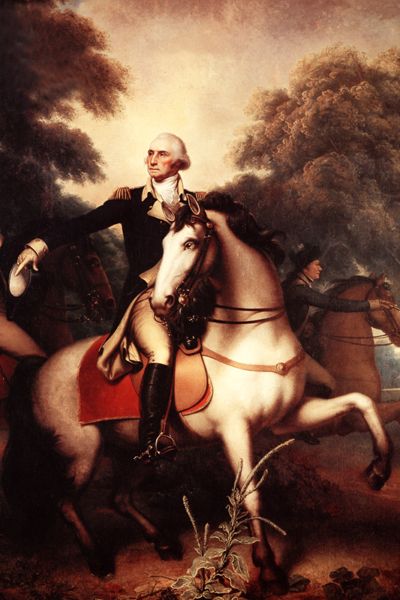
General George Washington.
If General Howe had followed up on this victory and quickly besieged the American army, he would undoubtedly have captured it. Here was a rare chance for the British to bring the war to a speedy close.
Too wise to storm the hilltop on which the enemy was encamped, they planned to surround Brooklyn Heights and starve its holders into surrender, but they did not act quickly enough. Washington realized the enemy’s plan, and, ever ready for an emergency, he outwitted them. He sent trusted messengers across the river to gather boats of all sorts. Into these, at nightfall, Washington loaded his entire force with firearms, horses, and supplies. Through the still darkness, they made many trips, with Washington on the bank, keeping order and quiet. He was the last man to leave the shore.
When the British awoke the following day, they found the Americans were gone. General William Howe crossed the river in pursuit, and General George Washington retreated northward to Harlem Heights. Several skirmishes took place in the vicinity, but after a few weeks, Washington was forced to abandon New York. With part of the army, he retreated to New Jersey, sending orders to General Charles Lee to join him with other troops. However, Lee was jealous of his superior officer and found some excuse for not obeying.
Washington, deprived of the aid he had been counting on, found himself in a most critical position. The British were in hot pursuit. They pushed him hard across New Jersey, but Washington skillfully hindered their progress by burning bridges and destroying supplies.
It was not difficult to follow the American line of march. Shoeless, many of them left footprints of blood on the frozen ground. Many were going home because their term of enlistment had expired, and others were deserting. This state of affairs became known to the British, and General Charles Cornwallis, concluding that the war would soon be over, began to pack his trunks for home. But he was premature.
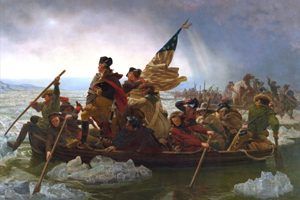
Washington Crossing the Delaware River by Emanuel Leutze, 1851.
General Washington had been forced to put the Delaware River between himself and his pursuers, but he was finally reinforced by the troops General Charles Lee had held back. More than a thousand Hessians comfortably settled in winter quarters at Trenton, New Jersey. Washington planned to surprise them on Christmas night in 1776. Even though the river was clogged with floating ice cakes, some fishermen-soldiers faced the difficult task of rowing Washington’s army across the river. Then came the long march of nine miles to Trenton. On the way, two men died of cold, and the sleet dampened the muskets. When someone suggested to Washington that they would be of no use, he replied,” Use bayonets, then. We must take that town.”
Separating into two parties, the patriots entered Trenton at dawn from two different directions. When the first shot rang out, the stupefied and half-dressed Hessians rushed into the streets. There was nowhere to escape. The dazed commander tried in vain to gather his men in line. All too late, he recalled that someone had handed him a note he had thrust into his pocket amid the Christmas merriment. It was a warning a spy brought, telling of Washington’s impending arrival and his troops’ approach. The next day, the unopened note was found on his dead body. Washington was in command of the town in about an hour, with 1,000 Hessians as his prisoners and a great store of war supplies.
British General Charles Cornwallis came posthaste from New York to Princeton and advanced with an army. On January 2, 1777, he was just south of Trenton, New Jersey. Nothing but a small creek separated him from the American army.
His men were tired, and it seemed advisable to him, since he had the enemy where he could watch them closely, to wait until the morning and then make a brilliant capture. So narrow was the separating stream that the British sentinels heard the American soldiers talking together as they piled wood on the campfires and dug entrenchments. The following day, however, Cornwallis awoke to find the opposite side of the stream deserted. The British had been deceived. The campfires and the noise of pickaxes had been kept up only to cover the flight of the Americans in the darkness. The distant roar of cannons in the rear told the English that Washington had marched his men around their army.
Near Princeton, General George Washington encountered some British soldiers who were en route to reinforce Cornwallis. As Cornwallis called him, the “old fox,” routed them successfully and pushed on to a strong position at Morristown, New Jersey. This was an excellent piece of work on Washington’s part. It undid all that the English had accomplished in six months. Except that they had gained New York, they were no better off than they had been when they started. In the meantime, Washington was safe at Morristown, New Jersey, and in control of most of the colony. At the same time, he was where he could reach the Hudson Valley in case he needed it. Washington had conducted a whole campaign in nine days.
The patriots were cheered by the commander-in-chief’s skillful leadership and the sturdy bravery of his men. Nevertheless, they had not raised money to pay their soldiers in a long time because Congress had neither the funds nor the means of obtaining any. They could ask the colonies for money, but they did not compel them to pay.
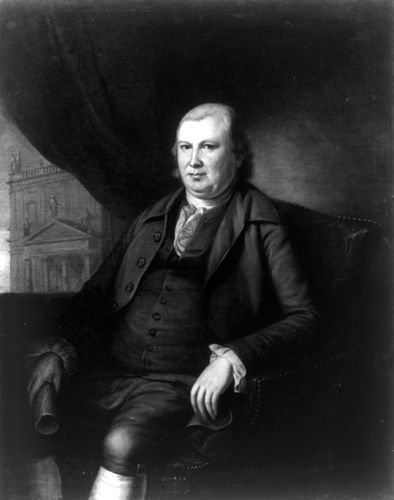
Robert Morris, a banker and friend of George Washington,
raised $50,000 for the desperate patriots.
Throughout the war, Congress was hard-pressed to raise funds. In 1775, the government began issuing paper money — bills that were essentially printed promises to pay. It continued throughout the war to issue these bills, asking the people to accept them instead of coins. However, the people did not have confidence in the old Continental government and thought it very unlikely that it would live to pay coins for these written promises. As a result, vendors were slow to accept paper money in exchange for supplies and services. As a result, the paper gradually became almost worthless. By the war’s end, many million dollars of this paper money had been issued, which was never redeemed.
With so much trouble over money, Washington found it hard to hold the troops together. In desperation, he wrote to his friend, Robert Morris, a wealthy banker in Philadelphia, Pennsylvania, asking him to obtain $50,000 as quickly as possible. On New Year’s Day, Morris went calling. He knocked at the doors of friends and strangers and asked for help. By noon, he had raised the required amount, and Washington received it in time to save the army.
While Washington was trying to strengthen his army, the British planned for the coming summer. They saw plainly that its plans to hold the city of New York were insufficient. They needed to conquer the entire state.
They then laid out a threefold plan. 1) General John Burgoyne was to invade New York State by way of Canada and Lake Champlain. 2) – Colonel Barrimore St. Leger was to go from the St. Lawrence River and Lake Ontario into the Mohawk Valley to join Burgoyne on the Hudson River. 3) – General William Howe, with the greater portion of his army, was to leave the city of New York and go up the Hudson River, joining the other two at Albany, New York.
With the colonies thus divided, the British thought they would find little difficulty in putting down the first group and then the other. Regarding Plan 1, Burgoyne approached Lake Champlain in June 1777 and captured Fort Ticonderoga. It is said that when the news of this victory was brought to the king, he clapped his hands and exclaimed, “I have beaten them. I have beaten all the Americans!”
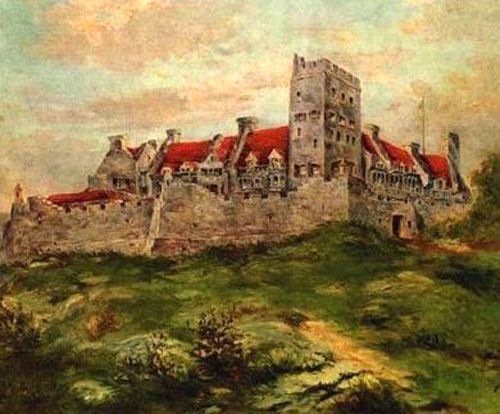
Fort Ticonderoga, New York.
However, Burgoyne, in passing from Lake Champlain to the Hudson River, found his way blocked by fallen trees and ruined bridges. If the patriots were not strong enough to meet him in battle, they were at least clever enough to hinder his advance. Burgoyne had to leave many soldiers behind to safeguard the transportation of his supplies from Canada, which slowed his progress. He knew the Americans had stores at Bennington, Vermont, so he sent about a thousand Hessians to secure them. Colonel John Stark met the invaders with a body of militia, and the Americans fought so successfully that only about seventy of the Hessians returned to the British camp. This was a hard blow to Burgoyne.
Working on Plan 2, Colonel Barrimore St. Leger gathered several British soldiers and Six-Nation Indians about him and proceeded to the Mohawk Valley as planned. His first move was to besiege Fort Stanwix, which 600 Continental soldiers held. When St. Leger learned that an army of 800 patriots was on its way to reinforce the garrison at the fort, the Colonel sent a detachment of troops to meet it. At Oriskany, New York, the Americans were caught in a ravine, and one of the bloodiest battles of the American Revolution was fought. The gallant American commander, General Nicholas Herkimer, was severely wounded, but seated at the foot of a tree, he continued to shout his cheering orders to his men. The Americans held the field, and the British retreated.
In this campaign, the American flag, featuring stars and stripes, was hoisted for the first time. While holding Fort Stanwix, New York, the Continentals dispatched a regiment that captured five British flags. These they hoisted, upside down, over their fort. Then, above them, they raised their own flag, which the men had hastily put together.
In June 1777, Congress decided upon a national flag. It was to be of 13 alternate red and white stripes, with a blue field containing white stars in a circle. Red was the emblem of strength, blue of unity, and white of purity. Some weeks earlier, Mrs. Betsy Ross made the first flag of this design. But, she would have found little resemblance to her beautiful handiwork in the first Red, White, and Blue raised over Fort Stanwix on August 6. One man gave his white shirt, another his blue coat, and a third, strips of his wife’s red flannel petticoat. It was a curious makeshift, but the three colors went up with a lusty hurrah from the throats of the proud Americans. St. Leger continued to besiege the fort, but help for the defenders was near at hand.
Benedict Arnold was approaching with a strong force of patriots. When the two armies were about 20 miles apart, Arnold played a clever trick on the enemy. Through captured British soldiers and a friendly Oneida Indian, he spread abroad exaggerated stories of the size and strength of the coming American army. The Indians were frightened and fled. In a very short while, St. Leger, with what was left of his army, pushed back to Oswego and embarked. This left Burgoyne with no one to depend upon but General William Howe.
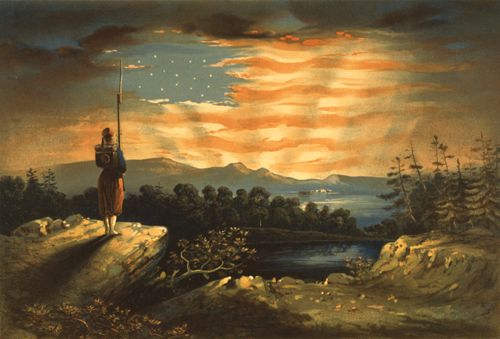
Our heaven-born banner, by William. Bauly, 1861.
In the meantime, General William Howe instigated the third plan in New York. He was in daily conference with a man whose name makes a dark blot on the pages of our nation’s history, General Charles Lee. It was he who had refused to obey Washington. Now, taken prisoner by the British, he turned traitor. Forgetting loyalty to his country, he laid out the plans of the American army before General Howe. He assured Howe that General Washington had sent so many soldiers into New York that his forces were significantly weakened. Since General Howe had not yet received direct orders to join Burgoyne, this seemed his chance to capture Philadelphia. He first tried to draw the Americans away from their strong position at Morristown but found that Washington was not thus to be caught.
Then General Howe started over again, this time sailing southward to Chesapeake Bay, hoping to reach Philadelphia that way. Soon after passing Brandywine, Pennsylvania, he landed, and General Washington met him at Brandywine Creek. Here, the Americans were defeated due to the British army’s superior strength in Germantown — 18,000 against 11,000. But General George Washington hindered General Howe in his march to Philadelphia, and it took him two weeks to make the 26 miles. Again, Washington’s forces attacked Howe and his troops outside of Philadelphia at Germantown in October. Again, Washington was defeated, and people began to wonder what he was doing. They could not understand why he was continually putting his army in a position to be beaten. But this was not carelessness on the part of the great general. It was a well-laid plan to keep General Howe so busy that he could not spare a single man to be sent to General Burgoyne in New York.

Surrender of General Burgoyne at Saratoga, New York.
And, indeed, Burgoyne’s need was very great. The American forces under General Horatio Gates were pressing him hard. Expecting General William Howe to join him, he crossed the Hudson River and stationed his men just below Saratoga, New York. At this move, a detachment of Americans pushed northward and cut him off from Fort Ticonderoga, his supply headquarters. Now, he was fairly trapped, and there was nothing to do but fight. Two battles were waged — in the first, the British were driven back. In the second battle, they were decisively defeated. On October 17, 1777, General John Burgoyne surrendered his whole army. Thus, by forcing St. Leger to retreat and capture Burgoyne, the Americans defeated England in the first of her two great plans for subduing the rebels.
In Europe, the capture of Burgoyne’s army produced a tremendous stir. The French rejoiced, quickly recognized the United States as an independent nation, and promised her aid.
Though many more battles would be fought before the Revolutionary War ended, recognizing the United States as a nation was a turning point in the struggle.
Arthur Cecil Perry and Gertrude A. Price, 1914. Compiled and edited by Kathy Alexander/Legends of America, updated April 2024.
About the Article: This article on the American Revolution was primarily written by Arthur Cecil Perry and Gertrude A. Price and included in a chapter of their book, American History, published in 1914. However, the original content has been heavily edited, and additional information has been added.
Also See: