LEGENDS OF AMERICA

A Travel Site for the Nostalgic & Historic Minded


  Search


Legends Home

Site Map

What's New!!


Recommend this site


American History

Ghost Towns

Ghostly Legends

Historic People

Native Americans

The Old West

Photo Galleries

Roadside Attractions

Rocky Mtn Store

Route 66

Travel Destinations

Treasure Tales

Legends Blog


Free E-Newsletter


Legends of America's Exclusive Custom Products


P.O. Box 19423

Lenexa, KS 66285

913-708-5119


Please report broken links, missing pictures, or other problems online by clicking HERE or send us an email.  Thanks!


Wyoming Forts of the Old West


Vintage Native American Photographs


<< Previous 1 2 3 Next >> 


Wind River ValleyFort Stambaugh (1870-1878) - When gold was discovered in the Wind River Valley, numerous mining camps, including South Pass City, Atlantic City and Miner's Delight  were established in what became known as the Sweetwater Mining District. A post, first called Fort Augur, then known as Camp Brown, was built there in 1870 to protect the settlers against from raiding Indians. On May 4, 1870, First Lieutenant Charles B. Stambaugh was shot from his horse by raiding Indians as he was helping defend a party of freighters. As a tribute to him the new fort was re-named Camp Stambaugh. A few months later, it became a permanent post in August and was renamed Fort Stambaugh. By August, 1878, when the mines were beginning to close, people were leaving the area and the Indian hostilities had decreased, the fort was abandoned. Today, all that's left of the fort is a historic marker near South Pass City, Wyoming.


Fort Fred Steele (1868-1886) - Fort Fred Steele was established on June 20, 1868 to guard the Union Pacific Railroad against Indian attacks. The fort, located on the west bank of the North Platte River, was named for Major General Frederick Steele, a Civil War hero. In the beginning it was little more than a tent city, until some 300 troops were tasked with building the fort. The post eventually included a sawmill, engineer, blacksmith, saddler, wheelwright and sutler's store, in addition to regular fort buildings..


After the major Indian threat had passed, the War Department deactivated the post on August 7, 1886 and transferred its troops to other military facilities. A small community continued to stand at the fort location, utilizing some of the fort buildings and surviving with the logging industry and sheepherding. The community saw a brief economic revival after the building of the Lincoln Highway in 1922 but died when the highway was rerouted in 1939.


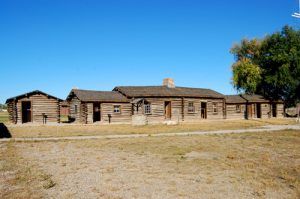
Today, all that's left of the site is a few remaining foundations, a few standing ruins, and a couple of buildings. The state historic site is located 7 miles east of Sinclair, Wyoming just about one mile north of I-80.


Fort Fred Steele

c/o Seminoe State Park
Box 30, HCR 67
Sinclair, Wyoming 82334-9801
307-320-3013


Fort Fred Steele

Fort Fred Steele today, photo by Anneli, Picassa Web Albums


Fort Washakie Indians.

Fort Washakie Indians.


Fort Washakie (1869-1909) - First known as Camp Brown, the fort was built in 1869 as a sub post to Fort Bridger on the newly created Shoshone Indian Reservation. In 1878, it was renamed to Fort Washakie in honor of the last chief of the Eastern Shoshone tribe, Chief Washakie. It served as a military post from 1869 to 1909. In 1913, it was transferred to the Shoshone Indian Agency.


Listed on the National Register of Historic Places, the Eastern Shoshone Indians still utilize some of the buildings located on the Wind River Indian Reservation in the foothills of the majestic Wind River Mountain Range.


Fort Washakie is also known as the final resting place for Chief Washakie and Sacajawea, the Shoshone woman who guided the Lewis & Clark Expedition.


The Wind River Indian Reservation is shared by about 3,500 members of the Eastern Shoshone Tribe and 7,000 members of the Northern Arapaho Tribe. The reservation is located about 17 miles northwest of Lander, Wyoming on US Highway 287.


More Information:

Shoshone Tribal Cultural Center

P.O. Box 1008

Fort Washakie, Wyoming 82514

307-332-9106


fort YellowstoneFort Yellowstone (1886-1918) - When Yellowstone National Park, the world's first national park, was established on March 1, 1872, a civilian staff with limited financial resources was in charge of running and protecting the park. Under the management of several superintendents, without adequate help, Yellowstone's natural resources were being destroyed as poachers killed animals, souvenir hunters broke off pieces of geological formations, and developers established numerous tourist camps.


As a result, the park turned to the U.S. Army for help. In August, 1886, the army arrived to begin what would be more than 30 years of military presence at Yellowstone. After living in temporary frame buildings at Camp Sheridan and enduring five cold winters, the Army realized there was no end in sight for the assignment and asked Congress for funds to establish a permanent post.


Fort Yellowstone was completed by late 1891 and as more troops were needed, additional buildings were constructed including officers' quarters, a guard house, headquarters, stables and barracks for the enlisted men. At the height of the Army's presence in Yellowstone in 1910, there were 324 soldiers stationed at Fort Yellowstone. The Army continued to manage the park until 1918, when the newly established National Park Service assumed the management. The National Park Service used Fort Yellowstone as Yellowstone National Park's headquarters, which has continued to this day.


During its thirty-two years at Yellowstone, the army developed regulations that put heavy emphasis on conservation and under their watchful eyes the features and wildlife of Yellowstone National Park were protected from vandalism and extinction. Many of the policies initiated by the army at Fort Yellowstone were later adopted by the National Park Service.


© Kathy Weiser/Legends of America, April, 2008.


<< Previous 1 2 3 Next >> 

From the Rocky Mountain General Store


Native American PostcardsNative American Postcards - Legends of America and the Rocky Mountain General Store has collected numerous Native American postcards - both new and vintage. For many of these, we have only one available. To see this varied collection, click HERE!


     Ranchos de Taos PostcardOklahoma Indians Postcard


                                                              Copyright © 2003-2008, www.Legends of America.com