

Fort Supply, Wyoming, by Merritt D. Houghton.
Fort Supply was a Mormon pioneer-era fort in Uinta County, Wyoming, once part of Utah Territory. Located approximately 12 miles Southwest of Fort Bridger, it was established in November 1853 under the direction of Mormon Apostle Orson Hyde.
The Bridger Valley (also called the Green River Valley) was a popular gathering place for Native Americans and mountain men in the first half of the 19th Century. Two mountain men, Jim Bridger and his business partner Louis Vasquez, established Fort Bridger as a trading post in the early 1840s. Several years later, Mormon pioneers established Salt Lake City, approximately 120 miles Southwest of Fort Bridger. Following the territory’s establishment by the U.S. Congress in 1850, Salt Lake City became the principal settlement in the Utah Territory.

Bridger Valley, Wyoming.
An act passed by the Utah Territorial Legislature gave the Mormons the right to control the operation of ferries on the Green River near the Bridger Valley. These ferries had been operated by mountain men, who opposed giving up control to the Mormons authorized by the Legislature to run them. Fort Bridger also saw its trading business decline as Salt Lake City grew. Both of these things led to contention between the groups, with Mormons claiming that the mountain men were trying to incite the local natives against them.
Relations with the natives deteriorated elsewhere in the Utah Territory. By the summer of 1853, tensions between the Mormon settlers and the Ute Indians had increased, and the Walker War had begun. The Utah Territory outlawed trade with all natives, including in the Bridger Valley.
However, illegal trade continued at Fort Bridger, and in August 1853, Sheriff James Ferguson sent 150 men to stop it. James Bridger had fled when they arrived at the fort, but when they discovered his whiskey and rum, they destroyed them. Afterward, they continued to the Green River, where they engaged the mountain men who had been unlawfully running ferries, killing some and seizing their livestock.
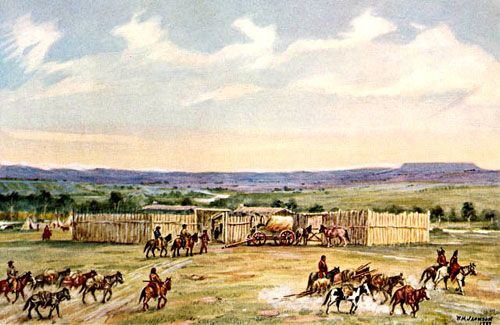
Fort Bridger, Wyoming.
Church leader Brigham Young hoped that building a fort in the area would solidify Mormon influence and control, and that the settlement would provide crops and supplies for Mormons traveling west and defray the costs of sending supplies overland from Salt Lake City to Fort Bridger, about 120 miles away.
Mormon Apostle Orson Hyde organized the effort to establish the “Green River Mission” and build a fort in the Bridger Valley. In October 1853, the church called 39 young men to the mission during its general conference. The first company of men, led by John Nebeker, left Salt Lake City for the Bridger Valley on November 2, 1853.
The remaining men left Salt Lake City on November 25 in a second company led by Isaac Bullock. By the time the second company arrived in the valley, the first company had already chosen a site for the fort, and construction had begun on a blockhouse with four log wings. This created a two-story center room so a guard could be placed on the second level. After about two weeks, the blockhouse was finished, but little else could be done until the following spring, as Winter had already set in.
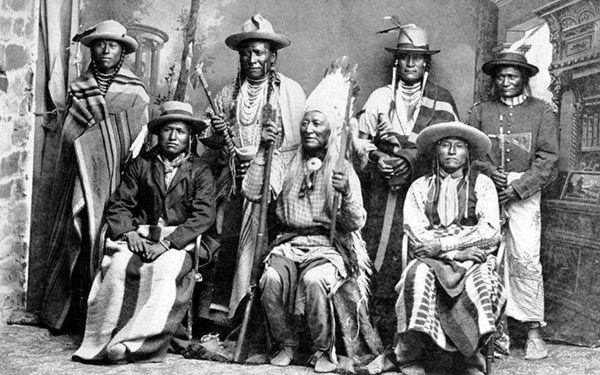
Shoshone Indians.
Many missionaries spent that first winter surviving on supplies from Salt Lake City and learning the Shoshone language from Elijah B. Ward, a mountain man who had recently converted to Mormonism, and his native wife, Sally. However, they accomplished little, and no Shoshone were baptized into the church.
Missionaries also planted crops in the spring and continued work on the fort. Irrigation was first introduced to the area at Fort Supply, and it was also the first Anglo-Saxon settlement in what would become Wyoming.
From the beginning, the fort struggled. As the year progressed, some missionaries grew discontented and left for Salt Lake City without permission. By July 1854, the fort and mission had largely been abandoned, except for a small group who stayed behind to harvest the crops.
An early September frost destroyed at least half of the second-year wheat crop. Native Americans also often petitioned the settlers for food and supplies. True to Brigham Young’s admonition that it was cheaper to feed them than to fight them, the Saints were often obliged to share their scant supplies.
During the church’s general conference in April 1855, the church called new missionaries to reoccupy Fort Supply and continue the mission. This group, led by James S. Brown, arrived at the fort in May 1855 and began repairing the fort and planting crops. They also restarted the mission to the Shoshone and had some success converting natives. The 1855 crop did well until an early frost in September destroyed most of what had not yet been harvested, and food had to be carefully budgeted that Winter. That year, the church purchased Fort Bridger, and Lewis Robinson was given charge over it.
In 1856, church leadership called 43 families from other settlements in the territory to join with the missionaries at Fort Supply and strengthen the community. By April 1856, the fort included a high stockade that enclosed ten acres, 25 homes, and a two-story building used as a courthouse and for other public functions. They also established numerous corrals, stockyards, and fenced fields. Later that year, supplies were also sent from Fort Supply to assist the Martin and Willie handcart companies, which suffered while crossing the plains.
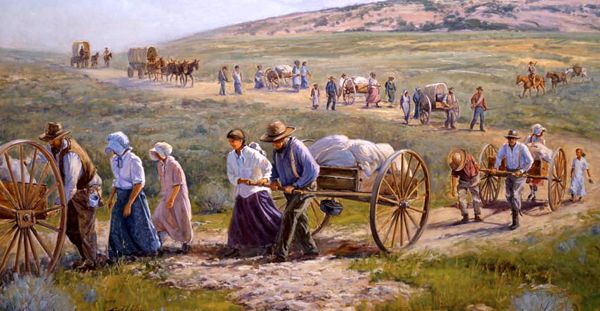
Mormon Handcart Pioneers.
Around this time, leaders at Fort Supply had received permission to establish a city. They chose a site for what would become “Supply City” about three miles north of the fort, and surveyed it in June 1857. By the end of the summer, they had built about 15 homes.

Colonel Albert Sidney Johnston.
U.S. General Albert Sidney Johnston led a punitive expedition against the Mormons in the Utah Territory during the Utah War in 1857. President James Buchanan had replaced Brigham Young as governor of the territory and ordered 2,500 troops to accompany Alfred Cumming, the new governor, to Utah.
As this federal force approached the territory, Young declared martial law and instructed that no federal troops would pass any closer than Fort Bridger and Fort Supply. By the fall of 1857, the families and most missionaries at Fort Supply and Supply City were recalled. However, the Utah militia headed in the opposite direction toward the Bridger Valley. The militia and a few remaining men from the settlements were instructed to implement a scorched-earth policy and burn anything the approaching army could use.
As U.S. forces approached Fort Bridger and Fort Supply, the Mormons burned both posts to the ground to prevent their use by U.S. troops. Mormon convert Jesse W. Crosby, who was at the burning, said the settlements had 100 or more log houses, a sawmill, a gristmill, and a threshing machine.
When the Utah War ended, some settlers desired to return to the sites of Fort Supply and Supply City, but the land had been made part of the military reserve when Fort Bridger became an official U.S. military post. They asked Governor Cumming for help, who was sympathetic, but John B. Floyd, the U.S. Secretary of War, would not allow it. Mormons did not return to the valley until the 1890s, when the military reserve was dissolved and the land opened for homesteading. This new group of Mormons primarily settled in present-day Lyman, Wyoming.
As part of Wyoming’s golden anniversary of statehood in 1937, a monument was erected near the original location of Fort Supply to honor the early pioneers who settled in the area. The monument, maintained as a satellite site of the Fort Bridger State Historic Site, is located near the modern-day community of Robertson, Wyoming. Visitors can visit the monument during summer when roads are passable on County Road 274.

Site of Fort Supply, Wyoming.
©Kathy Alexander/Legends of America, updated September 2026.
Also See:
Brigham Young – Leading the Mormons
Sources:
Ensign Peak Foundation
Fort Wiki
Historic Marker Database
Wikipedia
Wyoming State Parks