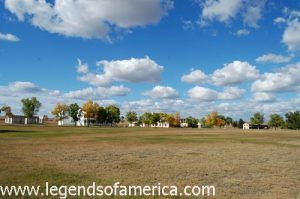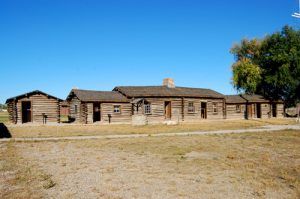
Camp Augur/Camp Brown (1869-1871) - A sub-post of Fort Bridger,
Camp Augur was established Lieutenant Patrick Henry Breslin and troops
from the 4th U.S. Infantry on June 28, 1869 where Lander now
sits. It was named after Brigadier General Christopher C. Augur,
commander
of the Army's Department of the Platte.
Less than a year later, it was reorganized on March
28, 1870 and renamed Camp Brown after Captain Frederick H. Brown, who
was killed in the Fetterman Massacre on December 21, 1866. The
site was abandoned 1871 and moved fifteen miles northwest of Lander
onto the Wind River Indian Reservation. It was later renamed
Fort Washakie in December, 1878, after Chief Washakie.
Fort
Bonneville (1832-1839)
- Never an official U.S. Military outpost, rather, Fort
Bonneville was a fur trading post built by
Captain E.L. Bonneville in 1832. In 1835, it was the site of a rendezvous, known as
"The Green River Rendezvous.”
The Fort was mocked and nick-named by other U.S. Forts as Fort Nonsense.
Early snow falls made the fort unusable in the winter and by 1839 it was
abandoned. Though all signs of the original fort have long since disappeared back into the
landscape, a historic marker is posted at the site, approximately three
miles northwest of Daniel,
Wyoming.
Fort Clay
(1855-1856) - Also known as Camp Davis, the fort was
established in 1855 to protect the Reshaw Bridge traffic in
what is present-day Evansville,
Wyoming (a suburb of Casper.)
Lieutenant Deschler and members of the 6th
Infantry, 10th Infantry, and 4th Artillery staffed Fort
Clay in November 1855. It was re-named Camp
Davis in March of 1856, but by
November, the outpost of Fort
Laramiewas abandoned. The site is located in
Evansville Town Park.
Fort H. W.
Halleck (1862-1866) - Established 1862 to protect the Overland Trail from Indian attacks, the
fort was named in honor of General H.W. Halleck, commander of the Division of
the Pacific. The site, on the north side of Elk Mountain at an elevation of about 7300
feet, was near a spring, had plenty of wood, and the area was filled
with ample game. The fort complex consisted of stables large enough to hold 200 horses, storehouses, two
sets of company quarters, officers' quarters, a store, bake house, a jail
and a hospital.
Though it was considered
one of the most dangerous sections of the trail and
the troops were kept busy defending the area, it was also a busy location.
In 1864, over 4200 wagons carrying 17,584 emigrants passed the fort,
bringing over 50,000 animals. Busy or no, after just four short years, the
fort was abandoned in 1866. By the following year, one traveler described it as "the most dreary place on the entire route."
Today, only one
building remains that may be the old blacksmith shop. The site is located
on a private ranch southwest of Elk Mountain in Carbon County. A stone marker indicates the
site of the Fort Halleck cemetery.
Fort
Laramie (1849-1890) - This site fir served as a fur trading
post in 1834. Later it was purchased by the government and became a
military post in 1849 along the
Oregon Trail. See Full Article
HERE.
Continued Next Page
|
|