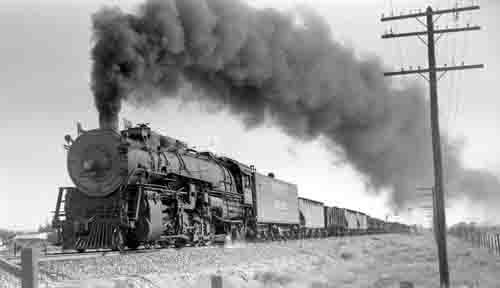
Union Pacific Train, late 1800s.
Sam Bass and his gang robbed the train in Big Springs, Nebraska, on September 18, 1877, in what became the single largest heist in the Union Pacific Railroad’s history.
In 1877, Big Springs, Nebraska, was not a town – just a railroad station and a few area settlers. However, the location had long been known as a spring used by Indian tribes. Later, the spring would furnish water for travelers along the Oregon and California Trails.
The site where the town of Big Springs was established in 1883 was first called “Lone Tree.” Here, amid the barren prairie, stood a single large cottonwood tree, believed to have been about 100 years old at the time, that served as a beacon to emigrants, overland stagecoaches, and the Pony Express.
In 1867, the Union Pacific Railroad barreled through the area and established a water station utilizing the nearby spring for its steam-powered locomotives. The railroad named the stop “Big Springs,” from which the town would later take its name.
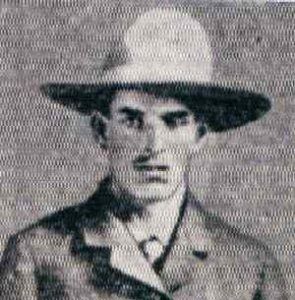
Sam Bass.
Years later, in the summer of 1876, Texas cowboys Sam Bass and Joel Collins would make their way to the area, driving a herd of cattle to the northern markets. However, after they sold the cattle for about $8,000, rather than returning to Texas and handing the profits to the ranchers who had hired them, they used the money to take up gold prospecting in the Black Hills of South Dakota. With no luck and no money left, they turned to outlawry.
Along with several other desperados, including Jack Davis, Tom Nixon, Bill Heffridge, and Jim Berry, the pair began to rob stagecoaches. They held up seven stages over the next several months and became known as the “Black Hills Bandits.” Four of these robberies were directed at the same stage line – the Deadwood Stage. On the fifth attempt on March 25, 1877, the outlaws killed the stage driver, Johnny Slaughter. At the sound of the shot, the horses bolted toward Deadwood, some two miles away. Folklore has it that the runaway stage was stopped by none other than Calamity Jane as it entered Deadwood.
The gang soon decided that their profits from stagecoach robberies were too low and turned their attention to the more lucrative business of robbing trains. After making their way to the isolated station at Big Springs, Nebraska, they carried out their first train robbery on September 18, 1877. Capturing the station master, John Barnhart, and destroying the telegraph, they forced him to signal the eastbound express train to stop.
At 10:48 p.m., the six bandits boarded the train. They found only $450 in the mail car safe, then went to rob the larger safe, but it had a time lock that prevented it from opening until the train reached its destination. Though they brutally beat the express messenger to get him to open it, he was unable to. However, the outlaws continued searching the train car and found wooden boxes containing $60,000 in freshly minted $20 gold pieces. Why they weren’t in the safe is unknown. The bandits then began to rob the train passengers systematically. In the end, they escaped with the $60,000 in freshly minted gold coins, $450.00 from the mail car safe, and about $1,300.00 and four gold watches from the passengers.
Splitting the money up six ways beneath the lone tree of Big Springs, the outlaws split up into pairs, each heading in a different direction.

Big Springs, Nebraska train.
Sam Bass and Jack Davis, posing as farmers, rode South in a one-horse buggy with their share of the haul stowed under the seat. After making it back to Texas, Sam Bass claimed his newfound wealth came from a strike in the Black Hills. He would soon start another gang, robbing trains in Texas before being killed the following year. On July 21, 1878 — his 27th birthday– he would die from gunshot wounds received in an ambush by Texas Rangers at Round Rock, Texas.
Meanwhile, Jack Davis, who had tried to persuade him to escape with him to South America, was never seen again.
A week after the robbery, Joel Collins and Bill Heffridge were killed by a sheriff’s posse near Buffalo Station (now Gove), Kansas, and some $20,000 was recovered. Jim Berry was captured and wounded in Mexico, Missouri, and died two days later. Tom Nixon disappeared carrying, according to Berry, $10,000, and was never seen again. It has long been thought that he went to Canada.

Big Springs in 1886.
The robbery is the single largest heist in the Union Pacific Railroad’s history. Today, the site is designated with a historical marker. Big Springs, located 10 miles East of the Nebraska-Colorado border, sits near the junction of I-76 and I-80.
Was there another bandit involved? Author and former North Dakota State Trooper Jim Benjaminson wrote about a shootout at the Pembina Post Office involving William Collins, Joel’s brother, who he says participated in the Big Springs robbery.
©Kathy Alexander/Legends of America, updated October 2026.
Also See:
Highwaymen of the Railroad, by William A. Pinkerton, 1893
Shootout At the Pembina, North Dakota Post Office
See Sources.