
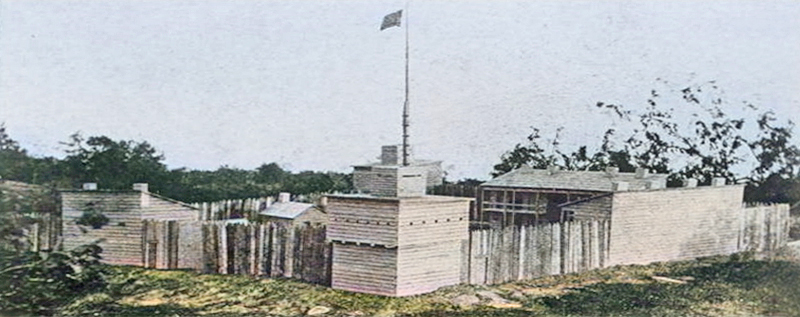
Fort Wayne, Indiana, 1795.
Old Fort Wayne in northeastern Indiana was established in 1794 in what is now the city of Fort Wayne, just after the decisive Battle of Fallen Timbers, Ohio, during the Northwest Territory Indian War. It was established by General “Mad” Anthony Wayne and named after him.
Located at a strategic junction where the St. Marys and St. Joseph Rivers join to form the Maumee River, the original four-gun bastioned earthwork was built by Captain Jean François Hamtramck under General Anthony Wayne’s orders to secure the territory gained in the Battle of Fallen Timbers, in which Wayne had recently been victorious. Built as part of the campaign against the Miami tribe, it had barracks with a separate blockhouse by the riverbank. This point was important because it could control water access to a large area of the Midwest. It was located at the present-day intersection of Clay and Berry Streets.
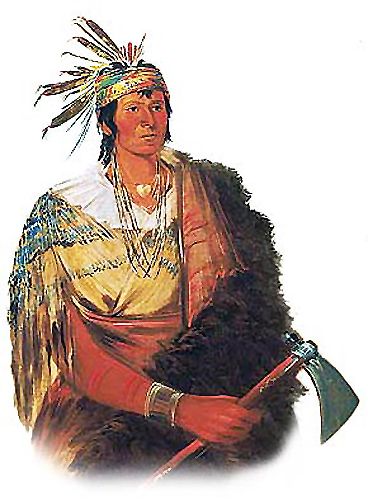
Miami Indian.
The French were the first Europeans to settle in the Great Lakes region, arriving in present-day northeast Indiana in the late 1600s. There, they found the Iroquois people, who, with support from the British and Dutch, had driven out most of the area’s original woodland tribes. A 1701 treaty established peaceful relations among the Iroquois, the British, the French, and the original tribes, who were allowed to return to the area. One of those tribes was the Miami, who formed a village at the confluence of the three rivers, called Kekionga.
To facilitate the lucrative fur trade with Native American tribes, the French built a trading post called Fort Miami near Kekionga around 1706. Here, about 80,000 to 100,000 beaver pelts were harvested each year and shipped back to Europe, via Detroit, Michigan, to Montreal, Canada.
Fort Wayne succeeded the original Fort Miami near Kekionga, Ohio, the principal village of the Miami tribe, whose origins date back to the early 1700s.
General Anthony Wayne’s Legion arrived at Kekionga on September 17, 1794, where General Wayne personally selected the site for a new US fort. Aiming for a strong and defensible structure, Wayne designed a fort that could withstand not only potential Native American uprisings but also possible attacks from the British at Fort Detroit. The construction of the fort was completed by October 17, and it was capable of enduring cannon fire from 24-pound cannons. It was named Fort Wayne and placed under the command of Major Jean François Hamtramck, who had previously served as the commandant of Fort Knox in Vincennes. The fort was officially dedicated on October 22, marking the fourth anniversary of Harmar’s Defeat, which is considered the founding date of the modern city of Fort Wayne.
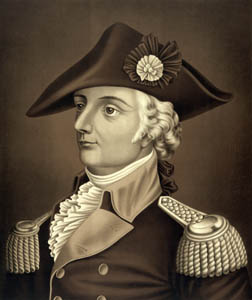
General Anthony Wayne.
The garrison at Fort Wayne typically consisted of about 100 soldiers and their families. In 1796, the garrison was ordered to march down the Maumee River to counter a British demonstration. During this time, they took control of Fort Miami, Ohio, from the British before Colonel Hamtramck was transferred to Fort Detroit, which would later be the site of another Fort Wayne and near the future town of Hamtramck, Michigan.
Colonel David Strong, a veteran of the American Revolution and Wayne’s Legion, succeeded Hamtramck as the commandant of Fort Wayne and served for two years before swapping commands with Colonel Hamtramck in 1798.
On May 16, 1798, Colonel Thomas Hunt, who had fought in the Battles of Lexington and Concord, Bunker Hill, and served in Wayne’s Legion, took command of the fort. He constructed a substantial new fort several hundred yards North of the original site, located near what is now Old Fort Park in Fort Wayne. This new fort included several guardhouses and Indian trading posts. The first fort was demolished around 1800.
During the War of 1812, Fort Dearborn, in present-day Chicago, Illinois, was evacuated, and its residents tried to reach Fort Wayne under the direction of William Wells. However, on August 15, 1812. Potawatomi warriors ambushed US soldiers and settlers evacuating the frontier outpost near present-day Chicago. The 15-minute battle resulted in about 55 to 70 American deaths, and the destruction of the fort.
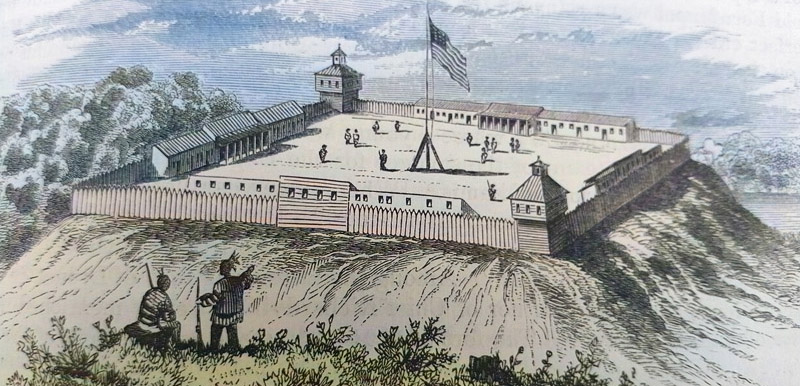
Fort Wayne, Indiana, 1812.
Fort Wayne was besieged next by the Indian forces of Tecumseh during the Siege of Fort Wayne on September 5–12, 1812. The stand-off occurred between the US military garrison at Fort Wayne and a combined Potawatomi and Miami forces.
Captain James Rhea, who had retreated to his quarters due to illness, was in charge of the fort and considered surrendering, but his two lieutenants relieved him of duty. General William Henry Harrison arrived on September 12, 1812, and broke the siege. Captain Rhea was formally relieved of duty, and one of the lieutenants, named Ostrander, was given official command of the fort.
After the war, settlements began to grow up around the fort.
Fort Wayne was later rebuilt as a bigger fort under the command of Major John Whistler in the Winter of 1815-1816. This new fort was sophisticated for the time, with two-story log chinked buildings forming the walls on all four sides. Two two-story blockhouses were placed at opposite ends.
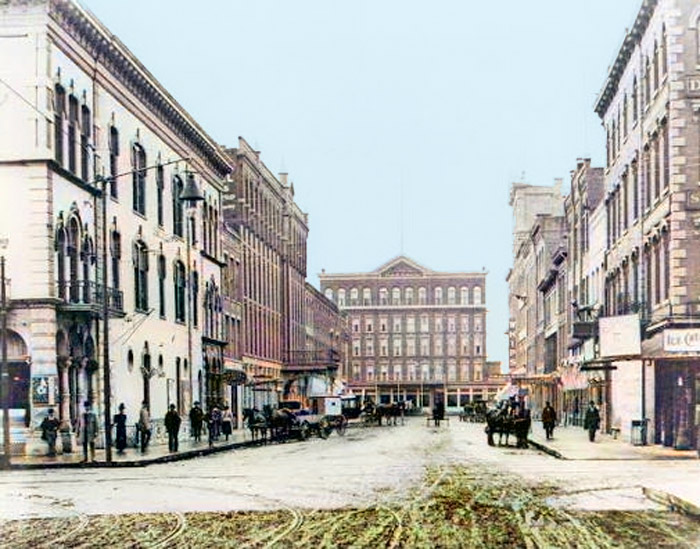
The city of Fort Wayne, Indiana.
On April 19, 1819, after Native hostilities ceased, the fort was decommissioned, its contents shipped to Fort Detroit, and the last soldiers departed. It found new use as a church and school for the Miami, and functioned as a social gathering place for city dwellers. Later, fort timbers were repurposed as beams and foundations for constructing homes. The Officer’s Quarters was the final building still standing. It was finally torn down in 1852.
The modern city of Fort Wayne was platted in 1823.
In 1964, Historic Fort Wayne, Inc. was established and started planning a reconstruction of the Old Fort, using Major Whistler’s 1814 drawings. After much fundraising, they purchased property in the late 1960s and sought a fort builder. It was constructed by Lok-N-Logs Inc., a log home company in Sherburne, New York, and then transported to Indiana, where it was reassembled. It officially opened shortly before July 4, 1976, to celebrate the nation’s Bicentennial, and remained open daily until the early 1990s. Historic Fort Wayne, Inc. disbanded in 1989, and the current Historic Fort Wayne, Inc. was formed in 2004 as a volunteer effort to preserve the Fort. Though they share a name, the two groups are not connected.
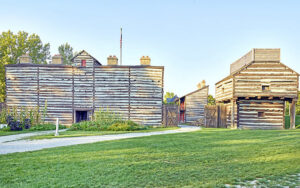
Historic Fort Wayne, Indiana. Photo by Carol Highsmith, 2016.
The present-day reconstructed fort is located on Spy Run Avenue and has been restored to the 1816 period. It is owned and operated by the city. Parking and access are through Headwaters Park at 333 South Clinton Street.
Today, a reproduction of the second fort originally built by Major John Whistler in 1815-16 stands in Historic Old Fort Park on Spy Run Avenue in Fort Wayne, Indiana. The original fort marker location is at the intersection of Clay Street and Berry Street. The second location is at the intersection of Main Street and Clay Street.
More information: Visit Fort Wayne.
©Kathy Alexander/Legends of America, updated August 2026.
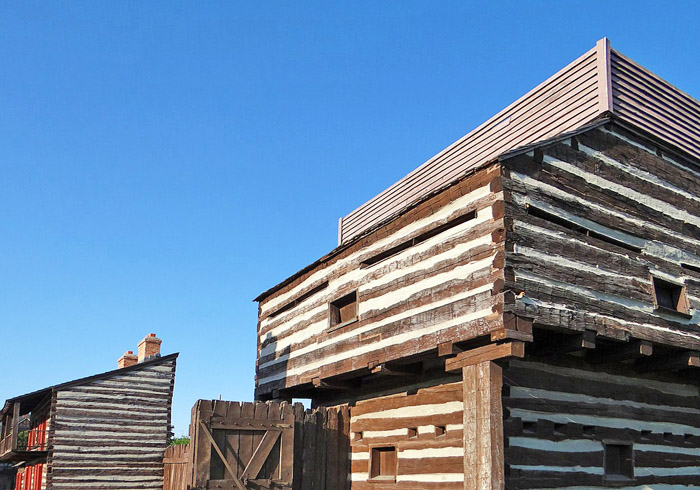
Buildings at Historic Old Fort in Fort Wayne, Indiana . Photo by Carol Highsmith.
Also See:
Forts & Presidios Photo Gallery
Soldiers & Officers in American History
Trading Posts of the Fur Trade
Sources:
American History Central
Fort Wiki
Old Fort Wayne
Wikipedia
Wikipedia – 2