
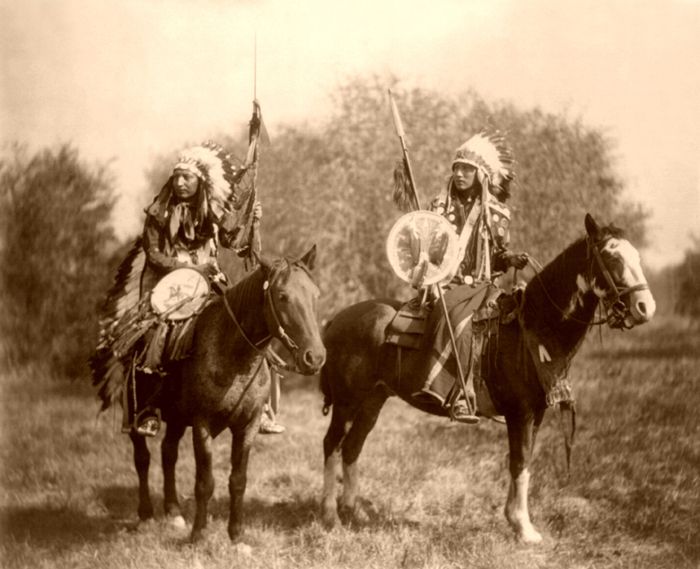
Sioux Indians on Horseback, by Heyn, 1899.
There was a time when the land was sacred, and the ancient ones were as one with it. A time when only the children of the Great Spirit were here to light their fires in these places with no boundaries…
In that time, when there were only simple ways, I saw with my heart the conflicts to come, and whether it was to be for good or bad, what was certain was that there would be change.
— The Great Spirit
The Sioux are a confederacy of several tribes that speak three different dialects: the Lakota, Dakota, and Nakota. The Lakota, also called the Teton Sioux, comprise seven tribal bands and are the largest and most western of the three groups, occupying lands in both North and South Dakota. The Dakota, or Santee Sioux, live primarily in Minnesota and Nebraska, while the smallest of the three, the Nakota, primarily reside in South Dakota, North Dakota, and Montana.
The name Sioux derives from the Chippewa word “Nadowessioux,” which means “Snake” or “Enemy.” Other definitions trace it to early Ottawa (Algonquian) singular /na:towe:ssi/ (plural /na:towe:ssiwak/) “Sioux,” apparently from a verb meaning “to speak a foreign language.” However, the Sioux generally call themselves Lakota or Dakota, meaning “friends, allies, or to be friendly.”
The Sioux are a proud people with a rich heritage. They were the masters of the North American plains and prairies, feared by other tribes from the Great Lakes to the Rocky Mountains.
Migrating west from Minnesota, the Sioux became nomads of the plains, taking advantage of horses initially brought to the Americas by the Spanish in the 1500s. Following the buffalo, they lived in teepees to allow them to move quickly.
Though the Sioux were known as great warriors, the family was considered the center of Sioux life. Children were called “Wakanisha,” meaning “sacred,” and were the center of attention. While monogamy was most often practiced, Indian men were allowed to take on more than one wife. However, infidelity was punished by disfigurement.
The roles of men and women were clearly defined, with the men expected to provide for and defend the family. Hunting was taken very seriously, and an infraction of the hunting rules could lead to the destruction of a man’s teepee or other property. Women were the matriarchs, ruling the family and domestic lives of the band.
The Sioux were deeply spiritual, believing in one all-pervasive god, Wakan Tanka, or the Great Mystery. Religious visions were cultivated, and the people communed with the spirit world through music and dance. By inflicting slashes upon themselves or other self-inflicted wounds, rituals of self-sacrifice asserted their identity as Indian warriors. Mourners also practiced this during burial ceremonies.
War and battles were another underlying principle of the Sioux people because, through it, men gained prestige, reflected in family honor.
The Lakota
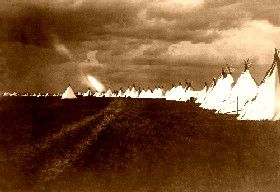
Sioux Tipis.
Sometimes also spelled “Lakhota,” this group consisted of seven tribes known for their warrior and buffalo-hunting traditions. Sometimes called the Tetons (referring to their dialect and location west of the Dakota on the plains), the seven tribes include:
- Ogalala (“they scatter their own,” or “dust scatterers”)
- Sicangu or Brule (“Burnt Thighs”)
- Hunkpapa (“end of the circle”),
- Miniconjou (“planters beside the stream”),
- Sihasapa or Blackfeet (Ntote confused with the separate Blackfeet tribe)
- Itazipacola (or Sans Arcs: “without bows”)
- Oohenupa (“Two Boilings” or “Two Kettle”)
This band was found in the upper Mississippi Region in the late 16th and early 17th centuries. There were about 20,000 Lakota in the mid-18th century, which has increased to about 70,000 today, of which approximately 1/3 still speak their ancestral language.
The Lakota were located in and around present-day Minnesota when Europeans began exploring and settling the land in the 1600s. Living on small game, deer, and wild rice, they were surrounded by large rival tribes. Conflict with their enemy, the Ojibwa, eventually forced the Lakota to move west. By the 1700s, the Lakota had acquired horses and flourished hunting buffalo on the high plains of Wisconsin, Iowa, the Dakotas, and as far north as Canada. The Tetons, the largest of the Lakota tribes, dominated the region.
As white settlers continued to push west onto Sioux lands and multiple treaties were made and broken, the Sioux retaliated, resulting in three major wars and numerous other battles and skirmishes.
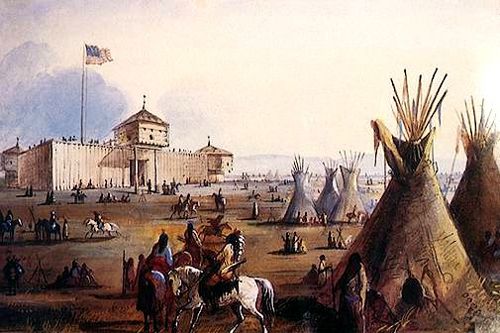
Fort Laramie, Wyoming, painting by Alfred Jacob Miller.
The first significant clash occurred in 1854 near Fort Laramie, Wyoming, when 19 U.S. soldiers were killed. In retaliation, in 1855, U.S. troops killed about 100 Sioux at their encampment in Nebraska and imprisoned their chief. In 1866-1867, Red Cloud’s War was fought, and it ended with a treaty granting the Black Hills to the Sioux in perpetuity. The treaty, however, was not honored by the United States; gold prospectors and miners flooded the region in the 1870s. In the ensuing conflict, General George Armstrong Custer and 300 troops were killed at the Battle of the Little Bighorn on June 25, 1876, by the Sioux Chief Sitting Bull and his warriors.
After that battle, the Sioux separated into various groups. The massacre by U.S. troops of about 150 to 370 Sioux men, women, and children at Wounded Knee in December 1890 marked the end of Sioux resistance until modern times.
Today, most of the Lakota live on the 2,782-square-mile Pine Ridge Reservation in southwestern South Dakota.
The Dakota
The Dakota Sioux, also called the Santee Sioux, originally migrated northeast into Ohio and Minnesota. The name “Santee” comes from long-term camping, during which they collected stones to make knives. The Woodland people thrived on hunting, fishing, and some farming. It was from the Dakota that the Lakota stemmed, moving further west into the Great Plains.
There are four bands in the Dakota tribe, who primarily live in South Dakota, Minnesota, Nebraska, and North Dakota, including:
- Mdewakantonwon
- Wahpeton
- Wahpekute
- Sisseton
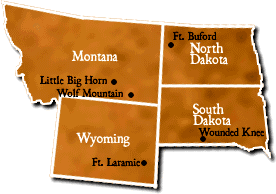
Major Sioux Battles, map courtesy of the History Channel
Fort Buford, North Dakota: site of Sitting Bull’s surrender in 1881.
Fort Laramie, Wyoming: Site of Treaty of 1868.
Battle of the Little Bighorn, Montana, 1876.
Wounded Knee, South Dakota, 1890
Battle of Wolf Mountain, Montana: Site of Crazy Horse’s surrender in 1877.
In the 19th century, the railroads hired hunters to exterminate the buffalo herds to force the tribes onto reservations. As the buffalo quickly became almost extinct, the Dakota and Lakota were forced to accept white-defined reservations in exchange for the rest of their lands. Domestic cattle and corn were given to the Sioux in exchange for buffalo, making the Sioux dependent upon the government for food and payments guaranteed by the treaty.
In 1862, the federal payment arrived late after a failed crop the year before and winter starvation. The local traders would not issue more credit to the Dakota, and the local federal agent told them they were free to eat grass. As a result, on August 17, 1862, the Sioux Uprising began when a few Dakota men attacked a white farmer, igniting further attacks on white settlements along the Minnesota River. The U.S. Army put the revolt down and later tried and condemned 303 Dakota for war crimes. President Abraham Lincoln remanded the death sentence of 285 warriors, signing off on the execution of 38 Dakota men by hanging on December 29, 1862, in Mankato, Minnesota, the largest mass execution in U.S. history.
The Nakota
The Nakota, also known as the Yanktonai or Yankton Sioux, split from the Dakota and moved to the prairies in the southeastern part of South Dakota. They were divided into three bands: Yankton, who are now on the Yankton Reservation in South Dakota; the Upper Yanktonai, who are split between the Standing Rock Reservation in South Dakota and the Devil’s Lake Reservation in North Dakota; and the Lower Yanktonai, who are split between the Crow Creek Reservation in South Dakota and the Fort Peck Reservation in Montana.
Modern Sioux
In 1980, the U.S. Supreme Court ruled that the Sioux Indians were entitled to an award of $17.5 million, plus 5% interest per year since 1877, totaling about $106 million in compensation for the unjust taking of the Black Hills and in direct contravention of the Treaty of Fort Laramie. The Sioux have refused to take the money, and it sits in a trust fund in Washington, D.C., collecting interest.
Today, there is division among the Sioux over whether to claim the money, thereby relinquishing their rights to the Black Hills forever, or to press for the return of the Black Hills.
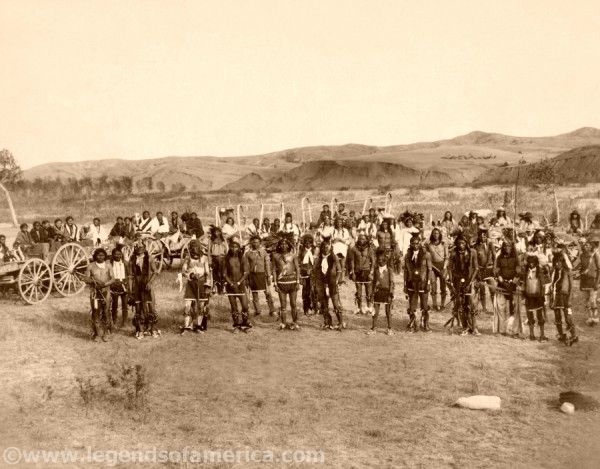
Sioux Dance, by John Graybill, 1890.
The Great Sioux Nation covers 2,782 square miles in South Dakota and neighboring states. The Sioux, one of the largest Native American groups, primarily live on reservations in Minnesota, Nebraska, North Dakota, South Dakota, and Montana. The Pine Ridge Indian Reservation in South Dakota is the second-largest in the United States. Many are engaged in farming and ranching, including bison raising. The Shakopee Mdewakanton Sioux have a large casino on their reservation in Minnesota. Still, the Oglala Sioux’s efforts to establish one at impoverished Pine Ridge have met with only partial success. Indian Country Today, a successful Native American newspaper, was founded at Pine Ridge in 1981 and is now based in Rapid City, South Dakota. In 1990, there were more than 100,000 Sioux in the United States and more than 10,000 in Canada.
Native American Symbols, Totems & Their Meanings – Digital Download.
There is violence, drunkenness, apathy, and despair on many reservations. School dropout rates range from 45 to 62%. Suicide among indigenous people is twice the U.S. national average, and unemployment is around 80%.
The Lakota have formed The Alliance of Tribal Tourism Advocates, whose goal is to enhance tourism development prospects through the nation’s organizations, beliefs, and priorities. In 1999, Shannon County, South Dakota, home of the Oglala Lakota on Pine Ridge Reservation, was identified as the poorest place in the country.
For more information and links to South Dakota tribal websites, see this valuable resource:
© Kathy Alexander/Legends of America, updated April 2024.November 2025.

Ogalala Sioux at an oasis in the Badlands, photo by Edward S. Curtis, 1905.