
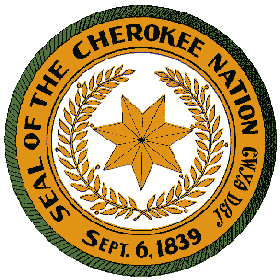
Cherokee Seal.
The Cherokee tribe was the first to inhabit what is now the eastern and southeastern United States, before most of them were forcefully moved to the Ozark Plateau. One of the tribes referred to by Native Americans as the Five Civilized Tribes, various Cherokee bands played an important role in colonial America and United States history.
The name Cherokee is an old pronunciation of Tsalagi, the name for the Cherokee in the Creek language. The name the Cherokee originally used for themselves is Aniyunwiya, meaning “principal people.” The Cherokee speak an Iroquoian language and had a system of writing their language, developed by Sequoyah.
Evidence indicates that the Cherokee migrated from present-day Texas or northern Mexico to the Great Lakes area in prehistoric times. However, wars with the Iroquois and Delaware tribes, who controlled those lands, pushed the Cherokee southeast to the mountains and valleys of the southern part of the Appalachian chain. They eventually settled in modern Virginia, West Virginia, North Carolina, Tennessee, Georgia, and Alabama.
The Cherokee economy, like that of other Southeast tribes, was based primarily on agriculture, growing corn, beans, squash, sunflowers, and tobacco. Deer, bear, and elk were hunted with bows and arrows. Smaller game, such as raccoons, rabbits, squirrels, and turkeys, were hunted with long cane-stem blowguns that propelled wood-and-feather darts. Hooks and lines, spears, and traps were used for fishing. Wild plant foods, including roots, greens, berries, and nuts, were also gathered for another source of nutrition.
The Cherokee women wore skirts woven from plants, while the men wore breechcloths or leggings. The men painted their skin and decorated it with tattoos, while the women sewn feathers into light capes made of netting.
The Cherokee were divided into seven matrilineal clans living in numerous permanent villages, typically along rivers and streams. Cherokee families typically had two dwellings: rectangular summer houses with cane and clay walls and bark or thatch roofs, and cone-shaped winter houses with pole frames and brushwork covered by mud or clay. The Cherokee crafted pottery and baskets.
The Spanish explorer Hernando de Soto first encountered them in the Appalachians in 1540. By 1715, smallpox had reduced the Cherokee population to about 11,000.
During the British and French struggle to control colonial North America, the Cherokee provided warriors to support the British but revolted against them in 1760 in the Cherokee War under Chief Oconostota. During the American Revolution, tribal members aided Great Britain with sporadic attacks on outlying settlements as the pioneers continually encroached upon Cherokee lands.
In 1785, several bands negotiated a peace treaty with the United States, but Cherokee resistance continued for a decade after that. In 1791, a new treaty reconfirmed the earlier one; part of Cherokee territory was ceded to the United States, and the permanent rights of the tribe to the remaining territory were established. Between 1790 and 1819, several thousand of the tribe began to leave their lands, becoming known as the Chickamauga. Led by Chief Dragging Canoe, the Chickamauga made alliances with the Shawnee and engaged in raids against colonial settlements, aided by the British.
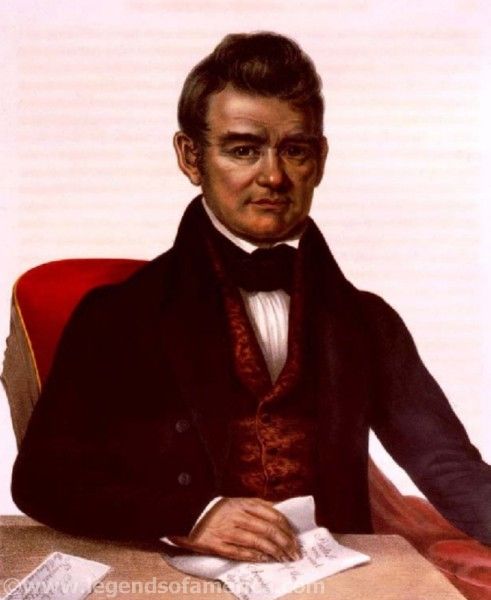
Cherokee Chief John Ross.
John Ross was an important figure in the history of the Cherokee tribe. Before the Revolutionary War, his father emigrated from Scotland, and his mother was a quarter-blood Cherokee woman. He began his public career in 1809. Still permitted under the Constitution, the “Cherokee Nation” was founded in 1820 with elected public officials. The Cherokee established a republican governmental system modeled on that of the United States, with an elected principal chief, namely John Ross, a senate, and a house of representatives. In 1827, they drafted a constitution and incorporated it as the Cherokee Nation. John Ross remained the chief until his death.
Meanwhile, valuable gold deposits were discovered on tribal lands in northwestern Georgia, eastern Tennessee, and southwestern North Carolina.
In 1819, Georgia appealed to the U.S. government to remove the Cherokee from Georgia lands. When the appeal failed, attempts were made to purchase the territory. In retaliation, the Cherokee Nation enacted a law forbidding any such sale, with the punishment of death.
Since Thomas Jefferson’s presidency, America has allowed Indians to remain east of the Mississippi River as long as they become assimilated or “civilized.” This means they were to settle in one place, farm the land, divide communal land into private property, and adopt democracy.
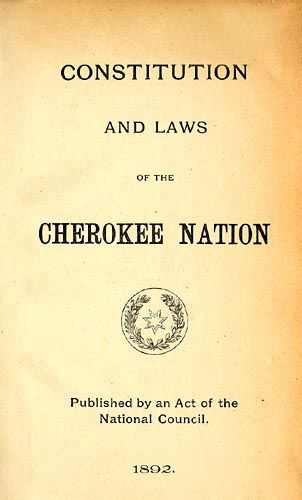
Cherokee Constitution.
In 1828, the Georgia legislature outlawed the Cherokee government and confiscated tribal lands. President Andrew Jackson rejected Cherokee appeals for federal protection.
In 1830, the “Five Civilized Tribes,” which included the Chickasaw, Choctaw, Creek, Seminole, and Cherokee, lived east of the Mississippi River. Despite the assimilation of the Cherokee, the position of the tribes was not secure. Some felt the presence of the tribes was a threat to peace and security since many Native Americans had fought against the United States in previous wars, often armed by foreign nations such as Great Britain and Spain. Other white settlers and land speculators desired the land that was occupied by the tribes.
Accordingly, the governments of the various U.S. states desired that all tribal lands within their boundaries be placed under state jurisdiction. When Georgia moved to enforce state laws on tribal lands, the Cherokee fought them in the U.S. Supreme Court, which ruled that while Indian tribes were not sovereign nations, state laws had no force on tribal lands.
However, President Andrew Jackson defied the court’s action when he enacted the Indian Removal Act in 1830. The Removal Act allowed the government to negotiate removal treaties with the various tribes. The Treaty of Dancing Rabbit Creek with the Choctaw was the first such removal treaty implemented; while around 7,000 Choctaw ultimately stayed in Mississippi, about 14,000 moved along the Red River.
In 1835 about 500 leading Cherokee agreed in the Treaty of New Echota to cede the tribal territory in exchange for $5,700,000 and land in the Indian Territory (now Oklahoma.) More than nine-tenths of the tribe repudiated their action, and several group members were later assassinated.
In 1838, federal troops began forcibly evicting the Cherokee. Approximately 1,000 Cherokee escaped to the North Carolina mountains, while those who lived on individually owned land (rather than tribal domains) were not subject to removal. Those who stayed behind eventually formed tribal groups based in North Carolina, including the Eastern Band of Cherokee.
Meanwhile, most of the tribe was driven west some 800 miles in a forced march known as the Trail of Tears. About 4,000 perished through hunger, disease, exposure, and attacks by bandits during the journey or in stockades awaiting removal. Others died after they arrived in the Indian Territory from disease or food shortages.
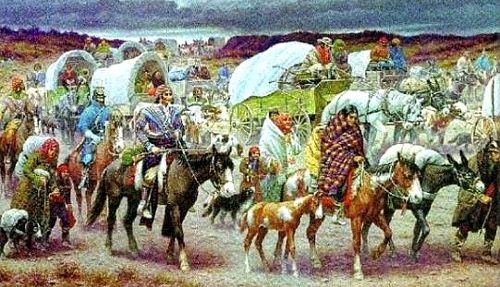
Cherokee Trail of Tears
Of this tragic event, Samuel Carter, author of Cherokee Sunset, wrote in 1976:
“Then… there came the reign of terror. From the jagged-walled stockades, the troops fanned out across the Nation, invading every hamlet, every cabin, rooting out the inhabitants at bayonet point. The Cherokee hardly had time to realize what was happening as they were prodded like so many sheep toward the concentration camps, threatened with knives and pistols, beaten with rifle butts if they resisted.”
The five tribes were resettled in the new Indian Territory in modern-day Oklahoma and parts of Kansas. The Cherokee reorganized their government under Chief John Ross and became known as the Western Band or the Cherokee Nation of Oklahoma.
Once the Cherokee reached Indian Territory, tensions ran high, and the suspension of the Cherokee Blood Law was ignored. On June 22, 1839, after the adjournment of a tribal meeting, some of the prominent signers of the Treaty of New Echota were assassinated, including the drafter of the Blood Law, Major Ridge, along with John Ridge and Elias Boudinot. This started 15 years of civil war among the Cherokee.
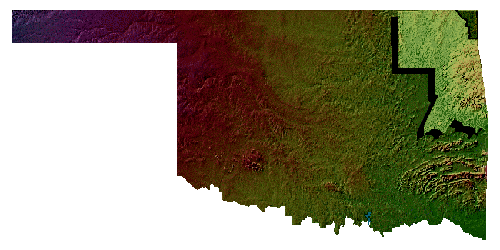
Cherokee Nation Map
During the American Civil War (1861-1865), after a great internal conflict, the tribe sided with the Confederacy, where Stand Watie became a Confederate general.
Other Cherokee in western North Carolina served as part of Thomas’ Legion, a unit of approximately 1,100 men of both Cherokee and white origin. They fought primarily in Virginia, where their battle record was outstanding. Thomas’ Legion was the last Confederate unit to surrender in North Carolina at Waynesville on May 9, 1865.
A postwar treaty with the United States freed the black slaves belonging to tribal members in Indian Territory. Under the General Allotment Act of 1887, uncompromisingly resisted by the Cherokee, plots of tribal land were forcibly allotted to individual members. The federal government parceled out surplus lands not assigned to Cherokee individuals, and in 1891, the tribe’s western land extension, the Cherokee Strip or Cherokee Outlet, was sold to the United States; in 1893, it was opened, primarily to non-Indian settlers, in a famous land run.
The Cherokee government was dissolved, and its people became U.S. citizens when Oklahoma achieved statehood in 1907. In this action, the Oklahoma Cherokee lost their right to elect their chiefs from there and were appointed by the President until 1970, when the Cherokee regained their right to elect their own government via a Congressional Act signed by President Nixon. W. W. Keeler was the first elected chief of the Oklahoma Cherokee. Keeler, also the President of Phillips Petroleum, was succeeded by Ross Swimmer, Wilma Mankiller, Joe Byrd, Chad Smith, and Bill John Baker.
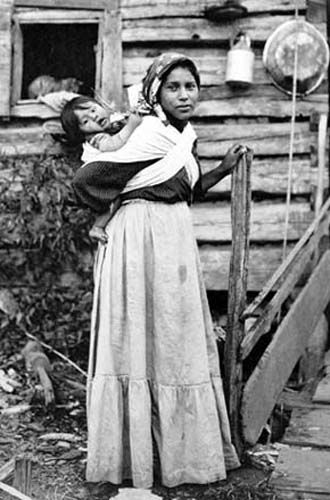
Cherokee woman and child.
The federally recognized tribal headquarters of the Keetowah Band of Cherokee is in Tahlequah, Oklahoma, while the Eastern Band of Cherokee is headquartered in Cherokee, North Carolina. State-recognized Cherokee tribes have headquarters in Georgia and Alabama. Other Cherokee organizations are located in Arkansas, Missouri, Tennessee, and other locations in the United States.
They remain one of the largest tribes in the United States, and many Americans of all backgrounds claim Cherokee ancestry.
The old ways, including traditional crafts, are most strongly preserved by the Eastern Band, some of whom continue to live on the Qualla Reservation in North Carolina. The quality of North Carolina Cherokee basketry is considered equal to or better than earlier. Farming, forestry, and factory work are sources of income for the Eastern Cherokee.
In 1984, the Cherokee Nation of Oklahoma and the Eastern Band of Cherokee Indians met in a joint council for the first time in a century and a half. Since then, these two groups have held a joint council every two years. Smaller Cherokee groups without federal recognition live in several Southern states.
In the 2000 U.S. census, about 281,000 people identified themselves as Cherokee only; an additional 448,000 people reported being part Cherokee. An estimated 12,000 to 22,000 people speak the Cherokee language.
Contact Information:
Georgia Tribe of Eastern Cherokee
P.O. Box 1915
Cummings, Georgia 30020
Cherokee Nation, Oklahoma
P.O. Box 948
Tahlequah, Oklahoma 74465
©Kathy Alexander/Legends of America, updated May 2025.
Also See:
Cherokee Trail – Alternate Route to the West
Chief John Ross of the Cherokee Nation
Sequoyah – Inventor of Written Cherokee
One Man’s Tribute to the Trail of Tears
See Sources.