
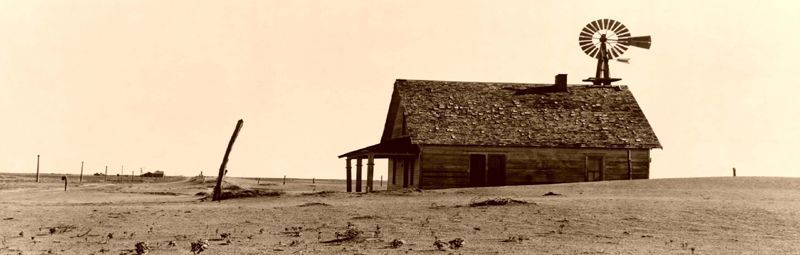
Dust Bowl Farm Near Dalhart, Texas, 1938.
“If you would like to have your heart broken, just come out here. This is the dust-storm country. It is the saddest land I have ever seen.”
— Ernie Pyle, a roving reporter in Kansas, just North of the Oklahoma border, June 1936.
The Dust Bowl of the 1930s, also known as the “Dirty Thirties,” lasted about a decade. This period of severe dust storms caused significant agricultural damage to American and Canadian prairie lands, primarily from 1930 to 1936, but in some areas, until 1940. Severe drought and decades of extensive farming without crop rotation caused the dust storms.
The main impact area was the southern plains, though northern areas were also affected, though not nearly as severely. The drought first hit the eastern part of the country in 1930, and by the following year, it began moving westward. By 1934, it had turned the Great Plains into a desert and prolonged the Great Depression.
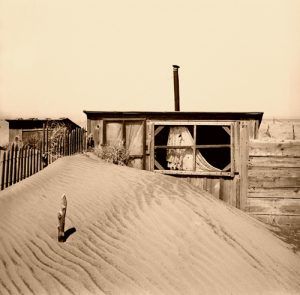
Dust Bowl, Cimarron County, Oklahoma.
For decades, farmers had unknowingly failed to use concepts such as fallow fields, crop rotation, cover crops to manage soil fertility and quality, or other techniques to prevent erosion. Deep plowing of the topsoil killed the natural vegetation that usually kept the soil in place and trapped moisture even during dry periods and high winds. High demand during World War I further exhausted the topsoil, and overgrazing stripped the western plains of virtually all other cover.
As a result, during the 1930s drought, the soil dried and turned to dust, soon blowing into large, dark clouds. Known as “Black Blizzards” and “Black Rollers,” these rolling clouds often reduced visibility to a few feet.
The region most affected – the Great Plains, including more than 100 million acres, centered in Oklahoma, the Texas Panhandle, Kansas, and parts of Colorado and New Mexico. These millions of acres of farmland became useless, and soon, hundreds of thousands of people were forced to leave their homes.
A resident of Oklahoma would say of the devastation, later published in Reader’s Digest:
“In the dust-covered desolation of our No Man’s Land here, wearing our shade hats, with handkerchiefs tied over our faces and Vaseline in our nostrils, we have been trying to rescue our home from the wind-blown dust which penetrates wherever air can go. It is almost a hopeless task, for there is rarely a day when the dust clouds do not roll over at some time. ‘Visibility’ approaches zero, and everything is covered again with a silt-like deposit which may vary in depth from a film to actual ripples on the kitchen floor.”
On May 11, 1934, a severe dust storm blew over 340 million tons of dust to the East Coast. The New York Times reported dust “lodged itself in the eyes and throats of weeping and coughing New Yorkers.” Dust flew as far as Boston, Atlanta, and even ships within a few hundred miles.
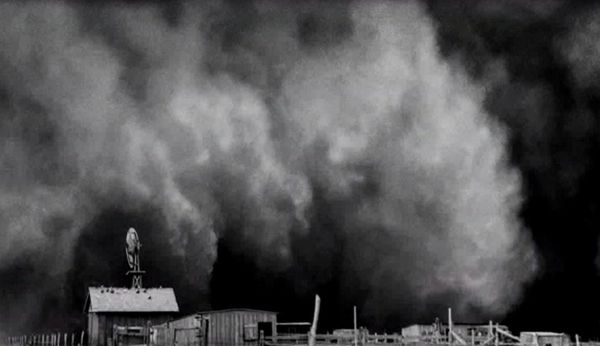
Black Sunday, April 14, 1935, during the Dust Bowl Days.
Another massive dust storm, dubbed “Black Sunday,” struck the nation on April 14, 1935. Famed American singer-songwriter Woody Guthrie lived in Pampa, Texas, at the time, and when the storm rolled in, many in the Texas Panhandle thought it was the end of the world. It inspired Guthrie to write the iconic song “So Long, It’s Been Good to Know Yuh,” considered one of Guthrie’s best and now included in the Library of Congress.
Shortly after the storm, the Dust Bowl got its name when Robert Geiger, a reporter for the Associated Press, traveled through the region and wrote the following:
“Three little words achingly familiar on a Western farmer’s tongue rule life in the dust bowl of the continent – if it rains.”
The term stuck, spreading across the airwaves and newspapers. However, the people of the region hated the term, which they knew contributed to declining property values and business prospects.
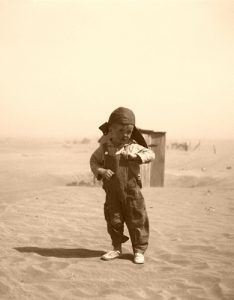
Son of a farmer in Cimarron County, Oklahoma, during the Dust Bowl.
Soon, hundreds of thousands of people began abandoning their land as the dust storms showed no signs of letting up. Others were forced out when banks foreclosed on their land. More than 500,000 people, primarily from Texas and Oklahoma, were left homeless. One-quarter of the population left the affected area, packing up everything they owned and heading westward in search of greater opportunities.
The Dust Bowl exodus was the largest migration in American history within a short time. By 1940, 2.5 million people had moved out of the Plains states, mostly to the West Coast. Two hundred thousand of them moved to California. Although these families left farms in Oklahoma, Arkansas, Missouri, Iowa, Nebraska, Kansas, Texas, Colorado, and New Mexico, they were generally called “Okies” because so many came from Oklahoma.
Unfortunately, many who traveled to California found economic conditions no better and were not received warmly. In fact, in 1936, when they reached the border, they found border patrols posted there to keep them out. Those who made it in owned no land and were forced to work, if they could find a job, mostly on large corporate farms growing unfamiliar fruit, nut, and vegetable crops.
Paid starvation wages, they were often required to pay as much as 25% of their wages to rent a tar-paper shack with no floor, electricity, or plumbing, and buy their groceries from a high-priced company store.
Many emigrants gave up farming and set up shacks and tents near large cities, hoping to find a job. Their homes, built from scavenged scraps, had no plumbing, electricity, or clean water. The lack of trash and waste facilities often led to outbreaks of typhoid, malaria, smallpox, and tuberculosis.
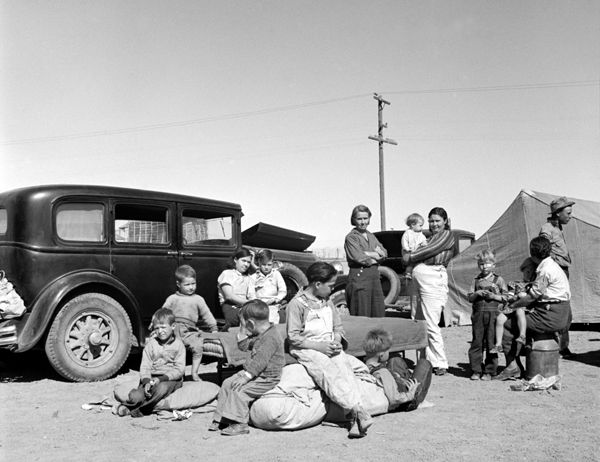
Texas Dust Bowl Refugees in Calipatria, California by Dorothea Lange, 1937.
Farming camps, filled with poverty-stricken migrants, dotted the countryside. But the native Californians who didn’t like it pressured lawmen to break them up. When this didn’t work, vigilantes sometimes formed, beating the migrants and burning their shacks.
In 1933, President Franklin D. Roosevelt established governmental programs to conserve soil on the Great Plains. The Federal Surplus Relief Corporation was also created to stabilize agricultural commodity prices and distribute food to families nationwide. After “Black Sunday” in 1935, which increased national pressure, the government formed a Drought Relief Service to coordinate relief efforts and began enforcing new regulations on the farm industry.
“The land just blew away; we had to go somewhere.”
— Kansas preacher, June 1936
Roosevelt also ordered the Civilian Conservation Corps to plant a huge belt of more than 200 million trees from Canada to Abilene, Texas, to break the wind, hold water in the soil, and hold the soil itself in place. By 1937, education programs taught farmers about soil conservation, and the following year, the conservation effort reduced blowing soil by 65 percent. However, it would take another two years for the drought to end and farmers to grow crops on the land again.
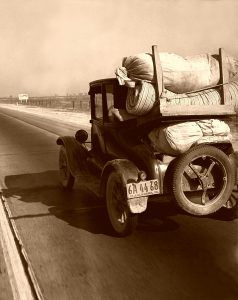
Drought refugees arriving in California.
One of the best literary descriptions of the time was John Steinbeck’s novel The Grapes of Wrath, published in 1939. Awarded both the Nobel Prize in Literature and the Pulitzer Prize, the novel follows a low-income family of sharecroppers who travel from Oklahoma to California during the Dust Bowl of the 1930s, seeking a better life.
One poignant excerpt from the book summarizes those many displaced farmers of the plains:
“And then the dispossessed were drawn West- from Kansas, Oklahoma, Texas, New Mexico; from Nevada and Arkansas, families, tribes, dusted out, tractored out. Car-loads, caravans, homeless and hungry; twenty thousand and fifty thousand and a hundred thousand and two hundred thousand. They streamed over the mountains, hungry and restless – restless as ants, scurrying to find work to do – to lift, to push, to pull, to pick, to cut – anything, any burden to bear, for food. The kids are hungry. We have no place to live. Like ants scurrying for work, for food, and most of all for land.”
©Kathy Alexander/Legends of America, updated September 2026.
Also See:
The Bum Blockade – Stopping the Invasion of Depression Refugees
Depression and Dust Bowl Photo Gallery
Hoovervilles of the Great Depression
See Sources.