

Threshing Machine Canyon, courtesy Kansas Tourism.
In 1867, a wagon train traveling to Salt Lake City, Utah, near Cedar Bluff State Park in Trego County, Kansas, was attacked by Plains Indians.
Within the canyon was once a stagecoach station along the Butterfield Overland Despatch stage line on the Smoky Hill Trail. Called Blufton Station, it was named for its location beneath an almost perpendicular 75-foot bluff at the heart of the canyon. Many travelers made their way along the trail to the Colorado goldfields.
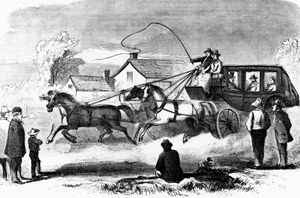
The Butterfield Overland stagecoach.
However, David Atchison, the owner of the stage line, had not fully considered the fury of the Plains tribes, who recognized the threat to their traditional way of life from the rush of incoming settlers after the Civil War.
Although soldiers were posted along the pathway at Fort Downer, Fort Harker, Fort Monument, Fort Wallace, and other stops to protect the stations and travelers from Indian attacks, it wasn’t enough.
After more Indian raids against settlers, railroad workers, and travelers, particularly along the Smoky Hill, Saline, and Solomon Rivers, Bluffton Station was abandoned in favor of White Rock Canyon further to the West.
After the station closed, travelers continued to use the site as a campsite. In 1867, freighters who were transporting several horse-powered threshing machines to be delivered to Brigham Young at Salt Lake City, Utah, camped for the night beneath a bluff overlooking the canyon floor. This was a mistake. Their site under the bluff was bordered by a deep, rocky gully that afforded the Indians easy, hidden access to creep up on the men. The warriors scalped and killed the freighters at their campfire and set everything on fire. Unfortunately, the freighters would have been safer had they camped on the grassy flat where the station once stood.
Afterward, the site was called Threshing Machine Canyon.
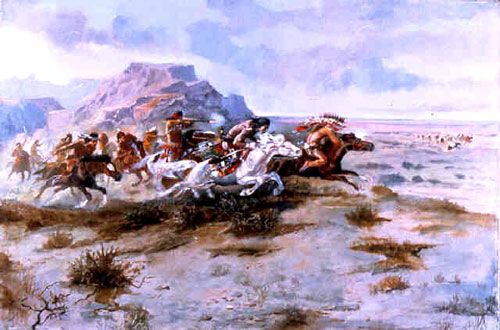
Indian Attack by Charles Marion Russell.
The burned machinery lay at the site for years, and many travelers picked up pieces as souvenirs. Decades later, the charred remains of a Threshing Machine were moved to the Trego County Historical Museum in WaKeeney, where they can be seen today.
Another notable aspect of the canyon is the carvings on the rocks throughout it. Early travelers on their way West recorded their names and dates on the bluffs. The canyon was a favorite camping spot of travelers heading West.
Travelers inscribed their names to such an extent that it was said that the pillar rivaled Independence Rock in Wyoming for names per square foot. One of the earliest recorded names was that of T.R. Hunt of New Jersey in 1849. He was probably a member of the government surveying party authorized by Congress as a result of John Fremont’s report to determine whether the Smoky Hill route would be practical for a government road to the West. Two other deeply inscribed names were C. Kelley and W.W. Spencer in 1859. The outline of an antelope and a well-defined Masonic square and compass accompanied these names.
The bulk of the early names were carved into the rock in 1865. Many were members of the Third Wisconsin Cavalry, which accompanied the survey party of Lieutenant Julian Fitch in the summer of 1865.
This historic canyon is located in a wildlife area along the Smoky Valley Scenic Byway.
©Kathy Alexander/Legends of America, updated June 2026.
Also See:
Blufton Station, Trego County, Kansas
Oregon Trail – Pathway to the West
California Trail – Rush to Gold
The Oregon-Mormon-California Trail Photo Gallery
Sources:
Bluffton Station on the Smoky Hill Trail
Indian Wars of Kansas
Kansas Park and Resource Authority
Kansas Outdoors
Kansas Tourism