
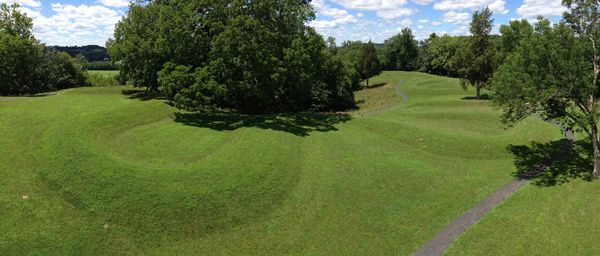
Great Serpent Mound, courtesy of Wikipedia.
An internationally known National Historic Landmark, Serpent Mound is a 1,348-foot-long, three-foot-high prehistoric effigy mound on a plateau along Brush Creek in Adams County, Ohio. Representing a snake with a curled tail, it is the world’s largest serpent effigy. Nearby are three burial mounds.
Euro-Americans first mapped the Serpent Mound as early as 1815. They documented it in surveys by Ephraim Squire and Edwin Davis in their historic volume Ancient Monuments of the Mississippi Valley, published in 1848 by the newly founded Smithsonian Museum.
Researchers have attributed the mound’s construction to two different prehistoric Indigenous cultures. The mound was initially thought to be of the Adena culture (800 BC to 100 AD), a pre-Columbian Native American society that existed in the Early Woodland period. These were probably made up of several related Native American groups that shared burial and ceremonial systems. The Adena lived in parts of present-day Ohio, Indiana, Wisconsin, West Virginia, Kentucky, New York, Pennsylvania, and Maryland.
Later, a 1996 carbon-dating study led scholars to believe members of the Fort Ancient culture built the mound around 1070 AD. These people predominantly inhabited land along the Ohio River in modern-day southern Ohio, northern Kentucky, southeastern Indiana, and western West Virginia. They were a maize-based agricultural society that lived in sedentary villages and built ceremonial platform mounds.
However, most recent dating places the mound at around 300 BC, once again suggesting Adena construction. Although archaeologists have excavated the massive earthwork, they have found no artifacts that would allow them to assign it to a particular culture. More work is needed to clarify the Serpent Mound’s age.
Effigy mounds, earthworks shaped like animals and birds, were raised in North America in areas that now correspond to parts of Wisconsin, Minnesota, Illinois, Iowa, and Ohio. The profile images, seldom more than six feet high, include felines, bears, and deer. During the 19th Century, many suffered as farming settlements expanded, often plowing them under. Fortunately, their extraordinary size and recognizable depictions saved many effigy mounds from that fate.
The exact function of the great mound is uncertain, though it was almost certainly ceremonial. While burials have been discovered in the effigy mounds farther northwest, none have been found in the Ohio mound.
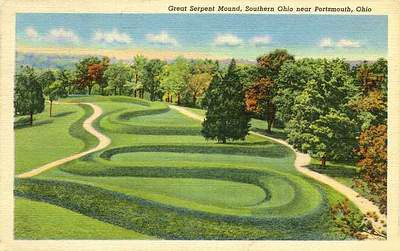
The Great Serpent Mound
Aspects of the serpent mound and its location suggest it may have had astronomical associations. The serpent’s head aligns with the summer solstice sunset, and the tail points to the Winter solstice sunrise. Perhaps the mound was utilized as a calendar, indicating when it was time to plant or harvest. Some have also suggested that the curves in the snake’s body parallel lunar phases or align with the two solstices and two equinoxes.
Serpent Mound Memorial is located at 3850 State Route 73, about five miles northwest of Locust Grove. A pathway lets visitors walk around the mound, and a museum features exhibits that include interpretations of the effigy’s form, descriptions of the processes used to construct the mound, the area’s geographical history, and an exhibit on the Adena culture, which is historically credited with creating the mound.
©Kathy Alexander/Legends of America, updated September 2026.
Also See:
The Adena Culture of the Northeast
Cahokia Mounds (IL)
Astronomy and Mythology in Native American Culture
Sources:
Khan Academy
Metropolitan Museum of Art
Ohio History
Wikipedia