
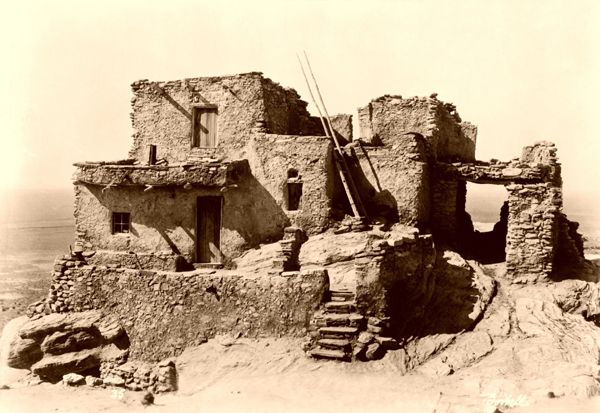
Hopi House in Arizona.
By Grady Winston.
Before the age of global positioning systems or compasses, people looked to the stars to find their way. And before civilizations knew what stars were, people formed their own beliefs about their significance. In North America, indigenous tribes had differing ideas about what the stars meant; some believed the night sky had spiritual meaning, while others attributed human-like qualities to the twinkling objects.
Archaeoastronomy is the study of how people in the past understood the stars and the sky; however, this applies broadly to all ancient cultures. The Mayans, Celts, and Egyptians alike had their own methods for tracking the movement of the stars and heavenly bodies, but all shared the belief that the phenomena above their heads were somehow larger and greater than they were. As such, the vast majority of ancient cultures associated the origins of everything, including the sky, moon, sun, and earth, with some form of star-related mythology. Astronomy played an important role in early Native American cultures, serving as the basis for governance, agricultural practices, and more. And studying the stars also caused tribes to theorize about the beginning of life in the universe.
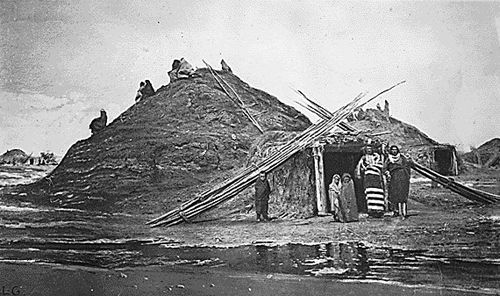
Pawnee lodge home.
The Pawnee’s Guiding Principles
The Skidi band of the Pawnee Indians referred to a ring of stars in the sky as “The Council of Chiefs.” The Pawnee believed the circle represented their governance style, in which elders held council to resolve important matters. This constellation was paramount to the way the Pawnee interacted daily and to their religious beliefs. They used the stars to set agricultural patterns and embody their own societal values. The Council of Chiefs was connected to their “Chief Star,” now known as Polaris, and represented their primary god, Tirawahat. They built their lodges with openings at the top – not only to allow smoke to escape from warming fires inside but to allow a clear view of the “Council” stars. Today, those stars are known as the Corona Borealis.
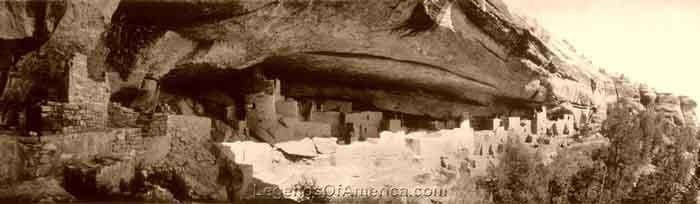
Cliff Palace is the largest cliff dwelling in North America. The structure, built by the Ancient Pueblo Peoples (also called the Anasazi), is located in Mesa Verde National Park in the southwest corner of Colorado. Photo from 1918
The Anasazi
In New Mexico, researchers found a cave painting that appears to depict a supernova explosion; the orientation of a crescent moon and stars indicates that the art may represent the Crab Nebula, formed in 1054 A.D. by a supernova. The Anasazi way of life remains somewhat of a mystery, but researchers have found that the tribe built a solar observatory, suggesting that the sky was extremely important to the Anasazi.
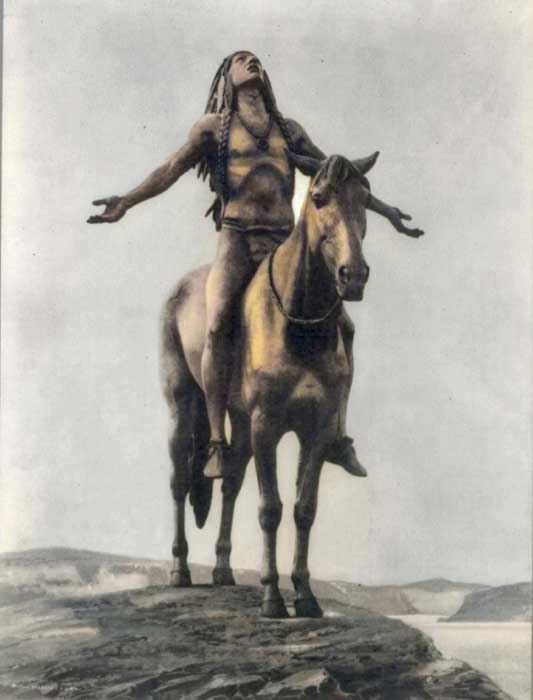
Appeal to the Great Spirit by the John Drescher Co, 1921.
Navajo Creation of the Sky
A Navajo legend describes the Four Worlds without a sun and the Fifth World, which represents Earth. According to the legend, the first people of the Fifth World were given four lights but were dissatisfied with the amount of light they had on Earth. After many attempts to satisfy the people, the First Woman created the sun to bring warmth and light to the land, and the moon to provide coolness and moisture. These were crafted from quartz, and when there were bits of quartz that were left behind by the carving, they were tossed into the sky to make stars.
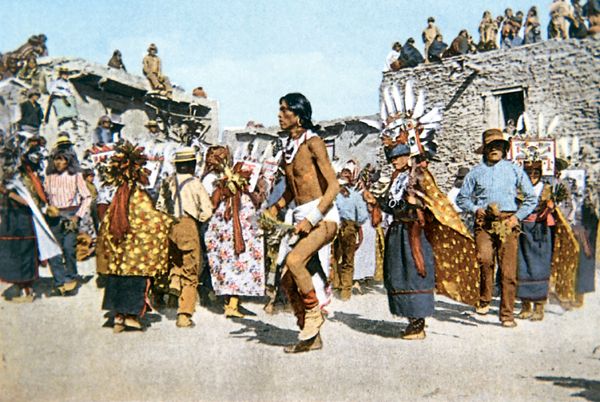
Hopi Ceremony.
Hopi Blue Star
Like the Navajo, the Hopi believe there were worlds before this one. The modern era is believed to be the Fourth World, and each world that came before this one ended with the appearance of “the blue star.” In carvings created by the Hopi in the American Southwest, it seems what they saw may have led them to a belief in aliens, a belief that certainly retains a place in the culture of the U.S. to this day.
The divisions among Native American cultures were not unlike those among today’s societies, so few myths extend beyond a single tribe. With the same sky overhead, ancient myths from around the world do share much in common. The History & Culture channel of the Chickasaw TV website features the tribe’s myths about Creation and the Great Flood, two stories repeated again and again throughout most cultures of the world, proving that, even when the world seemed impossibly large, many people were not far from each other, in terms of what they believed under the night sky.
By Grady Winston, submitted December 2012. Updated March 2026.
About the Author: Grady Winston is an avid internet entrepreneur and copywriter from Indianapolis. He has worked across technology, business, marketing, and advertising, implementing a range of creative projects and solutions for a range of clients.
Also See:
Native American Mythology & Legends
Anasazi – Ancient Puebloans of the Southwest
Chickasaw – Unconquerable in the Mississippi Valley
Hopi – Peaceful Ones of the Southwest
The Navajo Nation – Largest in the U.S.
The Pawnee – Farmers on the Plains