

Rocky Mountain Rendezvous by William Henry Jackson.
In the early 19th Century, the fur trade flourished in the American West. Peaking in the early 1840s, trappers and traders began roaming the Rocky Mountains in large numbers, starting around 1810 and continuing through the 1880s. Many mountain men were primarily interested in beaver pelts, which, at the time, were used to make the tall, shiny hats of well-to-do eastern gentlemen.
The trappers transported their furs from the Rocky Mountains back to St. Louis, Missouri, where they sold the furs or traded them for supplies and equipment for the coming year. Beginning in about 1825, some traders also began transporting supplies back to the mountains, where they traded them for furs. This allowed the trappers to remain in the wilderness without personally taking their goods back to Missouri.
In addition to trapping and trading, these mountaineers helped open several trails that would later be widened into wagon roads, allowing thousands of emigrants to settle in the Far West.
Representing the North West Company, Donald Mackenzie, a Scottish-Canadian explorer and fur trader, held one of the first rendezvous in the Boise River Valley in 1819. William Henry Ashley of the Rocky Mountain Fur Company later implemented a regular rendezvous system, in which company representatives hauled supplies to specific mountain locations in the spring, traded with trappers, and brought pelts back to communities on the Missouri and Mississippi Rivers in the fall. This rendezvous system with trappers continued when other firms, notably the American Fur Company owned by John Jacob Astor, entered the field.

Gathering of the Trappers, 1904, Frederic Remington.
These annual gatherings began in 1825 and were held at various locations. The large fur companies assembled teamster-driven mule trains packed with whiskey and supplies and set up a trading fair called the “rendezvous.” These events were lively, festival-like affairs open to free trappers, Indians, and families alike. The Rendezvous was not only a place where trappers could sell and trade their furs for all sorts of commodities, such as clothing, saddles, bridles, tobacco, and whiskey—but also a place to meet traders who might want to hire their services for the coming year. Famous mountain man, Jim Beckwourth, described them as: “Mirth, songs, dancing, shouting, trading, running, jumping, singing, racing, target-shooting, yarns, frolic, with all sorts of extravagances that white men or Indians could invent.”
In about 1835, ministers also became a regular feature at the Rendezvous. Over the years, these included the Reverend Samuel Parker, Father De Smet, and Dr. Marcus Whitman.
The annual rendezvous, referred to as the Rocky Mountain Rendezvous, was often held at Horse Creek on the Green River, now called the Upper Green River Rendezvous Site, near present-day Pinedale, Wyoming. Subsequently, the annual event was also called the Green River Rendezvous.
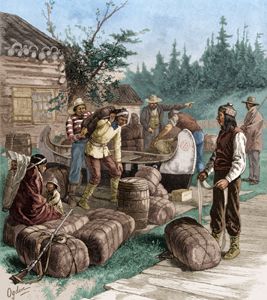
Hudson Bay Company traders by Henry Alexander Ogden.
By the mid-1830s, the annual event attracted up to 500 men—essentially all the American trappers and traders working in the Rockies —along with numerous Native Americans. However, like so many other Wild West endeavors, this soon changed when the Canadian-based Hudson’s Bay Company decided to destroy the American fur trade. Beginning in 1834, the Hudson’s Bay Company visited the Rocky Mountain Rendezvous to buy and trade for furs. The Canadian company offered manufactured trade goods at prices far below those American fur companies could match. This competition, along with a decline in demand for beaver pelts, effectively destroyed the American fur trade system. The last rendezvous was held in 1840.
Of the 15 annual meetings held, eight of the Rendezvous took place at a Green River site, and five convened near the junction of Horse Creek and the Green River.
Today, the main Rendezvous site near Pinedale, Wyoming, is a National Historic Landmark. Each year, the Museum of the Mountain Man in Pinedale holds a Rendezvous reenactment on the second Sunday in July. The celebration is part reenactment and part living history.
The actual Green River Rendezvous site is located four miles West of Pinedale on U.S. Highway 187.
More Information:
Museum of the Mountain Man
Sublette County Historical Society Inc
PO Box 909
700 E Hennick
Pinedale, Wyoming 82941
1-877-686-6266
©Kathy Alexander/Legends of America, updated October 2026.
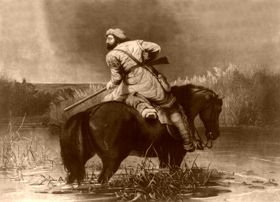
Trapper’s Last Shot by T.D. Booth.
Also See:
Explorers, Trappers, & Traders
See Sources.