
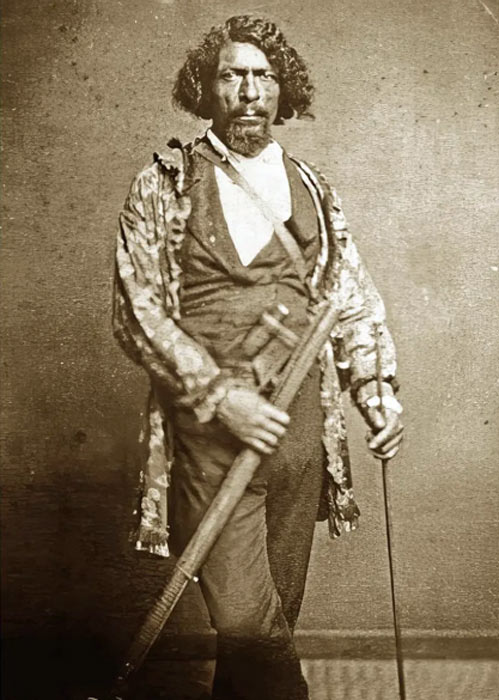
James Beckwourth
James Pierson Beckwourth, generally known as Jim Beckworth, was an American mountain man, fur trader, and explorer.
Born as a slave in Fredericksburg County, Virginia, on April 26, 1798, Jim’s mother was a mulatto slave in the service of his white father’s household. The Beckwourth family later moved to St. Louis, Missouri, where James was raised “free” and completed four years of schooling before being apprenticed to a blacksmith for five years.
When he was 18, he ran away but had trouble finding work until he joined General William Henry Ashley’s Rocky Mountain Fur Company. In 1825, he left Ashley’s expedition and went to live among the Crow Indians for the next six years, where they made him a chieftain and called him “Bull’s Robe.” In 1837, he returned to “civilization,” established two trading posts, and helped to found the town of Pueblo, Colorado. He later fought in the Seminole War in 1842 and the California Revolution in 1846.
In 1848, he became General John C. Fremont’s chief scout. In 1850, he discovered a safer route through the Sierra Nevadas called “Beckwourth Pass.” There, he built a ranch and trading post. Beckwourth’s last adventure occurred in 1866 when he fought in the Cheyenne War. During the California Gold Rush years, he improved the Beckwourth Trail, which thousands of settlers followed to central California.
At different times, Jim married at least four women: two Native Americans, a Hispanic, and an African American. He had numerous children by them, although he spent most of his time on the move, exploring and trapping beavers and bears.
Over the years, Beckwourth’s travels took him from Florida’s Everglades to the Pacific Ocean, blazing the trail in the early exploration and settlement of the American West. He died in October 1860 of mysterious causes while visiting the Crow Indians along the Bighorn River.
Colenel Henry Inman would write about Beckworth in his 1897 book The Old Santa Fe Trail, saying:
His success as a trader among the various tribes of Indians has never been surpassed, for his close intimacy with them made him know what would best please their taste. They bought of him when other traders stood idly at their stockades, waiting almost hopelessly for customers.
But Beckwourth himself said: “The traffic in whiskey for Indian property was one of the most infernal practices ever entered into by man. Let the most casual thinker sit down and figure up the profits on a forty-gallon cask of alcohol, and he will be thunderstruck, or rather whiskey-struck. When it was to be disposed of, four gallons of water were added to each gallon of alcohol. In 200 gallons, there are 1600 pints, for each of which the trader got a buffalo robe worth $5. The Indian women toiled many long weeks to dress those 1,600 robes. The white traders got them for worse than nothing, for the poor Indian mother hid herself and her children until the effect of the poison passed away from the husband and father, who loved them when he had no whiskey and abused and killed them when he had. $6,000 for 60 gallons of alcohol! Is it a wonder with such profits that men got rich who were engaged in the fur trade? Or was it a miracle that the buffalo were gradually exterminated? — killed with so little remorse that the hides, among the Indians themselves, were known by the appellation of ‘A pint of whiskey.'”
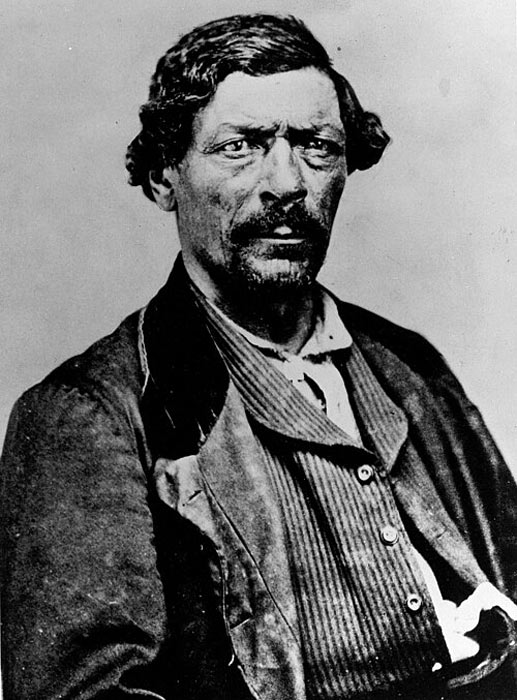
James Pierson Beckwourth
Beckwourth claims to have established the Pueblo, where the beautiful city of Pueblo, Colorado, is now situated. He says: “On October 1, 1842, on the Upper Arkansas River, I erected a trading post and opened a successful business. I was joined by 15 to 20 free trappers with their families in a very short time. We all united our labor and constructed an adobe fort 60 yards square. By the following spring, it had grown into quite a little settlement, and we called it Pueblo.”
More from Inman on Beckworth here…
©Kathy Alexander/Legends of America, updated April 2026.
Also See:
Early Traders on the Santa Fe Trail
Santa Fe Trail – Highway to the West
Famous Men of the Santa Fe Trail
Heroes of the Old Santa Fe Trail
See Sources.