
By William Worthington Fowler in 1877
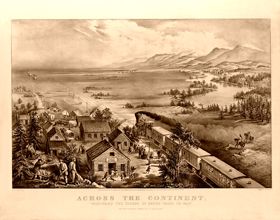
Westward the Course of Empire Takes Its Way, Fanny Palmer, Currier and Ives, 1868.
The emigration movement westward since the early part of the 17th century resembles the great ocean billows during a rising tide. Sweeping over the watery waste with a steady roll, dragged by the lunar force, each billow dashes higher and higher on the beach until the attractive influence has been spent and the final limit reached. The spirit of religious liberty and adventure carried the Europeans across the Atlantic. This was the first wave of emigration. The achievement of our Independence gave the movement its next great impetus. The acquisition of California and the discovery of gold were the third stimulus that carried our race across the continent. The completion of the Pacific Railroad communicated the final impulse.
At the close of the Mexican-American War in 1848, our frontier States were Texas, Arkansas, Missouri, Iowa, and Wisconsin. Except for a few forts, trading posts, missionary stations, and hunters’ camps, the territory extending from the line of furthest settlement in those States westward to the Pacific Ocean was mainly an uninhabited waste.
This tract, including the Gadsden Purchase, covering upwards of seventeen hundred thousand square miles and nearly half as large as the whole of Europe, was now to be penetrated, explored, reclaimed, and added to the area of civilization.
The pioneer army of occupation that was to commence this mighty work moved through Missouri and Iowa and, crossing the turbid flood that formed one of the great natural boundaries of that wild empire, saw before them the vast plains of Nebraska and Kansas stretching with scarcely a break for 500 miles as the crow flies to the foothills of the Rocky Mountains. The Platte, Kansas, and Arkansas Rivers, with their tributaries, indicated the general bearings of the march; the sun and moon were unerring guides.
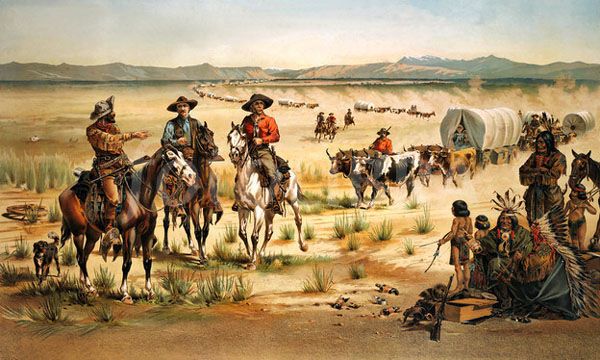
A wagon train and Indians.
The host divided itself: one part spread over and tilled the rich country that extends for 200 miles west of the Missouri River; another part grazed its flocks and herds on the pasture ground beyond; another, crossing the belt of desert, settled in the picturesque region between the barrens and the foothills, another penetrated the mountains and planted itself in the labyrinthian valleys and on the lofty table-lands between the Black Hills and the California Sierras, another more boldly marched 1,000 miles across a wilderness of mountain ranges and settled on the slope which descends to the shores of the Pacific.
The rivers and streams between the Missouri River and the mountains, and latterly the railroads, were the axes around which the population gathered and turned itself. Here were the dwelling places of the settlers, where women’s work was to be done and their influence employed in building up the empire on the plains.
We have stated how, by a series of processes extending through successive generations and the lapse of centuries, she grew more and more capable of fulfilling her mission on this continent and how, as the physical and moral difficulties that beset frontier life multiplied, she gathered corresponding strength and faculties to meet them. In entering that new field of pioneer enterprise which lay beyond the Missouri River in 1848, there still, among others, remained that one great grief over the separation from her old home.
When the eastern woman bade farewell to her friends and started for the plains, it seemed to her and often proved to be a final farewell. We say nothing of that large class which, more scantily endowed with this world’s goods, was forced to make the long, wearisome journey with ox teams from the older settlements of the East.
We take the weaker case of the well-to-do immigrant wife who, by railroad and by steamboat on the lakes or rivers, reached, after a journey of 2,000 miles, the point upon the Missouri River where she was to enter the “prairie schooner” and move out into that vast expanse; even to her, the pangs of separation must have then been felt with renewed and redoubled force.
That “turbid flood” was the casting-off place. She was like one who ventures into a small boat in a vast, dark ocean, not knowing whether she will ever return or find a haven within the murky depths.
There was the uncertainty, the positive dangers of the route, the apprehended dangers that might surround the settlement, the new country with all its difficulties, privations, labors, and trials, the possibilities of disease, with little means of relief, and the utter solitude, with little prospect of solacing companionship.
And yet, with so dreary a picture presented to her mental vision, she did not shrink from the enterprise nor turn back until all hope of making a home for her family in that remote region had fled. We recall a few instances in which, after years of toil, sorrow, and suffering–when all had been lost, the heroine of the household has been driven back by the stress of circumstances with which human power was unavailing to cope. Such a case was that of Mrs. N., of which the following are the substantial facts:
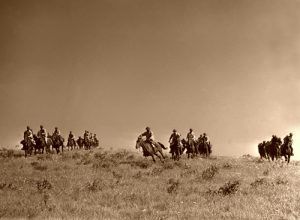
Kansas Cavalry Unit.
While a squad of United States cavalry was journeying in 1866 from the Great Bend of the Arkansas River to Fort Riley, Kansas, the commanding officer, as he was sweeping with his glass the horizon of the vast level plain over which they were passing, described a small object moving towards their line of march through the tall grass some two miles to their left. No other living thing was visible throughout their field of vision, and conjecture was rife as to what this single moving object in that lonely waste could be. It moved slowly and hesitatingly, sometimes pausing as if weary and then resuming its sluggish course toward the East.
They finally made it out clearly. It was a solitary woman. She had a rifle in her hand, and as the squad changed course and approached her, she could be seen at a distance of half a mile, assuming a defensive posture and preparing to use her rifle.
The horsemen waved their hats and shouted to tell her they were friends. She kept her rifle at her shoulder and stood like a statue until, seeming to be reassured, she changed her attitude and approached them with tottering steps.
She was a woman under 30 who had been tenderly reared; small and fragile, her pale, wasted face bore those lines that mutely tell the tale of long sorrow and suffering. Her appearance awoke all those chivalrous feelings that are the honor of the military profession. She was speechless with emotion. The officer addressed her with kind and respectful inquiries. Those were the first words in her mother tongue she had heard for four weeks. Like the breath of the “sweet south” blowing across the fabled lute, those syllables, speaking of home and friends, relaxed the tension to which her nerves had been so long strung, and she wept. Twice, she essayed to tell how she happened to be found in such a melancholy situation on that wild plain, and twice, she broke down, sobbing with those convulsive sobs that show how the spirit can shake and over-master the frail body.
Weak, weary, and worn as she was, they ceased questioning her and preserved a respectful silence while they did all that rough soldiers could do to make her comfortable. An army overcoat was wrapped around her, stimulants and food given to her, and one of the soldiers, shortening a stirrup and strapping a folded blanket over his saddle, made a comfortable seat upon his horse, which he surrendered to her. The following day, she had acquired sufficient strength to tell her sad story.
Three years before, she, with her husband and four children, had left her childhood home in eastern Ohio and set out for Kansas. Her oldest boy sickened and died while passing through Illinois, and they laid him to rest beneath the waving prairie grass. After crossing the Missouri River, her second child, a lovely little girl of six years, was carried off by scarlet fever, and they left her sleeping beneath the green meadow on the bank of the Kansas River.
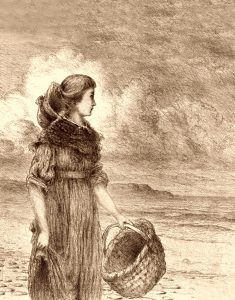
Prairie Girl.
After a wearisome march of 80 days, they reached their destination on the Smoky Hill Branch of the Kansas River, lying about 300 miles west of Fort Leavenworth. Here, they chose their home in a country suitable for grazing and tillage. Mr. N. devoted himself to raising cattle, tilling only land enough to supply the wants of himself and his family.
She had toiled day and night to make their home comfortable and happy for her husband and children. Fortune smiled upon them. Their herds multiplied and thrived upon the rich pasture and in the mild air of the region where they grazed. Two more children were added to their flock. Their roof-tree sheltered all from the summer heat and the bleak winds sweeping those plains in the winter season. Bounteous harvests blessed their store. They were visited by the red man only as a wanderer and friend.
This bright sky was suddenly overcast at last. A plague raged among their cattle. A swarm of grasshoppers ravaged their crops. A drought followed, which burned up the herbage. “Terrors,” says the poet, “come not as single spies but in battalions.” Pestilence, at last, came to complete the ruin of that hapless household. Her husband was first stricken down and, after a week of suffering, died in delirium, which, while it startled and saddened the little flock, kept him all unapprehensive of the evils which might visit his bereaved family after his departure. The wife dug, with her own hands, a shallow grave on the bluff where their house stood, and bearing, with difficulty, in her slender arms the wasted remains, laid them, coffinless, in the trench and covering them with earth, returned to the house to find her three oldest children suffering from the same illness. The pestilence is made short but sure to work with their little frames. One by one, they breathed their last in their mother’s arms. Kissing their waxen features, she bore them out all alone and laid them tenderly side by side with their father.
The four-month-old baby was still the picture of health. All unconscious of its griefs and of the bitter sorrows of her on whose bosom he lay, he thrived upon the maternal bounty which poured for him, though her frail life seemed to be passing away with it.
Like some subtle but potent elixir, which erects the vital spirit and holds it when about to flee from its tenement, so did that sweet babe keep the mother’s heart pulsing with gentle beat during the days that followed those forlorn funeral rites.
A week passed, during which a great terror possessed her, lest she too should have the latent seeds of the pestilence in her frame and should have imparted the dreadful gift to her babe through the fountain of motherhood.
A racking pain in her forehead, followed by lassitude, told her, alas! That all she had shuddered to think of was coming to pass. Weary and suffering, she lay upon the couch, which she prayed but for her infant might be her last resting place. Too soon, as she watched with a keenness of vision that only a mother can possess, she saw the destroyer’s first shadow reflected on her little one’s face. It faded like a flower in the hot blast of July, “So softly worn, so sweetly weak,” and before two suns had come and gone, it lay like a bruised lily on the fever-burning bosom that gave it life.
Unconsciousness came mercifully to the poor mother. For hours, she lay in blessed oblivion. But the vital principle, which often displays its wondrous power in the feeblest frames, asserted its triumph over death, and she awoke again to the remembrance of losses that could never be repaired this side the grave.
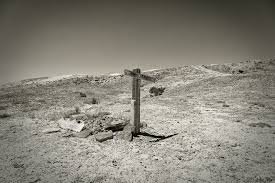
Pioneer Grave.
Three days passed before the fever left her. She arose from her couch and, with the shaking frame, laid her little withered blossom on its father’s grave, covering it with a mound of dried grass and crowned it with yellow autumn leaves.
The love of life slowly returned, but disease, the grasshoppers, and the drought had destroyed the means to sustain that life. The household stores would suffice, but for a few days longer. The only and precarious means of subsistence remaining would be such game as she could shoot. The Indians, becoming apprised of the death of Mr. N., had carried off the horses.
Only one avenue of escape was left her; casting many “a longing, lingering look” at the home once so happy but now so swept and desolate, she took her husband’s rifle and struck boldly out into the boundless plain, towards the trail which runs from the Arkansas River to Fort Riley, and after several days of great suffering fell in with friends, as we have already described.
The sad experience of Mrs. N. is fortunately a rare one in today’s world. The vast area occupied by the plains of Kansas and Nebraska is in many respects naturally fitted for those forms of social life in which woman’s work may be performed under the most favorable circumstances; a country richly adapted to the various forms of agriculture and pastoral occupations; a mild and generally equable climate is there well calculated to show the pioneer-housewife at her best.
Another great advantage has been that this region served as a finishing school, to which the antecedent schools of pioneer life could send their skilled pupils. These pupils, upon a fair and wide field and in virgin soil, could build a civil and social fabric, reflecting past experiences and embodying a multitude of separate results into a large and harmonious whole.
Visiting the States of Kansas and Nebraska some years ago, we passed through that rich and already populated region in the eastern part of the former State, which 25 years prior had been an uninhabited wasteland. Here were all the appliances of civilization: the school, the church, the town hall; improved agriculture, the mechanic arts, the varied forms of mercantile traffic, and at the base of the fabric, the homemade and ordered by a woman.
Here but yesterday was the frontier where a woman was performing her oft before the repeated task and laying, according to her methods and habits, and within her appropriate sphere, the foundations of that which is today a great, rich, and prosperous social and civil State. Here, too, we saw many of the mothers, not yet old, who, through countless trials, labors, and perils, have aided in the noble work on which they now are looking with such honest pride and satisfaction.
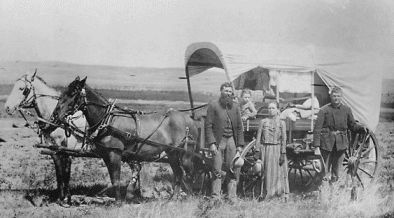
Frontier homesteaders.
For many successive afternoons, we passed from city to city and from village to village. The sun preceded us westward; we steered our course directly towards it, and each day, as it sank to the earth, the sky glowed brightly and more brightly, like the purest gold. The settlements became more scattered, and the uninhabited areas expanded. We were nearing one of the frontiers.
In the spring, the mead through which we were passing was a natural parterre, where amid the lively vernal green bloomed the oxlip, the white and blue-violet, the yellow-cup dotted with jet, and many another fragile and aromatic member of the floral sisterhood.
Ascending a knoll crowned by a bit of wood that lay like a green shrub upon that treeless, grassy plain, we saw the prairie stretching onward, its loftily waving extent to the horizon. Here and there, amidst the vast stretch, small log houses arose, which resembled little birds’ nests floating upon the ocean. Here and there, people were also harvesting grain.
Among the harvesters were three young women nimbly binding sheaves with little children around them. The vastness of the prairie made the harvesters themselves look like children playing games.
Some distance beyond us, in the track we were pursuing, we saw what, at first glance, appeared to be a white dahlia. As we neared it, this vast white flower seemed to be moving; it was the snowy sun bonnet of a young schoolteacher conveying a troop of children to the schoolhouse, whose brown roof showed above the luxuriant herbage. She seemed to be beloved by her scholars, for they surrounded her and clung to her. She had been giving them, and it appeared, a lesson in practical botany; their hats were adorned with scarlet and yellow blossoms, and they carried bunches of oxlips and violets.
The schoolmistress’s face was like that of a sister of charity. The contour and lines showed resolution and patience. The whole expression blended intelligence and intelligence, a strong and lovely character. She entered the door of the log schoolhouse and gently drew the youngest of her charges within it. Around the schoolhouse, we saw other groups of sturdy boys and chubby girls frisking and shouting gaily as we drove by.
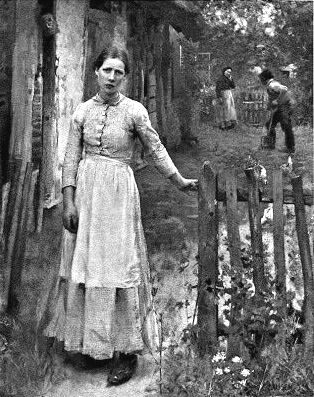
Pioneer Woman.
A vigorous, intelligent, and laborious race grows up in these border settlements on the plains, especially under the women’s tuition. The children are taught the rudiments and endeavor to improve their condition in life afterward. The boys often enter into political and public careers. The girls marry early and contribute to the creation of new societies in the wilderness. These farms are the nurseries from which the State will soon obtain its officials and teachers, both male and female.
The gardens, the cottages, and the cabins nearly all showed some external signs of the embellishing hand of a woman. Entering one of these houses, we found the men and young women gathering the harvest. An elderly woman acted as our hostess. She was a maid of all work, a chambermaid, cook, dairywoman, laundress, and children’s nurse, and yet she found time to make us a cordial welcome. The house was only one year old and relatively open to the weather, yet bore the marks of a woman’s thrift and even refinement.
The matron who entertained us displayed piety, restless activity, humanity, intelligence, and a youthfully warm heart, all of which marked her as a type of that large class of elderly housewives who are using the education they acquired in their girlhood in the East to form new and model communities on these vast and rich plains.
We asked her about her life and heard, without the least complaint, of its many difficulties. And yet, when her husband and sons and daughters returned home from the field, it was clear that they had a joyous and happy home.
The eldest daughter, Mrs. B., then a widow of about 25, told us the story of her experience in border life. She was born in Wisconsin, which had a population of only 3,000 at the time it was a territory. Soon after her father and mother were removed to Kansas, at the age of 16, she married one of the most adventurous of the young pioneers of the race who drew their first breath upon the then frontier in Illinois.
Their wedding tour was in a prairie schooner from Atchison to the semi-fertile region bordering the desert belt stretching through western Nebraska and Kansas to New Mexico. Here, they made their first home. Life in that particular section must have been pastoral rather than agricultural: her husband devoted himself almost entirely to raising cattle.
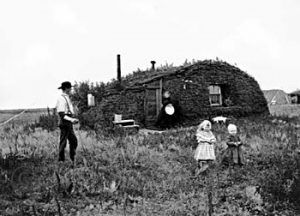
Homestead.
We hardly need to say that next to the hunter, the cattle-herder approximates most nearly to savage life; his wife must accordingly find her position under such peculiarly trying circumstances. The house in which Mrs. B. and her husband lived was a simple hut constructed by digging away the side of a hill, which formed the earthen rear and side walls of their dwelling; the top and front were also made of logs, covered with earth. A single apartment represented their kitchen, sleeping room, dining room, and parlor. Three men, accompanied by their wives, were their companions in the enterprise, and all lived in similar houses.
As most of the men’s time was occupied with looking after their herds and preventing them from wandering too far or being stolen by thieving Indians, a large share of the other outdoor labor fell upon the women. Cheerfully accepting these burdens, Mrs. B. and her three female companions tilled the small patches of corn and potatoes, which, with pickled beef, formed their only food. Much of the time, they were left entirely alone. They were alarmed as well as annoyed by frequent visits from Indians, who, however, abstained from violence, contenting themselves with eating what was given them and pilfering whatever stray articles they could find.
The little colony passed three years in this wild pastoral life. Though the heat of summer and the sudden storms of wind in winter were severe, disease was never added to their list of ordinary discomforts and privations. Two of the men drove their cattle 250 miles to the nearest railway station twice a year, but none of the women accompanied them on these trips, which their husbands always looked forward to as a relief from the monotony of their life as herders.
The third summer after their arrival was extremely sultry, and the drought, so common in that region, promised to be more severe than usual. The crops were rapidly being consumed by four weeks of continuous hot, dry weather when one day late in July, the four housewives, who were sitting together in the cabin of Mrs. B., observed a sudden darkening of the western sky and felt sharp, whirling gusts of wind which blew fitfully from the southwest. A succession of small whirlwinds carried aloft the sand in front of their houses, which were ranged not far apart on the hillside.
These phenomena, accompanied by other atmospheric disturbances, lasted for half an hour and ceased to attract their attention. The wind, however, continued to increase, and the ears of the four matrons anon caught the sound of a dull, steady roar, which rose above the fitful howling of the blast. They ran to the door and saw a dark cloud shaped like a monstrous funnel moving swiftly toward them from the west. The point of this funnel was scarcely more than 100 feet from the earth and swayed like the car of a balloon descending from a great height.
Dismayed by this extraordinary spectacle, they hastened indoors. Scarcely had they gained shelter when their ears were saluted by a sound louder than the broadside of a double-decker, and the next moment, the roof of the house was torn away with tremendous force. Almost at the same instant, a flood of water 20 feet deep swept the four women with the debris of the house down the hillside and whirled them away over the plain.
Three of the women, including Mrs. B., severely bruised and half-drowned, emerged from the torrent when it spread out and spent itself upon the level; the fourth was stunned by a blow from one of the house logs and suffocated by the rush of the waters, and could not be resuscitated. The water spout, for such was the agent of the destruction which had been wrought, had fallen on the hillside and swept away two of the other houses besides that of Mrs. B. For ten days, while new dwellings could be constructed. The furniture and other articles carried away could be recovered; the three houseless families were quartered partly in the remaining house. The rest encamped under the open sky, where they suffered additional discomfort from the thunderstorms that followed the water spout.
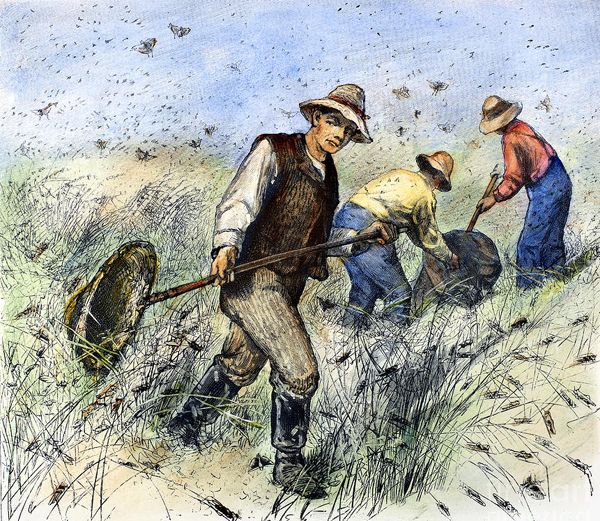
Grasshopper Plague.
The following summer, they were visited by another disaster in the shape of grasshoppers. Often had these terrible pests of the settlers in that. The adjacent regions, flown in immense clouds over their heads during former seasons, winging their way to the more prosperous country which lay to the East, but never before had they been attracted to the scanty patches of corn and potatoes which skirted the hovels where the herders dwelt. But early in July of that year, a swarm settled down almost ankle-deep on the little strip of plowed land, and within the space between the rising and the setting of the sun, every vestige of greenness had disappeared as if burned with fire.
After a short consultation that evening, the whole party determined to rest for a few days and joined a company of five pioneers who were traveling over the military road via Fort Kearny and through the Platte Valley to settle in the picturesque and well-watered region east of the foothills of the Rocky Mountains and slaughter buffalo for their skins.
Mrs. B. and her two female companions, with a shrewd eye to profit, concluded an arrangement with the hunters by which they were to board and make the whole party comfortable, in their capacity as housewives, for a share in the profits of the buffalo skins, their husbands joining the party as hunters.
All the necessary preparations having been made, they set out on horseback with ten pack mules. They made rapid progress, reaching the buffalo country without an accident in 22 days.
Here, the women occasionally joined in the hunt, and, being fearless riders and skilled shots, added a few buffalo robes to their accounts. On one of these hunts, Mrs. B., becoming separated from the party while following a stray bison with too much ardor, reached a small valley that looked as if it might be a favorite grazing ground for the brutes.
The wind blew in her face as she rode, and owing to this circumstance, the bison being a quick-scented animal, she was enabled to approach a solitary bull feeding by a stream at the foot of the hill and dispatched it by a shot from her rifle.
Buffalo Stampede.
Dismounting, she whipped out her hunting knife and was proceeding to flay the carcass when she was attracted by a low rumbling sound that shook the earth, and looking up the steep bluff at the foot of which she stood, saw a herd that must have contained 10,000 bison, plunging madly down upon her. Her horse, taking fright, broke away from the bush to which he was fastened and galloped off. Mrs. B. ran after him at the top of her speed but was conscious that the black mass behind her would soon overtake and trample her underfoot; such was the impetus they had received in their course down the hill.
Not a tree was in sight, but remembering two or three sinkholes she had seen beside a clump of bushes near the spot where she had aimed the bull-bison, she hastened thither. She succeeded in dropping into one some ten feet in depth just as the herd leaders were almost upon her. Lying there panting and up to her waist in water, she heard the shaggy battalions sweep over her and, a moment after they had passed, caught the sound of voices.
Emerging cautiously because she feared Indians swarming in the region, she saw four of the hunters whom she had left an hour before galloping in hot pursuit of the herd. The five other hunters came up in front of the herd as it was commencing to climb the bluff on the other side of the valley, succeeding in turning the terrified multitude to one side. When they came up with Mrs. B., she saw they had caught her horse, which had met them as it was galloping homeward.
Thus supplied with a steed, she mounted and, regaining her rifle, which she had dropped in her flight, nothing daunted by the danger she had so narrowly escaped, joined in the hunt, which ended in a perfect battle. The hunters succeeded in driving a part of the herd into a narrow gorge and strewing the ground with carcasses.
Three months of this wildlife made our heroine pine for more quiet pursuits, and she induced her husband to return to the frontier of eastern Nebraska, where, with the profits of the cattle enterprise and the hunt, a large tract was purchased on one of the tributaries of the Platte. After six years of labor, they built a model farm, well-stocked with choice breeds of cattle, planted with nurseries of fruit trees, and laid out in grain fields. Attracted by their success, other settlers flocked into the region. Completing the Pacific Railroad soon after furnished them with easy market access. Everything went on prosperously till the death of Mr. B. from a casualty. But notwithstanding this loss, Mrs. B. kept up the noble farm; her energy and perseverance had done so much to make it what it was. She was then on a visit to her father’s family in Kansas, where we met her and had invited her father, mother, and sisters to move to her home in Nebraska, which they intended to do shortly.
The whole family showed evidence of possessing the same bold and energetic character that the eldest daughter had displayed during her ten years of experience on the extreme frontier, in addition to those other qualities of heart and mind that mark the true pioneer woman.
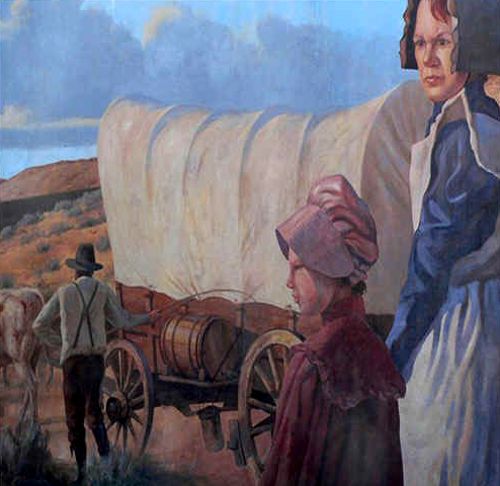
Pioneer woman.
Heartfelt kindness and hospitality, seriousness and joy in the family circle —these characteristics of border life, when it is good —had all been transplanted into the western wilderness by these colonists. That day, among the dwellers of the plain, that fine old lady, those handsome, fearless, warm-hearted, kind, and modest young women, that domestic life, that rich hospitality, combined to show how much happiness may be enjoyed in those frontier homes, where a woman is the presiding genius.
By William Worthington Fowler, 1877. Compiled and edited by Kathy Alexander/Legends of America, updated October 2025.
About the Author: William Worthington Fowler’s book “Woman On The American Frontier: A Valuable and Authentic History” was originally published in 1877. This article is excerpted from this excellent work. The text as it appears here is not verbatim; it has been edited for clarity and ease for the modern reader.
Also See: