
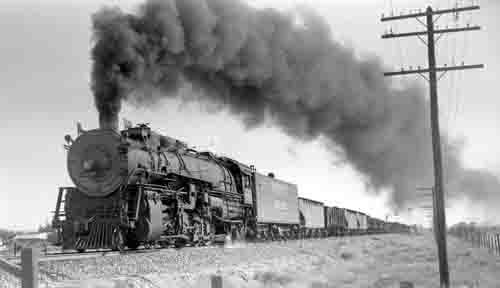
Union Pacific Train, late 1800s.
By William Francis Bailey in 1906.
The country through which the Union Pacific Railroad was built was the hunting grounds of the Pawnee, Sioux, Arapaho, Crow, Blackfeet, Bannock, Snake, and Shoshone, the first three on the plains and the others to the west. These were among the most warlike tribes of the West, and during the construction of the road, they were the occasion of serious trouble, not to speak of the annoyance and delay as well as the extra expense occasioned.
The following summarizes the conditions on the plains during road construction.
During the summer of 1864, the whole line of the Overland Stage from St. Joseph, Missouri, to Salt Lake City, Utah, was subject to Indian depredations, so much so that Ben Holladay, its proprietor, asked the Government for five soldiers at each of the stage stations, and two to accompany each coach. Without these, he stated, he would discontinue the line.
The year 1865 was known as “The Bloody Year on the Plains.” Its history is one constant account of attacks, skirmishes, depredations, and murders by the Indians.
Notwithstanding, the Peace Conference at Laramie, Wyoming, in May 1866 was not much better, and the relations between the whites and the Indians were kept at a fighting point, culminating in the massacre by the Indians at Fort Phil Kearny of 81 regular soldiers.
The year 1867 opened with troubles all along the line. The Government inspectors reported, “Indian depredations have caused serious embarrassment to the line’s locating, construction, and operation. Constant and persistent attacks have occasioned great delay and expense.” The Government awoke to the dangers of temporizing, pushed many troops into the field, and restored old posts and built many new ones. This, along with the ease of communication from the rapidly extending railroad, deterred the Indians.
1868 was a repetition of the preceding year. A Peace Conference at Fort Laramie, called for April, was not attended by the Indians until November. They attacked the whites, and the country was in turmoil. During the fall, there was desperate fighting. The army, assisted by citizen soldiers, punished the Indians as they had never been punished before, resulting in much better conditions of affairs during 1869 and after. Nearly all the Indian troubles occurred on the plains and east of Cheyenne. West thereof, either owing to the better organization on the part of the railroad and military or else to the intimidation of the tribes, there was but minor annoyance from this source.
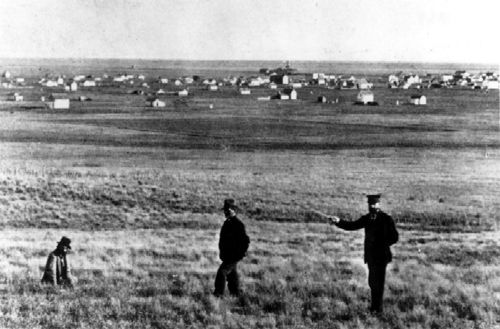
Railroad surveyors, 1861.
The surveying parties were, as a rule, accompanied by a small detachment of regulars, which may be attributed to their comparatively small loss of life. While they lost but a few of their number, they were still compelled to work at a significant disadvantage and frequently brought to a complete stop by the presence of war parties in numbers too great to be ignored.
The surveying and engineering parties were numerically weaker than the grading outfits and lacked resources. The different parties were frequently driven in, and many were obliged to fight for their lives. The station Hilldale, Wyoming, perpetuates the name of one engineer, Mr. Hill, who was killed near this place by the Indians while locating the road.
Another victim of the Indians was Colonel Percy, in charge of an engineering party on the preliminary survey. He was surprised by a party of them twenty-four miles west of Medicine Bow, Wyoming — retreating to a cabin, he stood them off for three days, at the end of which time they managed to set fire to the building. When the roof fell in, he was compelled to get out, after which he was attacked and killed. This occurred near Hanna Station, Wyoming, which was initially called Percy in memory of the Colonel.
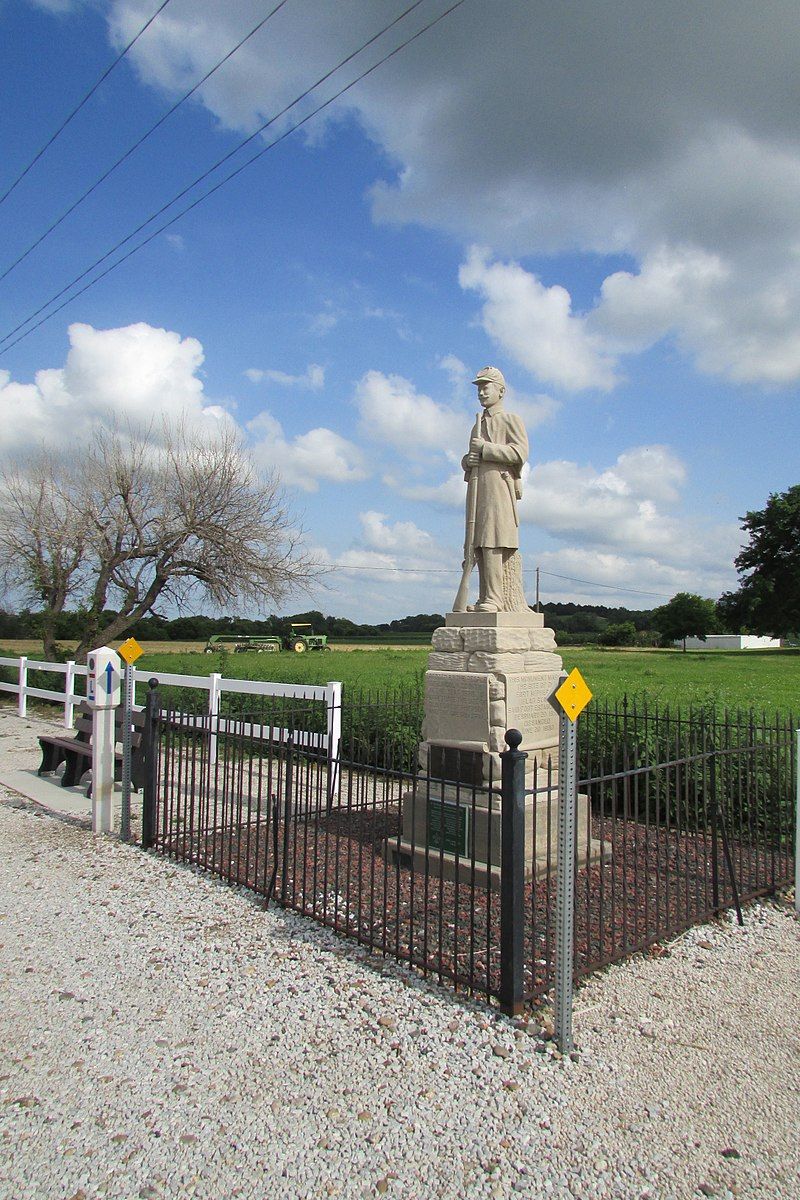
Site of Fort McPherson, along the Oregon and California Trails, courtesy Wikipedia.
Realizing the necessity of the military to protect the construction forces, the Government established numerous forts or posts along the line, viz:
Fort McPherson, Nebraska (originally called Cantonment McKeon, then Cottonwood Springs Cantonment). Established February 1866.
Fort Sedgwick, Colorado, is about four miles from Julesburg, Colorado.
Fort Mitchell, near Scotts Bluff, Nebraska, was a temporary proposition occupied only during the construction period.
Fort Morgan, Wyoming, near Sidney, was established in May 1865 and abandoned in May 1868.
Fort D.A. Russell, near Cheyenne, Wyoming, was established in July 1867 and was still occupied as an army post.
Fort Sanders, Wyoming, near Laramie, was established in June 1866.
Fort Fred Steele, 15 miles east of Rawlins, Wyoming, was established in June 1868.
Fort Halleck, 22 miles west of Medicine Bow, Wyoming, was abandoned in 1866.
General William Sherman had prophesied that the influx of graders and teamsters, with their following, would bring enough whiskey into the country to kill off all the Indians and that the only good Indians were the dead ones.
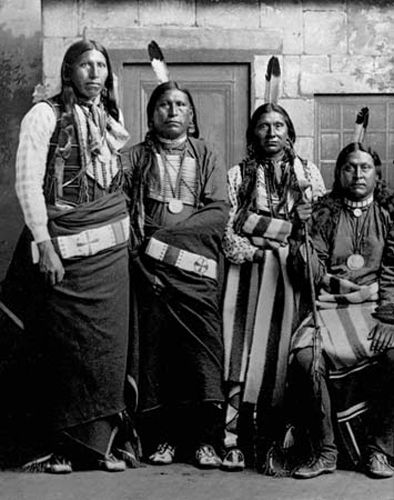
Pawnee Scouts.
One of the most valuable forces during the building of the road was a battalion of four companies of Pawnee Indians mustered into the United States service under the command of Major Frank J. North on January 13, 1865; this action was taken at the instance of George Custer. They proved most effective, notwithstanding their somewhat ludicrous appearance. They were furnished with the regular soldiers’ uniform, which they could modify to suit their ideas and taste. As a rule, their headdress was the customary Indian feather headdress. Their arms were the regulation carbine and revolver of the cavalry, to which they added on their own accord, hatchet, knife, spear, etc., and when fighting was to be done, they would strip down to the buff.
The construction forces at this time were being annoyed by the Cheyenne and Sioux, both of whom were the bitter foes of the Pawnee. Fort Kearny was the headquarters of Major North and his Pawnee warriors, and their duty was to protect the construction forces while at work.
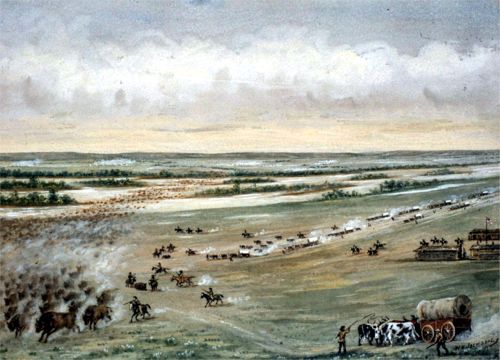
Fort Kearny, Nebraska.
As illustrating conditions existing, the following is of interest: A large body of Indians appeared on the scene near Julesburg, Major North, and 40 of his Pawnee started from Fort Kearny to the scene of the anticipated trouble. On the way, he found the bodies of fourteen white men killed by the Indians and their bodies mutilated beyond recognition, their scalps torn off, tongues cut out, legs and arms hacked off, and their bodies full of arrows. On arriving at Julesburg, he found the place besieged. He fell on the Sioux and put the whole band to fight, killing 28 in the transaction. This party of Indians had, but a few days before, surprised a party of 14 soldiers, killing them all. Soon after, this trouble broke out with the Cheyenne. Major North and a party of 20 of his Pawnee started to look into the matter and struck a band of 12 Cheyenne while out. Taking after them, the Major was the only one who could get near them because his men’s horses were tired out, but being better mounted, he got within gunshot and killed one of the Cheyenne. Seeing his Pawnee were some distance in the rear, the whole party turned on Major North. He shot his horse and, using its body for a breastwork, fought the whole party, killing or wounding nine of them, and held them at bay until his men could come up. This fight was considered one of the most daring on the Plains and added greatly to the fame of the Major and his Pawnee. After completing the road, Major North retired and, in company with W.F. Cody (Buffalo Bill), went into the cattle business near North Platte.
As stated, many officers and men engaged in the work were ex-soldiers accustomed to using arms. The construction trains and workers were liberally supplied with arms, principally rifles. It was the boast that ten any time was long enough to transform a gang of graders or track layers into an infantry battalion. Every man on the work was armed, and it was the custom for the graders to carry their guns to and from work, keeping them stacked within easy distance while at work.
“The front” was seldom bothered. As a rule, too many were at hand to make an attack attractive. It was the little-detached parties or single individuals that were most often molested. After the rails were down, the trains passing to and from the front and the employees at the isolated stations, especially the section gangs, were in constant danger.
Among the first serious incidents was a construction train near Ogallala, Nebraska. A party of Sioux decided to capture it and compel it to stop; they massed their ponies on the track, resulting in 20 or more dead horses without damage to the train. The trainmen used their guns and pistols to good advantage, resulting in a number of the Indians being killed. Later on, one of the Sioux of the party, on being interviewed, said, “Smoke wagon, big chief, ugh, no good.”
At another time, the Indians succeeded in capturing a freight train near Plum Creek and held it and its crew in their possession.
General Dodge, the Chief Engineer, with several men, train crew, discharged men, etc., was running special, returning from the front to Omaha when the news reached them, and to quote the General’s own words:
“They (the men on his special train) were all strangers to me. The excitement of the capture and the telegraph reports brought all of them to the platform. When I called on them to fall in and go forward and retake the captured train, every man on the special went into line and, by his position, showed he had been a soldier. We ran down slowly until we came in sight of the train. I gave the order to deploy as skirmishers, and at the command, they went forward as steadily and in as good order as we had seen the old soldiers climb the face of the Kennesaw under fire.” The train was quickly recaptured.
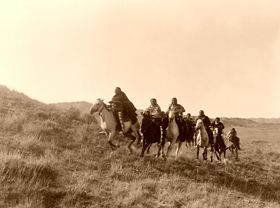
Cheyenne on horses, Edward S. Curtis, 1910.
Another incident occurred in the same locality, four miles west of Plum Creek, in July 1867. A band of Southern Cheyenne, under Chief Turkey Leg, took up the rails and ties over a dry ravine. It so happened that the train was preceded by a hand car with three section men — encountering the break, the car and men fell into the ravine, and one of their men was captured and scalped. In agony, he grabbed his scalp and got away in the darkness, as did his two more fortunate companions. The engineer discovered the break by the light of his headlight, but not in time to stop his train, and the engine and two carloads of brick, immediately following it, toppled into the ravine with the balance of the train, boxcars loaded with miscellaneous freight, piled up and roundabout. The engineer and fireman were caught and killed in the wreck.
The conductor, discovering the presence of the savages, ran back and flagged the second section following, which was backed up to Plum Creek Station. In the morning, the inhabitants of Plum Creek, together with the train crews, sallied out to give battle with the Indians but found they had departed. They had thrown out boxes and bales from the cars, taking whatever had struck their fancy from them. Bolts of bright-colored flannels and calicoes had been fastened to their ponies, which streamed in the wind or dragged over the prairies. Major North and his Pawnee were scattered in small detachments at the front between Sidney and Laramie; within 24 hours, they arrived on the scene on a special train. Following the trail, in about ten days, they fell upon the Cheyenne, 150 in number, and killed 15, taking two prisoners, one of them the nephew of Chief Turkey Leg.
Another occurrence occurred in April 1868 near Elm Creek Station; a band of Sioux attacked, killed, and scalped a section gang of five, and on the same day, attacked the station of Sidney, coming out on the bluff above it and firing down on the town. At the time of the attack, two conductors were fishing in Lodge Pole Creek, a little way below the station. They were discovered by the Indians, who charged at them and shot one who fell forward as if killed. The other happened to have a pistol on his person, which he kept at a distance until he reached the station, where he arrived with four arrows sticking in him and some four or five other bullet and arrow wounds, none of which proved severe. His companion also recovered.
Another severe attack was made on a train near Ogallala Station in September 1868. The ends of two opposite rails were raised to penetrate the cylinders, the engine went into the ditch, and the cars piled up. The fireman was caught in the wreck and burned to death, and the engineer and forward brakeman, riding on the engine, escaped unhurt. Armed, the train crew and passengers defended the train, keeping the Indians at bay until a wrecking train and crew arrived. The word was sent to Major North, who was at Willow Island with one Company of his Indians and overtaking them; two were killed, the balance escaping. The following month, the same party attacked a section gang near Potter Station, driving them in and running off 20 horses and mules. About fifteen of Major North’s Pawnee started in pursuit, overtook and killed two, and recovered most of the stolen stock.
The great battle of construction days occurred near Julesburg in July 1869. The regulars, under General Carr, and the Pawnee (150), under Major North, had put in two months scouting for several bands of Cheyenne and Sioux that had been raiding through the Republican and Solomon Valleys, attacking settlements, burning houses, killing and scalping men, women, and children, and raising Cain generally.
They ran them to earth near Summit Springs, where they were encamped. On July 11, they surprised and attacked those under the leadership of Tall Bull, a noted Cheyenne Chief. One hundred and sixty warriors were slain, among them Tall Bull.
As the attack was underway, he was seen mounted on his horse, with his wife and child behind him, trying to escape. Being headed off, he rode into a draw or pocket in the side of a ravine where some fifteen other warriors had taken refuge. He had been riding on an excellent horse; this he took to the mouth of the draw and shot. He then sent his wife and child out to give themselves up; this they did, the wife approaching Major North with hands raised in token of submission. She then advised the Major that seven warriors were still alive in the draw, entreating their lives to be spared.
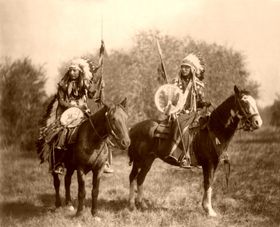
Sioux Indians on horseback, by Heyn, 1899.
As the Indians were shooting at every man they caught sight of, it was impossible to save them, and they were finally shot down. Among the prisoners was a white woman captured by one of their raids. Tall Bull had appropriated her as his wife, and when the village had been attacked, he had shot her and left her in his tepee, supposedly dead. Soon after the fight commenced, she was found by one of the officers who, entering the lodge, saw her in a sitting position with blood running down her waist. She was a German, unable to speak English, and up to this time, had supposed the fight was between Indians. On realizing that white men were in the vicinity and thinking when he started to leave her that she was about to be deserted, she clasped him around his legs and, in the most pitiful manner, begged him by signs and with tears not to leave her to the Indians. After the fight, she was taken to Fort Sedgwick, where she recovered and, in a few months afterward, married a soldier whose time had expired. During the fight, the troops captured nearly 600 head of horses and mules and an immense amount of miscellaneous plunder, including nineteen hundred dollars in $20 gold pieces taken from the German woman’s father when he was killed, and she was captured. Of this sum, nine hundred dollars was turned over to the woman, $600 by the Pawnee, and the balance by the regulars. Had the latter been as generous as the scouts when the appeal for its restoration was made, every dollar would have been returned.
The above incidents are a few out of thousands that occurred during the stormy construction days. They illustrate the trials and dangers encountered by the hardy pioneers. It was not only at “the front” that trouble was incurred, but after the building had progressed, the section men, station employees, and train crews were in constant danger. At the stations, it was a rule to build sod forts connected by an underground passage with the living quarters, to which retreat could be had in case of Indian attacks. For some time, small squads of soldiers were stationed at every station and section house along the line, quartered in sod barracks.
With the completion of the road and the establishment of regular train service, immigration soon poured in to such an extent as to make the settlers numerous enough to protect themselves. It was not long until “Lo,” like the buffalo, was only a memory.
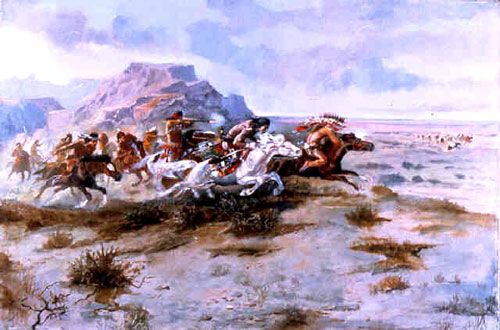
Indian Attack by Charles Marion Russell.
William Francis Bailey, 1906. Compiled and edited by Kathy Alexander/Legends of America, updated November 2025.
Author & Notes: This tale is adapted from a chapter of William Francis Bailey’s The Story of the First Trans-Continental Railroad: Its Projectors, Construction, and History, published in 1906 by the Pittsburgh Printing Co. The tale is not 100% verbatim, as minor grammatical errors and spelling have been corrected.
Also See: