
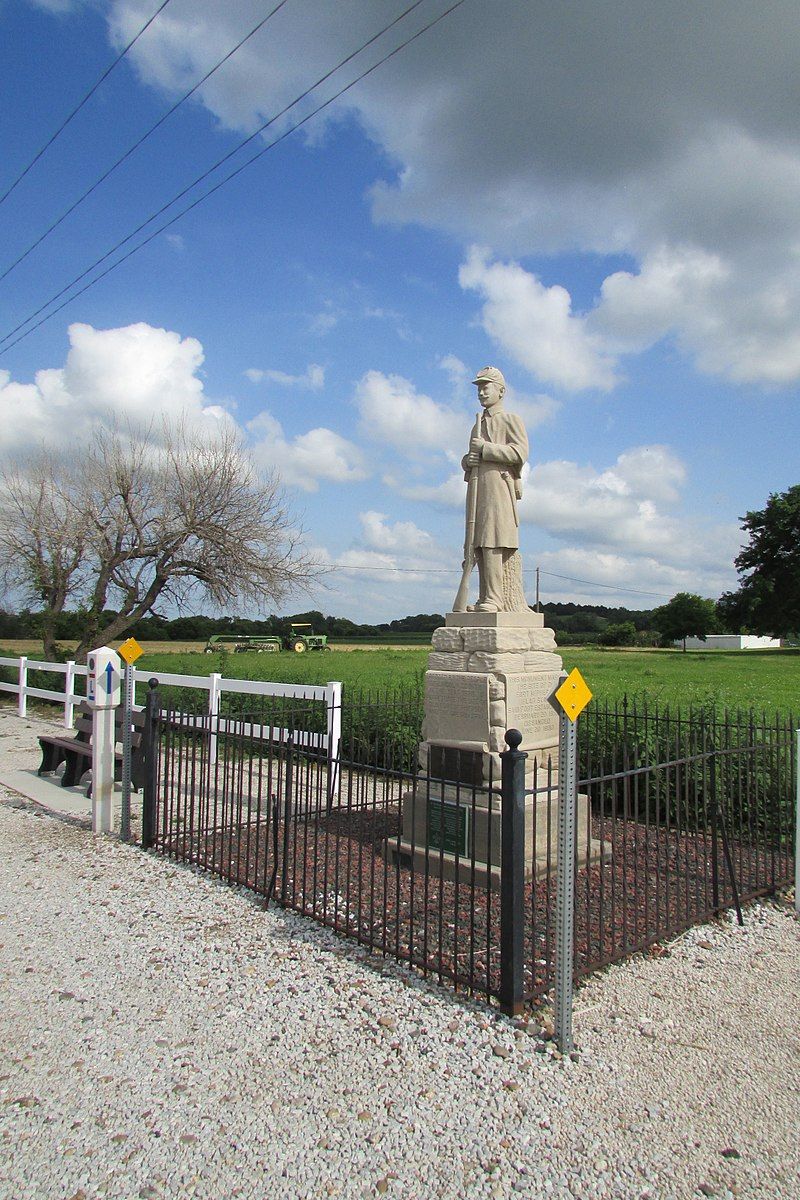
Site of Fort McPherson, along the Oregon and California Trails, courtesy of Wikipedia.
Fort McPherson, Nebraska, was first established in October 1863 in Cottonwood Canyon to protect the Overland Trail between Fort Kearny and Julesburg, Colorado. It was first known as Cantonment McKean, but was renamed Fort Cottonwood when construction began.
However, it was soon moved closer to Maxwell, Nebraska. It was renamed Fort McPherson on February 26, 1866, to honor General James B. McPherson, who fell while fighting with General William T. Sherman against Confederate forces in the Battle of Atlanta, Georgia. During its 17 years, the fort’s main activities were escorting stagecoaches and emigrant wagon trains, pursuing and punishing Indians for depredations, and protecting the mail and telegraph lines.
Fort McPherson played a vital role in the Indian Wars from 1864 until its abandonment in 1880. The fort launched numerous important campaigns and expeditions, including General Eugene Carr’s, which culminated in the defeat of the Cheyenne at the Battle of Summit Springs. Buffalo Bill Cody, the North Brothers, and the Pawnee Scouts served at Fort McPherson during this period. Lieutenant Colonel George A. Custer led the 7th Cavalry from Fort McPherson on June 15, 1867, for operations against Indians in Kansas.
On October 13, 1873, a tract of 107 acres was set aside as a national cemetery. Subsequent reductions have limited the cemetery to 20 acres. Burials in the McPherson National Cemetery have included soldiers who served in the Indian Wars across the West and those who served in the Civil War, Spanish-American War, World Wars I and II, and the Korean War.
After nearly two decades of strong economic and developmental influence across hundreds of miles, the Army abandoned the fort in 1880. The following spring, the buildings were sold at auction. Today, all that is left is the National Cemetery, located at Maxwell, Nebraska.
©Kathy Alexander/Legends of America, updated November 2026.
Also See:
Nebraska – The Cornhusker State
See Sources.