

Depiction of Faro in Tonopah, Nevada, in 1905
Whether on a riverboat atop the Mighty Mississippi River or in the smoky dimness of a mining camp saloon, a lucky draw could turn a broken man into a winner. In the days of the frontier west, poker was king with the mustachioed likes of Wild Bill Hickok, Doc Holliday, “Canada” Bill Jones, Wyatt Earp, Bat Masterson, and hundreds of others.
In the old west towns of Deadwood, Dodge City, Tombstone, and Virginia City, gamblers played with their back to the wall and their guns at their sides, as dealers dealt games with names such as Chuck-A-Luck, Three Card Monte, High Dice, and Faro, by far the favorite in the wild west saloons.
The exact origin of poker is unknown, but many have speculated that it originated from the 16th-century Persian card game called As Nas. Played with a 25-card deck containing five suits, the rules were similar to today’s Five Card Stud. Others are of the opinion that it was invented by the Chinese in 900 A.D. In all likelihood, the game derived from elements of various gambling diversions that have been around since the beginning of time.
Poker in the United States was first widely played in New Orleans by French settlers playing a card game that involved bluffing and betting called Poque in the early 1800s. This old poker game was similar to the “draw poker” game today. New Orleans evolved as America’s first gambling city as riverboat men, plantation owners, and farmers avidly pursued the betting sport.
John Davis opened the first American gambling casino in New Orleans around 1822. The club, open 24 hours a day, provided gourmet food, liquor, roulette wheels, Faro tables, poker, and other games. Davis also made certain that painted ladies were never far away. Dozens of imitators soon followed, making the gaming dens the primary attraction of New Orleans. The city’s status as an international port and its thriving gambling industry created a new profession called the card “sharper.”
Professional gamblers and cheats gathered in a waterfront area known as “the swamp,” an area even the police were afraid to frequent, and any gambler lucky enough to win stood a good chance of losing his earnings to thieves outside of the gambling rooms and saloons.
Gambling was outlawed in the rest of the huge Louisiana territory in 1811, but New Orleans continued to enjoy the prosperity brought by gambling for more than 100 years. Though the law was passed for the entire Louisiana Purchase, it was obviously not enforced, and casinos and gambling began to spread.
As commerce developed on the waterways, gambling traveled up the Mississippi and Ohio Rivers, then westward via covered wagons, and later on the railroad. The first written reference in the United States came from Jonathan H. Greer in 1834, when he referred to the amusement as the “cheating game.”
Some of the first gambling dens outside of New Orleans were started in river towns that were popular with both travelers and professional gamblers. It was here that many “sharpers” preyed on these transient people, with their pockets filled with their life savings, on the way to the new frontier. The dishonest gamblers also often ran confidence games and other con artist businesses in order to gaff the unwary pioneers. A host of companies specialized in manufacturing and selling card cheating devices. One riverboat gambler named George Devol was so proud of his ability to slip a stacked deck into a game that he once used four of them in one poker hand, dealing four aces to each of his four opponents.
It was professional gamblers who were largely responsible for the poker boom. Considering themselves as entrepreneurs, they took advantage of America’s growing obsession with gambling. Though they had a high opinion of themselves, the public viewed them with disdain, considering them as contributing nothing to society. This viewpoint was often warranted in many cases, as a large number of professional gamblers often cheated in order to win. To be successful, professional gamblers had to have irresistible personalities in order to attract men to play with them. Often dressing in dandy clothes, their success depended partly on chance and partly on skill, sometimes on sleight of hand, and in the Old West, on their shooting abilities. By the 1830s, citizens began to blame professional gamblers for any and every crime in the area, and gambling itself began to be attacked.
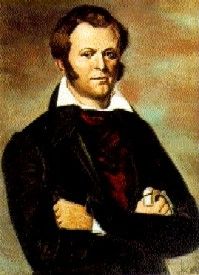
James Bowie
It was during these riverboat gambling heydays that an interesting story occurred in 1832. On a Mississippi steamboat, four men were playing poker, three of whom were professional gamblers, and the fourth, a hapless traveler from Natchez. Soon, the young, naïve man had lost all his money to the rigged game. Devastated, the Natchez man planned to throw himself into the river; however, an observer prevented his suicide attempt and then joined the card game with the “sharps.” In the middle of a high-stakes hand, the stranger caught one of the professionals cheating and pulled a knife on the gambler, yelling, “Show your hand! If it contains more than five cards, I shall kill you!” Six cards fell to the table when he twisted the cheater’s wrist. Immediately, the stranger took the $70,000 pot, returning $50,000 to the Natchez man and keeping $20,000 for his trouble. Shocked, the Natchez man stuttered, “Who the devil are you, anyway?” to which the stranger responded, “I am James Bowie.”
Anxious citizens of these river port towns grew increasingly wary of the confidence men who were multiplying so quickly. In Vicksburg, Mississippi, the citizens’ rage had become so intense by 1835 that a vigilante group lynched five cardsharps. Soon after this, many of the gamblers moved onto the riverboats, benefiting from the transient riverboat lifestyle.
After the Civil War, America pushed its boundaries West, where the frontier was born of speculators, travelers, and miners. These hardy pioneers had high-risk-taking characteristics, making any gambling situation a popular pastime for these rough-and-tumble men of the frontier. In virtually every mining camp and prairie town, a poker table could soon be found in each saloon, surrounded by prospectors, lawmen, cowboys, railroad workers, soldiers, and outlaws for a chance to tempt fortune and fate.
During the California Gold Rush of 1849, gambling houses sprouted up all over Northern California, offering a wide array of gaming tables, musicians, and pretty women to entertain the gamblers as they played. At this time, dance halls began to appear and spread throughout later settlements. While these saloons usually offered games of chance, their chief attraction was dancing. The customer generally paid 75¢ to $1.00 for a ticket to dance, with the proceeds being split between the dance hall girl and the saloon owner. After the dance, the girl would steer the gentleman to the bar, where she would make an additional commission from selling a drink.
A popular girl would average 50 dances a night, sometimes making more a night than a working man could make in a month. Dance hall girls made enough money that it was very rare for them to double as prostitutes. In fact, many former “soiled doves” found they could make more money as a dance hall girl.
As the Gold Rush gained momentum, San Francisco replaced New Orleans as the United States’ gambling center. Over 100 thriving saloons and brothels met the sailors and fortune-seeking travelers as they disembarked at the San Francisco harbor and stumbled into the infamous Barbary Coast Waterfront District.
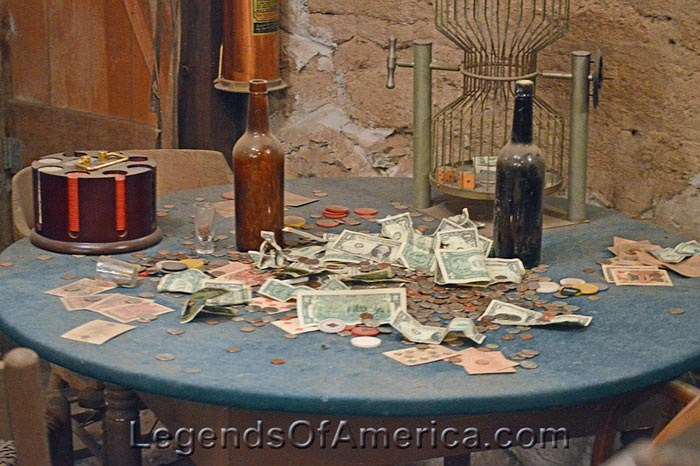
Tombstone, AZ – Birdcage Theatre Poker Table
Faro was by far the most popular and prolific game played in Old West saloons, followed by Brag, Three-card-monte, and dice games such as High-Low, Chuck-a-Luck, and Grand Hazard. During this time, gambling also began to invite more diversity, including Hispanics, blacks, Chinese, and women in the games. Three of this time’s more famous women gamblers were Calamity Jane, Poker Alice, and Madame Mustache.
Before long, many of the Old West mining camps, such as Deadwood, Leadville, and Tombstone, became as well known for gunfights over card games as they were for their wealth of gold and silver ore. Professional gamblers such as Doc Holliday and Wild Bill Hickok learned early to hone their six-shooter skills at the same pace as their gambling abilities. Taking swift action upon the green cloth became part of the gamblers’ code – shoot first and ask questions later.
One such occasion that clearly showed the quick and violent code was when Doc Holliday was dealing Faro to a local bully named Ed Bailey in Fort Griffin, Texas. Bailey was unimpressed with Doc’s reputation, and in an attempt to irritate him, he kept picking up the discards and looking at them. Peeking at the discards was strictly prohibited by the rules of Western Poker, a violation that could force the player to forfeit the pot.
Though Holliday warned Bailey twice, the bully ignored him and picked up the discards again. This time, Doc raked in the pot without showing his hand or saying a word. Bailey immediately brought out his pistol from under the table, but Doc’s lethal knife slashed the man across the stomach before the man could pull the trigger. With blood spilled everywhere, Bailey lay sprawled out dead across the table.
Inevitably, there were liquored-up miners and cowboys who would shoot up the saloons and sometimes the poker winner when they were angered by their losses. Even Wild Bill Hickok, mostly known for his heroics and prowess with a six-shooter, took advantage of those abilities when faced with a loss in Deadwood, South Dakota. Shortly before midnight, after a night of drinking and gambling, Hickok was playing a two-handed game with a man named McDonald when the stakes began to increase with every card dealt.
When the hand was complete and the middle of the table piled high with money, McDonald showed his hand, displaying three jacks. To this, Hickok responded, “I have a full house – aces over sixes,” then threw his hand face down upon the table. However, when McDonald picked up Hickok’s hand, he exclaimed, “I see only two aces and one six.” Wasting no time, Wild Bill drew his six-shooter with his right hand and replied, “Here’s my other six.” Then he flashed a Bowie knife with his left hand, stating, “And here’s my one spot.” McDonald immediately backed down, saying coolly, “That hand is good. Take the pot.”
By the end of the 19th century, gambling had spread like wildfire through the many mining camps, multiplying as the gold and silver hunters spread across the West, searching for new strikes. At this time, states and cities started to take advantage of these growing ventures by taxing gambling dens and raising money for their communities.
During the late 1800s, many towns and states across the western frontier began to enact new laws against gambling. Attempting to gain new levels of respectability, the laws primarily targeted the “professional gambler” more than gaming in general. Some types of gambling were made illegal, while limits were established on others. Initially, anti-gaming laws were weak and had little real effect on gambling, as they were difficult to enforce, establishments simply introduced new variants, and penalties were light.
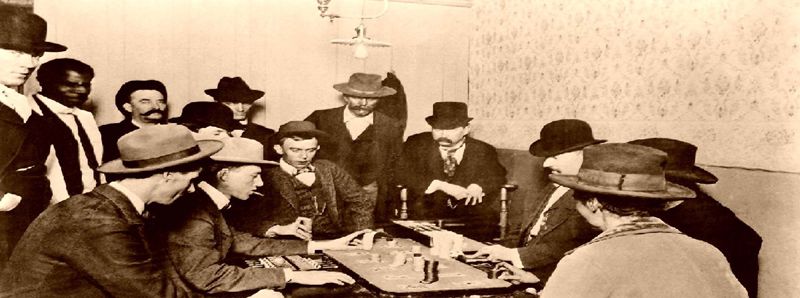
Faro gambling card game about 1900.
However, the laws were gradually strengthened; ironically, Nevada was one of the first states in the West to make gambling illegal in 1909. Other states soon followed suit, and true to the worst fears of the Puritans, gangsters combined liquor and gambling in the cities of New York, Cleveland, and Chicago during the 1920s.
By the time the Hoover Dam was constructed in 1931, Nevada relaxed its gambling laws, and casinos once more began to flourish. By 1939, there were six casinos and 16 saloons in Las Vegas. As automobile traffic increased and people began to travel more for leisure, Las Vegas began to boom into the gambling Mecca it is today.
Over the years, poker has evolved through legitimate casinos and backroom games to its many present variations. Over the last decades, several states have reintroduced gambling in limited formats, and the fastest-growing gambling opportunity today doesn’t even require you to leave your home as you log onto your computer to tempt the fates. Carefully regulated by gaming laws, poker is now the most popular card game in the world.
© Kathy Alexander/Legends of America, updated May 2026.
“If you’re playing a poker game and you look around the table and can’t tell who the sucker is, it’s you.” –– Paul Newman
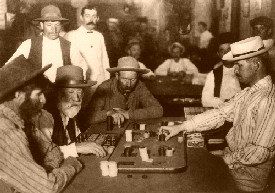
Playing Faro
Also See:
George Devol – Card Sharp of the Old West
See our Gamblin’ In the Old West Photo Gallery HERE!