
By Emerson Hough in 1905.
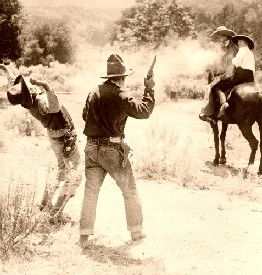
Highway Men.
What’s true for Texas, in the record of desperadoism, is equally applicable to the country adjoining Texas upon the north, long known under the general title of the Indian Nations. However, it is now being rapidly divided and allotted to meet the increasing demands of an ever-advancing civilization.
The great breeding ground of outlaws has ever been along the line of demarcation between the savage and the civilized. Here, in the Indian Territory, as though in a hotbed especially contrived, the desperado has flourished for generations. The Indians themselves retained much of their old savage standards after they had been placed in this supposedly perpetual haven of refuge by the government. They have been followed, ever since the first movement of the tribes into these reservations, by numbers of unscrupulous whites, such as hanging on the outskirts of the settlements and rebelling against the requirements of civilization.
Many white men of a certain type married among the Indians, and the half-breed is reputed as a product inheriting the bad traits of both races and the good ones of neither, a sweeping statement not always wholly true. Among these also was a large infusion of African-American blood emanating from the slaves brought in by the Cherokee and added to later by blacks moving in and marrying among the tribes.
These mixed-bloods seem to have been little disposed toward the ways of law and order. Moreover, the system of law was, of course, altogether different from that of the States. The freedom from restraint, the exemption from the law, which always marked the border, here found their last abiding place. The Indians were not adherents to the white man’s creed, save as to the worst features, and they kept their own creed of blood.
No man will ever know how many murders have been committed in these fair and pleasant savannahs, among these rough hills, or upon these rolling grassy plains from the time William Clark, the “Red Head Chief,” began the government work of settling the tribes in these lands, then supposed to be far beyond the possible demands of the white population of America.
Life could be lived here with small exertion. The easy gifts of the soil and the chase, coupled with the easy gifts of the government, unsettled the minds of all from those habits of steady industry and thrift accompanying the observance of the law. If one coveted his neighbor’s possessions, the ready arbitrament of firearms told whose the spoils were. Human life has been cheap here for more than half a hundred years, and this condition has endured directly up to and into the days of white civilization. The writer remembers very well that in his hunting expeditions of twenty years ago, it was always considered dangerous to go into the Nations, and this was true whether parties went in across the Neutral Strip or farther east among the Osage or the Creek Indians. The country below Coffeyville, Kansas, was wild and remote as we saw it then. However, now it is settling up, is traversed by railroads, and is slowly passing into the hands of white men in severalty, as fast as the blacks release their lands or as fast as the government allows the Indians to give individual titles. In those days, it was a matter of small concern if a traveler never returned from a journey among the timber-clad mountains or the blackjack thickets along the rivers, and many were the murders committed thereabouts that never came to light.
In and around the Indian Nations, there have also always been refugees from the upper frontier, Texas, or Arkansas. The country was long the natural haven of the lawless, as it has long been the designated home of a wild population. In this region, the creed has been much the same even after the wild ethics of the cowmen yielded to the scarcely more lawful methods of the land boomer.
Each man in the older days had his own notion of personal conduct, as each had his own opinions about the sacredness of property. It was natural that train robbing and bank looting should become recognized industries when the railroads and towns came into this fertile region, so long left sacred to the chase. The gangs of such men as the Cook boys, the Wickliffe boys, or the Dalton boys were natural and logical products of an environment. That this should be the more likely may be seen from the fact that for a decade or more preceding the great rushes of the land grabbers, the exploits of the James and Younger boys in train and bank robbing had filled all the country with the belief that the law could be defied successfully through a long term of years.
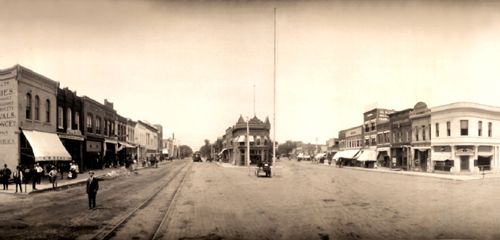
Coffeeville, Kansas.
The Cook Boys acted upon this basis until, at length, marshals shot them both, killed one, and sent the remnants of the other to the penitentiary.
Since it would be impossible to go into any detailed mention of the scores and hundreds of desperadoes that the Nations have at different times produced, it may be sufficient to give a few of the salient features of the careers of the band, which, as well as any, may be called typical of the Indian Nations brand of desperadoism, the once-notorious Dalton boys.
The Dalton family lived in lower Kansas, near Coffeyville, which was situated almost directly upon the border of the Nations. They engaged in farming, and two of the family were respectable farmers near Coffeyville within the last three or four years. The mother of the family still lives near Oklahoma City, where she secured a good claim when the Oklahoma lands opened to white settlement. The father, Lewis Dalton, was a Kentucky man and served in the Mexican-American War. He later moved to Jackson County, Missouri, near the home of the notorious James and Younger boys, and in 1851 married Adelaide Younger; they later moved from Missouri to Kansas. Thirteen children were born to them: nine sons and four daughters.
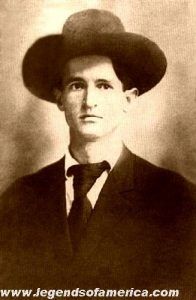
Bob Dalton, leader of the outlaw Dalton Gang.
Charles, Henry, Littleton, and Coleman Dalton were respected and quiet citizens. All the boys had nerve, and many of them reached office as U.S. Deputy Marshals. Franklin Dalton was killed while serving as a U.S. Deputy Marshal near Fort Smith, Arkansas, in 1887; his brother Bob was a member of the same posse at the time his fight was made with a band of horse thieves who resisted arrest. Grattan Dalton, after the death of his brother Franklin, was made a U.S. Deputy Marshal after the curious but efficient Western fashion of setting dangerous men to work at catching dangerous men.
He and his posse in 1888 went after a bad Indian, who, in the melee, shot Grattan in the arm and escaped. Grattan later served as U.S. Deputy Marshal in the Muskogee district, where the courts certainly needed men of stern courage as executives, for they had to deal with the most desperate and fearless class of criminals the world ever knew. Robert R. Dalton, better known as Bob Dalton, served on the posse of his brothers and soon learned what it was to stand up and shoot while being shot at.
He turned out to be about the boldest in the family and was later accepted as the clan leader during their exploits. He was also a U.S. Deputy Marshal at the dangerous stations of Fort Smith and Wichita, having much to do with the desperadoes of the Nations. He was chief of the Osage police for some time and saw many violent scenes. Emmett Dalton also possessed cool nerve and was soon known as a dangerous man to affront.
All the boys were good shots, but they seemed to have cared more for the Winchester than the six-shooter in their exploits, in which they were perhaps wise, for the rifle is, of course, far the surer when it is possible of use, and men mostly rode in that country with the rifle under their leg. Uncle Sam must take such material for his frontier peace officers as it proves itself efficient in serving processes. A coward may be highly moral, but will not do as a border deputy. The personal character of some of the most famous Western deputies would scarcely bear scrutiny. However, the Washington, D.C. government was often obliged to wink at that sort of thing. There came a time when it became increasingly difficult to wink at the methods of the Daltons as deputies. In one case, they ran off with many horses and sold them in a Kansas town. Because of this episode, Grattan, William, and Emmett Dalton made a hurried trip to California. Here, they became restless and returned to their old trade, thinking that no one on the Pacific Slope had any right to cause them fear. They held up a train in Tulare County and killed a fireman, but were repulsed. Later arrested and tried, William was cleared, but Grattan was sentenced to twenty years in the penitentiary. He escaped from jail before he got to the penitentiary and rejoined Emmett at the old haunts in the Nations, Emmett having evaded arrest in California. The Southern Pacific railway had a standing offer of $6,000 for the robbers at the time they were killed.
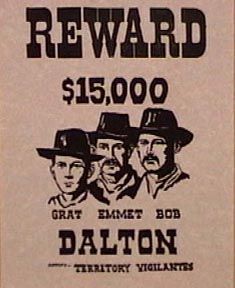
Dalton Wanted Poster.
The Daltons were now more or less obliged to hide out and to make a living as best they could, which meant robbery. On May 9, 1891, the Santa Fe train was held up at Wharton, Oklahoma Territory, and the express car was robbed, the bandits supposedly being the Daltons. In June of the following year, another Santa Fe train was robbed at Red Rock in the Cherokee Strip. The Frisco train was robbed at Vinita, Indian Territory. An epidemic of the old methods of the James and Younger bands seemed to have broken out in the new railway region of the Southwest. The next month, the Missouri, Kansas & Texas Railway was held up at Adair, Indian Territory, and a general fight ensued between the robbers and the train’s armed guard, assisted by the town’s citizens. A local physician was killed, and several officers and citizens were wounded, but none of the bandits was hurt, and they got away with a heavy loot of the express and baggage cars.
At Wharton, they had been less fortunate, for though they killed the station agent, they were rounded up, and one of their men, Dan Bryant, was captured, later killing and being killed by U.S. Deputy Marshal Ed Short.
Dick Broadwell joined the Dalton gang about now, and they nearly always had a few members besides their own family; their gang was made up and conducted on much the same lines as the James boys’ gang of Missouri, whose exploits they imitated and used as text for their bolder deeds. In fact, it was the boast of the leader, Bob Dalton, in the Coffeyville raid that he would beat anything the James boys ever did: rob two banks in one town at the same time.
Bank robbery was a sideline for the Daltons, but they did fairly well at it. They held up the bank in El Reno, Oklahoma, when no one was in the bank except the president’s wife, and took $10,000, forcing the bank to suspend business. By this time, the whole country was aroused against them, as it had been against the James-Younger boys. Pinkerton detectives had blanket commissions offered, and railway and express companies offered rewards running into the thousands. Each train across the Indian Nations was accompanied for months by a heavily armed guard concealed in the baggage and express cars. Passengers dreaded the journey across that country, and the slightest halt of the train for any cause was sure to bring to the lips of all the word of fear, “the Daltons!” It seems almost incredible that, in these modern days of fast railway service, of the telegraph, and of rapidly increasing settlements, the work of these men could so long have been continued, but such, nonetheless, was the case. The law was powerless and demonstrated its own unfitness to safeguard life and property, as it often has in this country. And, as so often has been the case, outraged society at length took the law into its own hands and settled the matter.
The full tale of the Dalton robberies and murders will never be known, for the region in which they operated was reticent, having its own secrets to protect. Still, at last, there came the climax in which the band was brought into the limelight of civilized publicity. They lived on the border of savagery and civilization. Now the press, the telegraph, the whole fabric of modern life, lay near at hand. Therefore, their last bold raid, in which they crossed from the country of reticence into that of garrulous news gathering, made them more famous than they had ever been.
The raid on Coffeyville on October 5, 1892, established and ended their reputation as border desperadoes. The rumor got out that the Daltons were down in the Nations, waiting for a chance to raid the town of Coffeyville, but the dreaded attack did not materialize when expected. When it was delivered, therefore, it found the town quite unprepared. Bob Dalton was the leader in this enterprise. Emmett did not want to go. He declared that too many people in Coffeyville knew them and that the job would be too big for them. However, he consented to join the party when he found Bob determined to attempt it in any case. There were in the band at that time Bob, Emmett, and Grattan Dalton, Bill Power, and Dick Broadwell. These lay in rendezvous near Tulsa, in the Osage country, two days before the raid, and spent the night before in the timber on Onion Creek, not far below town.
They rode into Coffeyville at half-past nine the following morning. The street being somewhat torn up, they turned aside into an alley about a hundred yards from the main street and, dismounting, tied their horses, which were thus left some distance from the banks, the First National and the Bank of C.M. Condon & Co., which were the objects of their design.
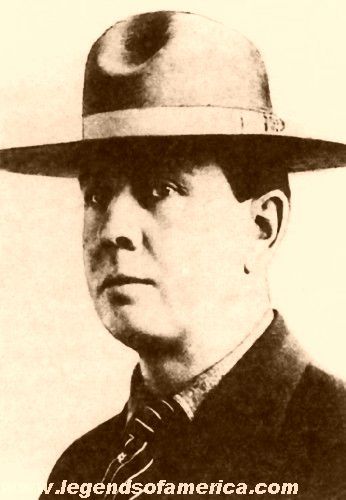
Emmett Dalton.
Grattan Dalton, Dick Broadwell, and Bill Power stepped over to the Condon bank, which was occupied at the time by C.T. Carpenter, C.M. Ball, the cashier, and T.C. Babb, a bookkeeper. Grattan Dalton threw down his rifle on Carpenter, with the customary command to put up his hands, the others being attended to by Powers and Broadwell. Producing a two-bushel sack, the leader ordered Carpenter to put all the cash into it, and the latter obeyed, placing three thousand dollars in silver and one thousand in currency in the sack. Grattan wanted the gold and demanded that the inner safe inside the vault be opened. The cashier, Ball, with a shifty falsehood, told him that they could not open that safe, for it was set on a time lock, and no one could open it before half-past nine o’clock. He told the outlaw that it was 20 minutes after nine (although it was 20 minutes past ten), and the latter said they could wait 10 minutes. He was, however, uneasy and was much of the mind to kill Ball on the spot, for he suspected treachery and knew how dangerous any delay must be.
It was daring to sit down in the heart of a civilized city, in broad daylight and on the most public street, and wait for a time lock to open a burglar-proof safe. Daring as it was, it was foolish and futile. As the robbers stood uneasily guarding their prisoners, the alarm was spread. A moment later, firing began, and the windows of the bank were splintered with bullets. The robbers were trapped. Broadwell was now shot through the arm, probably by P.L. Williams from across the street. Yet they coolly went on with their work as best they could, Grattan Dalton ordering Ball to cut the bag’s string and pour out the heavy silver, which would have encumbered them too much in their flight. He asked if there was not a back way out by which they could escape. He was shown a rear door, and the robbers stepped out to find themselves in the middle of the hottest street fight any of them had ever known. The city marshal, Charles T. Connolly, had given the alarm, and citizens were hurrying to the street with weapons they could find at the hardware stores and in their homes.
In the meantime, Bob and Emmett Dalton had held up the First National Bank, ordering cashier Ayres to hand over the money and terrorizing two or three bank customers who happened to be present. Bob knew Thomas G. Ayres and called him by his first name, “Tom,” and said, “Go into the safe and get out that money; get the gold, too.” He followed Ayres into the vault and discovered two packages of $5,000 each in currency, which he tossed into his meal sack.
The robbers here also poured out the silver and, having cleaned up the bank as they supposed, drove the occupants out of the door in front of them. As they got into the street, they were fired upon by George Cubine and C. S.Cox, but neither shot took effect. Emmett Dalton stood with his rifle under his arm, coolly tying up the neck of the sack that held the money.
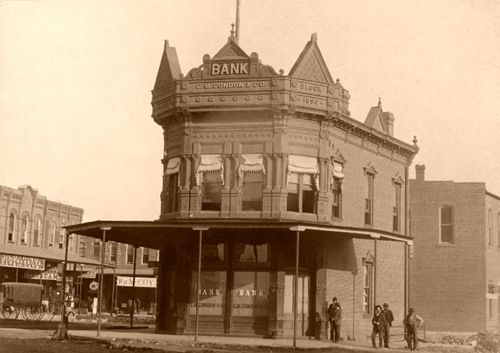
C.M. Condon Bank, Coffeyville, Kansas.
They then both stepped back into the bank and went out through the back door, which was opened for them by W. H. Shepherd, the bank teller, who, with Tom Ayres and B. S. Ayres, the bookkeeper, made the bank force on hand. J.H. Brewster, C.H. Hollingsworth, and A.W. Knotts were in the bank on business and were joined by E.S. Booth; all these were left unhurt.
The firing became general when the robbers emerged from the two bank buildings. The first man to be shot by the robbers was Charles T. Gump, who stood not far from the First National Bank armed with a shotgun.
Before he could fire, Bob Dalton shot him through the hand, the same bullet disabling his shotgun. A moment later, a young man named Lucius Baldwin started down the alley, armed with a revolver. He met Bob and Emmett, who ordered him to halt, but he kept on toward them for some reason. Bob Dalton said, “I’ll have to kill you,” and so shot him through the chest. He died three hours later.
Bob and Emmett Dalton now passed out of the alley behind the First National Bank and came into Union Street. Here, they saw George B. Cubine standing with his Winchester in his hands, and an instant later, Cubine fell dead with three balls through his body. Near him was Charles Brown, an old man who was also armed. He was the next victim, his body falling near that of Cubine, though he lived for a few hours after being shot. All four of these victims of the Daltons were shot at distances of about 40 or 50 yards and with rifles, the revolver being more or less uncertain at such ranges even in practiced hands. All the gang had revolvers, but none used them.
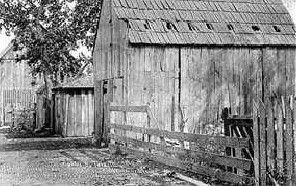
Death Alley, where the Dalton Gang was killed.
Thomas G. Ayres, late prisoner in the First National Bank, ran into a store nearby as soon as he was released, caught up a Winchester, and took a station near the street door, waiting for the bandits to come out at that entrance of the bank. Here, he was seen by Bob Dalton, who had gone through the alley. Bob aimed and, at 75 yards, shot Ayres through the head. Friends tried to draw his body back into the store, but they now met the fire of Grattan Dalton and Powers, who, with the crippled Broadwell, were now coming out of their alleyway.
T.A. Reynolds, a clerk in the same store, who went to the door armed, received a shot through the foot and thus became the third wounded man in that building.
H.H. Isham, one of the store’s owners, aided by M. A. Anderson and Charles K. Smith, joined in the firing. Grattan Dalton and Bill Power were shot mortally before they had gone more than a few steps from the door of the Condon Bank. Powers tried to get into a door when he was shot and kept his feet when he found the door locked, managing to get to his horse in the alley before a second shot killed him. Grattan Dalton also kept his feet and reached cover back of a barn about seventy yards from Walnut Street, the main thoroughfare. He stood at bay here and kept on firing. City Marshal Connolly, carrying a rifle, ran across to a spot near the corner of this barn. He had his eye on the bandits’ horses, which were still hitched in the alley. His back was turned toward Grattan Dalton. The latter must have been crippled somewhere in his right arm or shoulder, for he did not raise his rifle to his face but fired from his hip, shooting Connolly down at a distance of about twenty feet or so.
There was a slight lull at this point of the street fight, and during this, Dick Broadwell, who had been wounded again in the back, crawled into concealment in a lumber yard nearby the alley where the horses were tied. He crept out to his horse and mounted, but just as he started away, he met the liveryman, John J. Kloehr, who did some of the best shooting recorded by the citizens. Kloehr was hurrying thither with Carey Seaman, the latter armed with a shotgun. Kloehr fired his rifle and Seaman his shotgun, and both struck Broadwell, who rode away but fell dead from his horse a short distance outside the town.
Bob and Emmett Dalton, after killing Cubine and Brown and shooting Ayres, hurried on to join their companions and get to their horses. They spied F. D. Benson climbing out of a window at an alleyway junction and fired at him, but missed. An instant later, as Bob stepped into full view of those who were firing from the Isham store, he was struck by a ball and badly wounded. He walked slowly across the alley and sat down on a pile of stones, but like his brother Grattan, he kept his rifle going, though mortally shot. He fired once at Kloehr but was unsteady and missed him. Rising to his feet, he walked a few paces and leaned against the corner of a barn, firing two more shots. He was then killed by Kloehr, who shot him through the chest.
Grattan Dalton was feebly trying to get to his horse by this time. He passed the body of Connolly, whom he had killed, faced toward his pursuers, and tried to fire. He, too, fell before Kloehr’s Winchester, shot through the throat, dropping close to the body of Connolly.
Emmett Dalton was now the only one of the band left alive. He was as yet unwounded, and he got to his horse. As he attempted to mount, several shots were fired at him, and these killed the two horses belonging to Bob Dalton and Bill Power, who by this time had no further use for horses.
Two horses hitched to an oil wagon in the street were also killed by wild shots. Emmett got into his saddle but was shot through the right arm and through the left hip and groin. He clung to the sack of money they had taken at the First National Bank, and he kept his nerve and wits even under such pressure of peril. He might have escaped, but instead, he rode back to where Bob was lying and reached down his hand to help him up behind him on the horse.
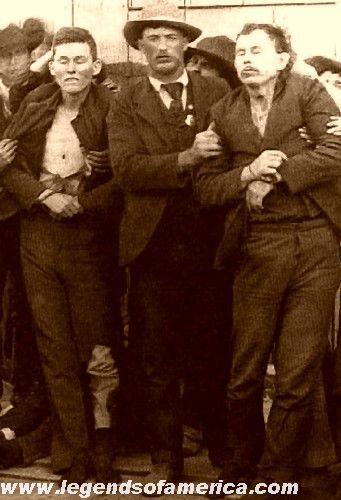
Bob and Grat Dalton, after having been shot in Coffeyville, Kansas.
Bob was dying and told him it was no use to try to help him. As Emmett stooped down to reach Bob’s arm, Carey Seaman fired both barrels of his shotgun into his back, Emmett dropping near Bob and falling upon the sack containing over $20,000 in cash. Men hurried up and called to him to throw up his hands. He raised his one unhurt arm and begged for mercy. It was supposed he would die, and he was not lynched but hurried away to a doctor’s office nearby.
In the little alley where the last scene of this bloody fight took place, there were found three dead men, one dying man, and one badly wounded. Three dead horses lay near the same spot. In the whole fight, which was, of course, all over in a few moments, four citizens and four outlaws were killed; three citizens and one outlaw were wounded. Less than a dozen citizens did most of the shooting, of which there were considerable — 80 bullet marks being found on the front of the Condon bank alone.
The news of this bloody encounter was flashed across the country, and within a few hours, the town was crowded with sightseers who arrived by trainloads. The dead bandits were photographed, and the story of the fight was told repeatedly, not always with uniformity of detail. Emmett Dalton, before he was sent to the penitentiary, confessed to different crimes, not all of them hitherto known, which the gang had at different times committed.
So ended in blood the career of as bloody a band as might well be discovered in the robber history of any land or time of the world. Indeed, it is doubtful if any country ever saw leagues of robbers as desperate as those that existed in America and had hands so red in blood.
This fact is largely due to this country’s peculiar history, with its rapid development under swift modern transportation methods. In America, the advance to the westward of the fighting edge of civilization, where it meets and mingles with savagery, has been more rapid than has ever been known in the settlement of any country of the world. Moreover, this has occurred precisely when weapons of the deadliest kind have been invented and made at a price that permits all to own them and many to become extremely skilled with them. The temptation and the means of murder have gone hand in hand. And in time, the people, not the organized law courts, have applied the remedy when the time has come for it.
Today, the Indian Nations are no more than a name. Civilization has taken them over. Statehood has followed territorial organization. Presently, rich farms will make a continuous sea of grain across what was once a flood of crime, and the wheat will grow yellow and the cotton white, where so long the grass was red.
Go To the Next Chapter – Desperados Of The Cities
Compiled and edited by Kathy Alexander/Legends of America, updated April 2026.
About the Author: Excerpted from the book The Story of the Outlaw: A Study of the Western Desperado, by Emerson Hough; Outing Publishing Company, New York, 1907. This story is not verbatim, as it has been edited for clerical errors and updated for the modern reader. Emerson Hough (1857–1923).was an author and journalist who wrote factional accounts and historical novels of life in the American West. His works helped establish the Western as a popular genre in literature and motion pictures. For years, Hough wrote the feature “Out-of-Doors” for the Saturday Evening Post and contributed to other major magazines.