Las Vegas, New Mexico.
Without exception, no town harbored a more disreputable gang of desperadoes and outlaws than did Las Vegas
–– Ralph Emerson Twitchell, historian
Las Vegas, New Mexico, lies on the edge of the eastern plains of New Mexico, at the foot of the Sangre de Cristo Mountains. Though not as well known as other Wild West towns, such as Dodge City, Deadwood, or Tombstone, Las Vegas is said to have been the worst of the worst in the Old West.
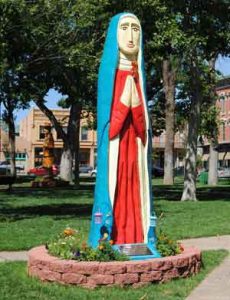
Our Lady of Sorrows, Las Vegas, New Mexico.
Las Vegas was established by a Mexican land grant in 1835. Originally called Nuestra Señora de Los Dolores de Las Vegas Grandes (Our Lady of Sorrows of the Great Meadows) by settlers whose roots in the area went back to the early 1600s, the settlement initially doubled as a fort, designed to be battened down for attacks by the Apache Indians. One-story adobe houses circled a large, central plaza where the stock could be driven to safety.
One of the colonists’ first large construction projects was the Acequia Madre (Mother Ditch), which channeled water from the Gallinas River. After more than 150 years, this ancient Mother Ditch still winds behind the buildings on the Plaza and waters the gardens of the western portion of the town.
In 1846, after the United States declared war on Mexico, General Stephen W. Kearney led his Army of the West to Las Vegas to declare New Mexico a U.S. possession. When he arrived, he found a thriving community of 1,500 Spanish settlers. Training several very large cannons directly on the Plaza, the men of Las Vegas quickly surrendered.
By that time, the Santa Fe Trail was being traveled frequently, allowing entrepreneurs to send their wares westward while enterprising Las Vegans traded eastward. For the travelers along this rustic path, Las Vegas was a welcome sight, as it was the first town of any size after 600 miles of travel from Kansas. These traders, along with other pioneers and prospectors, demanded whiskey and women, and the town readily complied.
The army remained in Las Vegas until moving to Fort Union, about 20 miles North of the city, in 1851. Built to protect the Santa Fe Trail from Indian raids, the new fort further encouraged Las Vegas’s growth and development, as the army bought supplies for the several hundred soldiers and civilians stationed there.
The Santa Fe Trail offered jobs, and the many town merchants prospered during this time, growing to over 1,000 people by 1860. During the next two decades, its population quadrupled as it established itself as a significant trade center.
But the era was also riddled with disagreements between the Spanish, the new Anglo emigrants, and the local Apache. When the Atchison, Topeka & Santa Fe Railroad settled in 1879, it was the biggest city between San Francisco, California, and Independence, Missouri.
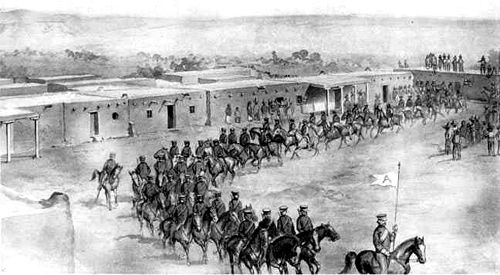
Army leaving Las Vegas, New Mexico.
Las Vegas soon had modern utilities such as waterworks and a telephone company. The tracks were laid East of the Gallinas River, a mile from the Plaza. When the iron horse finally arrived on July 4, 1879, hundreds of citizens gathered around, including merchants, professionals, desperados, and dancehall girls.
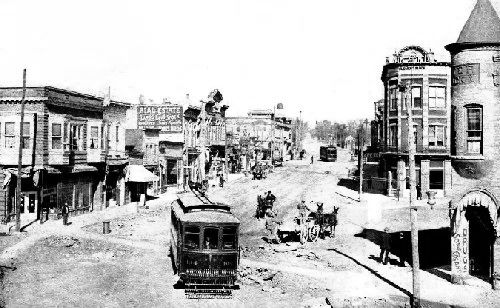
Overnight, a new town was born on the East banks of the Gallinas River, a mile East of the Plaza. At first, a settlement of tents, sheds, and makeshift shelters was built, but within just a few short years, many permanent buildings and a competing commercial district had been established. By then, the town had grown so large that it rivaled Denver, Tucson, and El Paso in size.
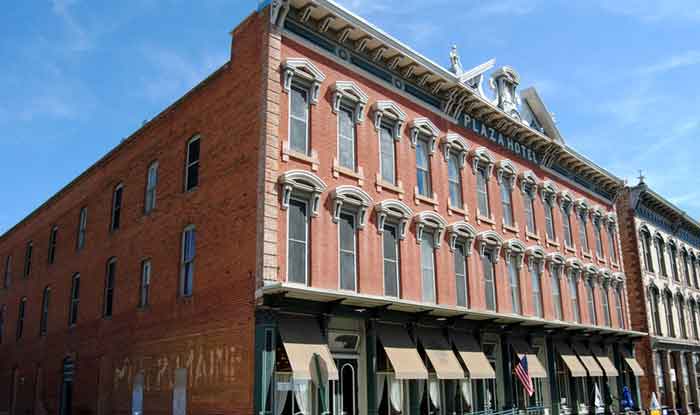
Plaza Hotel in Las Vegas, New Mexico
The six trains that stopped there daily opened up yet another era of prosperity, bringing legitimate businesses and introducing even more new elements into the town’s already distrustful environment. Before long, outlaws, bunko artists, murderers, and thieves became so common that the eastern part of the settlement became utterly lawless.
Soon, the rail terminus policed the new arrivals with a group of “peace officers” called the “Dodge City Gang.” However, these members were almost as lawless as the rest, including J.J. Webb, the current marshal; “Mysterious Dave Mather,” Joe Carson, “Dirty Dave” Rudebaugh; and “Hoodoo Brown,” the Justice of the Peace.
It was during these notorious days of Las Vegas history that the town was called home or visited by the likes of Doc Holliday, Big-Nose Kate, Jesse James, Billy the Kid, Bob Ford, Wyatt Earp, Rattlesnake Sam, Cock-Eyed Frank, Web-Fingered Billy, Hook Nose Jim, Stuttering Tom, Durango Kid, Handsome Harry the Dancehall Rustler, Vicente Silva, and his gang, and Belle Sidons (alias Monte Verde).
In the summer of 1879, Doc Holliday rode into Las Vegas, where he hung out his shingle for the last time. However, the idea was short-lived; only a few weeks later, he bought a saloon on Center Street. His partner and financial backer, John Joshua Webb, once a Dodge City lawman, was by then a part of the notorious Dodge City Gang.
On July 19, 1879, Doc got into an argument with a local gunman named Mike Gordon, who was rather popular with the locals. The two took the argument to the street, where Doc politely invited Gordon to start shooting whenever he felt like it. Gordon accepted this invitation and wound up dead, lying in the dusty street with three shots in his belly.
After a lynch mob formed with plans to lynch Holliday, Doc headed back to Dodge City. However, he arrived only to find that Wyatt Earp had gone to a new silver strike in Tombstone, Arizona.
By January 1880, Las Vegas was firmly under the Dodge City Gang’s control. On January 22, 1880, the Las Vegas Shootout at the Variety Hall Shootout would launch Dave Mather into Old West fame after a wild gunfight that left several dead or eventually lynched.
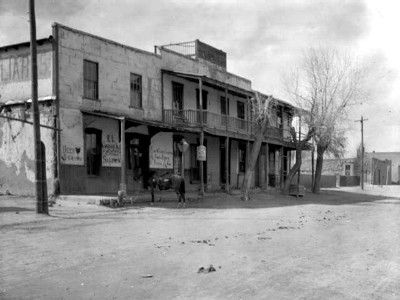
Las Vegas, New Mexico Saloon
Townspeople soon tired of the escapades of the lawless people of their city and took matters into their own hands. The Las Vegas Optic, on April 8, 1880, posted this notice:
TO MURDERERS, CONFIDENCE MEN, THIEVES:
“The citizens of Las Vegas have tired of robbery, murder, and other crimes that have made this town a byword in every civilized community. They have resolved to put a stop to crime if in attaining that end, they have to forget the law and resort to a speedier justice than it will afford. All such characters are, therefore, hereby notified that they must either leave this town or conform themselves to the requirements of law, or they will be summarily dealt with. The flow of blood must and shall be stopped in this community, and the good citizens of both the old and new towns have determined to stop it, if they have to HANG by the strong arm of FORCE, every violator of the law in this country.” — Vigilantes
Soon after this notice, most outlaws headed for new locations with less resistance. However, the lawlessness wasn’t entirely done. In 1881, after Billy the Kid was killed at Fort Sumner, New Mexico, his index finger was sent in a jar to the Las Vegas newspaper.
The Las Vegas Optic reported about the incident:
“It [his finger] is well-preserved in alcohol and has been viewed by many in our office today. If the rush continues, we shall purchase a small tent and open a sideshow to which complimentary tickets will be issued to our personal friends.”
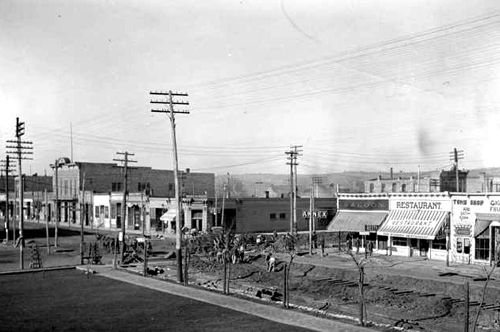
Las Vegas Plaza
Lawlessness continued in Las Vegas, though it was not so apparent to the town’s citizens. Distracted by earlier Shootout in the streets, the town noticed a marked increase in cattle rustling. By the late 1880s, entire herds were disappearing. Secretly led by Vicente Silva, a respected saloon owner of the Imperial Saloon, the group was called the Silva’s White Caps, or Forty Bandits, or sometimes the Society of Bandits. Often meeting in Silva’s saloon, the gang held the area in a virtual stranglehold until October 1892. At this time, the Las Vegas citizens hanged a fellow gang member named Pat Maes. Soon after that, the bandit group gradually disintegrated. Silva was eventually murdered by former gang members and was buried at Camp de los Cadillos on May 19, 1895.
Finally, the town began to settle down, and in 1898, Las Vegas provided 21 Rough Riders to Teddy Roosevelt, most of whom were at his side during the famed charge up San Juan Hill. The town hosted the first Rough Riders reunion — attended by the soon-to-be president himself.
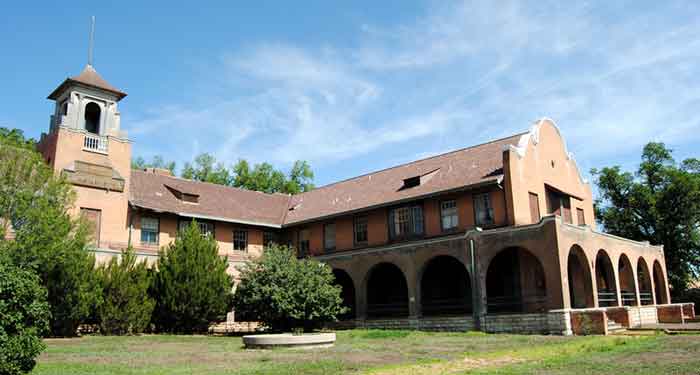
La Casteneda Hotel, Las Vegas, New Mexico, by Kathy Alexander.
Today, this historic town of some 15,000 souls is one of New Mexico’s lesser-known tourist destinations, offering an extremely rich history with much to see and do. Over 900 buildings in Las Vegas are listed on the National Register of Historic Places. With old Spanish colonists and European immigrants, the city offers a myriad of architectural treasures that give Las Vegas its special charm.
While in Las Vegas, visit the Las Vegas City Museum and Rough Riders Memorial, as well as several picturesque historic districts, including the Bridge Street and Plaza areas, where there is a designated Santa Fe Trail site. The La Castenada Hotel is a “must-see” landmark of Las Vegas’ post-Santa Fe Trail era. The 1898 building, once housing one of the famous Harvey House Hotels, faces the railroad tracks in the 500 block of Railroad Avenue. Still displaying its graceful facade and arched walkways, the old hotel hosted Teddy Roosevelt’s Rough Riders Reunion in 1899. After years of vacancy and abandonment, Allan Affeldt purchased the hotel in 2014 with plans to renovate the historic property. Affeldt and his wife helped restore the La Posada Hotel in Winslow, Arizona, back in the 1990s. After making some improvements, the old hotel was sold again in August 2025 to Dennis & Annette Lucero and Carlos & Patricia Lopez, who say they plan to keep its rich character and launch a complementary restaurant and bar.
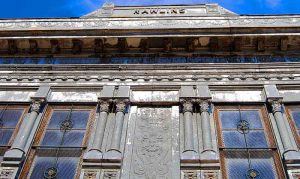
Rawlins Building, Las Vegas, New Mexico, by Kathy Alexander.
Across the street looms the Rawlins building, once the residence for the Harvey Girls who staffed the hotel’s dining room. Interested travelers should stop at the Chamber of Commerce to pick up free maps and pamphlets detailing six separate walking tours. Modern Las Vegas also offers traditional arts and crafts in shops and galleries featuring everything from antiques to unique original furniture, paintings, art objects, clothing, weavings, and jewelry. The Las Vegas National Wildlife Refuge and MacAlister Lake, surrounded by recreation and wilderness experiences, are within easy driving distance of Las Vegas.
Fort Union National Monument is about 20 miles North of Las Vegas and offers a peek into the past through its historic fort buildings, which attract thousands of people each year. Pecos National Monument, about 30 miles Southwest of Las Vegas, is a monument museum that pays tribute to Native Americans who lived in the area in the 1500s.
They are as tough a bunch of bad men as ever gathered outside a penal institution.
–– Miguel Otero, Territorial Governor, speaking about the men of Las Vegas, New Mexico
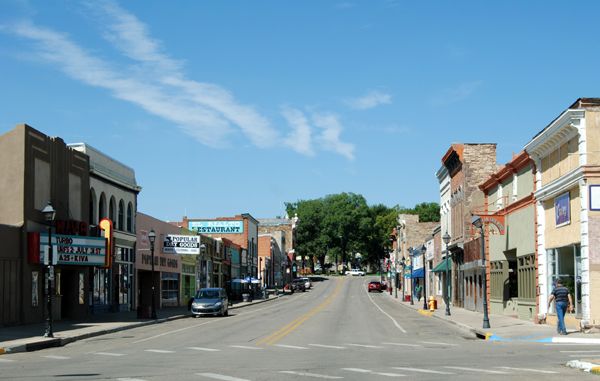
Las Vegas, New Mexico, today, by Kathy Alexander.
©Kathy Alexander/Legends of America, updated October 2026.
Also See:
Outlaws, Gunfighters, Lawmen & More
See Sources.