

Cherokee Chief John Ross.
Born on October 3, 1790, in Turkeytown, Alabama, John Ross was the longest-serving Principal Chief of the Cherokee Nation, a businessman, and a landowner who led his people through the Trail of Tears during the Indian Removal.
John was the son of Daniel Ross, a Scotsman who had gone to live among the Cherokee during the American Revolution. His mother was also ¾ Scottish and ¼ Cherokee.
John’s father, Daniel, established a store at Chattanooga Creek near the foot of Lookout Mountain, which operated until about 1816. Determined that his children would receive a quality education, Daniel built a small school and hired a teacher. John Ross received his early education here before attending another school in Kingston, Tennessee, and later the Maryville, Tennessee Academy.
Though only 1/8th Cherokee, Ross was of Indian heritage through and through. Early in his life, he witnessed much brutality on the American frontier as both Indians and settlers alike were constantly raiding the Cherokee villages.
In 1809, at the age of 19, U.S. Indian Agent Return J. Meigs sent Ross on an official mission to the Western Cherokee of Arkansas. Due to his quiet and reserved manner, the mission succeeded, as he inspired confidence among the Indians and the white settlers. Proving his leadership and diplomacy at an early age, he was immediately sent on another trip.
During the War of 1812, he served as an adjutant in the Cherokee regiment. The Cherokee fought valiantly without pay, yet were still not considered true Americans.
A year later, he fought in the Creek War of 1813-14 with General Andrew Jackson and 1,000 other Cherokee. Attaining the rank of Lieutenant, he fought at the Battle of Horseshoe Bend against the British-allied Creek Indians. On March 28, 1814, 600 Creek warriors were killed, and peace was restored.
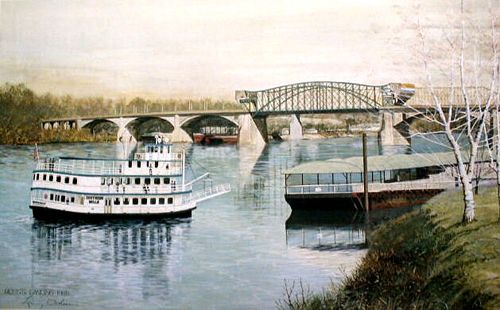
Ross Landing, Tennessee.
In 1815, John Ross and Timothy Meigs opened a trading post on the Tennessee River in Chattanooga that soon became known as Ross’ Landing. In addition to providing supplies at the trading post, a ferry was used to transfer merchandise and people across the river. Soon, a group of Congregationalists, descendants of the Puritans, built a mission at Ross’ Landing called the Brainerd Mission. Seeing the value of a good education, Ross did everything he could to help the missionaries provide schooling for the Cherokee youth.
Viewed as astute and likable, Ross relocated to Georgia in 1817 and was chosen as a member of the Cherokee Nation Council. The same year, the U.S. government asked the Cherokee to cede all lands North of the Hiwassee River and move West, despite the March 30, 1802 treaty, which guaranteed them perpetual rights to their land.
Two years later, in 1819, Ross was elected president of the National Cherokee Committee, a position he held until 1826. During this time, Ross and Major John Ridge, the speaker of the Cherokee National Council, established a capital near present-day Calhoun, Georgia, in 1825.

Cherokee leader Major Ridge.
He then became Assistant Chief of the Eastern Cherokee and participated in drafting the Cherokee Constitution in 1827. The Constitution, modeled after the U.S. Constitution, included a Senate and a House of Representatives. John Ross was elected Principal Chief of the Cherokee Nation in 1828, a position he would hold until he died in 1866.
Ross was also an astute businessman involved in several business ventures and owned a 200-acre farm and several slaves.
Over the next ten years, Ross fought the white settlers, attempting to displace the Cherokee from their lands. Fighting not with weapons but with words, he turned to the press and the courts to support the Cherokee cause.
When gold was discovered in White County, Georgia, in 1828, the state began to push even harder to remove the Indians. The Georgia Legislature soon outlawed the Cherokee government and confiscated tribal lands. When the Cherokee appealed for federal protection, their appeal was rejected.
Though Ross won several court rulings, this would make no difference as Ross’ former comrade, President Andrew Jackson, authorized the Indian Removal Act of 1830.
The Jackson Administration began pressuring the Cherokee and other tribes to sign removal treaties, but the Cherokee rejected any proposals. However, when Jackson was reelected in 1832, some Cherokee believed removal was inevitable. A Treaty Party, led by Major John Ridge and including Stand Watie, believed that it was in the best interest of the Cherokee Nation to get the best possible terms from the U.S. government. Cautiously, Ridge began unauthorized talks with the Jackson administration.
However, Chief John Ross and most Cherokee people remained adamantly opposed to removal. In 1832, Ross canceled the tribal elections, and the Council impeached Ridge, and a member of the Ridge Party was murdered. The “Treaty Party” responded by forming their council, representing only a small minority of the Cherokee people. Both the Ross government and the Ridge Party sent independent delegations to Washington.
In the end, 500 of the Cherokee (out of thousands) supported a treaty to cede the Cherokee lands in exchange for $5,700,000 and new lands in Indian Territory (now Oklahoma). Though more than nine-tenths of the tribe repudiated the actions, and a single elected tribal official did not sign it, Congress ratified the treaty on May 23, 1836.
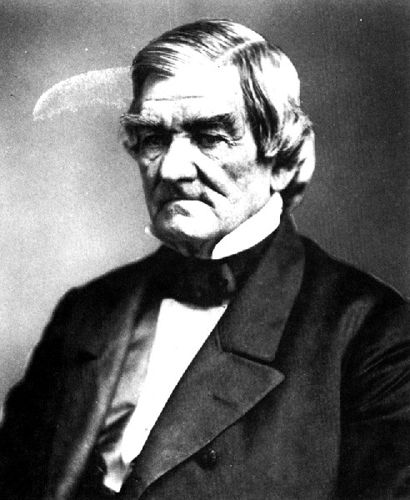
John Ross.
Chief Ross and the Cherokee National Council maintained that the document was a fraud and presented a petition with more than 15,000 Cherokee signatures to Congress in the spring of 1838. Other white settlers were also outraged by the treaty’s questionable legality. On April 23, 1838, Ralph Waldo Emerson appealed to Jackson’s successor, President Martin Van Buren, urging him not to inflict “so vast an outrage upon the Cherokee Nation.” But it was not to be.
Soon, the Cherokee were forced to move to Indian Territory (Oklahoma) on what would become known as the Trail of Tears. Along the 2,200-mile journey, road conditions, illness, cold, and exhaustion took thousands of lives, including Chief John Ross’ wife, Quatie. Though the federal government officially stated some 424 deaths, an American doctor traveling with one party estimated that 2,000 people died in the camps and another 2,000 along the trail. Other estimates have been stated that conclude almost 8,000 of the Cherokee died during the Indian Removal.
Once the tribe was relocated to a site near present-day Tahlequah, Oklahoma, John Ross was reelected Principal Chief. The same day, Major Ridge was killed for violating the law forbidding the unauthorized sale of the property. Soon, the land was set aside for schools, a newspaper, and a new Cherokee capital.
During the Civil War, the Cherokee aligned themselves with the Confederacy, a move that repudiated any treaties previously signed with the Federal Government.
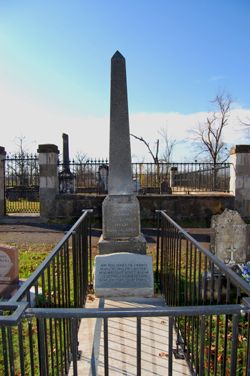
John Ross Grave at Park Hill, Oklahoma, near Tahlequah.
In September 1865, Ross attended the Grand Council of Southern Indians at Fort Smith, Arkansas, where new treaties were prepared between the Cherokee and the Federal government. In July 1866, though in failing health, he accompanied a delegation to Washington, where new treaties were signed on July 19, 1866. Soon after the treaties were signed, Ross took to his bed at the Medes Hotel in Washington, D.C., where he died on August 1, 1866. Although first buried beside his wife Mary in Wilmington, Delaware, his body was returned to Indian Territory a few months later, where he is buried at Ross Cemetery in Park Hill, Oklahoma.