
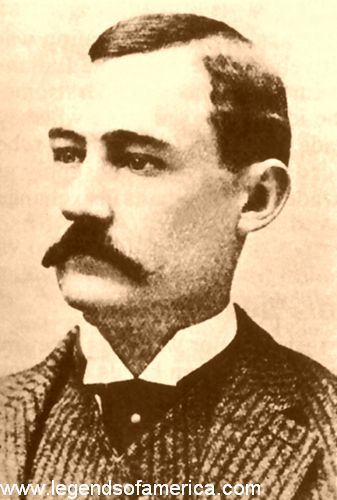
Luke Short.
By W.R. (Bat) Masterson in 1907
The subject of this narrative might have “died with his boots on,” for he had many chances — but he didn’t. The fact that he lived to die in bed, with his boots removed, as all good folk like to do when the end has come, may have been due to good luck, but I hardly think so. That he was the quickest at the critical moment is, perhaps, the best answer. When the time came for Luke Short to pass out of this life — to render up the ghost as it were, he was able to lie in bed in a home that was his own, surrounded by wife and friends, and peacefully await the coming of the end.
There was nothing in his wan and drawn features as he lay on that last bed of sickness at Fort Worth, Texas, to indicate that luck had ever been his friend. He knew that his time had come and was reconciled to his fate. Every contour in that cold, stern face, upon which death had already left its impress, showed defiance. He could almost be heard to say: “Death! You skulking coward! I know you are near; I also realize I cannot defeat you, but if you will only make yourself visible for one brief moment, I will try!”
That he was willing to try, no matter how great the odds might be against him, was the one trait in his character that was ever conspicuously present.
Was Known as a “White Indian”
Luke was a little fellow, so to speak, about five feet, six inches in height and weighing in the neighborhood of one hundred and forty pounds. It was a small package but one of great dynamic force. In this connection, it will not be out of order for me to state that, though of slight build, it required a 7 1/8 hat to fit his well-shaped, round head. When he left his father’s ranch in western Texas, where he had been occupied as a cowboy in the mid-seventies, for the Red Cloud Agency in South Dakota, he was nothing more than a white Indian. That is, he was an Indian in every respect except color. And, as nearly all of our American Indians living west of the Missouri River in those days were wild and hostile and on the warpath most of the time, a fair idea of Luke Short may be gleaned from this statement. Luke had received none of the advantages of a school in his younger days; he could hardly write his name legibly. Indeed, it wasn’t very likely that he had ever seen a schoolhouse until he reached man’s estate. But he could ride a bronco and throw a lariat; he could shoot both fast and straight and was not afraid.
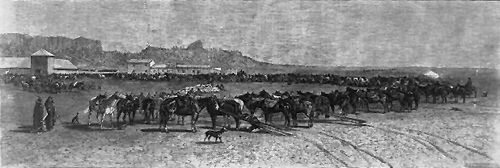
Red Cloud Agency, illustration from Harper’s Weekly, 1876.
He had no sooner reached Nebraska’s northern boundary line, hard by the Sioux Indian Reservation, than he established what he was pleased to call a “trading ranch.”
His purpose was to trade with the Sioux Indians, whose reservation was just across the line in South Dakota. Instinctively, he knew that the Indians loved whiskey. As even in those days he carried on his shoulders something of a commercial head, he conceived the idea that a gallon of whiskey worth ninety cents was not a bad thing to trade an Indian for a buffalo robe worth ten dollars. Accordingly, Luke proceeded to lay in a goodly supply of “Pine Top,” the name by which the whiskey was traded to the Indians in exchange for their robes.
Uncle Sam Objects to His Business
He was not long in building up a lucrative business, nor was it long before the Indian chiefs of the Sioux tribe came after him. Drunken bands of young bucks were regularly returning to their villages from the direction of the Short rendezvous, loaded to the muzzle with “Pine Top,” and, as every drink contained at least two fights and as it usually took about ten drinks to cause an Indian to forget that the Great White Father abode in Washington, the condition of those who had found entertainment at the Short ranch, when they reached their camp, can better be imagined than told.
The Indian agent in charge of this particular branch of the Sioux tribe, with whom Short had been dealing, soon got busy with Washington. He represented to the Department of the Interior that a band of cutthroat white men, under the leadership of Luke Short, were trading whiskey to his Indians and that he was powerless to stop it, as the camp of the white men was located just across the reservation line, in the State of Nebraska, which was outside of his jurisdiction. He requested that the government immediately remove the whiskey traders and expel them from the country. Otherwise, said he, an Indian uprising will surely follow. As was to be expected, the government instructed the post commander at Omaha to get after the purveyors of the poisonous “Pine Top,” who were charged with causing such havoc among the noble red men of the Sioux reservation.
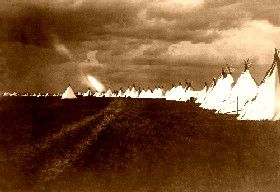
Sioux Tipis, 1902.
The military commander at Omaha soon had a company of United States cavalry after Short. As he had no notice of such a move being made against him, he was soon a prisoner in the hands of the government authorities. When the soldiers arrived, he was alone in his little dugout, cooking his dinner. He was told that he was a prisoner, by order of the government, for having unlawfully traded whiskey to the Indians.
“Is that all, gentlemen?” said Luke as he invited the officer in command of the soldiers to sit down and have a bite to eat with him.
“There will be no time for eating,” said the officer, “as we must reach Sidney by tomorrow morning in time to catch the Overland train for Omaha. So get together what things you care to take along, and we will be on our way.”
“I have nothing that I care to take along,” Luke replied, “excepting what I have on,” and as that mainly consisted of a pair of Colt pistols and a belt of cartridges, the officer soon had them in his custody.
“Where are your partners?” queried the Captain.
“I have no partners,” replied Short. “I’ve been running this ranch by myself.”
But Luke did have a partner, who was at that very time in Sidney procuring provisions and more “Pine Top.”

Sidney, Nebraska.
After everything around the ranch resembling whiskey had been destroyed by order of the officer in command, the trip to Sidney, about 75 miles away, was taken up. Luke was put astride a government horse, his feet fastened with a rope underneath the animal’s girth, and told to ride in the center of the cavalry company. Sidney reached in time to catch the Overland train, and Luke was hustled aboard with as little ceremony as possible.

Sidney, Nebraska.
Luke had, by his quiet and diffident manner during the short time he had been prisoner, succeeded in having the officer regard him in the light of a harmless little adventurer, who really did not seem capable, even if so disposed, of committing a crime of any sort; and for this reason did not have him either handcuffed or shackled, after placing him aboard the train for Omaha.
Sidney, Nebraska, was a tiny place in those days. The permanent population, in all probability, did not exceed the thousand mark. Sidney, following the custom of all small hamlets, however, would turn out when there was anything unusual going on. And the sight of a company of United States soldiers lined up at the railroad station was enough to arouse her curiosity and cause her townsfolk to turn out in a body and investigate the cause. Luke Short’s partner was among those who came to see the big show at the depot, and his surprise can well be imagined when he discovered that no less a person than his partner was responsible for the big event. It did not take Luke and his partner long to fix up a code of signals by which they could communicate with each other. Luke could say a few things in the Indian language that his partner could understand, and to which he could make a comprehensible reply.
Short Escapes from the Soldiers
“Skidoo” and “Twenty-three” were terms familiar to Short, even in those days. However, they were conveyed through sign language instead of being spoken, as they are now.
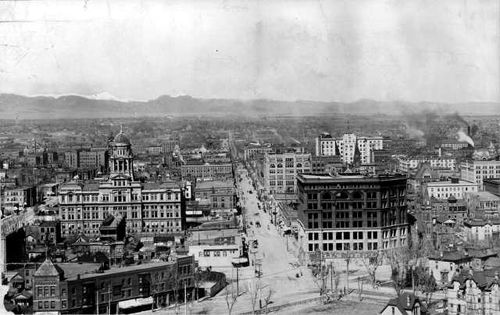
Vintage Denver, Colorado.
Luke made his partner understand that he would soon be back in Sidney and have everything in readiness so that they could leave the country with as little delay as possible as soon as he arrived. The charge of unlawfully trading whiskey to the Indians did not seem to concern him. “I can beat that sure,” he said to himself, “but supposing that agent should take a notion to call for a count of heads. What then? I know that there are several young men, whom I caught trying to steal my ‘Pine Top,’ who will not be there to answer roll call in case one is ordered. I planted those bucks myself, and, outside of my partner, no one knows the exact location of the cache. While I have no notion of putting in a claim against the government for the work, I must be careful and avoid having it endeavor to show that I really did perform such a service.”
These were perhaps the thoughts he was conveying to his partner by signals when he boarded the train at Sidney that was to take him to Omaha.
To state the story briefly, Luke did not tarry long with the soldiers after the train left Sidney. That night, Luke found himself back in town, and before the following morning, he and his partner were well on their way to Colorado, driving a significant span of mules hitched to a canvas-covered wagon.
This occurred in the fall of 1878, and as Leadville was then experiencing a major mining boom, Luke headed for Denver, Colorado.
It must be remembered that in that country in those days, there were no settlements of any kind, and, by keeping from the line of the railroad, a white person was seldom seen.
A Little Affair in Leadville
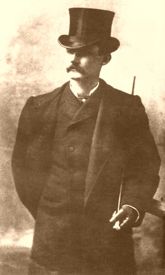
Luke Short.
Luke and his partner arrived in Denver at a later time and drove to one of the city’s horse corrals, where they disposed of their outfit at a reasonable price the next day. Luke’s partner returned to his home in Austin, Texas, where his family connections were wealthy and prominent. Luke went to Leadville, where everything was booming at the time. Here, he began associating with a class of people far different in manner, taste, and dress from those he had been accustomed to. He was thrown into the society of wealthy mine buyers and mining promoters. He became acquainted with gamblers and the keepers of the mining camp, known as “honkatonks.”
The whole thing was a new life, and he took to it like a duck to water. It was the first place where he saw the game of faro dealt, and he was fascinated. He was not long in camp before he was talked about. One day, he ran afoul of a bad man with a gun in one of the camp’s prominent gambling houses. The bad man, who had a record of having killed someone somewhere, attempted to take some liberty with one of Luke’s bets, and when the latter politely requested the bad man to keep his hands off, the bad man became furious and made some rude remarks. The dealer was frightened half out of his wits. He looked to see Short shot full of holes before anyone could raise a hand to prevent it. The dealer, of course, didn’t have Luke’s number. He knew the other fellow but had yet to become acquainted with the late vendor of “Pine Top” up Nebraska way.
“Gentlemen,” said the dealer, in his most suave manner, “I will make the amount of the bet good, rather than quarrel.”
“You will not make anything good for me,” said Short. “That is my bet, and I will not permit anyone to take it.”
“You insignificant little shrimp,” growled the bad man, at the same time reaching for his canister. “I will shoot your hand off if you dare to put it on that bet.”
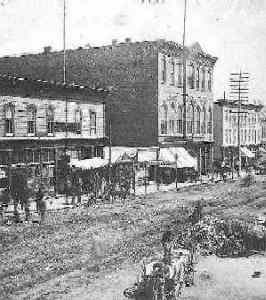
Leadville Street Scene.
But he didn’t. Nor did he reach for his pistol in his hip pocket. For quicker than a flash, Luke had jammed his own pistol into the bad man’s face and pulled the trigger, and the bad man rolled over on the floor. The bullet passed through his cheek but, luckily, did not kill him.
There was no arrest or trial. Such things were happening all the time in those days in Leadville. This, however, gave Luke quite a standing. He was soon in significant demand. Gambling house proprietors wanted him to stay around their places of business during the busy hours to keep the bad men in camp from carrying off their bankrolls. He had a knack for making friends and was soon popular with the quieter and more refined class of the sporting fraternity. He learned to play cards and was soon dealing faro. No one who saw him then togged out in tailor-made clothes and a derby hat would have recognized in him the man who took the header from the Overland train ten miles east of Sidney, when he made the getaway from the soldiers.
Snuffing out a Gambler
In the spring of 1881, Luke Short was found in Tombstone, Arizona, dealing faro in a house managed by Wyatt Earp.
One morning, I went into the Oriental gambling house, where Luke was working, just in time to keep him from killing a gambler named Charlie Storms. There was scarcely any difference between this case and the one with the bad man in Leadville a couple of years previous. Charlie Storms was one of the best-known gamblers in the entire West and had, on several occasions, successfully defended himself in pistol fights with Western “gunfighters.”
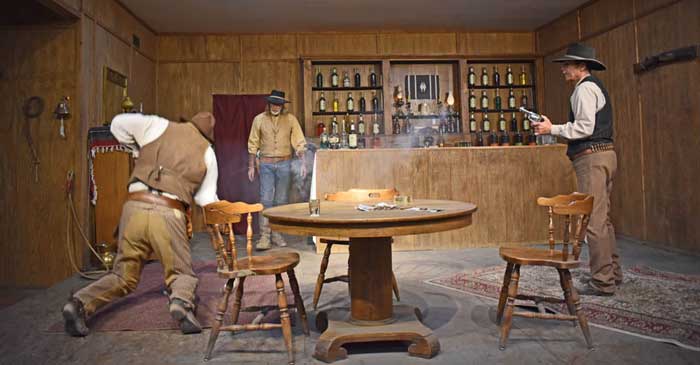
Gunfight re-enactment in Tombstone, Arizona. Photo by Kathy Alexander
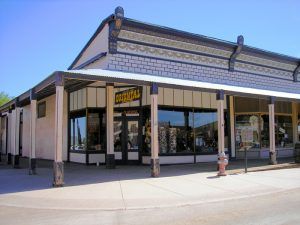
Oriental Saloon in Tombstone, Arizona by Kathy Alexander.
Charlie Storms and I were very close friends, as much as Short and I were, and for that reason, I did not care to see him get into what I knew would be a severe difficulty. Storms did not know Short and, like the bad man in Leadville, had sized him up as an insignificant-looking fellow whom he could slap in the face without expecting a return. Both men were about to pull their pistols when I jumped between them and grabbed Storms, at the same time requesting Luke not to shoot, — a request I knew he would respect if it were possible without endangering his own life too much. I had no trouble getting Storms out of the house, as he knew me to be his friend. When Storms and I reached the street, I advised him to go to his room and sleep, for I then learned for the first time that he had been up all night and quarreling with other persons.
He asked me to accompany him to his room, which I did, and after seeing him safely in his apartments, where I supposed he could go to bed, I returned to where Short was. I was explaining to Luke that Storms was a very decent sort of man when, lo and behold! There he stood before us. Without saying a word, he took hold of Luke’s arm and pulled him off the sidewalk where he had been standing, at the same time pulling his pistol, Colt’s cut-off, 45 caliber, single-action. Still, like the Leadvillian, he was too slow, although he succeeded in getting his pistol out. Luke stuck the muzzle of his own pistol against Storms’ heart and pulled the trigger. The bullet tore the heart, and as he fell, Luke shot him again. Storms was dead when he hit the ground. Luke was given a preliminary hearing before a magistrate and exonerated.
The Story of Two Rival Shows
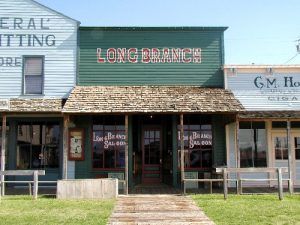
Long Branch Saloon, Dodge City, Kansas, by Dave Alexander.
In the spring of 1883, Luke formed a partnership with Harris and Beeson of Dodge City and operated the Long Branch Saloon, the biggest and best-paying gambling house in Dodge at the time. The mayor of Dodge, whose name was Webster, was also running a gambling house and saloon next door to that operated by Short. At this time, Dodge City was the shipping point for the Texas cattle driven every summer from the great cattle ranges of western Texas to the northern markets.
A fortune was to be made every season by the gambling house that could control this trade, and, as Short was from Texas and had once been a cowboy himself, he held the whip-hand over the mayor, so far, at any rate, as the patronage of the cattlemen was concerned.
This, the mayor did not relish, and, as he was a stubborn and strong-minded man himself, who would brook no opposition if he could help it, he set to work to put Luke out of business. He had an ordinance passed by the City Council prohibiting music in all the gambling houses and saloons in the city. Short employed a band in his place of business, and Webster did likewise, but the latter was the mayor and therefore in control of the situation, so he thought. The mayor instructed the city marshal to notify Short that the music in his place must be discontinued. “That suits me,” Luke is reported to have told the marshal. “I don’t need music in my house to do business, and, besides, maintaining a band is quite an item of expense.”
The following night, the only house in the city that had music was operated by the mayor. Luke then smelled a mouse.
“We’ll see about this,” remarked Luke to his partners, Beeson and Harris.
The next night, he re-engaged the band and instructed it to go ahead, grinding out the old familiar melodies so dear to the heart of the Texas cowboy. Luke remained about the place for several hours to see what move, if any, was to be made by the mayor. As he saw nothing to cause alarm, he concluded to go away for a while and pay a visit to a sick friend. He had not left the place more than ten minutes before all the members of the band, among them, one woman, the pianist, were arrested and locked up in the city calaboose.
Forced to Leave the Town
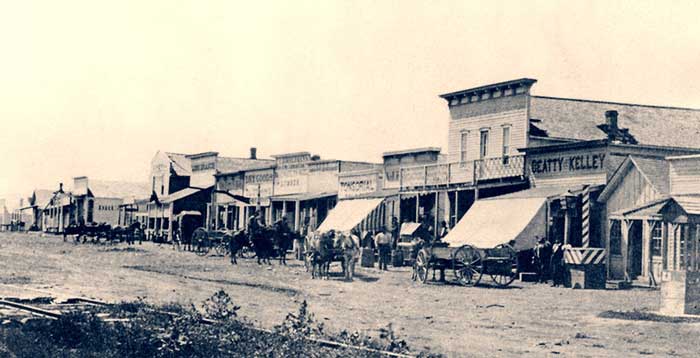
Dodge City, Kansas, 1875.
Luke was notified and came hurriedly down to the saloon. He learned the facts of the arrest and went out to hunt up the officer in charge of the squad so that he might furnish bail for the musicians and have them released. However, he could not find him or any other person considered competent to accept a bail bond. All the time Luke tried to get his employees out of the calaboose, the music in the mayor’s place was in full swing. This, as can well be imagined, did not tend to help matters in the least.
About the time Luke had made up his mind that nothing could be done that night to release the prisoners, he saw the officer he had been looking for standing at some distance away. Luke started towards him.
The officer, standing on the sidewalk, a foot or so above the street, saw Luke coming and instantly pulled his pistol and fired point-blank at him. The shot missed, and Luke returned the fire, but just as he pulled the trigger, the officer started to run, and in leaving the sidewalk for the dark street, he fell. Thinking he had hit him, Luke went to his place of business, secured a shotgun, and stood off the town until morning. He accomplished this by refusing to submit to arrest that night.
The next morning, he was persuaded to lay aside his weapons, go to the police court, plead guilty to creating a disturbance, pay a fine, and have the whole matter settled. That was what had been promised him if he would take off his arms and surrender to the officers. He accordingly gave up his pistols and started for the police court with the officers. But, instead of them taking him to the police court as they promised, they took him to the city jail and kept him locked up until the noon trains arrived. The passenger trains traveling east and West passed each other at Dodge, and Luke was escorted to the depot by armed guards with shotguns and instructed to choose which train he would take. There was nothing left for him to do. They had him and were only waiting for an excuse to riddle him with buckshot if he offered the least resistance.
He took the Eastbound train and landed in Kansas City.
Lining Up for a Big Fight

Early Day, Kansas City, Missouri.
I was in Denver at the time, and he wired me to come to Kansas City, Missouri, immediately, which I did. We discussed the matter when we met and concluded to go to Topeka, Kansas, and present it to the Governor. The next day, we did so. The Governor denounced the conduct of the Dodge City authorities. Still, he said that he could do nothing, as the local authorities at Dodge City had informed him that they were amply capable of preserving the peace and did not desire state interference. We stated to the Governor that we believed we were able to rehabilitate ourselves in Dodge, but did not care to run afoul of state authorities in case we concluded to do so. The Governor told us to go ahead and re-establish ourselves if we could, that he would keep out of it, and wished us luck. Immediately, I started for Silverton, Colorado, where Wyatt Earp was located at the time, and enlisted him in our cause. Luke went to Caldwell, Kansas, where he had a couple of staunch friends who were willing to take the bit in their mouths and go to the front and fight his battles whenever called upon.
Within a week of Luke and me separating in Kansas City, we had our forces organized and were on our way to Dodge. It was decided that if a fight were all that would satisfy the mayor of Dodge, — a fight he would have.
Wyatt was selected to land in Dodge first. With him, but unknown to the Dodge authorities, were several desperate men. Several more dropped into town unobserved by the enemy. It finally became whispered about that Wyatt Earp had a strong force of desperate men already domiciled in town in the interest of Luke Short. The mayor called a hasty meeting of his friends, and after they had all assembled in the council chamber of the city hall, informed them solemnly of what he had heard about the Earp invasion. Anyone present at that meeting could easily have seen that anything but a fight was what the mayor and his friends were looking for, now that such a thing was not altogether improbable. Someone present suggested that Wyatt be invited to attend the meeting and state he would his position on the matter. The suggestion met with instant approval from all present, and the mayor proceeded to appoint a committee forthwith to call upon Earp and inform him of its action. Wyatt was soon found and told of the wishes of the assembled patriots.
A Conference with the Enemy
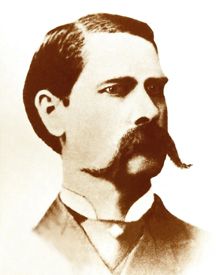
Wyatt Earp.
“It will afford me great pleasure to attend your meeting,” was the laconic reply of the noble Warwick, and he was soon the central figure of as fine a collection of cutthroats as ever scuttled a ship.
The mayor, addressing Wyatt, inquired as to the truth of the report that he and numerous other desperate men were in the city to reinstate Short in Dodge.
“Mr. Mayor and gentlemen of the meeting,” said Wyatt, “I guess the report is true. I came here some days ago,” said he, “and, thinking that perhaps something might happen where I would need assistance, brought along some other gentlemen who signified a willingness to join in whatever festivities might arise.”
“Moreover,” continued Wyatt, “Luke and Bat will each arrive at noon tomorrow, and on their arrival, we expect to open up hostilities.”
“Now, look here, Wyatt,” said the mayor, “you have no better friends anywhere than we are, and we don’t want any more fighting in this town. There has already been enough shooting and killing in Dodge to do for a while. Now, why can’t this thing be fixed up before it goes any farther?”
“It can,” said Wyatt, “if you are willing to allow Luke to return and conduct his business unmolested as heretofore.”
“I am perfectly willing to agree to that,” said Webster. “And so are we,” sang out the meeting in a chorus.
“All right, gentlemen,” replied the phlegmatic Mr. Earp, “there shall be no conflict. I will proceed to inform both Mr. Short and Mr. Masterson of your decision in the case, and I will guarantee that if you keep your part of the agreement, there shall be no bloodshed.
Wyatt immediately notified Short and me by wire of the complete backdown of the enemy, and when we reached the city the next day, we were cordially received by our friends. The enemy, not being sure that Wyatt could control the situation, kept in the background until he had received assurances from both Short and me that we would faithfully live up to the peace terms made by Earp.
As soon as things quieted down a bit, Short sent for the mayor and sheriff to meet him and some of his friends at his place of business to discuss the situation and reach a better understanding. The mayor and sheriff accompanied them, along with the city attorney and the county’s prosecuting attorney. Short’s party consisted of himself, his two partners, Beeson and Harris, Wyatt Earp, and me.
Humiliating His Honor, the Mayor
Luke addressed the mayor in something after this fashion after we had all settled down in our chairs:
“Mr. Webster, you have on the police force of this city two men who, without any reason known to me, showed themselves during the late trouble to be bitter enemies of mine. I want them removed from the force.”
The mayor assured Luke that he need not give himself any further concern on that score, as both men had already resigned and left town.
“Very well,” said Luke. “There is, however, another thing I wish to call to your notice. You had an ordinance passed by the city council prohibiting music in saloons. I want that ordinance repealed.”
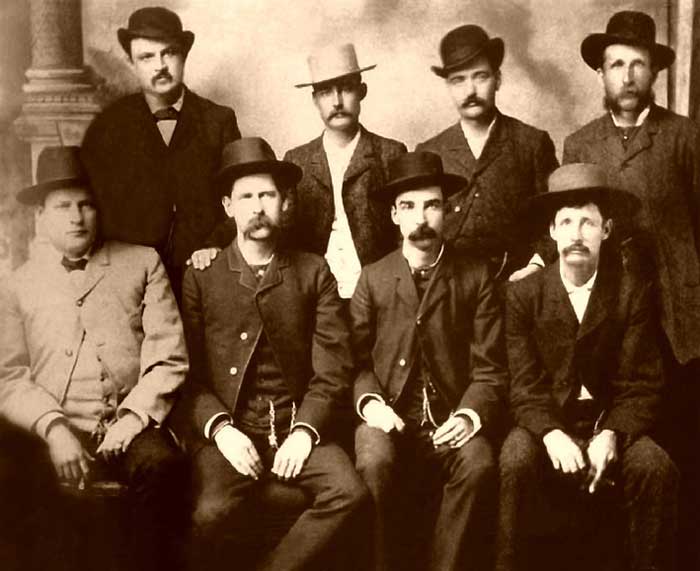
Front Row: Charlie E. Bassett, Wyatt Earp, M. F. McLain, Neal Brown. Back Row: William H. Harris, Luke Short, Bat Masterson, W. F. Petillon.
“It shall be done,” said the mayor, and turning to the city attorney, instructed him to prepare a call for a special meeting of the council and to draw up an ordinance calling for the repeal of the objectionable one.
This ended Short’s business with the mayor. He then turned to the sheriff and said in substance:
“Mr. Sheriff, you also have two men in your office that are objectionable to me, and I would like to have you remove them.” He then named the men, and the sheriff promised that they would have to go.
“Here are the names of the men you can appoint in their place,” and he handed the sheriff a piece of paper containing the names of the men he desired appointed.
“All right, Luke,” said the sheriff. “They are good enough for me.”
Luke then turned to the county prosecuting attorney and said, “I furnished bail for Mr. Blank for $2,000 before I was ordered to leave town, and I want that bail bond containing my name returned to me and all record of it destroyed.”
“That will be easy,” said the prosecutor.
“Now, gentlemen,” said Luke, “there being nothing further to do, suppose we return to the bar and take a little something just for old times’ sake.”
“All right,” said everybody present, and the procession to the bar started.
Luke had won a bloodless battle, but that such was the case was no fault of his, for he had been willing to fight at any stage of the proceedings.
Short Owns the Town Again
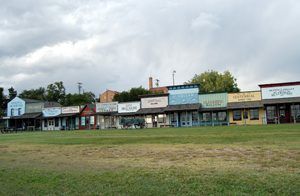
Front Street and Boot Hill Museum, Dodge City, Kansas by Kathy Alexander.
We subsequently found that when Mayor Webster learned how Earp had trapped him, he hunted up the sheriff and prosecuting attorney and sent a hurry-up telegram to the Governor, which was signed by all three of them, requesting him to send, with as little delay as possible, two companies of militia, assuring him that unless that were immediately done, a great tragedy would surely be enacted in the streets of Dodge City. The Governor, anticipating just such a move, like this on the part of the authorities at Dodge as soon as they got frightened — and the telegram calling for militia strongly indicated that that time had now arrived, — refused point-blank to send the militia and reminded the senders of the message that they had already repeatedly assured him that they were sufficiently able to handle the situation and did not need the militia; “and,” said the Governor, in concluding his reply, “I expect you to do it.”
When it became known in Dodge the sort of reply the Governor had sent back to the appeal for the militia, something of consternation took possession of the mayor’s followers. Those who had lately been the loudest in their declarations of hostility to Short were now for peace at any price.
Webster, himself no coward, saw that the yellow streak he knew was in the makeup of his followers was giving unmistakable signs of recrudescence. He knew that when the time came, he would have to fight the battle alone. He remembered that those very men, upon whom he would now have to rely for support, had already hidden from Short the night of the arrest of the musicians, and he could well imagine what they were likely to do now that Short had been strongly reinforced. It was at this stage of affairs that Webster concluded to send for Wyatt and, if possible, bring about a settlement of the difficulty without an appeal to arms. In making this move, the mayor acted both wisely and timely, for had the case gone over to the next day, there would have, in all probability, been bloodshed on both sides.
Luke, soon after his restoration to Dodge, concluded to settle up his affairs and move to Texas. He somehow could not bring himself to like those with whom he had so recently been at odds, and that fall, he sold out all his interests in Kansas to his partners and moved to Texas.
The fall of 1884 found him the proprietor of the White Elephant gambling house in Fort Worth. The White Elephant was one of the largest and costliest establishments of its kind in the entire Southwest at the time. As a matter of course, he made plenty of money, but it required a lot of money to keep him going, for he was one of the best-hearted men who ever lived. He could not say no to anyone, and, as might be expected, was continually being taken advantage of by professional “cadgers,” who make it a point to borrow as much as they can and never repay anything. While he made fortunes in his gambling establishments, he died a comparatively poor man. He perhaps owed less and had more money due to him when he died than any gambler who ever lived.
In the spring of 1887, I visited Short in Fort Worth and learned soon after my arrival that he was having some trouble which was likely to end seriously with a notorious local character by the name of Jim Courtright. It appears that this fellow Courtright, who had killed a couple of men in Fort Worth, also a couple more in New Mexico, and was therefore dreaded by almost the entire community, asked Short to install him as a special officer in the White Elephant. Luke, who had been a substantial friend of Courtright’s during his trouble at Fort Worth, told him he could not think of such a thing.
“Why, Jim,” said Luke, “I would rather pay you a good salary to stay away from my house entirely.”
“You know,” continued Luke, “that the people about here are all afraid of you, and your presence in my house as an officer would ruin my business.”
Courtright, a sullen, ignorant bully, could not see it as Luke did, with no sense of right or wrong. He could not understand that it was a purely business matter and would be much better for Short to hire him to stay away from the house altogether than to have him come around it. At any rate, Courtright got huffy at Luke and threatened to indict him, and his place closed up. Courtright could not get it through his head how it was that Luke had dared to turn him down. He knew that he had everybody else in town “buffaloed” and could see no reason why Luke should be different from the others.

Timothy Isaiah “Longhair Jim” Courtright.
Luke and I were sitting together in the “White Elephant” billiard room one evening [February 8, 1887], discussing the trouble he had with Courtright and the effect it was likely to have on his business.
Just then, one of Luke’s business associates, Jake Johnson, came over to where we were sitting and informed Luke that Courtright was in the outer lobby and would like to speak with him.
“Tell him to come in,” said Short.
“I did invite him in,” replied Johnson, “but he refused and said I was to tell you to come out.”
“Very well,” said Luke, “I will see what he has to say; and immediately got up and accompanied Johnson to where Courtright was waiting.
It did not take Luke very long after meeting Courtright to discover that the latter’s mission was anything but one of peace. He brought along no olive branch, but instead a brace of pistols, conspicuously displayed. It was not a parley that he came for, but a fight, and his demeanor indicated a desire that hostilities open up forthwith.
No time was wasted in exchanging words once the men faced each other. Both drew their pistols at the same time, but, as usual, Short’s spoke first, and a bullet from a Colt’s 45-caliber pistol went crashing through Courtright’s body. The shock caused him to reel backward; then he got another and still another, and by the time his lifeless form had reached the floor, Luke had succeeded in shooting him five times.
Luke was arrested on the spot by a deputy sheriff and taken to the county jail, where he remained during the night. The next day, he was taken before a justice of the peace. Who held him for the grand jury on a nominal bond. This ended the case, as the grand jury refused to indict on the evidence, holding that it was a case of justifiable homicide.
This ended Luke Short’s shooting scrapes, with the exception of a little gun dispute three years later at Fort Worth, which had no fatal results.
I took the opportunity at the opening of this story to state that when Luke reached the age of young manhood, he was severely lacking in education. It is now but proper for me to say that twenty years later, at the time of his death. He was an exceptionally well-read man. He could write an excellent letter, always used good English when speaking, and could quote Shakespeare, Byron, Goldsmith, and Longfellow more accurately and effectively than most scholars.
The burning of the midnight oil was a result of the transformation. It transformed him from a white Indian when I first met him to a diffident, courteous gentleman, who, at his death about 12 years ago, was one of the best-known and most popular sporting men in this country.
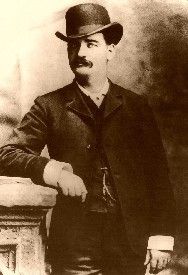
Bat Masterson.
Written by Bat Masterson, 1907. Compiled and edited by Kathy Alexander/Legends of America, updated October 2025.
About the Author and Articles Notes: Although most of us are familiar with W.B. “Bat” Masterson’s reputation as a gunfighter and friend of notable characters such as Wyatt Earp, Doc Holliday, and Luke Short, many may not be aware that he was also a writer. After his many escapades in the American West, he accepted a post of U.S. Marshal in New York state. However, by 1891, he was working as a sports editor for a New York City newspaper. In 1907 and 1908, he wrote a series of articles for the short-lived Boston magazine, Human Life. This tale of Luke Short was just one of several of those articles.
Masterson died in 1921 of a heart attack. The article on these pages is not verbatim, as it has been edited primarily for spelling, grammatical corrections, and easier readability. However, Mr. Masterson’s original reference to the Red Cloud Agency, where Luke sold “pine-top” to the Sioux, was not such a minor correction. The original article lists the agency as being located in “North Dakota.” It is located in South Dakota, and this has been changed.
Also See:
Adventures in the American West
Doc Holliday as Told by Bat Masterson