
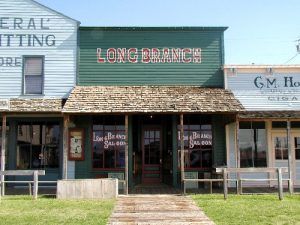
Long Branch Saloon, Dodge City, Kansas, by Dave Alexander
Kansas entered the Union as a Free State on January 29, 1861.
The Long Branch Saloon really did exist in Dodge City, Kansas. One of the owners, William Harris, was a former resident of Long Branch, New Jersey, and named the saloon after his hometown in the 1880s. The Long Branch Saloon still stands in Dodge City and can be seen at the Boot Hill Museum.
Though most people say that Kansas is “flatter” than a pancake, it certainly looks that way, but it actually slopes from an elevation of more than 4,000 feet along the Colorado border to 700 feet on the Missouri line.
Kansas State Game rules prohibit the use of mules to hunt ducks.
It is illegal to shoot rabbits from a motorboat in the State of Kansas.
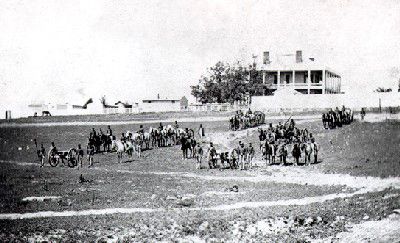
Early Fort Leavenworth, Kansas
Established in 1827, Fort Leavenworth, Kansas, is the oldest military post in continuous operation west of the Mississippi River.
According to some biographers, Billy the Kid was afraid of only one man. That man, who was known as “Dirty” Dave Rudabaugh, was an outlaw from Kansas before making his way to New Mexico and joining up with the “Kid’s” gang.
In 1901, Governor William Stanley declared, “We cannot afford to have the state made a dumping ground for the dependent children of other states, especially New York.” This statement was made in response to the Orphan Trains movement, which spanned the turn of the century and brought hundreds of orphans to Kansas.
At Kansas State University College of Veterinary Medicine, waterbeds for horses are used in surgery.
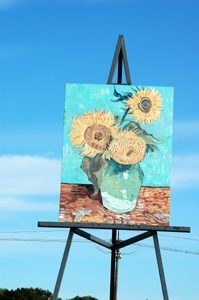
Sunflower painting in Goodland, Kansas, by Reletta Clumsky.
Goodland, Kansas, proudly boasts the world’s largest easel. Sitting atop the 80-foot, 40,000-pound steel easel is a giant replica of Vincent van Gogh’s Sunflowers painting.
In Salina, it is against the law to leave your car running unattended.
William Purvis and Charles Wilson of Goodland, Kansas, invented the helicopter in 1909.
The First United Methodist Church in Hutchinson was built in 1874, during the grasshopper plague. Grasshoppers or no, the work on the church continued, and as a result, thousands of grasshoppers were mixed into the mortar of the original building’s foundation.
Musical car horns are banned in Russell, Kansas.
There is a grain elevator in Hutchinson, Kansas, that is 1/2 mile long and holds 46 million bushels of grain.
Helium was discovered in 1905 at the University of Kansas.
The Boulevard Drive-In Theater in Kansas City, Kansas, was the first drive-in in the world to install digital sound. Built in 1950, the drive-in continues to operate today with the best sound system of all of the remaining drive-ins in the country.
Dodge City is the windiest city in the United States, with an average wind speed of 14 miles per hour.
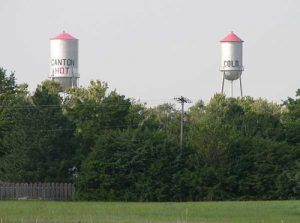
Hot and Cold Water Towers in Canton, Kansas
“Hot” and “cold” water towers stand in Pratt, Kansas. This “joke” was first labeled on the side-by-side water towers in 1956. Furthermore, Pratt’s not the only town boasting the “hot” and “cold.” Another pair can also be found in Canton, Kansas.
The first restaurant chain in the U.S. was the Harvey Houses, which started in 1876 to serve railroad travelers. The Harvey House Museum can be seen in Florence and Fred Harvey’s home in Leavenworth.
Any person convicted of using or carrying bean snappers in Wichita will be fined.
At one time, it was against the law to serve ice cream on cherry pie in Kansas.
Sumner County is known as the Wheat Capital of the World.
The term “red-light district” came from the Red Light Bordello in Dodge City, Kansas. The front door of the building was made of red glass and produced a red glow to the outside world when lit at night. The name carried over to refer to the town’s brothel district.
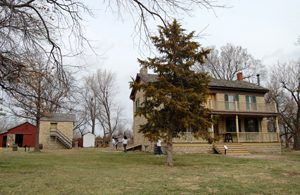
Mahaffie Farmstead in Olathe, Kansas
The Stagecoach Stop in Olathe was the first eating station for westbound passengers on the Santa Fe Trail in 1863.
Almon Stowger of El Dorado invented the dial telephone in 1889.
Dwight D. Eisenhower, the 34th President of the United States, was from Abilene.
Riding an animal down the road is against the law in Derby, Kansas.
Lucas, Kansas, a tiny town of less than 500 residents, is the officially designated “Grassroots Art Capital of Kansas” due to its numerous artistic displays.
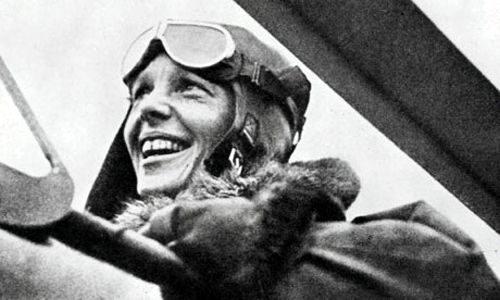
Amelia Earhart
Amelia Earhart, the first woman to hold a pilot’s license from the National Aeronautics Association and the first woman to fly solo across the Atlantic Ocean, was from Atchison.
Hutchinson is nicknamed the Salt City because it was built atop some of the world’s richest salt deposits. Salt is still actively mined, processed, and shipped from Hutchinson.
There are 27 Walnut Creeks in Kansas.
If you’re going to cross a highway at night in Kansas, you are required to wear taillights.
All places of business in Dodge City are required to provide a horse water trough.
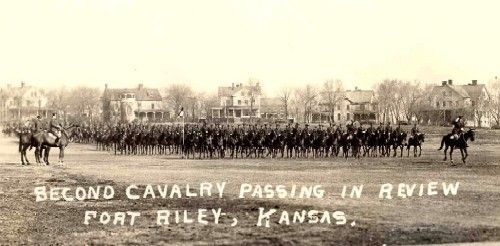
Fort Riley, Kansas, 1920s
Fort Riley was the cradle of the United States Cavalry for 83 years. George Armstrong Custer formed the famed 7th Cavalry there in 1866. Ten years later, at the Battle of the Little Bighorn, the 7th was virtually wiped out. The only Cavalry survivor was a horse named Comanche, whose stuffed body is displayed at the University of Kansas Natural History Museum in Lawrence.
Wyatt Earp, James Butler “Wild Bill” Hickok, and William B. “Bat” Masterson were three of the legendary lawmen who kept the peace in rowdy frontier towns like Abilene, Dodge City, Ellsworth, Hays, and Wichita.
The public swimming pool at the Lee Richardson Zoo in Garden City once occupied half a city block and held 2 1/2 million gallons of water. It is gone today.
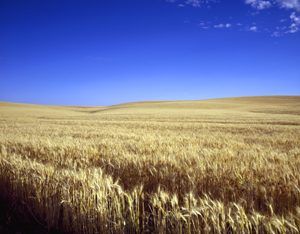
Wheat in Kansas by Carol Highsmith.
Kansas produced a record 492.2 million bushels of wheat in 1997, enough to make 35.9 billion loaves of bread.
The installation of bathtubs in Topeka is prohibited.
The three largest herds of buffalo in Kansas are located on public lands at the Maxwell Game Preserve in McPherson, the Big Basin in Ashland, and the Buffalo Game Preserve in Garden City.
In Dodge City, it is illegal to spit on a sidewalk.
Russell Springs, located in Logan County, is known as the Cow Chip Capital of Kansas.
Before proceeding through the intersection of Douglas and Broadway in Wichita, Kansas, a motorist must get out of their vehicle and fire three shotgun rounds into the air.
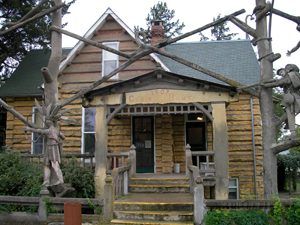
Garden of Eden in Lucas, Kansas, by Kathy Alexander
Civil War veteran S.P. Dinsmoor used over 100 tons of concrete to build the Garden of Eden in Lucas. Even the flag above the mausoleum is made of concrete.
Second, only in Texas have more meteorites been found than in any other state west of the Mississippi River.
The Hollenberg Station, two miles northeast of Hanover, Kansas, is the only original Pony Express Station still standing in its original location. It is now a museum.
Fire Station No. 4 in Lawrence, originally a stone barn constructed in 1858, was a station site on the Underground Railroad.
The Hugoton Gas Field is the largest natural gas field in the United States. It underlies all or parts of 10 southwestern Kansas counties and parts of Oklahoma and Texas, covering some 8,500 square miles, an area nearly five times as large as the state of Rhode Island.
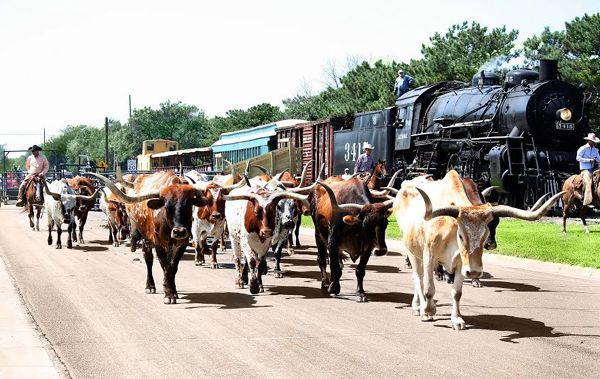
Cattle in Abilene, Kansas, today
In the days of Wild Bill Hickok, Abilene, Kansas, saw shootings almost daily, such as the wild gunfight in a local bar when one gunman refused the drink of another. Another gunfight occurred when one drunken cowboy rode his horse atop a pool table.
Opened in 1857, Hays House in Council Grove is the oldest continuously operating restaurant west of the Mississippi River.
Kansas has the largest population of prairie chicken wild grouse in North America.
In 1990 Kansas wheat farmers produced enough wheat to make 33 billion loaves of bread, or enough to provide each person on earth with six loaves.
Handel’s Messiah has been presented in Lindsborg each Easter since 1889.
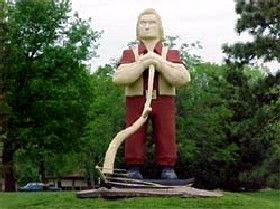
Johnny Kaw, photo courtesy City of Manhattan, Kansas.
A 30-foot-tall statue of Johnny Kaw stands in Manhattan City Park. The statue represents the importance of the Kansas wheat farmer.
The Geodetic Center of North America is about 40 miles south of Lebanon at Meade’s Ranch. It is the starting point of reference for land surveying in North America, meaning that when a surveyor checks a property line, he or she checks the property’s position relative to Meade’s Ranch in northwest Kansas.
Between 1854 and 1866, 34 steamboats paddled up the Kaw River (Kansas River.) One made it as far west as Fort Riley.
Kansas law requires that if two trains meet on the same track, neither shall proceed until the other has passed.
The rocks at Rock City are huge sandstone concretions, hard, compact accumulations of mineral matter, usually spherical or disk-shaped, embedded in a host rock of a different composition. In an area about the size of two football fields, 200 rocks, some as large as houses, dot the landscape. There is no other place in the world with so many concretions of such giant size.
Cawker City, Kansas, lays claim to the world’s largest ball of twine with a 38-foot circumference, weighing almost 17,000 pounds, and still growing.
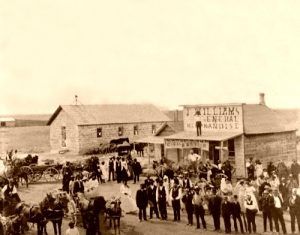
Nicodemus, Kansas, 1885.
By 1880, approximately 40,000 black people had left the South for new lives in Kansas, a wave of emigration known as “the Exodus.” The “Exodusters” built numerous African American towns during this time, only one of which remains today. Nicodemus, Kansas, now a virtual ghost town, has been designated a National Historic Site.
In Hutchison stands a ½ mile-long elevator that contains 1,000 bins and holds 46 million bushels.
In Derby, Kansas, if you hit a vending machine after it stole your money, you are breaking the law.
South of Ashland, the Rock Island Bridge spanning the Cimarron River is the longest railroad bridge of its kind, at 1,200 feet long and 100 feet above the riverbed.
The Arkansas River may be the only river whose pronunciation changes as it crosses state lines. In Kansas, it is called the Arkansas (ahr-KAN-zuhs). On both sides of Kansas (Colorado and Oklahoma), it is called the Arkansas.
A hailstone weighing more than one and a half pounds once fell on Coffeyville.
In Lawrence, it is illegal to wear a bee in your hat.
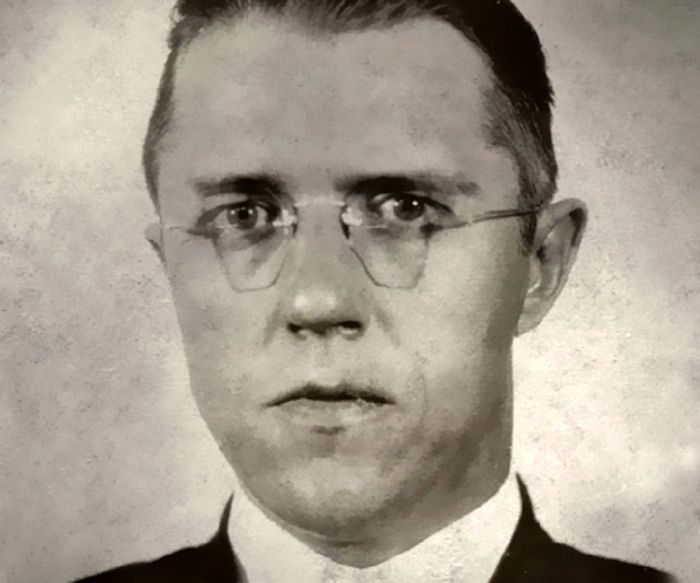
Alvin Karpis
Alvin “Creepy” Karpis, a notorious outlaw in the 1930s and a member of the Barker Gang, was raised in Kansas.
Fort Riley has the distinction of being the site of the only exorcism in U.S. history paid for by the military.
The Oregon Trail passed through six states, including Kansas.
All cars entering the Lawrence city limits must first sound their horn to warn the horses of their arrival.
Topeka, Kansas, was the scene of many a gun battle, but the most bizarre incident occurred in the Kansas House of Representatives, where Boston Corbett, the reported killer of John Wilkes Booth, President Lincoln’s assassin, ran amok. Corbett threatened to kill several state congressmen for stalling legislation; he finally surrendered his weapon without shooting anyone and was sent to an insane asylum.
The world-famous fast-food chain of Pizza Hut restaurants opened its first store in Wichita.
Kansas is one of two sources of helium in the U.S.
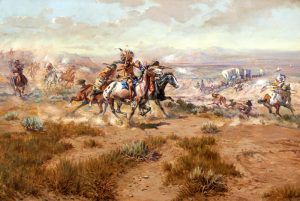
Indian Attack on a Wagon Train by Charles Marion Russell
There were no reported Indian attacks along the Oregon Trail as the travelers passed through the state.
Catching fish with your bare hands in Kansas is illegal.
The world’s largest hand-dug well is in Greensburg, Kansas.
Silent comedian Buster Keaton, of early film success, was from Piqua, Kansas.
In Overland Park, it is against the law to picket a funeral.
Kansas was the first state to ratify the 15th Amendment to the U.S. Constitution, which granted African American men the right to vote.
The hide and head of the first MGM Lion, Leo, are at the McPherson Museum.
On August 21, 1863, William Clark Quantrill and his band of ruthless raiders attacked Lawrence, Kansas, in the ongoing Kansas/Missouri Border War that began six years before the start of the Civil War. Burning Lawrence to the ground and killing more than 180 men and boys, the men fled at the sound of approaching Union troops. Frank and Jesse James learned their methods of gunmanship and murder under the command of William Quantrill.
Kansas Sunset
The first national hamburger chain started in Kansas when Walter Anderson opened the first White Castle hamburger restaurant in Wichita in 1921. You can still eat slyders – in Chicago, New York, or St. Louis.
It is illegal to “screech” your tires in Derby.
Compiled and edited by Kathy Alexander/Legends of America, updated February 2026.
Also See:
Ghost Towns and Near Ghosts of Kansas
See Sources.