
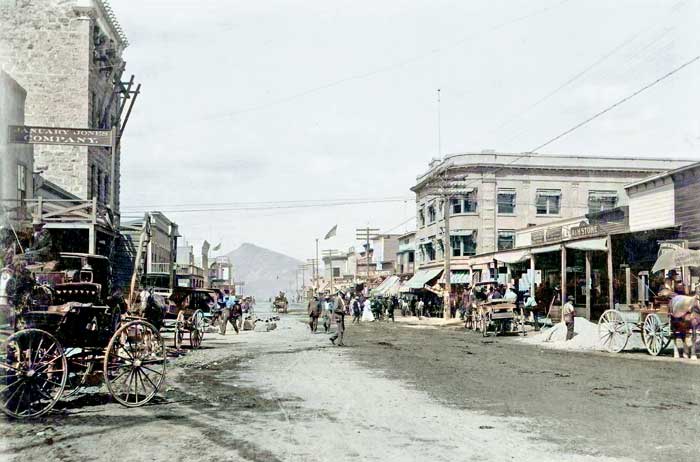
Goldfield, Nevada, around 1906 or 1907.
In December 1902, gold was discovered in the hills south of Tonopah, Nevada, by two grub stake prospectors named Harry Stimler and Billy March. In no time, tents began to dot the barren hills in the mining district dubbed “Grandpa,” later named Goldfield. Just a year later, only 36 people lived in the new town, but that would quickly change as gold began to be mined in the area in increasing quantities.
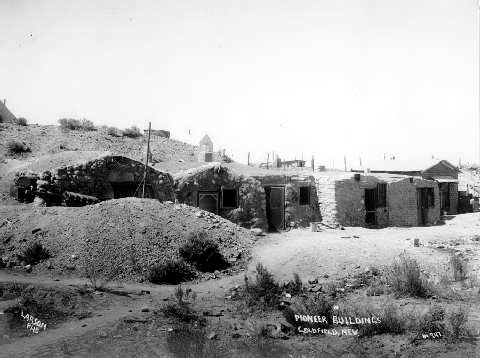
Early prospectors built dugout houses in Goldfield, Nevada.
In the summer of 1903, miners who had spent the previous winter in Goldfield, living in quickly constructed shanties or tents, devised a better solution.
Soon, they began to dig new homes along the banks of Coyote Wash. Brownstones from the canyons of Malpai Mesa were hauled in to close the fronts of these hastily dug caves, making them more suitable against the harsh winter winds and the summer desert heat. Some parts of these old brownstone homes were still evident as late as the 1940s, but today it is almost impossible to determine where these structures once stood.
By 1904, the town supported three saloons, a grocery store, and two feedlots, along with its area mining operations. In the spring of that same year, Virgil and Wyatt Earp arrived in Goldfield, chasing the prospect of easy riches. Though Virgil’s arm was atrophied from the bullet he had taken in Tombstone, Arizona, in 1881, he was soon sworn in as a deputy sheriff in Goldfield. In February 1905, Tex Rickard opened the Northern Saloon, Goldfield’s most celebrated saloon and gambling house. Wyatt, who had met and become friends with Tex in Nome, Alaska, was hired as a pit boss.
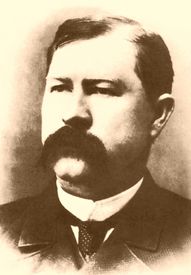
Virgil Earp.
On July 8, 1905, Goldfield suffered its first significant fire when a stove exploded in the Bon Ton Millinery shop. The flames soon spread to adjoining structures. Without enough water to fight the quickly spreading flames, beer was used as an extinguisher. The July 9, 1905, issue of the Tonopah Daily Sun reported:
“The free and unlimited use of beer saved the buildings of the Enterprise Mercantile Company. Barrel after barrel was used and had a most desirable effect. Had it not been for the liquid, the entire stock of goods of the company would have been ruined.”
Goldfield was finally saved when the wind shifted, but not before two blocks of businesses and homes had burned to the ground.
1905 also saw the arrival of the Tonopah & Goldfield Railroad, which came as a great relief to its many residents. It was also this year that the Santa Fe Saloon was built. One of Goldfield’s oldest continuously operating businesses, the saloon continues to offer four motel rooms, while also serving as a popular oasis in the desert. Complete with its false front, Western wood sidewalks, and rough floor planking, the interior features an original Brunswick Bar, dominating the Santa Fe’s back wall.
In October, Virgil Earp contracted pneumonia, so sick that his doctor cut him off his favorite cigars. On October 19, 1905, he seemed to rally, asking his wife, Allie, for a cigar. Believing he was getting better, she gave him one. He then requested that she sit with him, holding his hand. Before he finished the cigar, he had died. Virgil’s remains were taken to Portland, Oregon, where he lies at the Riverview Cemetery. Wyatt left Nevada shortly after Virgil’s death.
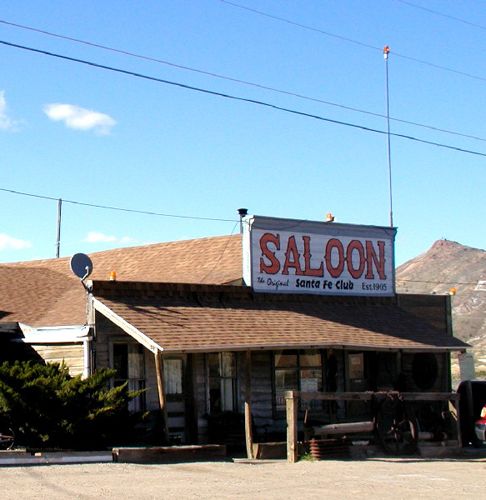
Santa Fe Club Saloon in Goldfield was established in 1905.
In 1906, the town reached its peak with a population of over 30,000, when as much as $10,000 a day in ore was being taken from the mines.
The town was called the “Queen of the Mining Camps” for its luxury and the abundance of saloons and other forms of entertainment, including its numerous sporting houses. At this time, building lots often sold for as much as $45,000. In addition to its numerous saloons, the town boasted three newspapers, five banks, and a mining stock exchange.
On Labor Day 1906, Goldfield was chosen as the site of the Gans-Nelson Lightweight Championship of the World. Tex Rickard’s Northern Saloon staged the prize fight, building an 8,000-seat arena, but more than twice that many people turned out to watch the fight. The fans got their money’s worth as the bout went 42 rounds, a record that still stands in the Guinness Book of World Records. The winner, Joe Gans, walked away with a $30,000 purse.
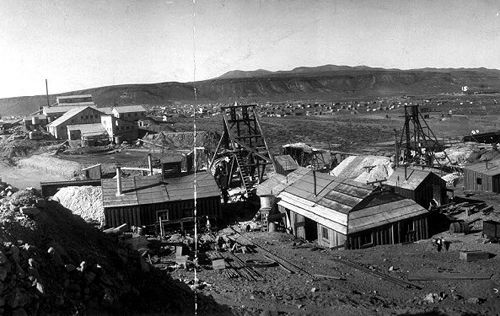
The Mohawk Mine was one of the many mines in Goldfield in 1906.
Soon after mining on an extensive scale began, the miners organized themselves as a local branch of the Western Federation of Miners. The Goldfield Consolidated Mines Company, primarily owned by George Wingfield, held a virtual monopoly in Goldfield, resulting in an adversarial relationship between mine owners and the unions. There were several strikes in December 1906 and January 1907 for higher wages, with more strikes continuing throughout the year for various reasons. Though there had been no serious disturbance in Goldfield, George Wingfield appealed to President Roosevelt in December 1907 to send Federal troops on the grounds that the situation was ominous. With no state militia to maintain order, the president ordered a California division in San Francisco to march upon Goldfield with 300 federal troops.
The troops arrived in Goldfield on December 6, 1907, and the mine-owners immediately reduced wages and announced that no members of the Western Federation of Miners would thereafter be employed in the mines. The troops remained in Goldfield until March 1908, with the contest of wills having been won by the mine owners.
From 1903 to 1910, Goldfield was the largest city in Nevada, and in 1907, the county seat was relocated from Hawthorne to Goldfield. Soon, the city fathers set about constructing a new courthouse, a two-story, fortress-like building that remains standing today. The large stone structure opened in May 1908, with a jail added onto the rear of the building.
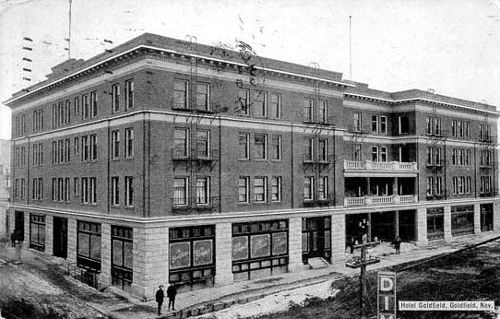
Vintage photo of the Goldfield Hotel
In 1908, the Goldfield Hotel, designed by Architect George E. Holesworth and owned by George Wingfield, was opened amidst a fanfare of celebration. Built over a dry mine shaft, the structure cost over $300,000. The four-story building, constructed of stone and brick, contained 154 rooms with every modern convenience, including telephones, electric lights, and steam heat. The lobby was paneled in mahogany and furnished with black leather, set beneath gold-leaf ceilings and crystal chandeliers. The hotel imported chefs from Europe and boasted one of the first Otis elevators west of the Mississippi River. Considered to be the most luxurious hotel between Chicago and San Francisco, it appealed to society’s upper crust, making owner George Wingfield an even wealthier man.
However, the prosperity was not to last. By 1910, the town’s population had dwindled to approximately 5,000, and by 1912, gold production had declined from its former high of $11 million per year to $ 5 million.
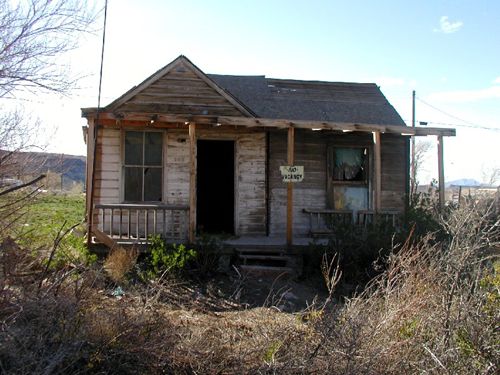
This old miner’s cabin in Goldfield survived the flood by Kathy Alexander.
A year later, on September 13, 1913, Goldfield suffered a devastating blow when heavy rains in the hills to the west caused a rolling wall of water to pour into the city, sweeping away hundreds of buildings and all their contents, including many of the sporting girls’ cabins, prospector’s homes, and the Moose Hall.
One resident reported that two sacks of gold were washed away from his cabin. Another man, not in Goldfield at the time, later reported that he had buried several stolen sacks of high-grade ore at his cabin. When he returned for the money, not only could he not find the gold, but the cabin itself was long gone, washed away by the waters of the gulch.
Another report stated that two safes containing hundreds of gold coins were lost in a gully west of town. For decades following the flood, prospectors crossing west of Goldfield would find a “previously dug” nugget or a gold coin, but the reported lost caches have never been found. The area west of the city remains a treasure hunter’s paradise today.
By 1918, the mines produced only $1.5 million in ore, with half that amount in the following year. By 1920, the town was home to only about 1,500 residents, and for the next three years, the area mines produced a cumulative $150,000 worth of ore.
But Goldfield’s misfortunes were not yet complete. On July 6, 1923, a moonshine still exploded across the street from the Goldfield Hotel early in the morning hours. With raging winds, the fire blazed for 13 hours before it was brought under control. Spreading down Main Street, the inferno took out many of the town’s businesses, destroying 27 blocks of homes and buildings in its path. The town never recovered.
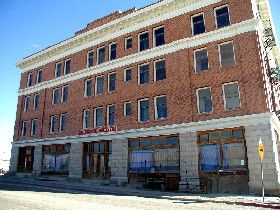
Goldfield Hotel by Kathy Alexander.
At about this same time, the Goldfield Hotel began a gradual decline, and by the 1930s, when the town supported fewer than 1,000 souls, it had become little more than a flophouse for cowboys and undiscriminating travelers.
During World War II, it was used to quarter soldiers and afterward closed its doors forever. Over the years, the hotel has changed hands numerous times, most recently in 2003. Although plans are in place to renovate and reopen the old hotel, as of this writing, it remains lonely and deserted.
In just a few more years, the last of five railroads that had once hauled millions of dollars in ore from Goldfield — the Tonopah & Goldfield– discontinued operations in 1947.
From 1903 to 1940, Goldfield’s mines produced more than $86 million. As late as 1997, some of the Goldfield mines were still in operation.
Today, although Goldfield is home to fewer than 500 residents and is all but a ghost town, it still retains the title of Esmeralda County Seat. The courthouse has been in continuous use by the county since its opening in 1908. Built of native sandstone resembling a castle, it was one of the most elaborate structures in the state at the time of its construction. Inside one of the courtrooms, you will find original Tiffany lamps. Behind the courthouse, the original jail also continues to stand, containing three levels of metal cells; two levels of which still house inmates in 18 cells.
More buildings in Goldfield offer glimpses of its more prosperous past. The Santa Fe Saloon, built in 1905, remains in operation at the entrance to the mining fields. Across the highway from the Goldfield Hotel is the Mozart Saloon, which continues to serve breakfast, lunch, and drinks next to its antique bar.
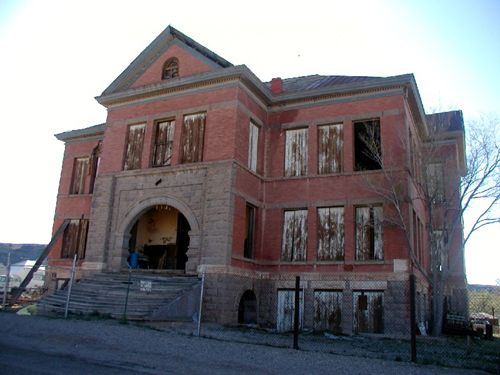
Goldfield School.
Across from the County Courthouse is Goldfield’s old High School. Though long closed, it displays a classic example of early 20th-century architecture. Across the street, in another direction, is the former Tex Rickard home, the one-time owner of the famous Northern Saloon, which masterminded the famous Nelson-Gans prize fight in 1906. The quaint Victorian home, built in 1905, continues to stand at the corner of Crook and Franklin Streets. Tex Rickard went on to become a major boxing promoter and ultimately gained fame as the man who built the original Madison Square Garden in New York City.
The Goldfield Hotel remains the centerpiece of the town, and when it opened in 1908, it was the most luxurious hotel in the state. Although it now stands dark and empty, it’s an impressive building that symbolizes Goldfield’s former glory. The old hotel is also considered to be one of the most haunted buildings in the United States. For more information on the Goldfield Hotel, including its history and hauntings, click here.
Outside of Goldfield, you can see massive metal and wooden headframes dotting the barren foothills north of town.
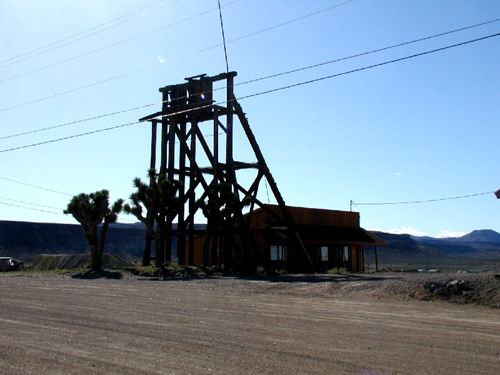
Goldfield, Nevada Headframe
Goldfield is about 25 miles south of Tonopah, Nevada, on Route 95.
© Kathy Alexander/Legends of America, updated September 2025.
Also See:
Ghost Towns & Mining Camps of Nevada
Ghost Towns of Nevada Photo Gallery
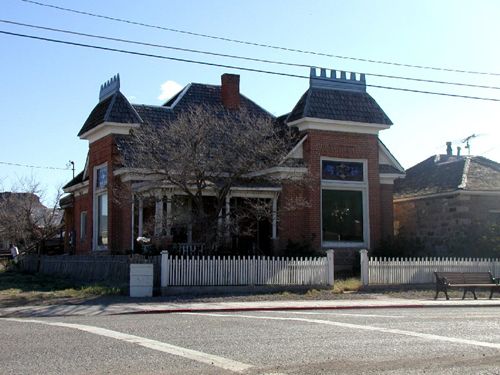
Tex Rickard’s former home, by Kathy Alexander.

This abandoned railcar speaks of Goldfield’s prosperous railroading days by Kathy Alexander.
See Sources.