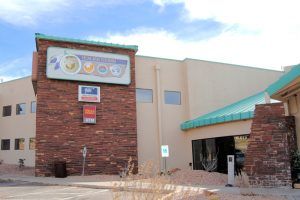
Hualapai Tourism at Peach Springs, Arizona by Kathy Alexander.
Peach Springs, Arizona, is the administrative headquarters of the Hualapai (“Wall-ah-pie”) Indian Tribe, located on Route 66 in Mohave County.
Just West of Grand Canyon Caverns, old Route 66 meanders onto the Hualapai Reservation, encompassing more than a million acres, including 108 miles of the Colorado River and a portion of the Grand Canyon. A beautiful stretch through the high-desert Hualapai Valley, the old pavement runs closely parallel to the Santa Fe Railroad tracks, passing through the town of Peach Springs and the near ghost towns of Truxton, which was explicitly born to cater to Route 66 travelers; Valentine, the home of an old Indian School; and Hackberry, which got its start as a mining town.
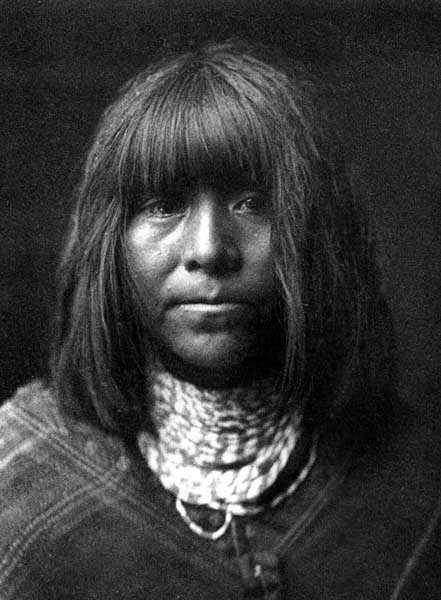
Ta’thamiche, a Hualapai Indian by Edward Curtis, 1907.
The Hualapai Indians have occupied these lands for more than 1,400 years. The West Rim of the Grand Canyon and the river below have long provided the tribe with food and medicinal resources. The Hualapai’s west rim was the earliest access point to the wild Colorado River below.
The place was first documented by Father Francisco Garces, a Spanish Franciscan missionary who camped here in June 1776. He called the natural springs in the area Pozos de San Basilio, meaning Saint Basil’s Wells.
Euro-Americans became aware of the area’s springs during explorations in the 18th and 19th centuries. In 1857, Edward Beale carved a wagon road from Fort Defiance to the Colorado River on the Arizona-California border. The path cuts right through Hualapai territory. In 1863, gold was discovered in the Prescott Valley, and the gold rush brought a steady flow of miners and other settlers to the area. The following year, a toll road was built through Hualapai territory between Prescott and Bull Head City. Like other tribes, the Hualapai were disturbed by increased traffic upon their lands, which erupted into the Hualapai War from 1865 to 1870.
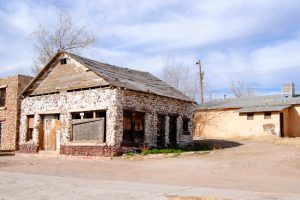
An old stone building in Peach Springs, Arizona, by Kathy Alexander.
In 1866, the U.S. government granted the Atlantic & Pacific Railroad (later known as the Atchison, Topeka & Santa Fe Railroad) a right-of-way to build a transcontinental railroad, and construction through northern Arizona was completed in 1883. With its abundant water, the location quickly became a “division point” for the railroad. The station was named “Peach Springs” for the many peach trees around the spring that fed their steam engines.
Soon, a lively railroad town sprouted along the tracks at Peach Springs. They established a post office in 1887. It didn’t take long for the settlement to have ten saloons but no churches or schools. Easy access to the Grand Canyon via Peach Springs led to the construction of a roundhouse, several shops, a stagecoach line, and a Fred Harvey restaurant and hotel for tourists. The initial period of prosperity lasted for approximately two decades.
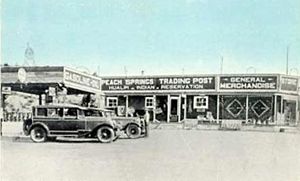
Peach Springs, Arizona Trading Post.
At the turn of the century, the railroad constructed the Santa Fe and Grand Canyon Railway from Williams to the Grand Canyon. Declining tourist traffic through Peach Springs led to a decline in the town. In 1907, the railroad moved its division point to Seligman, leaving Peach Springs as a minor stop along the tracks.
However, Peach Springs was saved with the “Good Roads” movement of the 1910s, which led to the establishment of the National Old Trails Road. This brought new prosperity to the town. In 1917, a trading post opened and did very well. In 1926, the National Old Trails Road became part of Route 66. As the road widened and improved, traffic through the town steadily increased, and business thrived. Several cafes, motor courts, and tourist businesses were established to serve the many travelers on the road. The Peach Tree Trading Post did so well that they razed the original frame building and erected a new stone building.
Unfortunately, when Route 66 was replaced by I-40, Peach Springs again declined. One local business owner recalled, “Route 66 was almost like a Big City street before the bypass. After completion of Interstate 40, it was ghostly quiet.”
Little is left of Route 66-era landmarks today, but the 1917 trading post building still stands, serving as a tribal administration building. It was listed in the National Register of Historic Places in 2003.
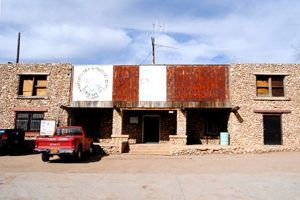
An administration office is now housed in the old trading post in Peach Springs, Arizona, by Kathy Alexander.
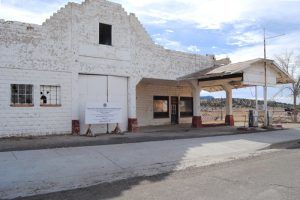
An old gas station in Peach Springs, Arizona, by Kathy Alexander.
In recent years, Peach Springs has seen a significant comeback thanks to the Hualapai tribe’s promotions and their exclusive access to one of the last undeveloped sections of the Grand Canyon. Visitors can tour the Grand Canyon West Rim on the Hualapai Reservation, stay at the Hualapai Lodge in Peach Springs, visit an authentic Native American village, and take a walk on the well-known Grand Canyon Skywalk — a glass bridge that juts out across the canyon, providing views some 4,000 feet down to the canyon floor. The Peach Springs area is called home to about 1,100 people today.
Route 66 travelers to tiny little Truxton, Arizona, can continue westward for about 8.5 miles.
©Kathy Alexander/Legends of America, updated October 2026.
Also See:
Arizona Route 66 Photo Gallery’
See Sources.