
Martin Parmer.
Martin Parmer was a frontiersman and soldier, a founder of Missouri, a veteran of the Texas Revolution, and a signer of the Texas Declaration of Independence.
Martin Palmer Jr. was born on June 4, 1778, in Charlotte County, Virginia, to Martin Palmer Sr., who had served as a lieutenant in the American Revolution, and Margaret Reed Palmer.
By age 20, he had moved to Kentucky and then Tennessee, where he worked for Montgomery Bell’s Iron Works in Dickson County. He married Sarah Hardwick in Madison County, Kentucky, in 1798. The couple would eventually have more than a dozen children. At some point, he changed the spelling of his surname to Parmer.
Martin entered the service in the War of 1812 and attained the rank of colonel.
He moved the family to Missouri Territory in 1816, settling in present-day Clay County. Living among the Osage and Ioway Indians, he soon made a name for himself as an Indian fighter and earned the nickname “The Ringtailed Panther.” His daring feats and eccentricity soon became the talk of the region.
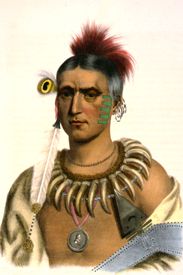
Ma-Has-Kah or White Cloud, an Ioway chief, by Charles King, 1837.
In 1820, he was elected to a two-year term in the Missouri General Assembly. Parmer was named as a delegate to the Missouri Constitutional Convention of 1821. Missouri became a state the same year, and Parmer was elected as a State Representative to the First Missouri General Assembly. He was also named colonel of the Missouri militia, where he led four military companies against the Indians. Later, he represented Clay County in the Missouri State Senate, and Governor William Clark appointed him Indian sub-agent to the Ioway Indians.
In 1825, Parmer briefly moved the family to Arkansas and Texas, where he settled near Mound Prairie in present-day Cherokee County. Unfortunately, his wife Sarah died on August 3, 1825. Martin would remarry three more times, be widowed again twice, and father seven more children.
Fredonian Rebellion
The following year, Martin Parmer joined brothers Haden and Benjamin Edwards in the Fredonian Rebellion. Haden Edwards received an empresarial grant on April 14, 1825, that entitled him to settle as many as 800 families in a broad area around Nacogdoches in eastern Texas. Like all empresarios, he was to uphold existing land grants and organize to protect all colonists in the area. After the Edwards arrived, they posted notices to all previous landowners requiring them to present evidence of their claims or forfeit to new settlers. Naturally, this offended the older settlers, and disputes began to arise.

Haden Edwards.
Stephen F. Austin, the empresario for Southeast Texas, wrote to Edwards telling him that he did not understand the nature of his duties and that continuing in the same manner would bring about Edwards’ ruin. However, Edwards ignored Austin’s advice and continued his heavy-handed policies, claiming areas that had already been settled. Edwards’s actions soon alienated established residents, and growing hostilities between them and settlers recruited by Edwards led Victor Blanco of the Mexican government to revoke Edwards’s contract in mid-1826.
The settlers, led by Haden Edwards, declared independence from Mexican Texas and created the Republic of Fredonia near Nacogdoches. On November 22, 1826, the rebellion began when 36 men arrested local authorities and took over the Old Stone Fort in Nacogdoches as their headquarters. It was the first attempt by Anglo settlers in Texas to secede from Mexico. The leaders believed the rebellion would be more successful if they could persuade local Indians to join the cause. Two Cherokee leaders, Richard Fields and John Dunn Hunter, pledged support for the rebellion in exchange for a promise of land. They designed and raised a flag inscribed with “Independence, Liberty, Justice” over the Old Stone Fort.
On November 25, 1826, Martin Parmer presided over the court-martial of the local government officials. Except for Hayden Edwards, Martin Parmer found all the government officials, including Samuel Norris, the alcalde of Nacogdoches, and his attorney, José Antonio Sepulveda, guilty and sentenced them to death. He commuted their sentences on the promise that each would leave Texas and never return. Parmer left Joseph Durst in charge as the Alcalde in Nacogdoches and returned to Ayish Bayou after the trial.
On December 21, 1826, the rebels signed their Declaration of Independence from Mexico. Martin Parmer led the Fredonian Rebellion, declaring the area around Nacogdoches the independent Republic of Fredonia.
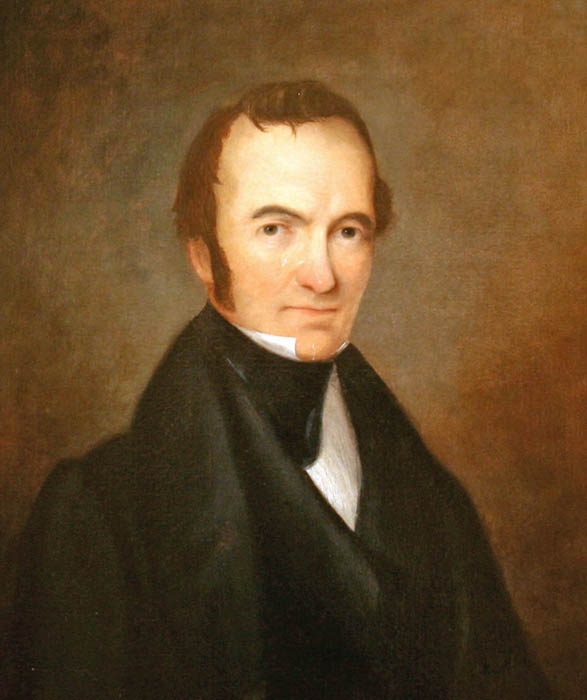
Stephen F. Austin
Empresario Stephen F. Austin strongly opposed the Fredonian rebels and encouraged the settlers in his colony to fight for Mexico. Meanwhile, Indian assistance never materialized.
A small party of infatuated madmen at Nacogdoches has declared Independence and invited the Indians from the Sabine to the Rio Grande to join them and wage a war of Murder, plunder, and desolation on the innocent inhabitants of the frontier. Martin Parmer leads this party.
— Stephen F. Austin to the Citizens of Victoria, January 1, 1827
With the militia and Mexican troops closing in, both the cause and the fort were abandoned by the end of January 1827. Most of the rebels fled eastward towards the Sabine River and then into Louisiana. Fields and Hunter were killed by their tribe for involving them in the rebellion. Martin Parmer fled first to Gonzales, Texas, and later to Louisiana. He tried to return to Texas in 1831 with James Bowie, but Mexican authorities expelled him.
After being pardoned in 1835, Parmer returned to East Texas and was elected a delegate from Tenaha (now Shelby County) to the Consultation of 1835 at San Felipe. The same year, he was elected to the General Council. The following year, San Augustine County selected Parmer as one of its delegates to the Constitutional Convention of 1836.

Texas Declaration of Independence.
On March 2, 1836, Martin Parmer seconded Sam Houston’s motion to adopt the Texas Declaration of Independence from Mexico at Washington-on-the-Brazos. He was then made the Chairman of the Committee that drafted the Constitution of the Republic of Texas.
On March 6, 1836, the day the Alamo fell, Martin Parmer penned a letter to his wife from the Convention at Washington:
“Dear wife, I am well, and we are getting along very well. We have three or four committees that are preparing a constitution, and we will have it ready soon. I shall be at home in ten or fifteen days. We have alarming news continually from the West; Frank Johnson’s division is all killed but five, it is supposed. He saw two shots begging for quarters. Dr. Grant, with a company of men, is supposed to be all slain.
Travis’ last express states San Antonio was vigorously besieged; it is much feared that Travis and company are all massacred, as dispatches have been due from that place three days and none have arrived yet. The frontiers are breaking up, Gonzales must be sacked, and its inhabitants murdered and defiled unless they get immediate aid. The last account shows that Gonzales and San Antonio had a considerable number of Mexicans. Fanning [Fannin] is at La Badia [La Bahia] with about 500 men and expects a daily visit from Santa Anna. Texas has been declared free and independent, but unless we have a general turnout and every man lays his helping hand too, we are lost. Santa Anna and his vassals are now within our borders, and the declaration of our freedom, unless it is sealed with blood, is of no force. I say again that nothing will save Texas but a general turnout. You all know my views about our condition; I have given you the facts, judge for yourselves. I wish a copy of this letter would be sent immediately to Capt. Bailey Anderson and Col. S.A. Lublett [Sublett], and publicly read in San Augustine. Travis closes his last express with these words: Help! Oh, my country.”

Battle of San Jacinto by Henry Arthur McArdle
Martin’s son, Isom Parmer, served in the Texas army and was the Sergeant at Arms for the Convention. He purchased a fine horse for 400 Mexican dollars, and when Sam Houston was appointed Commander-in-Chief of the Texas forces and needed a new mount, Isom sold him the horse. This same horse was later shot out from under Houston at the Battle of San Jacinto.
Parmer’s activities during the Texas Revolution did not end with his services at the Convention. On March 16, 1836, Thomas Jefferson Rusk, the newly appointed Secretary of War, tasked Parmer with helping alleviate the Texas army’s supply shortage. He authorized Colonel Martin Parmer to demand, receive, and dispose of all public property, whether money, provisions, horses, wagons, teams, arms, and other munitions of war, found within the Municipalities of Nacogdoches or San Augustine. The Secretary also authorized Parmer to requisition horses, wagons, teams, arms, and other munitions that were not public property, as needed for the efficiency and sustenance of the army.
In 1839, President Mirabeau B. Lamar appointed Parmer Chief Justice of Jasper County, but he held this post for less than a year.
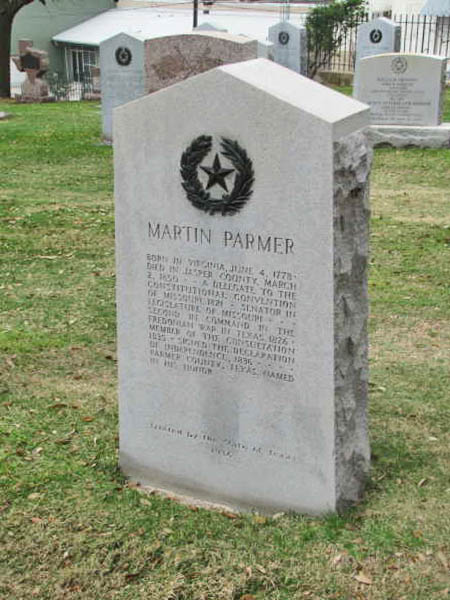
Martin Parmer Grave
On March 2, 1850, Parmer died in Jasper County and was buried 12 miles Southeast of Jasper on the A. C. Parmer survey. His body was re-interred in the Texas State Cemetery in 1936 at the time of the Texas Centennial. He was buried about 30 feet away from the grave of Stephen F. Austin, who had so vigorously opposed Parmer’s early attempt to declare Texas independent of Mexico during the Fredonian Rebellion. A granite marker preserves and honors his memory as one of the signers of the Texas Declaration of Independence.
On August 21, 1876, Parmer County was named in his honor.
©Kathy Alexander/Legends of America, updated October 2026.
“Though illiterate and rough-mannered, Palmer was a man of more than ordinary parts, of most extraordinary strength of mind and body, and brave as a lion. He was of large stature and bronzed of feature, always dressed in a buckskin hunting shirt and leather trousers, with a panther skin cap, wore his hair long and plaited in Indian style, and was indeed a unique figure. I first saw the ‘panther’ at our home in Taylor’s Bayou, and he impressed me as a most extraordinary character. As a boy, I was fascinated with the marvelous stories of his exploits and adventures with red men and wild animals.
On this occasion, the Panther was well mounted and armed, and in high glee, eager for a brush with the enemy; as he expressed it, ‘just itching and clawing for a scrap with the cowardly ‘greasers.'”
— Creed Taylor, speaking of Martin Parmer in Tall Men and Long Rifles

Martin Parmer Family Tree
Martin Parmer is the writer and Kathy Alexander’s 4th-great-grandfather.
Also See:
Sources:
East Texas History
Handbook of Texas – Fedonian Rebellion
Handbook of Texas – Martin Parmer
Rootsweb
Searle, Kameron; Texas History Page
Wikipedia – Fredonian Rebellion
Wikipedia – Martin Parmer
Williams, Alfred M., Sam Houston and the War of Independence in Texas, Houghton, Mifflin & Company, The Riverside Press, 1893