
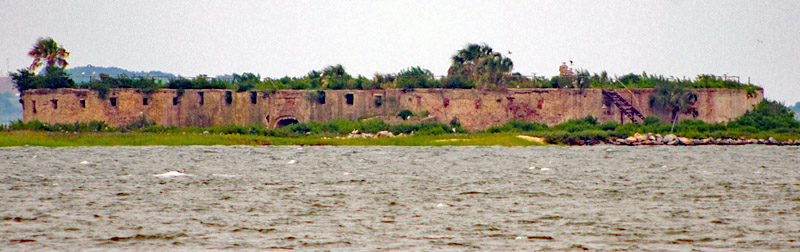
Castle Pinckney, courtesy of Wikipedia.
Castle Pinckney is a small masonry fortification constructed by the U.S. government in Charleston, South Carolina, in 1810.
During his 1791 visit to Charleston, President George Washington recognized the strategic value of this part of the land where the Cooper River transitions into Charleston Harbor. He ordered a fort to be built there to defend against a naval attack from France that seemed imminent, but never happened.
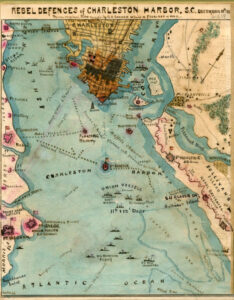
Charleston, South Carolina Harbor.
Located on Shutes Folly, a small island about one mile off the coast of Charleston, the first fortification, called “Fort Pinckney”, was a log-and-earthen fort named in honor of American Revolution hero Charles Cotesworth Pinckney. It was built beginning in 1797 to protect the city from a possible naval attack as war with France seemed imminent. Completed in 1804, it saw no hostilities and was virtually destroyed by a severe hurricane in September of that year.
In 1809, construction of a brick-and-mortar structure called “Castle Pinckney” began on the ruins of the old “Fort Pinckney”. By 1811, Castle Pinckney was ready for the installation of armaments. The design of Castle Pinckney is attributed to Jonathan Williams, the first superintendent of the United States Military Academy. Williams had served as Benjamin Franklin’s secretary in France, where he studied the latest developments in military architecture. The fort’s innovative design featured elliptical fortresses that housed cannon inside. Built to house 200 men, the fort resembled a medieval castle.
The fort was garrisoned throughout the War of 1812, but it saw no action during the two-and-a-half-year conflict. Afterwards, Castle Pinckney was abandoned.
Rapid advancements in early 19th-century weaponry, with new cannons capable of greater ranges, made the fort located so close to High Battery obsolete, rendering Castle Pinckney obsolete as well.
As plans for Fort Sumter began in 1826, Castle Pinckney had begun its long fall into disrepair.
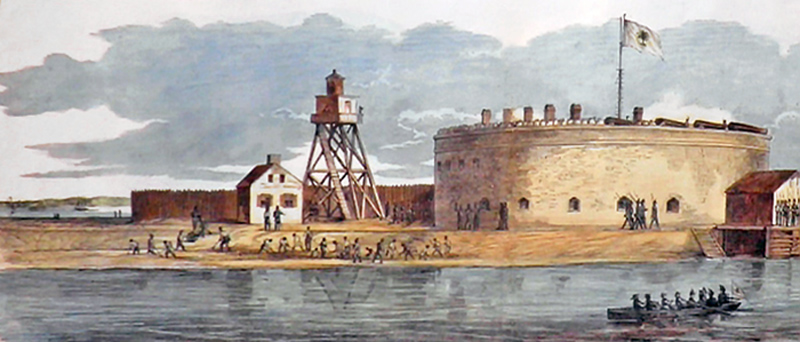
Castle Pinckney Fort.
It was briefly re-garrisoned during the Nullification Crisis of 1832, when President Andrew Jackson prepared to collect a controversial tariff using military force if necessary. After that brief period of activity, the fort again fell into disuse and was primarily used as a storehouse for gunpowder and other military supplies.

Zouave Cadets at Castle Pinckney, South Carolina.
By the late 1850s, Castle Pinckney was part of a network of defensive positions in the harbor, which included the larger, more strategically located Forts Sumter and Moultrie, as well as other, lesser earthworks and fortifications.
In 1860, Castle Pinckney’s armament consisted of fourteen 24-pounders, four 42-pounders, four 8-inch howitzers, one 10-inch and one 8-inch mortar, and four light field pieces to protect its flanks.
When South Carolina seceded on December 20, 1860, Castle Pinckney was occupied by only a lieutenant, an ordnance sergeant, four mechanics, and 30 laborers, totaling 36 people. Only the lieutenant and the ordnance sergeant were part of the U.S. Army available to defend the fort.
This garrison of two was inadequate to defend the fort. On December 27, 1860, one week after South Carolina seceded from the Union, Castle Pinckney was seized and occupied by South Carolina secessionists, who easily overwhelmed its small federal garrison. Castle Pinckney became the first Federal military installation seized forcefully by a Southern state government. Three days later, the Union’s Charleston Arsenal joined Castle Pinckney in falling to South Carolina forces. After the subsequent Confederate attack on Fort Sumter, the Charleston Zouave Cadets garrisoned Castle Pinckney.
Following the First Battle of Manassas in July 1861, 154 Union Army prisoners of war, including 120 enlisted men and 34 officers, were captured and previously incarcerated at Ligon’s Prison in Richmond, Virginia. Later, they were transported to Charleston, South Carolina, on September 10, 1861. They were kept at the Charleston City Jail until Castle Clinton was repurposed as a Prisoner-of-War camp, with the lower casemates of Castle Pinckney converted into cells. According to the Charleston Mercury, the prison included captives “who had evinced the most insolent and insubordinate disposition.”
On September 18, the prisoners were moved to the makeshift prison at Castle Pinckney. They were allowed to wander during the day and were confined to cells only at night. However, the Castle quickly proved to be too small and inadequate for permanent confinement; the prisoners were transferred back to the Charleston City Jail on October 31, 1861, after only six weeks. After the prisoners were removed, the fort was strengthened with earthen embankments and with additional mortars and Columbiads on the barbette tier.

Castle Pinckney, South Carolina, 1882.
On December 12, the prisoners were transferred back to the island, following a fire that had burned a large section of Charleston and damaged the jail. They remained for just over a week, with many sleeping on the inner parade ground before being transferred.
In 1863, Castle Pinckney was refitted as an artillery post. Realizing that Fort Sumter and Fort Moultrie would probably fall soon, Confederate authorities strengthened Charleston’s inner-harbor defenses. Incorporating lessons learned at Fort Pulaski and Fort Sumter about the effectiveness of rifled artillery against masonry forts, Castle Pinckney’s walls were reinforced with large earthen mounds. The original 30 guns were replaced by four much larger guns mounted on the top, or barbette, level.
Federal troops reclaimed the fort on February 18, 1865. Afterward, Castle Pinckney’s exterior walls were reinforced with massive earthen berms on both the exterior and the interior, as the fort played an integral role in the defense of Charleston Harbor.
The fort was modernized for possible use during the Spanish-American War, but again it was not needed. Some sources suggest that the fort never fired a single hostile shot during its existence.
Parts of the old brick walls and casements were dismantled in 1890 to make way for a harbor lighthouse, which operated until 1917, when it was abandoned as well.
Castle Pinckney was designated a U.S. National Monument by President Calvin Coolidge in 1924.
In 1951, Congress passed a bill to abolish Castle Pinckney National Monument due to a lack of interest and funding, and transferred it back to the U.S. Army Corps of Engineers. The island became excess property subject to sale by the Federal government in March 1956.
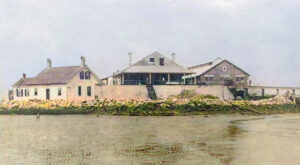
Castle Pinkney, South Carolina Lighthouse.
The State Ports Commission acquired the island, now called the South Carolina Ports Authority, as a spoil area in 1958 for $12,000. The Commission investigated improving part of the land and using it as a historic destination. However, plans for the island as a spoil area proved impractical, and the Commission did not develop any successful plans for it as a tourist destination. The Commission then attempted to return the island to the Federal government, but the government declined, citing the cost of operations as outweighing the island’s historical value. The Commission received offers to buy the island for uses including a private residence, a nightclub, and a restaurant, but the agency refused all of them. A fire on December 22, 1967, destroyed an abandoned house on the island, but a warehouse was saved.
A local Sons of Confederate Veterans fraternal post took over management and care of the island in the late 1960s, attempting to preserve it and establish a museum.
Castle Pinckney was listed on the National Register of Historic Places in 1970. Eventually, unable to raise the needed funds, the South Carolina Veterans post allowed the fort to revert to state ownership. Castle Pinckney has undergone some limited restoration efforts. With its location on an isolated shoal in the middle of the harbor, access is difficult; maintenance is nearly impossible. Only a portion of its brick foundation and a cannon remain. It is gradually being reclaimed by nature.
©Kathy Alexander/Legends of America, updated November 2025.
Also See:
Civil War Battles in South Carolina
South Carolina – The Palmetto State
South Carolina Photo Galleries
Sources:
Charleston Raconteurs
National Park Service – Castle Pinckney
National Park Service – Fort Sumter & Fort Moultrie
Wikipedia