
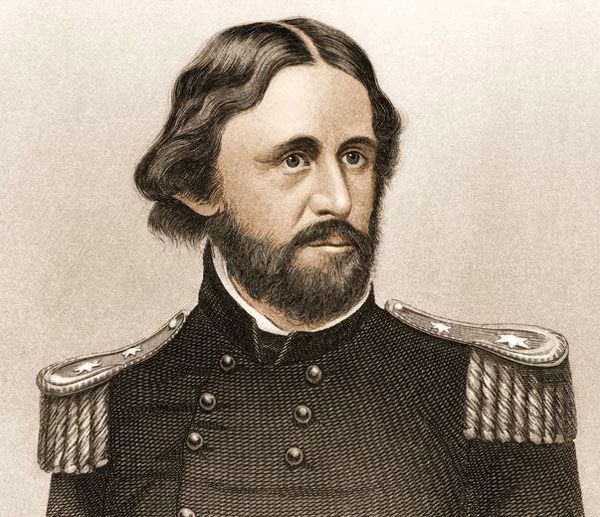
John Charles Fremont.
John Charles Fremont was an explorer, surveyor, military officer, and politician who led five western expeditions.
On January 21, 1813, Fremont was born in Savannah, Georgia, to Charles Fremont, a French-Canadian schoolteacher, and Anne Beverley Whiting, the youngest daughter of socially prominent Virginia planter Colonel Thomas Whiting. When his father died when John was just five years old, the family moved to Charleston, South Carolina, where he attended college before being expelled for irregular attendance. However, he’d done well in math and got a teaching job on a warship.
His career as an explorer began when he left the Navy to join the United States Topographical Corps, later becoming the Army Corps of Engineers. In 1838, he was commissioned as a second lieutenant by President Martin Van Buren. In that year and the next, he took part in Jean Nicollet’s expedition to the plains between the upper Mississippi and Missouri Rivers. Becoming an expert in geology and topography, he headed his expedition to survey the Des Moines River in 1841. On October 19, 1841, he secretly married Jessie Benton, the daughter of Thomas H. Benton, even though her parents opposed the union because of her age.
For the next ten years, Fremont explored the country between the Missouri River, the Rocky Mountains, and the Pacific Coast (see Fremont’s Expeditions). His reports gave many their first knowledge of what is now the American West’s many states, and his work earned him the nickname “Pathfinder.”
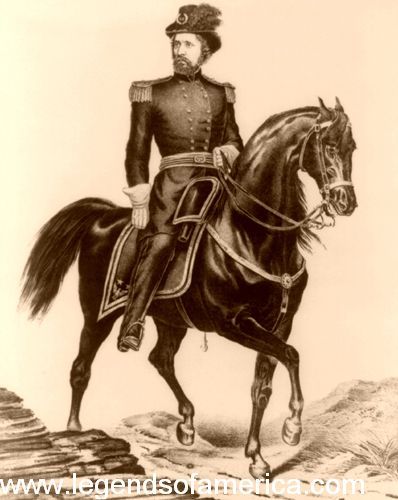
John C. Fremont by Ehrgott, Forbriger and Co.
Landing in California with his wife, Fremont led much of the revolt in Alta that led to the state’s admission to the Union. During the Mexican-American War, Commodore Robert Stockton was appointed civil governor. Trouble brewed within the American ranks when Fremont refused to recognize Brigadier General Stephen Kearny’s authority to organize a new territorial government. After Washington, D.C., confirmed Kearny’s authority, Fremont was arrested for mutiny, disobedience, and improper conduct. Kearny would return with Fremont to Fort Leavenworth, Kansas, in August of 1847 for trial. Fremont was found guilty; however, President James Polk commuted his sentence, and he was reinstated.
He became a millionaire when gold was found on the land he purchased in the Sierra foothills. He then moved to politics, serving as one of California’s first senators. The first Republican National Convention in 1856 nominated him for the presidency, but he received only 114 electoral votes, while James Buchanan received 174 and went on to win the election.
Soon after the Civil War began, he was promoted to major general and assigned to command the Western Department, with headquarters at St. Louis, Missouri. On August 31, 1861, he proclaimed martial law and the emancipation of the slaves belonging to those in arms against the government. President Abraham Lincoln endorsed the proclamation, except for that part concerning emancipation, but Fremont refused to rescind it, and the president’s order finally annulled it. This and other complaints led to his relief from command, but he was placed in command of the mountain district in Kentucky, Tennessee, and Virginia the following spring. Fremont asked to be relieved when his command was made a part of General John Pope’s Army of Northern Virginia. His request was granted, and this ended his military career.
Afterward, he lost his fortune through poor railroad investments and moved to Arizona, where he served as territorial governor from 1878 to 1883. In 1887, Fremont returned to California. General Fremont was the author of various works, most of them relating to his explorations. He died on July 13, 1890, in New York City.
©Kathy Alexander/Legends of America, updated January 2026.
Also See:
Fremont’s Expeditions of the American West
Trappers, Traders & Pathfinders
Sources:
Colorado Encylclopedia
Georgia History
Thrapp, Dan L.; Encyclopedia of Frontier Biography, Volumes I-III; University of Nebraska Press, 1988.
Wikipedia