
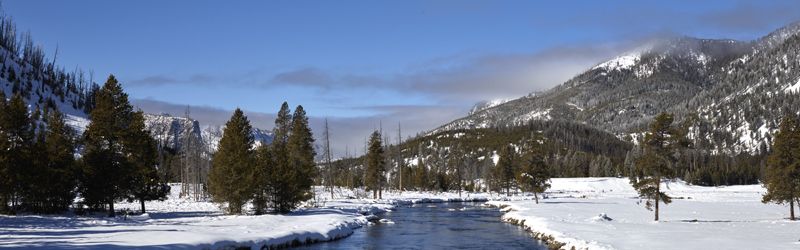
A wintertime view of the Yellowstone River in Yellowstone National Park by Carol Highsmith.
Yellowstone, the oldest U.S. National Park, attracts three million visitors yearly to experience its many wonders. In Montana, Wyoming, and Idaho, Yellowstone covers 3,470 square miles, primarily in the northwest corner of Wyoming. Famous for its geysers, hot springs, and free-ranging wild animals, Yellowstone is a seasonal wonder, offering an abundance of activities for all ages and interests!
Some 640,000 years ago, Yellowstone and its scenic views formed when a colossal volcanic eruption ejected an immense volume of ash that covered the western U.S., much of the Midwest, northern Mexico, and parts of the eastern Pacific Coast. Leaving a volcanic depression about 30 miles wide and 45 miles long, the eruption created what the early American pioneers called “the place where hell bubbles up.”
Geothermal wonders, such as Old Faithful, are evidence of one of the world’s largest active volcanoes, which typically erupts about every 600,000 years.
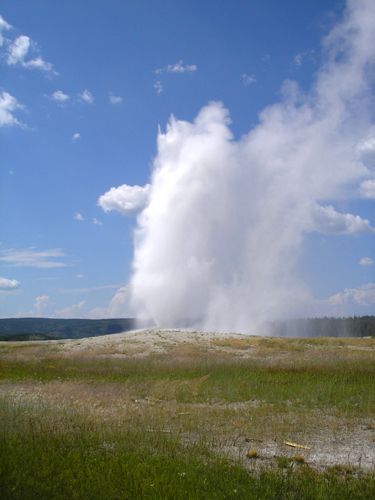
Old Faithful, Yellowstone National Park by Kathy Alexander.
Though it offered spectacular features that bemused and befuddled the park’s earliest visitors, the volcano is known to have been the largest ever to occur on Earth, causing the worldwide population to fall to as few as 10,000.
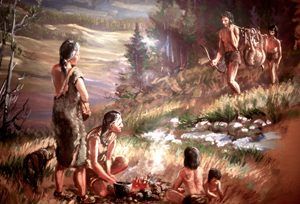
Native Americans at Yellowstone.
The park was named for the yellow rocks seen in the rocky cliffs along the northern portion of the Yellowstone River. The iron in the rocks gives them a yellow tint, which the Native Americans first called “Mitzi-a-dazi,” or “River of Yellow Rocks.” Later, French fur trappers translated this to “Yellow Rock” or “Yellow Stone.”
Based on archaeological evidence, Native American history here is said to date back as far as 12,000 years. These earliest people were primarily hunter-gatherers who used large amounts of obsidian to make cutting tools and weapons. They may also have practiced some rudimentary farming. Arrowheads made of Yellowstone obsidian have been found as far away as the Mississippi Valley, indicating that a regular obsidian trade existed between Yellowstone Native Americans and tribes further east.
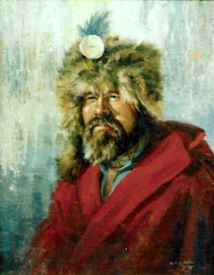
John Colter.
In 1806, when the Lewis and Clark Expedition passed through the area, a man named John Colter left the expedition to join a group of fur trappers. Colter is credited as the first non-Native American to visit the region and make contact with Native Americans. These Native Americans, called Sheepeaters, were a Shoshone band who survived by hunting bighorn sheep and fishing in the headwaters of the Snake, Madison, and Yellowstone Rivers.
Colter spent the winter of 1807-08 traveling, trapping, and exploring Yellowstone before moving down into what would be known as Jackson Hole and crossing the Grand Tetons into Idaho. However, his adventure ended when, in the fall of 1808, he was captured by Blackfeet Indians. Stripped naked, Colter was somehow able to escape. When he returned to Missouri from his adventures, people mocked his stories of steam rising from the earth and boiling mud, calling them mad hallucinations, which earned Yellowstone its first name, “Colter’s Hell”.
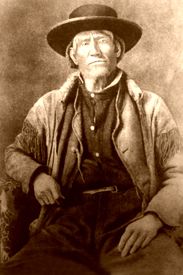
James Bridger.
In 1857, mountain man Jim Bridger led an expedition to Yellowstone. He also returned with stories of boiling springs and spouting water; however, because he had already earned a reputation as one to tell “tall tales,” his accounts were largely ignored.
Tall tales or not, the stories told by Colter and Bridger aroused the interest of explorer and geologist Dr. Ferdinand V. Hayden. In 1859, Hayden began a survey of the upper Missouri River region, accompanied by U.S. Army surveyor W.F. Raynolds and Jim Bridger acting as a guide.
Unfortunately, the party could not reach the Yellowstone region due to heavy snow. Afterward, the Civil War halted further exploration of the region, and Hayden would not be able to fulfill his mission for another eleven years.
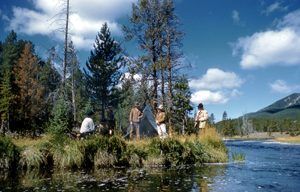
Re-enactment of the Washburn-Langford camp in Yellowstone, 1960.
Before Hayden could return, another expedition was organized by Montanans in 1870. Referred to as the Washburn-Langford-Doane Expedition, the group was led by the surveyor-general of Montana, Henry Washburn. Also part of the group was Nathaniel P. Langford, who would later become known as “National Park Langford” and the first superintendent of Yellowstone National Park. After spending about a month exploring the region, the expedition named many of the sites of interest that are still used today.
In the meantime, Dr. Hayden had been working with the government to sponsor a second expedition to Yellowstone, and discussions were already in progress to make Yellowstone a National Park. In early 1871, the U.S. Geological Survey sponsored Hayden’s second trip to the park. Along with Hayden were naturalists, geologists, a landscape artist, and two photographers.
Closely following the Washburn-Langford-Doane Expedition, the group compiled a comprehensive report on Yellowstone, including photographs and paintings, which helped to convince the U.S. Congress to create Yellowstone National Park on March 1, 1872.
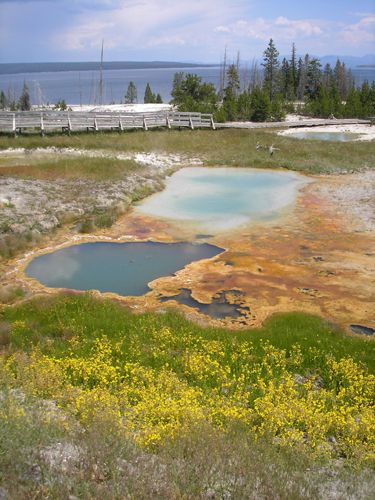
Yellowstone Lake Pots by Kathy Alexander.
Nathaniel P. Langford, who had been on the earlier 1870 expedition, was appointed as the first superintendent of Yellowstone. However, there was no money available for a salary, so he was forced to make his living elsewhere. During his five-year term, he entered the park only two times, the first as a guest for yet another Hayden Expedition in 1872, and the second to evict a man who claimed ownership of Boiling River, a natural spring within the park.
The second superintendent was Philetus Norris, who volunteered for the position. Reporting on the problems he witnessed firsthand, Congress finally provided funds for a salary and a minimal amount to operate the park.
Additional superintendents followed, but without adequate help, Yellowstone’s natural resources were being destroyed as poachers killed animals, souvenir hunters broke off pieces of geological formations, and developers established numerous tourist camps.
As a result, the park turned to the U.S. Army for help. In August 1886, the army arrived to begin a military presence that would last more than 30 years at Yellowstone.
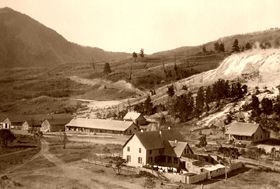
Camp Sheridan, Yellowstone, Wyoming, about 1900.
After living in temporary frame buildings at Camp Sheridan and enduring five cold winters, the Army realized there was no end in sight for the assignment and asked Congress for funds to establish a permanent post.
Fort Yellowstone was completed by late 1891, and as more troops were needed, additional buildings were constructed, including officers’ quarters, a guardhouse, headquarters, stables, and barracks for the enlisted men.
At the height of the Army’s presence in Yellowstone in 1910, there were 324 soldiers stationed at Fort Yellowstone. The Army continued to manage the park until 1918, when the newly established National Park Service assumed the management.
Today, Yellowstone is one of the most popular national parks in the United States due to its numerous natural wonders. Visitors to the park will see hot springs, canyons, geysers, lakes, and abundant wildlife. Activities for visitors include fishing, boating, hiking, and camping, along with opportunities to see wildlife such as buffalo, moose, bighorn sheep, elk, and more.
A couple of notices to potential visitors include:
- Due to the park’s geothermal activity, sulfur odor is typical in some areas, and visitors with respiratory difficulties should consult their doctors before visiting.
- Though they may “look” friendly, visitors should never approach wildlife.
- Stay on safe trails; outside them, boiling liquids and toxic gases can be found.
Lodging, ranging from hotels to cabins, is available at eleven locations within the park boundaries.
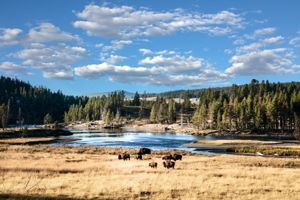
Buffalo on the move in Yellowstone National Park, Wyoming, by Carol Highsmith.
Contact Information:
Yellowstone National Park
P.O. Box 168
Yellowstone National Park, Wyoming 82190-0168
307-344-7381
©Kathy Alexander/Legends of America, updated December 2025.
Also See:
Fort Yellowstone – Preserving the First National Park
National Parks, Monuments & Historic Sites
The Yellowstone Tragedy, a Legend
See Sources.
Did You Know?
There are more people hurt by bison than by bears each year in Yellowstone. Park regulations state that visitors must stay at least 25 yards away from bison or elk and 100 yards away from bears.