
By Bayard Fox.
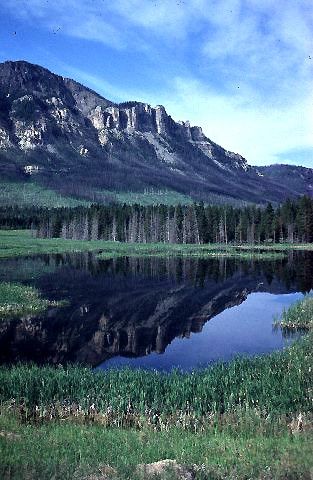
Shoshone National Forest.
Our valley in northwest Wyoming was settled by white men only a little over a century ago, hardly a blip in history compared to at least 9,000 years of Native American habitation. One cannot live long in this land of spectacular natural beauty without becoming aware of a previous culture that carved out a unique way of life. They lived in harmony with nature.
We often find stone tools like arrowheads, hatchets, scrapers, awls, and chippings, which silently testify to great activity over the millennia. A spot near the ranch, just below some awe-inspiring rock pillars on a high point, reminds me of the Acropolis, with a superb view of the Wind River Valley and the snow-capped mountains beyond. Heaps of chippings lie there in great profusion, attesting that craftsmen worked here for years to make their stone tools.
The sheep eaters (named for their staple diet), or Tukudeka, lived high in mountain fastnesses, which the bighorn sheep they ate also favored. They were a branch of the Shoshone. Both Indians and sheep found a precarious niche in the rugged mountain country at higher altitudes.
Even in Winter, like many sheep, they sought the windswept slopes at high altitudes where there was little snow, and travel was more manageable, especially on the southern exposures. They lived in caves and wickiups in sheltered canyons high in the mountains. They used mountain ridges as travel routes rather than river valleys, as tribes in lower elevations did. They were expert craftsmen, especially famous for their tremendously powerful compound bows made mainly from laminated bighorn sheep horns. These bows were highly sought-after trade items with other tribes. They are said to have driven an arrow straight through a buffalo.
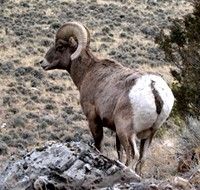
Bighorn Sheep.
Tucked away in the mountains behind the ranch, traces of the sheep traps the Indians used to catch wild sheep can still be found. They built wooden fences as wings to drive them into narrow corrals where they could be killed. We found a wickiup in a remote, narrow canyon, an hour’s walk from the main lodge. The sticks are still standing in this sheltered place after at least 140 years.
Tony Taylor has written a hauntingly beautiful little book about these people called Alpine Sentinels, published by Brushhog Books. He describes how in the mid-1700s, the Plains Indian Tribes acquired the horse and the gun. This caused a technological revolution that transformed their way of living by making the buffalo much easier to hunt and facilitating travel, transport, and warfare.
In Taylor’s words, the Plains Indian culture turned toward abundance, speed, power, and mobility, forsaking most old ways. In contrast, the Sheep Eaters clung to their ancient culture and still depended on reverence, cunning, simplicity, and finesse.
Sadly, the advent of the white man and his diseases like smallpox decimated the Sheep Eaters. Around the same time, diseases brought in by domestic sheep nearly wiped out the bighorn sheep herds, and the surviving Indians moved to the Wind River Indian Reservation, where they sought refuge with their Shoshone cousins.
By Bayard Fox. Compiled and edited by Kathy Alexander/Legends of America, updated October 2026. About the Author: Bayard Fox is a Yale graduate who has traveled widely and speaks several languages. Fox established the Bitterroot Dude Ranch in Dubois, Wyoming, in 1971. Operated by Bayard, his wife Mel, and their son Richard, the ranch offers outstanding horseback-riding vacation opportunities, unique among dude ranches. Visit the Bitterroot Dude Ranch website at http://www.bitterrootranch.com/
Also See:
Native American Mythology and Legends