
By Emerson Hough in 1905.

Western manhunt by John W. Newton appeared in The Story of the Outlaw.
In offering this study of the American desperado, the author presents himself as no apologist for the acts of any desperado. Yet, he feels no need to apologize for the theme itself. The outlaw, the desperado—that somewhat distinct and easily recognizable figure generally known in the West as the “bad man”- is unique in our national history and one whose like scarcely has been produced in any land other than this. It is unnecessary to promote absurd and melodramatic impressions of a type appropriately called historic and adequately handled as such. The truth itself is thrilling enough and challenging as that frequently has been of discovery; it is the truth sought herein.
A thesis on the text of disregard for law might well be put to better use than to serve merely as exciting reading, fit to pass away an idle hour. It might, and indeed it may — if the reader so shall choose — offer a foundation for broader arguments than those suggested in these pages, which deal instead with premises than conclusions. If we like, the lesson from our dealings with our bad men of the past can teach us the best way to deal with our bad men today.
There are other lessons that we might take from an acquaintance with frontier methods of enforcing respect for the law, and the first of these is a practical method of handling criminals in the initial executive acts of the law. American laws were never as strong as they are today, nor were our executive officers so weak. Our cities are frequently riddled with criminals or rioters. We deployed hundreds of policemen to restore order, but it was not restored. What is the average policeman as a criminal-taker? Cloddy and coarse of fiber, rarely with personal heredity of mental or bodily vigor, with no training at arms, with no sharp, penetrating quality of nerve action, fat, unwieldy, unable to run a hundred yards and keep his breath, not skilled enough to kill his man even when he has him cornered, he is the archetype of all unseemliness as the agent of a law which today needs a sterner unfolding than ever was the case in all our national life. We use this sort of tool in handling criminals when each of us knows, or ought to know, that the city would select twenty Western peace officers of the old type and set them to work without restrictions as to the size of their imminent graveyards, would free itself of criminals in three months, and would remain free so long as its methods remained in force.
As for the subject matter of the following work, it may be stated that while attention has been paid to the significant and well-known instances and epochs of outlawry, many facts have not previously found their way into print. The story of the Lincoln County War of New Mexico is given truthfully for the first time, and after full acquaintance with sources of information now inaccessible or passing away. The Stevens County War of Kansas, which took place, as it were, but yesterday and directly at our doors, has had no history but a garbled one, as much might be said of many border encounters whose chief use heretofore has been curling the blood in penny-dreadfuls. Accuracy has been sought among the confusing statements purporting to constitute the record in such historical movements as those of the “vigilantes” of California and Montana mining days and of the later cattle days when “wars” were common between thieves and outlaws and the representatives of law and order, themselves not always duly authenticated officers of the law.
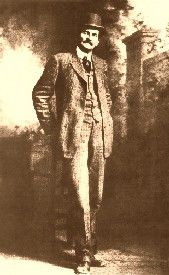
Sheriff Pat Garrett.
No one man can have lived through the entire time of the American frontier, and any work of this kind must be, in part, a matter of compilation insofar as it refers to matters of the past. In all cases where practicable, however, the author has compiled the records from the stories of actual participants, survivors, and eyewitnesses, and he can write of things and men personally known during 25 years of Western life. Captain Patrick F. Garrett of New Mexico, a central figure in the border fighting in that district in the early railroad days, has been instrumental in expanding the author’s knowledge of that region and time. Herbert M. Tonney, now of Illinois, tells his own story as a survivor of the typical county seat war of Kansas, where he was shot and left for dead. Many other men have offered valuable narratives.
In dealing with any subject of early American history, there is no authority more incontestable than Mr. Alexander Hynds of Dandridge, Tennessee, whose acquaintance with singular and forgotten bits of early frontier history borders upon the unique in its way. Neither does a better authority exist than Honorable N.P. Langford of Minnesota, upon all matters concerning life in the Rocky Mountain region in the decade of 1860-1870. He was an Argonaut of the Rockies and a citizen of Montana and other Western territories before the coming of the days of law. Free quotations are made from his graphic work, “Vigilante Days and Ways,” which is both interesting and valuable as a historical record.
The stories of modern train-robbing bandits and outlaw gangs are drawn in part from personal narratives, judicial records, and works that are often more sensational than accurate and require extensive sifting and verification. Naturally, very many volumes of Western history and adventure have been consulted. Much of this labor has been one of love for the days and places concerned, which exist no longer as they once did. The total result, it is hoped, will aid in telling at least a portion of the story of the vivid and significant life of the West and of that frontier whose van, if ever marked by human lawlessness, has, nonetheless, ever been led by the banner of human liberty. May that banner still wave today, and though blood is again the price, it may never be replaced by that of license and injustice in our America.
Go To the First Chapter – The Desperado
Compiled and edited by Kathy Alexander/Legends of America, updated April 2026.
About the Author: Excerpted from the book, The Story of the Outlaw: A Study of the Western Desperado, by Emerson Hough; Outing Publishing Company, New York, 1907. This story is not verbatim, as it has been edited for clerical errors and updated for the modern reader. Emerson Hough (1857-1923) was an author and journalist who wrote factional accounts and historical novels of life in the American West. His works helped establish the Western as a popular genre in literature and motion pictures. For years, Hough wrote the feature “Out-of-Doors” for the Saturday Evening Post and contributed to other major magazines.
Other Works by Emerson Hough: