

Salt Lake City, Utah, Capitol Building by Carol Highsmith.
Salt Lake City, Utah, is the state’s capital and most populous city. It is also the county seat of Salt Lake County, the state’s most populous county. The city is the core of the Salt Lake City Metropolitan Statistical Area, which had a population of 1,257,936 at the 2020 census. Located in the northeast corner of the Salt Lake Valley, the Great Salt Lake surrounds the city to the northwest, the steep Wasatch Range to the East, and the Oquirrh Mountains to the West. It has an area of 110.4 square miles and an average elevation of 4,327 feet above sea level. The Jordan River flows through the city and is a drainage of Utah Lake that empties into the Great Salt Lake.
Salt Lake City was founded on July 24, 1847, by early Mormon pioneers led by Brigham Young, who sought to escape the persecution they had experienced farther East.
Long before Europeans arrived, Utah was inhabited by various Native American groups. Ancient Pueblo people, known as Anasazi, constructed large communities around Southern Utah from 1 to 1300 AD. Navajo Indians later arrived in this region.

Shoshone Camp, about 1900.
Before Mormon settlement, the area was home to the Shoshone, Ute, and Paiute, who had dwelt in the Salt Lake Valley for thousands of years. The state takes its name from the Ute tribe. The first Europeans in the area were members of the Dominguez-Escalante Expedition in 1776. However, they only came as far North as Utah Valley (Provo), some 60 miles South of Salt Lake City.
Jim Bridger was the first U.S. visitor to see the Salt Lake area in 1824.
U.S. Army officer John C. Fremont surveyed the Great Salt Lake and the Salt Lake Valley in 1843 and 1845.
The Donner Party, a group of ill-fated pioneers, traveled through the Great Salt Lake Valley a year before the Mormon pioneers. They spent weeks traversing rugged terrain and brush, cutting a road through the Wasatch Mountains, and coming through Emigration Canyon into the Salt Lake Valley on August 12, 1846.
Mormon leader Brigham Young led the Mormons West after Joseph Smith’s death.
The first company of Mormon pioneers followed this same path, arriving on July 24, 1847. This group included 143 men, three women, two children, 70 wagons, a boat, a cannon, 93 horses, 52 mules, 66 oxen, and 19 cows. These members of the Church of Jesus Christ of Latter-day Saints (“LDS Church”) sought to establish an autonomous religious community. Upon arriving at Salt Lake Valley, Young had a vision, saying, “It is enough. This is the right place. Drive on.” Orson Pratt and Erastus Snow were the first two in this company to enter the Salt Lake Valley. They found the broad valley empty of any human settlement.

Mormon Pioneers entering the Salt Lake Valley.
The Mormon pioneers traveled beyond the boundaries of the United States into Mexican Territory, seeking a secluded area to safely practice their religion away from the violence and persecution they experienced in the United States. They founded Great Salt Lake City and were the first people of European descent to settle permanently in what is now Utah.
On the day of arrival, the pioneers began tilling the soil and planting crops. Within a few days, plans were drawn for Great Salt Lake City, named after the salty inland lake that dominated the desert to the West.
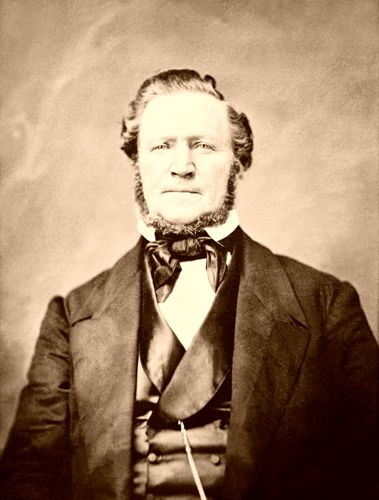
Brigham Young.
Four days after arriving in the Salt Lake Valley, Brigham Young designated the building site for the Salt Lake Temple, but construction would take several years. Out from the city’s center, now Temple Square, blocks were arranged on a grid pattern in ten-acre squares, separated by streets 132 feet wide—wide enough for a team of four oxen and a covered wagon to turn around. They also began planning and building an extensive irrigation network to feed the population and foster future growth. The city was originally named Great Salt Lake City due to its proximity to the Great Salt Lake.
At that time, the valley was within the territory of the Northwestern Shoshone, which had seasonal camps along streams within the valley and in adjacent valleys. The United States treated the land as a public domain at that time. No aboriginal title by the Northwestern Shoshone was ever ceded or relinquished by treaty with the United States.
The first group of settlers brought African slaves with them, making Utah the only place in the western United States to have African slavery. Three slaves, Green Flake, Hark Lay, and Oscar Crosby, came West with the first group of settlers in 1847. The settlers also began to purchase Indian slaves in the well-established Indian slave trade, as well as enslaving Indian prisoners of war.
During the Winter of 1847, an outbreak of measles killed many of the Shoshone in the area. Settlers buried 36 Native Americans in one grave.

State of Deseret.
Young initially governed the territory and church by a High Council, which enacted the original municipal orders in 1848. This system was later replaced with a city council and mayor-style government. Under Young’s leadership, Pioneers developed a system of communal crop sharing across the various warehouses established throughout the Salt Lake Valley.
That year, more emigrants came to the valley. Thousands of Mormon pioneers would arrive in Salt Lake in the following months and years. Many pioneers were European converts to the church who brought their cultures, languages, and skills to the valley, helping build Salt Lake City into a cosmopolitan center.
A treaty signed in 1848 ceded Mexico to the United States.
The pioneers organized the State of Deseret and petitioned for its recognition in 1849. The California Gold Rush brought many people through the city in search of fortune. Salt Lake became a vital trading point for speculators and prospectors traveling through the westward trek’s crossroads. They brought goods from the East, such as clothing and other manufactured items, and traded with local farmers for fresh livestock and crops. Trade with these sojourners brought prosperity to the locals, although agriculture remained the mainstay.
When Captain Howard Stansbury came to the Great Basin to survey the Great Salt Lake in 1849, he found,
“A city has been laid out on a magnificent scale, being nearly four miles long and three in breadth… Through the city flows an unfailing stream of pure, sweet water, which, by an ingenious irrigation mode, is made to traverse each side of every street… spreading life, verdure, and beauty over what was heretofore a barren waste. “
In 1850, the State of Deseret became the official state of Utah and part of the United States.
At that time, 26 slaves were counted in Salt Lake County. That year, the United States Congress rebuffed the settlers’ request for recognition in 1850. A few months later, on January 6, 1851, the city was formally organized as “The City of the Great Salt Lake.”

Territorial State House in Fillmore, Utah, courtesy Wikipedia.
On October 28, 1851, Utah Governor Brigham Young chose the site for Fillmore, Utah, to be the capital of the Utah Territory. Located near the territory’s geographic center, Jesse W. Fox surveyed the town. Anson Call headed the colonizing company that followed, building houses, a grist mill, and a sawmill.
In 1852, the Utah territorial Legislature passed two acts formally legalizing slavery in the territory. Construction on the Capitol building began that year.
The following year, construction of the Salt Lake Temple began in Temple Square, and it would take 40 years to complete. The region was considered a route along the 38th parallel for the transcontinental railroad. Captain John W. Gunnison, leading a military party surveying the region, was attacked by a band of Ute Indians West of Fillmore. Gunnison and seven of his men were killed in October 1853. Other disagreements developed with the Native Americans in the area, but peace was soon negotiated.
In 1855, Congress directed the President of the United States to appoint a surveyor general for Utah Territory and to cause the territory’s lands to be surveyed to bring them on the market. Certain sections were reserved for schools and universities in the territory. The surveyor general arrived in Utah in July of the same year to begin surveying. He established the initial point for his survey at the Southeast corner of the Temple Block and, from there, extended that survey over 2,000,000 acres.
In 1856, the state Legislature moved the Territorial Capital from Fillmore, Utah, to Salt Lake City.
Because of numerous conflicts between the surveyor and the territorial government, the first surveyor general abandoned his post in 1857. His successors recommended that no additional land be surveyed.
At that time, after the Mormon practice of polygamy came to national awareness, President James Buchanan responded to public outcry by sending an army of 2,500 soldiers, called the Utah Expedition, to investigate the LDS Church and install a non-LDS governor to replace Brigham Young. After Brigham Young refused to step down as governor, President Buchanan declared the area in rebellion. In response, Brigham Young imposed martial law, sending the Utah militia to harass the soldiers during the Utah War. The people of Great Salt Lake City joined a general movement southward.

Utah Expedition by Harpers Weekly, 1858.
When a division of the United States Army, commanded by Colonel Albert Sidney Johnston, marched through Salt Lake City, it found the city had been evacuated. “George ” Beefsteak ” Harrison, a cook with Johnston’s army, ” said that Salt Lake was still as a cemetery when they marched in. He saw only two people: a man riding a sorrel mule and an old lady who peeped out of a window blind at the troops.”
“The utter silence of the streets was broken only by the military bands’ music, the regiments’ monotonous tramp, and the baggage wagons’ rattle.
— An Army Correspondent
The soldiers continued their march through the deserted city to vacant land at the Southwest corner of the valley.
Young eventually surrendered to federal control when the new territorial governor, Alfred Cumming, arrived in Salt Lake City on April 12, 1858. Most troops pulled out at the beginning of the Civil War.
Following the Utah War, lawlessness ensued when the army’s camp followers settled in the city. T.B.H. Sten recorded that during part of 1859, there was a murder every week. Mormon people kept away from “Whisky Street” and attended to their business, but Brigham Young’s house was strictly guarded, day and night. Gradually, a lucrative trade grew between the city and Camp Floyd, but the soldiery was always resented.

Pony Express Monument in Salt Lake City, Utah.
Great Salt Lake City became a Pony Express stop in 1860 when the first riders came in from Sacramento, California, and St. Joseph, Missouri.
In the summer of 1860, explorer and ethnologist Richard Francis Burton traveled by coach to Great Salt Lake City to document local life. He met with Brigham Young and other key figures during his three-week stay. His records include sketches of early buildings, descriptions of geography and agriculture, and commentary on politics and social structure, along with essays, speeches, and everyday snippets like newspaper clippings and a high-society ball menu.
Upon completing the Pacific Telegraph line to Great Salt Lake City in 1861, Brigham Young sent the first eastbound message to Cleveland, Ohio.
To secure the road to California during the Civil War, more troops arrived under the command of Colonel Patrick Edward Connor in 1862. They settled in the Fort Douglas area East of the city. Anti-LDS, Connor viewed the people with disdain, calling them “a community of traitors, murderers, fanatics, and whores.” He worked with non-LDS businesses and bank owners to dilute their influence and encouraged mining.
In 1862, President Abraham Lincoln authorized the construction of a transcontinental railroad, and the Union Pacific and Central Pacific Railroad companies launched the project the following year.

Salt Lake Theater in Salt Lake City, Utah.
On June 19, 1862, during the Civil War, Congress prohibited slavery in all U.S. territories. The Salt Lake Theater, the largest building in Utah, opened in 1862 for $100,000 and became the leading theatrical center of the Intermountain West.
In July 1862, Colonel P.E. Connor and his regiment were sent to the Utah Territory to protect overland routes and address concerns of a Mormon uprising. Commanding 850 men from the Third California Infantry and Second California Cavalry, Connor arrived in Salt Lake City to find women and children greeting them due to fears of rebellion. He became the Commander of the District of Utah on August 6, 1862, and established Camp Douglas in October. Efforts by Brigham Young to remove federal troops failed. In 1863, after the passage of Federal anti-polygamy laws, rumors circulated that Connor’s soldiers might capture Young. A telescope was placed on the Beehive House to monitor Camp Douglas, and Young’s militia often gathered for protection. Some of Connor’s troops also discovered valuable gold and silver in the Wasatch Mountains that year.
Work began on the Tabernacle in 1864, and relations between townspeople and soldiers became poor. However, the following Fourth of July, they united in a joint celebration of Abraham Lincoln’s second inauguration and Union successes in the Civil War. Two months later, the city and camp joined in mourning President Lincoln’s assassination.

Ute Warriors by James Ayers.
The Ute Black Hawk War, Utah’s last major Indian conflict, broke out in 1865. Continuing until 1868, the intermittent, desperate warfare was waged between marauding Utes and the settlers of central Utah. More than 50 Mormon settlers were slain, and immense quantities of livestock were lost, while many of the southern settlements for a time were abandoned. Economic losses of the settlers were estimated at more than a million dollars. The Ute finally quieted, with most of the tribe not having participated in the war and mainly settled on a reservation in the Uintah Basin.
The Tabernacle was sufficiently completed to house the annual conference of the Mormon Church in 1867.
The survey conflict between the federal and territorial governments kept the issue on hold until 1868. In the meantime, large sections of the territory were transferred to neighboring territories and states. That year, Congress again directed the President to appoint a surveyor general in the Utah Territory, establish a land office in Salt Lake City, and extend the federal land laws over the city and the territory. The word “Great” was dropped from the city’s name that year. At about the same time, Brigham Young founded Zion’s Cooperative Mercantile Institution (ZCMI) to prevent dependency on outside goods and hinder ex-LDS retailers. By then, the transcontinental railroad had gathered momentum, and the Union Pacific and Central Pacific Railroad companies had graded into Utah.
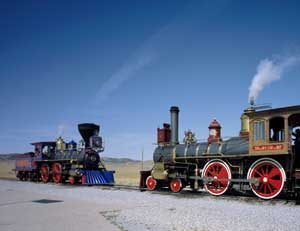
Engines Meet, Golden Spike, Promontory Summit, Utah by Carol Highsmith.
The land office opened in Salt Lake City on March 9, 1869. On May 10, 1869, the transcontinental railroad was completed by driving the Golden Spike at Promontory Summit, some 80 miles northwest of Salt Lake City. Afterward, Brigham Young began the construction of the Utah Central Railroad, connecting Salt Lake City with Ogden. The completion of the transcontinental railroad revolutionized Utah economically. Prices of manufactured goods fell, and those of agricultural products rose significantly. The mines’ opening depended on transportation, and boom developments owed much to the railroads. In turn, the opening of mines influenced the expansion of railroads through central and southern Utah.
That year, President Ulysses S. Grant gave polygamy its political aspect, drawing the battle lines: polygamy was to be crushed.
By 1870, Salt Lake had been linked to the Utah Central Railroad. People began to pour into Salt Lake, seeking opportunities in mining and other industries. Mass migration of different groups followed. Ethnic Chinese, who had laid most of the Central Pacific railway, established a flourishing Chinatown in Salt Lake City nicknamed “Plum Alley,” which housed around 1,800 Chinese during the early 20th century.
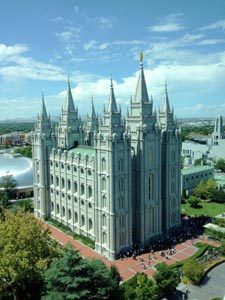
Mormon temple in Salt Lake City, Utah.
Building progressed on the Temple in the meantime, its granite walls gradually rising tier after tier, and Temple Square was a scene of constant industry. Consternation was created in 1870 when two boys, practicing with a rifle, blew up the arsenal on the present site of the State Capitol, breaking nearly every window in the city; long queues of people formed outside establishments selling window glass, and there were gruesome descriptions of finding parts of the boys’ bodies.
The struggle over polygamy intensified after 1870, shifting from a moral to a political issue. Before this, Mormons primarily practiced polygamy with little interference, aside from the ineffective Anti-Polygamy Act of 1862. A pivotal debate between Reverend J.P. Newman and Mormon leader Orson Pratt in the Tabernacle focused on Biblical justification for polygamy and drew significant national attention. Although no formal resolution was reached, the press indicated that Newman had technically won the debate, highlighting a growing intolerance for polygamy in American society and foreshadowing future conflicts.
The first streetcar ran in 1872.
The Utah Southern Railroad was completed from Salt Lake City to Provo in 1873. Until then, the Temple’s construction had been slow, but a branch railroad line was run into Little Cottonwood Canyon to facilitate the movement of granite blocks. Afterward, the project sped up.
The Poland Act of 1874, also known as the Plural Marriage Prosecution Act, aimed to combat polygamy in Utah by reducing the LDS Church’s influence on the justice system. Signed by President Ulysses S. Grant, the law defined polygamy as a felony with penalties of up to $500 in fines and five years in prison. It also classified polygamous living as a misdemeanor, punishable by fines or short imprisonment. The act removed all elective offices in Utah, establishing a commission to oversee voter registration and elections. Between 1882 and 1884, about 12,000 voters were disfranchised via a test oath against polygamous involvement. Despite these measures, Utah’s attempt for statehood in 1882 was unsuccessful.

Old Salt Lake City Hall, courtesy Wikipedia.
That year, Salt Lake City police were arrested by U.S. Marshals, who took control of the national election in Salt Lake City. Mayor Daniel H. Wells, an LDS Church First Presidency member, declared martial law from the balcony of the Old Salt Lake City Hall. Federal troops arrested the mayor, but he was soon released.
In 1874, Salt Lake City acquired connections with Logan upon completing the Utah Northern Railroad to Logan and, in later years, to Pocatello, Idaho, and Montana points. European ethnic groups and East Coast missionary groups constructed St. Mark’s Episcopal Cathedral in 1874.
Brigham Young died at the Lion House in Salt Lake City on August 29, 1877. The Saints were stunned, and the event drew 25,000 people to view the body of their leader as it lay in state in the flower-decked Tabernacle. Music played on the Tabernacle organ included Brigham Young’s Funeral March, composed by Joseph J. Daynes. Daniel H. Wells’s funeral address occupied probably less than a minute. “I have no desire or wish to multiply words,” he said, feeling it was a time to mourn. Goodbye, Brother Brigham, until the morning of the resurrection day. So dominant a figure had he been that many believed Mormonism must collapse with his death.

Brigham Young’s Grave, courtesy Wikipedia.
Young’s death occurred just as political battles, initiated in 1870 by the formation of a non-Mormon Liberal Party, took on more heat. For all their strenuous efforts, however, the Liberals could not carry the city until 1890, when the ” manifesto ” disavowing polygamy in the Church ended the warfare in the city and Territory over that issue.
By the 1870s, Commercial Street in downtown Salt Lake City was the center of the red-light district. Parlor houses along the street housed legitimate businesses, usually liquor or tobacco stores, and held “female boarders” in the upper parts of the houses. Miss Helen Blazes and Miss Ada Wilson were madams of these establishments. Police regularly raided the establishments, fining, arresting, and even sometimes physically examining the women. At its height, the district employed approximately 300 courtesans.
The Utah Southern Extension of the railroad reached Milford and Frisco in 1880.
Struggle in the 1880s centered fiercely and conclusively on polygamy. Enemies of the Mormons wanted to shatter the non-religious power of the Church to break down its economic, social, and political domination of Utah.
The prelude to the combat was the dispute over the office of delegate to Congress, fought out on the floor of the House between 1880 and 1882 by George Q. Cannon, Mormon incumbent, and Allan G. Campbell, gentile contestant. Cannon won the election with an overwhelming majority, but Governor Eli Murray certified Campbell because Cannon was not a citizen. Campbell was not admitted and was rendered ineligible by the passage of the Edmunds Bill in 1882.

Denver & Rio Grande Western Railroad Near Salt Lake City.

Mormons in the Sugar House Prison in Salt Lake City.
Between 1881 and 1883, the Denver & Rio Grande Western Railroad graded West into Utah from Colorado; by 1883, it had 386 miles of narrow-gauge road in Utah.
Chief Justice Charles S. Zane, who arrived in 1884, convicted Rudger Clawson, subsequently a member of the Quorum of the Twelve, of polygamy under the Edmunds Act and sentenced him to four years in the penitentiary. An appeal to the Supreme Court was lost. Federal authorities then began intensive prosecutions. Mormons were peremptorily excused from jury service if they declined to deny the doctrine of polygamy; wives and minors were permitted, even forced, to testify against husbands and fathers.
The Mormons had to give up all they had stood by for 40 years, all the sternly held religious beliefs of four decades, their wives and their children to whom they were bound, or risk imprisonment if caught.
Six terrible years ensued for the polygamists. Church leaders almost uniformly embraced polygamy as a test of their faith. The most prominent leaders were forced into hiding. Brandishing warrants, United States deputies broke into homes in the dead of night on “poly hunts. Popular feeling was exemplified in Salt Lake City on July 4, 1885, when flags were flown at half-mast until raised by angered gentile mobs; in Provo, the Enquirer carried a large cut of a coffin inscribed “Independence Day, Died July 4, 1885. ”
“The hounds of hell were lying in wait for me. How long will the Lord allow these wicked reaches to gain power over us?”
— A hunted polygamist
Imprisoned men were considered martyrs and often were met by the town band upon their release, and parties were held in their honor. Congress made the laws against polygamists even stronger with the Edmunds-Tucker Act of 1887. The LDS Church was disincorporated and most of its property confiscated; female suffrage was abolished; the Perpetual Emigration Company was abolished; the Utah Commission was continued in office, and a test oath was required of citizens who would vote, hold elective office, or serve on juries. The Church was already in financial stress; this last blow almost bankrupted it.
Railroad connections were made with Denver, Colorado, and other eastern points over the Denver & Rio Grande Western Railroad by 1886.
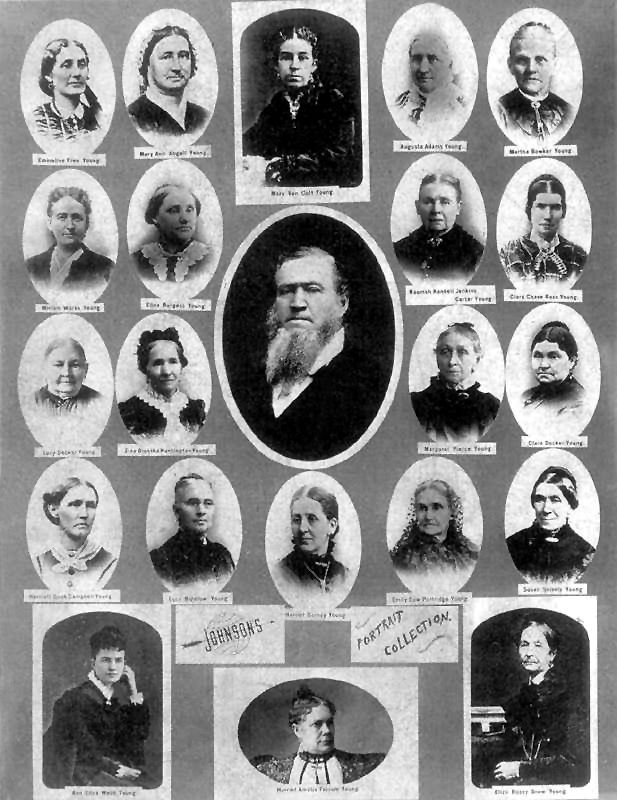
Brigham Young was an ardent supporter of polygamy,
marrying 56 wives during his lifetime and fathering 57 children. This photo shows less than half of his wives.
The anti-polygamy Edmunds-Tucker Act of 1887 systematically denied many prominent LDS Church members the right to vote or hold office. Polygamists were detained in a Federal prison just outside Salt Lake City.
Developments within the Territory, promised between 1887 and 1890, promised better days for Utah. Gentile businessmen began to desert the radical anti-Mormons.
The streetcar system was electrified in 1889.
That year, the Mormon People’s Party offered prominent Gentiles four places on its Salt Lake City ticket as a gesture of reconciliation, but the Fusionist Party efficiently carried the election. In Salt Lake City, a Chamber of Commerce was organized, which ignored religious differences.
The immediate effect of the capitulation to Federal pressure was to deliver populous centers into gentile hands politically. The Liberals carried Ogden in 1889 and the following year took Salt Lake City. They embarked on a spending program for municipal improvements.
The non-LDS Liberal Party took control of the City government in the 1890 election. Three years later, the Liberal Party and the People’s Party dissolved into national parties in anticipation of Utah statehood. Still, both LDS and non-LDS leaders would govern Salt Lake City from that point onward.
In September 1890, Wilford Woodruff, the new president, published a manifesto in the Deseret News advising all members of the Church to abstain from polygamy. In October, the manifesto was ratified at a general conference, and the Saints officially abandoned polygamy as an essential Church doctrine. This crucial decision was not made without bitterness among the Church members or skepticism among the Gentiles. Many of those who had suffered for polygamy doubted the power of man to set aside the decree of God. In the ensuing 50 years, there were undercurrents, constantly diminishing, of polygamic thinking in Church ranks.

Deseret News.
The church began its eventual abandonment of polygamy in 1890, releasing “The Manifesto,” which officially suggested members obey the law of the land (which was equivalent to forbidding new polygamous marriages inside the U.S. and its territories, but not in church member settlements in Canada and Mexico. This paved the way for statehood in 1896, when Salt Lake City became the capital.
Joseph L. Rawlins, elected to Congress in 1892, introduced an enabling act for Utah and a bill to return confiscated Mormon Church property. Both bills carried; Caleb W. West, governor during the last phase of the polygamy struggle, recommended statehood in his annual report for 1893. The Enabling Act was signed by President Cleveland the following July.
The Salt Lake Temple’s capstone was placed at the annual Church conference in 1892. When the temple was completed, over 40,000 people gathered within the confines of Temple Block, while thousands of others could not find a place in the great square, standing in the street or looking down from roofs or windows of adjoining buildings. This was the largest assembly of people ever known in Utah at the time. The temple was dedicated on April 6, 1893. It has become an icon of the city and its centerpiece.
On September 25, 1894, President Cleveland, after a period of waiting, pardoned all polygamists and restored their civil rights.
In March 1895, Utah’s seventh constitutional convention met in Salt Lake City, where two main issues were debated. First, women were granted the right to vote, a significant concession. Second, the Enabling Act mandated the prohibition of polygamous marriages. The convention decided that those already in polygamous marriages could continue living that way. The constitution was ratified in the autumn of 1895, and Heber M. Wells was elected as the first Governor of Utah.
On January 4, 1896, President Cleveland proclaimed Utah the 45th State of the Union, and Salt Lake City became the state capital. Two days later, its officers were inaugurated. That year, Utah became the third state to extend the right to vote to women.

Trolley Square in Salt Lake City, Utah.
Utah marked its semi-centennial, or “Golden Jubilee, ” with five days of celebration in the summer of 1897. The celebration opened with the unveiling of the Brigham Young Monument at Main and South Temple Streets. More than 700 pioneers were presented with badges, and the Jubilee closed with a display of pyrotechnics from Capitol Hill.
Many historical buildings were constructed in the 1890s. Electric trolleys were installed at Trolley Square and used to transport people living in the Avenues, Capitol Hill, Liberty Park, and the Sugarhouse Areas to downtown.
The Spanish-American War, which broke out in 1898, demonstrated the changes in widespread Utah feelings since the Civil War. Utah supplied three batteries of light artillery, two cavalry troops, and volunteers who were seeing active service in Cuba and the Philippines.
That year, Brigham H. Roberts, a ranking Mormon and a polygamist, was elected to Congress. His opponents made campaign issues of his Church connections and his participation in polygamy, and a petition protesting his seating, signed by upwards of a million citizens, was sent to Congress. The House voted not to admit him, necessitating a special election in 1900, when he was succeeded by William H. King, who later was elected to the Senate.

Salt Palace in Salt Lake City, Utah, 1901.
The Salt Palace, built in 1899 on Ninth South Street, was covered with rock salt and illuminated at night with hundreds of electric lights. At the time, a saucer-shaped bicycle track was probably the fastest in the country, and world records were established. Barney Oldfield was one of the early competitors.
Salt Lake began to assume its present character in the early 1900s when the state capitol and many other historic buildings were constructed.
In 1903, calls to purge Commercial Street of its sordid establishments began, citing its soiling of the central business district and its decrease in property value.
The Utah Southern and Utah Southern Extension roads were acquired in 1900 by the San Pedro, Los Angeles & Salt Lake Railroad, which completed its line to southern California in 1905.
The development of open-cut copper mining at Bingham, beginning in 1907, was the most productive enterprise of its kind.
By 1908, a formal registration system existed. Police kept track of the names and addresses of madams and their houses, and in turn, the madams supplied current lists of their girls. The girls paid a $10 fine each month, which supplied much of the city’s revenues.
That year, Salt Lake City Mayor John Bransford and the city council adopted a “stockade” policy, planning to build a compound where the women could practice their inevitable trade freely but discretely. Bransford said,
“I propose to take these women from the city’s business section and put them in a district which will be one of the best, if not the very best, regulated districts in the country.”
— Salt Lake City Mayor John Bransford

Stockade Crib Row in Salt Lake City, Utah, about 1908.
In 1908, Mrs. Dora B. Topham, known as Utah’s “Belle London” of Ogden’s “Electric Alley,” was approached by a group of men to establish a stockade for prostitution in Salt Lake City. She formed the Citizens’ Investment Company and purchased land between 500 and 600 West and 100 and 200 South. This area was chosen for its proximity to railroads, division of school districts, and its already blighted condition due to the influx of Greek and Italian workers.
The community had mixed reactions. The West Side Citizens’ League sought to abolish the stockade, but others viewed it as a practical solution to managing prostitution. On December 18, police instructed prostitutes to vacate the area by 4:00 a.m., offering them three options: leave town, go to jail, or move into the stockade.
The stockade contained nearly 100 small brick “cribs,” each ten feet square, where girls paid $1 to $4 per day to stay. It also included larger parlor houses and liquor storage, with guarded entrances and an alarm system to deter unwanted guests during police raids. The stockade closed unexpectedly on September 28, 1911, when Belle London announced it would not reopen. Reactions varied, with some relieved while others worried about more sex workers on the streets. Some former occupants accepted help from the Women’s League and moved to the Women’s Rescue Station, while others returned to Commercial Street, which remained a red-light district until the 1930s, or stayed near West 200 South, active in prostitution until the 1970s.

Wasatch Range from the Valley of the Jordan River in Utah, by the Detroit Photographic Co., 1900.
From 1908 to 1910, the Denver & Rio Grande Western Railroad built a line from Salt Lake City to San Francisco. This construction coincided with the country’s first development East of the Wasatch Mountains. The railroad ran through Utah’s most affluent coal sector, and exploitation of the Carbon-Emery mines quickly followed. The railroads also boosted the livestock business, making the raising of sheep and cattle a vital part of Utah’s economy.
The Salt Palace burned in 1910.
The city adopted a nonpartisan city council in 1911. As LDS/non-LDS tensions eased, people began to work together for the common good, improving roads, utilities, and public healthcare.
The Lincoln Highway, the first transcontinental highway, traversed Salt Lake City in 1913.
Electric trolleys garaged at Trolley Square were installed to transport people living in The Avenues, Capitol Hill, Liberty Park, and Sugarhouse areas to downtown.
World War I sealed the rapprochement of Mormon Utah and Gentile United States. Utah supplied 21,000 men and millions of dollars to prosecute the war. During the War, 760 Utah men died in service, and nearly every town in the State has its memorial to the war dead. The course of Utah’s history after World War I bore little relation to the violent years, giving Utah a history unlike that of other States. Developments in Utah, socially and economically, had become nearer the American norm.
San Pedro, Los Angeles & Salt Lake Railroad was incorporated into the Union Pacific system in 1921.
The Great Depression brought construction to a standstill. At its peak, the unemployment rate reached 61,500 people, about 36%. The annual per capita income in 1932 was $276, half of what it was in 1929, $537 annually. Jobs were scarce. Although federal New Deal programs and the Church of Jesus Christ of Latter-day Saints boosted the economy, it did not fully recover until World War II.
The post-war mining and manufacturing boom swept Utah, though agriculture was handicapped by drought and uncertain markets. Urban areas drew the rural population. Between 1900 and 1930, the city’s population nearly tripled.

Salt Lake City in the 1930s.
In the 1930s, trolleys were gradually replaced by buses. In 1936, Eagle Gate, which had marked the entrance to Brigham Young’s estate, was reconstructed to allow traffic flow. City parks were built, sewer systems and street lighting were installed, and streets were paved.
In 1940, there were approximately 730 active church congregations in Utah, of which approximately 575 were Mormon. Congregationalists, Catholics, Episcopalians, and Presbyterians took an active interest in education, conceiving the schools as the best means of attacking entrenched Mormonism and establishing many schools throughout Utah in pre-statehood days. At that time, only the Catholic church maintained a parochial school system.
The last streetcar line was discontinued in 1941.
Salt Lake’s economy was boosted during World War II due to the influx of defense industries to the Wasatch Front. Demand for raw materials expanded Utah’s mining industry, and several military installations, such as Fort Douglas and Hill Air Force Base, were established. These installations revitalized the economy, and workers and soldiers spent money in the city’s restaurants, shops, ballrooms, and theaters.
After the war, Salt Lake City continued to grow and suffered some of the same problems as other cities. Urban sprawl became a growing problem due to a combination of rapid growth and abundant available land. The military and aerospace industries also became dominant.
The Chinese businesses and residences were demolished in 1952, although a historical marker has been erected near the parking ramp that replaced Plum Alley. Immigrants also found economic opportunities in the booming mining industries.

ZCMI Center Mall in Salt Lake City.
The city’s population stagnated during the 20th century as population growth shifted to suburban areas North and South of the city. Few of these areas were annexed to the city, while nearby towns were incorporated and expanded. As a result, the population of the surrounding metropolitan area greatly outnumbers Salt Lake City. A primary concern of recent government officials has been combating inner-city commercial decay. The city lost population from the 1960s through the 1980s.
During the 1960s, several commercial and service centers were built in the suburbs, drawing business away from downtown. To counter this trend, the church invested $40 million to develop a downtown shopping mall called the ZCMI Center Mall. It was named for Zions Cooperative Mercantile Institution, a prominent retail chain that began in Salt Lake’s pioneer days. In the 1970s, new businesses and shopping malls were built, and classic older buildings were renovated. Citywide beautification projects generated vitality and activity in the downtown community.
Salt Lake continued to grow in the 1980s. Developments included expanding the Salt Palace Convention Center, the Salt Lake International Center, the University of Utah Research Park, and the Triad Center.
The downtown skyline changed again in the 1990s when the Salt Palace Convention Center was rebuilt, a major office tower and a new court complex were constructed, and the Delta Center was built as the home for the Utah Jazz. The arena can seat more than 18,000 for NBA games and 20,000 for concerts. Redeveloped city blocks, restored building facades, and new urban parks further enhanced the beauty of downtown.
In the 1990s, the city experienced some population recovery.
Salt Lake City was selected in 1995 to host the 2002 Winter Olympics. The games were plagued with controversy. A bid scandal surfaced in 1998, alleging bribes had been offered to secure the bid. During the games, other scandals erupted over contested judging scores and illegal drug use. Despite the controversies, the games were heralded as a financial success. In preparation, major construction projects were initiated. Local freeways were expanded and repaired, and a light rail system was constructed. Olympic venues are now used for local, national, and international sporting events and Olympic athlete training.
After 132 years in business, ZCMI was sold to the May Department Stores Company in 1999. The remaining ZCMI stores, including one in downtown Salt Lake City, were converted into Meier & Frank stores, although the facade still reads “1868 ZCMI 1999.”
Light rail transit returned to the city when UTA’s TRAX opened in 1999. The $312 million light-rail system transports passengers from Ogden to Provo.
In the early 2010s, the LDS Church purchased the Crossroads and ZCMI malls. It rebuilt them into the City Creek Center, which is connected by walkways and is surrounded by new high-density residential and commercial buildings.
The S Line (formerly Sugar House Streetcar) opened for service in December 2013 on an old Denver & Rio Grande Western Railroad right-of-way.
Utah continues to experience strong economic and employment growth. Ranked among the best environments for business, the Salt Lake area’s concentration of biomedical, technology, and software firms is among the highest in the nation.
The Salt Palace Convention Center once again underwent expansion. It now features 164,000 square feet of meeting space, 515,000 square feet of exhibit hall space, and a 45,000-square-foot ballroom. A 26-story convention hotel is next.

Downtown Salt Lake City, Utah, by Carol Highsmith.
In 2020, the city experienced a 5.7 magnitude earthquake, protests against the killing of Bernardo Palacios-Carbajal, and a damaging windstorm with hurricane-force winds amidst the wider national George Floyd protests, the global COVID-19 pandemic, and protests against pandemic measures.
On July 24, 2024, the International Olympic Committee formally chose Salt Lake City to host the 2034 Olympic Winter Games. All of the facilities from the previous Games can be re-used, and the bid enjoyed support from the International Olympic Committee and the city.
Two major cross-country freeways, I-15 and I-80, now intersect in the city. The city also has a belt route, I-215.

Salt Palace Convention Center, Salt Lake City, Utah.
©Kathy Alexander/Legends of America, updated August 2026.
Also See:
Sources:
Federal Writers’ Program, published by New York: Hastings House, 1945.
Utah.com
Utah History to Go
Visit Salt Lake
Wikipedia – Fillmore, Utah
Wikipedia – History of Salt Lake City
Wikipedia – Salt Lake City