
By John Moody in 1919
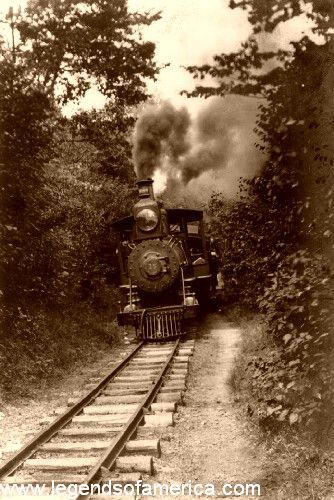
A train through the woods.
Only when one reads such a book as Francis Parkman’s “Oregon Trail” does one fully realize the vast transformation that has occurred within little more than half a century in the great Northwestern territory beyond the Mississippi and the Missouri Rivers. In that fascinating history, we read of the romantic and thrilling experiences of Parkman and his companions in their summer journey across the plains of Nebraska and through the mountain ranges of Wyoming, Montana, and Oregon. We read of their hairbreadth escapes from the Indians, their chase of the buffalo and other wild animals of the far Western country, the wearisome weeks that they spent crossing the deserts where absolute loneliness reigned, and finally of their arrival after months of hardship, in the vast Oregon country, which with its great natural resources, splendid climate, and large extent has come to be known in these modern days as the Empire of the Northwest.
The Northern Pacific Railroad Company was chartered by Congress in 1864, just before the closing of the Civil War, to penetrate and bring this great virgin region within the reach of the East. During this same period, the Union Pacific route was being surveyed. The first ground was broken in December 1863 for the line to connect Omaha with San Francisco.
Like the Union Pacific charter, that of the Northern Pacific Railroad also contained an extensive land grant. From the modern viewpoint, such land grants look colossal. However, in those days, the general opening up and development of the Western country had progressed to so slight an extent that the significance of giving away millions of acres of public lands to encourage a precarious railroad enterprise was then no more than the passing over to capitalists today of exclusive rights in extensive tracts of territory in Brazil and the other South American Republics. Even these great opportunities to acquire almost an empire of fertile lands or rich forests were not, as a rule, looked upon as attractive enough to tempt capital into the wilderness. The old saying that capital is the most timid thing in the world and does not like pioneering is strongly emphasized by such instances as this, and no doubt, in 1864, the enormous grants of free land made by Congress did not appear especially attractive to the man who had money to invest.
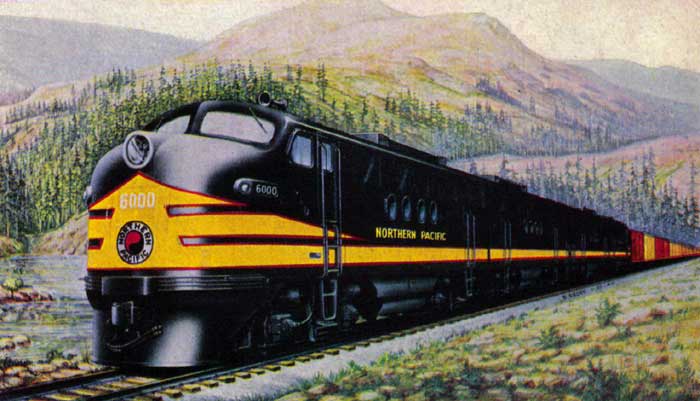
Northern Pacific Railroad.
Whatever the public attitude may have been, the Act of Congress of July 2, 1864, creating the Northern Pacific Railroad, gave that company the right to construct a line from some point on Lake Superior, either in Minnesota or in Wisconsin, westward and north of latitude 45 degrees, to or near Portland, Oregon. The land grant consisted of forty alternate sections of public land for each mile within the Territories penetrated and twenty alternate sections within the States through which the railroad might pass.
The hazardous character of this undertaking will be realized when it is remembered that at this time, no railroad had yet penetrated the Rocky Mountains, that the entire railroad system of the United States was less than 40,000 miles, and that west of the Mississippi River, there was no mileage worth mentioning. It was still less than a generation since Parkman and his companions had made their four-month journey from St. Louis to the mouth of the Columbia River, and between the fringe of civilization along the Pacific slope and the region about Chicago and St. Louis lay almost a third of the continent uninhabited, undeveloped, and unknown. The scheme languished for several years until, finally, in 1869, the firm of Jay Cooke and Company of Philadelphia undertook to raise the necessary capital.
The story of the Northern Pacific for the next few years was closely bound up with that of Jay Cooke, one of the most conspicuous characters of his time in the financial world. He had a commanding personality, great energy, unusual resourcefulness, and a large personal following. He had built his reputation by successfully financing United States government loans during the Civil War. He undertook to raise more than $100,000,000 to carry through the Northern Pacific enterprise. He achieved remarkable success for a time and, within three years, had built over 500 miles of the mainline to the Pacific coast.
But, the outbreak of the Franco-Prussian War and the consequent financial stringency abroad, the difficulty of marketing bonds on an uncompleted enterprise, combined with the poor showing made by those sections of the line completed and in operation, brought matters to a crisis. In September 1873, Jay Cooke and Company were obliged to close their doors. The railroad affairs were so closely tied to those of the banking firm that, despite strenuous efforts to save the railroad, its revenues proved inadequate. As a result, in April 1874, General Lewis Cass was appointed the receiver.
Northern Pacific Railroad.
The uncompleted property was operated for some years after that under the protection of the courts, and no plan of reorganization was devised until 1879. During the receivership, only a moderate amount of additional mileage was incurred. Not until many years had passed did the system penetrate the mountains and reach the Pacific coast. However, when the new company took possession in 1879, the aggressive building was resumed, and for a time, it looked as though the project would be promptly finished. However, in 1882, the company still had about 1,000 miles to construct to complete its main artery. At this time, financial difficulties appeared, and the days of stress were tided over only by the help of a syndicate and the Oregon and Transcontinental Company.
With the formation of the Oregon and Transcontinental Company began the regime of Henry Villard, the dominating factor in Northern Pacific affairs for many years afterward. Some years before, Villard, who had long been interested in Western railroad enterprises and who had become prominent through his activities in connection with the Kansas and Pacific Railway, had succeeded in forming the Oregon Railway and Navigation Company as a combination of steamboat lines operating on the Willamette and Columbia Rivers in Oregon, with an ocean line connecting Portland and San Francisco. A connecting railroad line, built to Walla Walla in southeastern Washington, penetrated a portion of the territory through which the Northern Pacific was projected.
In 1880, a contract was arranged between the two companies, under which the Oregon Railway and Navigation Company undertook to share in the traffic and construct a line eastward to meet the Northern Pacific line at the mouth of the Snake River.
This arrangement would allow the Northern Pacific to run its trains into Portland and would obviate the necessity of constructing its own road into that city.
Despite this arrangement, Villard feared that the Northern Pacific Company might decide, after all, to build its own line to Portland as soon as it could finance the project. To prevent this move, he formed the Oregon and Transcontinental Company. This holding corporation promptly acquired a dominating interest in the Northern Pacific Railroad in the open market and by private purchases. At the same time, Villard placed the control of the Oregon Railroad and Navigation Company in the hands of the new Transcontinental.
Villard thus came to control the entire Northern Pacific system and, backed by the Deutsche Bank of Berlin and other German and Dutch interests, began an aggressive policy of expansion and development. The business of the system developed rapidly. The main line to the Pacific coast was now in operation, and the entire system amounted to about 2,300 miles of road. But Villard followed a financial policy that was not sound and paid dividends without justification. In a short time, the company consequently found itself financially embarrassed.
As a result of financial losses in 1884, Villard was obliged to retire from active control of the properties. But in 1887, he got possession of the Northern Pacific with German capital. He succeeded in arranging a lease of the Oregon Short Line, developed by the Union Pacific interests, embracing a cross-country road from its main lines in Wyoming northward into Oregon and Washington. At the same time, the interest of the Transcontinental Company in the Oregon Railway and Navigation Company was linked with the Oregon Short Line Company. These transactions, however, still left the Transcontinental Company in control of the situation, as it retained its majority ownership of Northern Pacific Railroad stock.
For the next few years, the Northern Pacific did not follow a policy of rapid expansion. Other trunk lines, such as the Union Pacific, Rock Island, Santa Fe, Burlington, and North Western, were all growing and keeping pace with the rapid settlement of the West, but the Northern Pacific in these years rested content with its position as a single-track transcontinental route having but few branches. Its only necessary extension was acquired by the Wisconsin Central Railroad, which gave the company a line between St. Paul and Chicago and a valuable and important entrance into the latter city. It was expected that, with this accession, the company’s affairs would be permanently established on a sound basis. Still, the over-liberal policy of paying out practically all the surplus in dividends was continued in the face of significant increases in fixed charges.
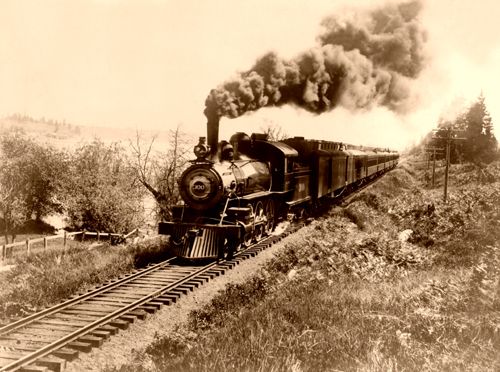
Northern Pacific Railroad train.
Early in 1892, rumors began to circulate that the Northern Pacific was not in as strong a financial position as had been assumed. The stockholders took alarm, and the committee appointed to investigate the situation discovered a deplorable state of affairs. As a result of the severe criticism of Villard’s policy, steps were taken to oust him from control, but without success until June 1893. Two months later, receivers were appointed, and they discovered that the company was insolvent and had no funds to pay maturing obligations quickly. Receivers were appointed also for most of the branch lines, including the Wisconsin Central system. Although leased to the Northern Pacific, the Oregon Short Line was tied through guarantees with the Union Pacific and was involved in the general crash, but was later separately reorganized.
Rehabilitating the Northern Pacific Railroad effectively was a complex problem. Its debt was enormous; its roadbed and rolling stock had been neglected; and, due to the recent crash, its valuable feeders on east and west, the Wisconsin Central, and the Oregon properties were removed from its control. Besides these adverse conditions, serious competition was looming. James J. Hill had quietly developed the Great Northern Railway for many years. He had financed this great system extremely conservatively, extended it through territory where construction costs were low, and secured control of branches and feeders that might have come under the sway of the Northern Pacific had that company been more farsighted. Hill had operated his road from the beginning at a very low cost; he had kept its credit high, and even in the period of financial depression, he had reported large profits and had paid substantial dividends on his stock. With such a competitor in the field, it looked like the Northern Pacific could have no future.
Finally, in May 1895, a plan sponsored by Edward D. Adams, representing New York interests and those of the Deutsche Bank of Berlin, proposed a practical merger with the Great Northern Railroad Company: the old stock and bondholders were to make all the sacrifices and to supply all the new capital, and the Great Northern was then to be presented with half the stock of the new company, in consideration for which it was to guarantee the new Northern Pacific bonds.
The situation was similar to that in New York State as early as 1868, when Commodore Vanderbilt had achieved his excellent reputation as a railroad wizard by acquiring the Harlem and Hudson River railroads and forcing the New York Central lines to terms. James J. Hill had become a modern wizard, and the only hope for the Northern Pacific seemed to be to lay the road at his feet and ask him to do with it what he had done with the Great Northern — make it a “gold mine.”
This plan, however, met with too much opposition and was abandoned. During the following year, a new plan, backed by both American and German interests, secured the strong cooperation and endorsement of J.P. Morgan and Company. This was the first instance of Morgan’s entry into railroad reorganization in the West. During the previous few years, he had been increasing his reputation as a reorganizer of Eastern railroad properties. By this time, he had successfully organized or rehabilitated the Erie, the Reading, the Baltimore and Ohio, the Southern, and the Hocking Valley systems. But he had kept clear of the far Western field. He had refused to reorganize the Union Pacific because its territory was too sparsely settled, and there was little hope for its future, especially as its partial control by the United States Government made any reorganization extremely difficult. The new plan for the
Northern Pacific was carried out without regard for Hill’s interests. The old stockholders were heavily assessed, and all bondholders were forced to make sacrifices. The Wisconsin Central lines were eliminated and separately reorganized, and the Oregon lines were dissociated from the Northern Pacific and then returned to the control of the new Union Pacific.
While the new Northern Pacific, as reorganized in 1898, came directly under Morgan’s control and was immediately classed as a Morgan property, it did not remain exclusively such for very long. Hill had hitherto maintained an independent position regarding banking alliances in promoting and developing the Great Northern system. Still, he began developing closer relations with the Morgans and became heavily interested in the First National Bank of New York. This institution had been more or less directly identified with Morgan’s interests for many years. On more than one occasion after that, the banking firm of J.P. Morgan and Company acted as financial agents for the Great Northern.

Northern Pacific Motor Car.
Soon after the Northern Pacific’s reorganization, it became known that Hill had acquired an important interest in the property. As time went on, this interest substantially increased. Within a year or two, the Northern Pacific began to be classed as one of the Hill lines. The company has entered a new career stage with substantial Hill representation on the board of directors and a managerial policy inspired by Hill.
The outstanding dramatic event in the story of the modern Northern Pacific was the famous corner, which occurred in the spring of 1901 due to a contest between the Hill and the Harriman interests to control the property. The details of this operation, which sent the price of Northern Pacific stock up to $1,000 a share and precipitated a stock-market panic, form part of the story of the Harriman lines. The contest resulted in the formation of the Northern Securities Company, a corporation of $400,000,000 capital, devised as a holding company under the joint control of the Hill and Harriman interests to retain most Northern Pacific stocks and the Great Northern.
The Hill interests, jointly with the Morgan control of the Northern Pacific, had been quietly accumulating stock in the Chicago, Burlington, and Quincy Railroad. Harriman felt a grave danger to the Union Pacific in this move, as the Burlington had already penetrated the Union Pacific territory and might start to build through to the coast its own line parallel to the Union Pacific. Harriman consequently began to buy up Northern Pacific stock in the open market and thus, together with the efforts of the Hill and Morgan people to retain and strengthen their control, brought about the corner.
The Northern Securities Company was designed to harmonize all interests and keep the Burlington property’s control jointly in the hands of Harriman and Hill. However, due to a suit under the Sherman Antitrust Act, this combination was declared illegal, and in 1904, the company was dissolved. The outcome of the situation was that the Northern Pacific, sharing with the Great Northern the joint control of the Burlington lines, was left indisputably in the hands of the Hill-Morgan group, where it has ever since remained. These three great railroad systems, the Northern Pacific, the Great Northern, and the Chicago, Burlington, and Quincy, constituting nearly 20,000 miles of railroad, have been known ever since as Hill lines.
Since the dramatic days of the Harriman-Hill contest, the history of the Northern Pacific system has been simply a striking reflection of the growth in population and wealth of the great Northwest. The States through which it operates have grown with astounding rapidity during the past two decades; small cities have spread into great centers of manufacture and trade; hundreds of smaller towns have sprung up; natural resources of untold value have been developed. Meanwhile, the Northern Pacific has forged ahead in its earnings and profits, and the stock of the road has become known as one of the highest classes of investment issues. Although new competition appeared in both the local and the through the business of the company — notably by the extension of the St. Paul system primarily through Northern Pacific territory to the Puget Sound region–the superior modern business management of James J. Hill, backed by the strong resources of the Morgan banking interests, made the Northern Pacific one of the standard railroad systems of America.
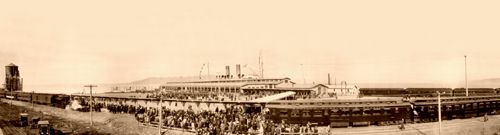
Great Northern Pacific Steamship Company terminals.
About the Author: John Moody wrote The Railroad Builders, A Chronicle of the Welding of the States in 1919. Penetrating the Pacific Northwest is the seventh chapter of the book. Compiled and edited by Kathy Alexander/Legends of America, updated August 2025.
Also See:
A Century of Railroad Building