LEGENDS OF AMERICA

A Travel Site for the Nostalgic & Historic Minded


  Search


Legends Home

Site Map

What's New!!


Recommend this site


American History

Ghost Towns

Ghostly Legends

Historic People

Native Americans

The Old West

Photo Galleries

Roadside Attractions

Rocky Mtn Store

Route 66

Travel Destinations

Treasure Tales

Legends Blog

Free E-Newsletter


Facebook Fanpage


Twittering


Legends of America's Exclusive Custom Products


Contact Us


Please report broken

links, missing pictures, or

other problems online by

clicking HERE or send us

 an email.  Thanks!


Oklahoma Flag - Indian Territory Legends IconOKLAHOMA LEGENDS

Oklahoma Forts of the Old West


<< Previous 1 2 Next >> 


Oklahoma Forts


Camp Nichols
Fort Arbuckle

Fort Cobb

Fort Davis

Fort El Reno

Fort Gibson
Fort McCulloch
Fort Sill
Fort Supply
Fort Towson

Fort Washita
Fort Wayne


Buffalo soldiers

After the Civil War, Fort Arbuckle was occupied by Buffalo Soldiers.
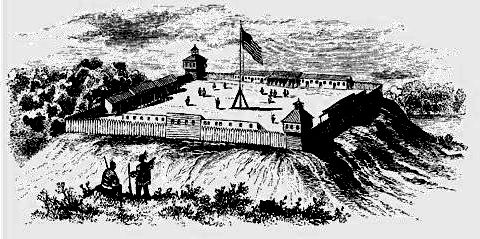
Camp Nichols (1865) - Also known as Fort Nichols or Camp Nichols Ranch, the historic fortification was located about 3.5 miles northwest of present-day Wheeless, Oklahoma. Founded by Colonel Kit Carson, the noted soldier, trapper and scout, it was occupied for only a few months in 1865. Established to protect travelers on the Cimarron Cut-off of the Santa Fe Trail from raids by the Kiowa and Comanche Indians, it was the only military site on the trail in Oklahoma.


Thought to have been named in honor of Captain Charles P. Nichols of the First California Cavalry, soldiers built a stone wall around the parade ground, officers' quarters, a hospital, a commissary and other outbuildings. Some 300 California and New Mexico troops were quartered in dugouts and tents.


Wagon trains traveling between Fort Dodge, Kansas and Fort Union, New Mexico stopped at Camp Nichols frequently. It never officially became a "fort" and was only utilized for a few short months. It was abandoned in November, 1865.


Today, there is nothing left of the fort other than a few tumbled stones. Though placed on the National Register of Historic Places in 1966, it is located on private property and is not accessible to the public. Wagon ruts can still be seen about 0.5 mile south of the fort.


Fort Arbuckle (1851-1870) - Established in April, 1851 by Captain Randolph B. Marcy and Company D of the 5th U.S. Infantry, the fort was named for  General Matthew Arbuckle, the Commander of the Military Department of Missouri, who died of cholera on April 11, 1851. Built in the mostly unsettled Indian Territory, its purpose was to protect the "Civilized" Indians, including the Chickasaws and Choctaws, from the Kiowa and Comanche Indians, as well as protecting emigrants making their way to the California gold fields using the trails between Fort Smith, Arkansas and Santa Fe, New Mexico.


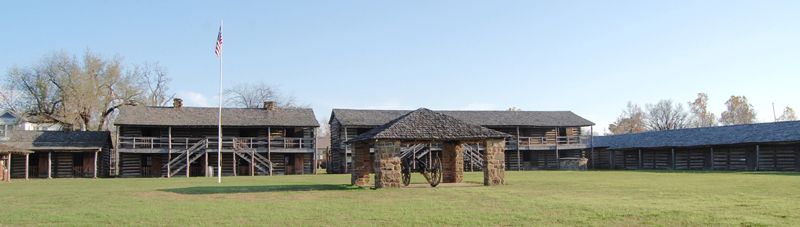
Erected in a rectangular shape, the log buildings included barracks, a commissary, quartermaster's quarters, and officers' quarters. Just outside the rectangle was a hospital and sutler's store.


Fort Arbuckle

Fort Arbuckle.


During its active years, the post was occupied by the U.S. Army, Confederate troops,  including the Chickasaw Brigade during the Civil War, and then reoccupied by the U.S. Army's 10th U.S. Cavalry of "Buffalo Soldiers."


When Fort Sill was established, the troops were transferred and Fort Arbuckle was abandoned in the Spring of 1870. Today, all that is left of the site is part of a chimney from the officers' quarters. A historical marker has been erected on Oklahoma State Highway 7 in Hoover, Garvin County.


Fort Cobb (1859-1869) - Established on October 1, 1859, Fort Cobb’s original purpose was to supervise the move of Texas Indians into Oklahoma. Under the guidance of Major W.H. Emory of Fort Arbuckle, the post was built by two companies of the First Cavalry and one company of the First Infantry.  Constructed on the high ground east of the present-day town of the same name, the buildings consisted of wood and adobe.  

During the Civil War, the post was occupied by both Confederate and Union forces. After the vast majority of Indians took up with the southern forces, Union troops retreated north into Kansas in May, 1861 and Confederate soldiers took over the post. The post was sacked by Indians in October, 1862, but continued to be held intermittently by Confederate commands until close of Civil War. It was re-garrisoned by Federal soldiers in the Fall of 1868, serving as a post for soldiers during the Indian Wars. General George Armstrong Custer's command was encamped at Fort Cobb from December, 1868 to January, 1869. Shortly afterwards, the fort was abandoned in March, 1869.

Today, there is nothing left of the post other than a monument in Fort Cobb, Oklahoma.

Fort Davis (1861-62) - Established to serve as a Confederate headquarters in Indian Territory and named in honor of Jefferson Davis, the post was located on the south bank of the Arkansas River 2 ½ miles northeast of present-day Muskogee, Oklahoma. Under the direction of Brigadier General Albert Pike, the fort’s construction began in November, 1861 and its purpose was to aid in the struggle to keep Indian Territory loyal to the south and prevent Union invasions into Texas from the north. When complete, the post included 13 wooden buildings, including barracks, a commissary, stables, and other out buildings. Garrisoned by troops from the Five Civilized Tribes, Texas, and Arkansas, it was officially named Cantonment Davis, though was always more commonly known as Fort Davis.

However, its life was short-lived, as, after the Confederate defeat at the Battle of Pea Ridge, Arkansas in March, 1862, Brigadier General Albert Pike believed that his headquarters at Fort Davis were vulnerable to attack. Gathering his scattered forces, he retreated to a bluff on the south bank of the Blue River and started a new post known as Fort McCulloch.

On December 27, 1862, the fort was burned by Union troops led by Colonel William A. Phillips.  Though nothing remains of the fort today, the site was placed on the National Register of Historic Places in 1971.


Continued Next Page

<< Previous 1 2 Next >> 

From the Rocky Mountain General Store

Camera - Vintage Photos IconPhoto Print Shop - Travel the trails of the American West with our many photographs! Just take a look at our galleries or purchase prints at very reasonable prices! Here you'll see photographs of Route 66, ghost towns, scenic and historic views, and roadside stops.

Scenic Views Photo Gallery       


                                                              Copyright © 2003-2010, www.Legends of America.com
