
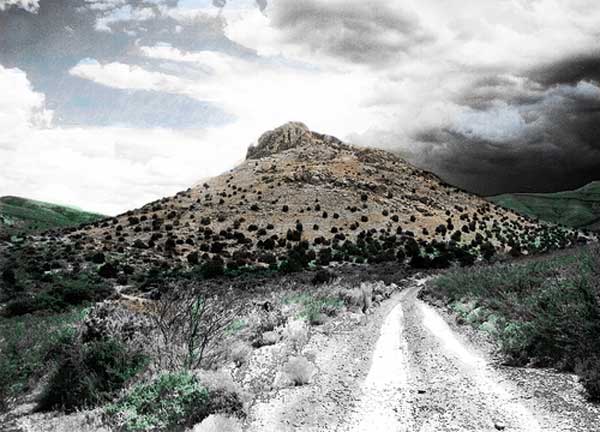
Victorio Peak, south-central New Mexico.
Victorio Peak, a craggy outcropping of rock barely 500 feet tall, lies in the center of a desert lake called the Hembrillo Basin in New Mexico. Beyond the Hembrillo Basin is a hundred-mile stretch of desert known as the Jornada del Muerto. Victorio Peak, located in northern Dona Ana County, now lies within the White Sands Missile Range in south-central New Mexico.
This was one of Apache Chief Victorio’s hideouts and the site of a 1880 battle between Victorio’s warriors and the U.S. Army Ninth Cavalry “Buffalo Soldiers.”
Many years later, a man named Milton Ernest “Doc” Noss spent some time exploring Victorio Peak while on a deer hunt. Doc Noss was born in Oklahoma and traveled all over the Southwest, seeking excitement. In 1933, he married Ova “Babe” Beckworth, and the two settled in Hot Springs, New Mexico, which later became Truth or Consequences.
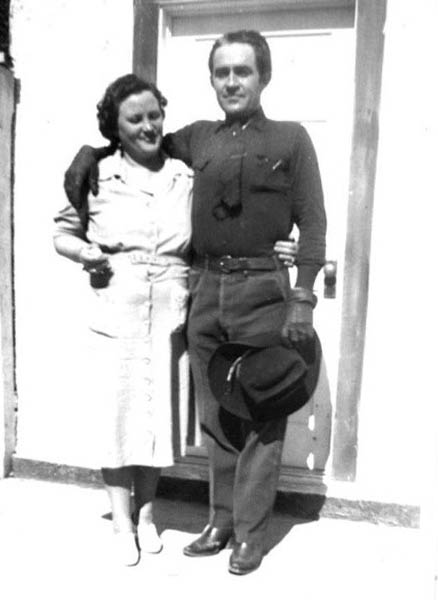
Ova “Babe” and Milton “Doc” Noss.
In November 1937, Doc, Babe, and four others left on a deer hunt into the Hembrillo Basin. Setting up camp on the desert floor at the base of Victoria Peak, the men headed into the wilderness while their wives stayed at camp. Hunting by himself, Doc scouted the base of the mountain. Doc sought shelter under a rocky overhang near the mountain’s summit when it began to rain. While waiting for the rain to subside, he noticed a stone that looked as if it had been “worked” somehow. Reaching down, he could not budge it, but after digging around the rock, he got his hands under it. Lifting the rock, he found a hole leading straight down the mountain.
Peering into the darkness, Doc saw an old man-made shaft with a thick, wooden pole attached at one side. Doc thought that he had discovered an old abandoned mineshaft. When the rain finally stopped, Doc returned to camp, telling Babe of the discovery. The two decided to keep the discovery between themselves and return to inspect the shaft later.
Within just a few days, Doc and Babe were back at the site with ropes and flashlights. Testing the old wooden pole attached to one side of the passage, Doc rejected the idea of using it and instead dropped into the shaft with a rope. While Babe looked on from above, Doc inched his way down the narrow passageway into the mountain nearly 60 feet. Near the bottom, he encountered a huge boulder hanging from the ceiling, almost blocking his way.
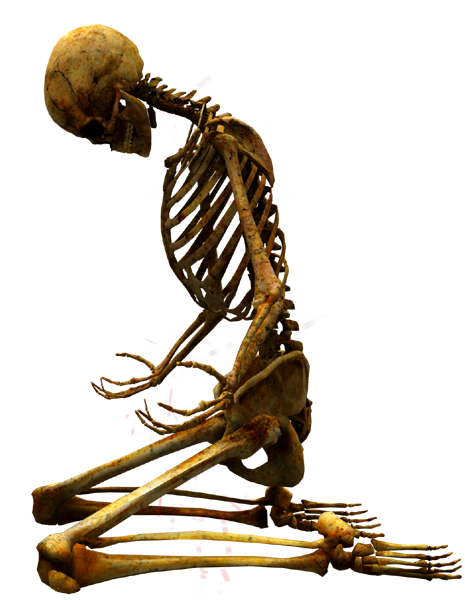 Finally reaching the bottom, Doc stepped into a chamber the size of a small room. On the walls were drawings, some painted and others chiseled, that appeared to have been made by Indians. At one end of the chamber, the shaft continued downward. Once again, Doc began to descend about 125 feet before the shaft again leveled off into a large natural cavern. Several smaller rooms had been chiseled from the rock along one wall. Stepping into the eerie darkness, Doc was alarmed when he saw a human skeleton, kneeling and securely tied to a stake, driven into the ground. The skeleton’s hands were bound behind its back — apparently, the person had been deliberately left there to die. Within moments, he found more skeletons, most of them bound and secured to stakes like the first. Exploring further, he found even more skeletons stacked in a small enclosure, much like a burial chamber. All told, he reportedly found 27 human skeletons in the mountain’s caverns.
As Doc continued to explore the side caverns, he found a hoard of treasure, including coins, jewels, saddles, and priceless artifacts, including a gold statue of the Virgin Mary. He also found some old letters, the most recent of which was dated 1880.
This treasure was only the beginning. In a deeper cavern, Doc found what he thought was a stack of worthless iron bars. He estimated there were thousands of these bars, each weighing over 40 pounds, stacked against a wall. He could barely lift one, much less think of returning it to the surface. Later, the wealth in the cave would be estimated at more than two billion dollars.
Gold Bars
Doc filled his pockets with gold coins, grabbed a couple of jeweled swords, and laboriously returned to Babe, who was waiting anxiously at the surface. After telling her what he had seen and showing her the loot, she insisted he return to the mine for one of the iron bars. After much searching, he finally found a small iron bar to carry back through the narrow passageway. When he reached the surface, he told Babe, “This is the last one of them babies I’m gonna bring out.” However, when Babe rolled the bar over, she noticed a yellow gleam where the hillside gravel had scratched off centuries of black grime. What looked to be a piece of iron was a solid gold bar.
After discovering the treasure, Doc and Babe spent every free moment exploring the tunnels inside the mountain, living in a tent at the base of the peak. On each trip, Doc would retrieve two gold bars and as many artifacts as he could carry. At one time, he brought out a crown containing 243 diamonds and one pigeon-blood ruby. Yet, Doc trusted no one, not even his Babe, disappearing into the desert, hiding pieces of the treasure in places that he never revealed.
Among the artifacts, Doc is reported to have retrieved documents dated 1797, which he buried in a Wells Fargo chest in the desert, along with other treasures. Although the originals have never been recovered, a copy of one of the documents has been identified as a translation by Pope Pius III. But Doc Noss cared little about the historical value of the treasures inside Victorio Peak, mostly ignoring the pouches, packs, and artifacts. At the same time, he concentrated on the gold coins and bars.
However, Doc could not capitalize on the gold bars, as four years before his discovery, Congress had passed the Gold Act, which outlawed the private ownership of gold. Unable to sell the gold bars on the open market, Noss was stymied but continued to work steadily to remove the treasure.
In the spring of 1938, Doc Noss and Babe went to Santa Fe to establish legal ownership of the find, filing a lease with the State of New Mexico for the entire section of land surrounding Victorio Peak. Subsequently, he also filed several mining claims on and around Victorio Peak, as well as a treasure trove claim. With legal ownership established, Noss began working the claim openly, but he also became increasingly paranoid, hiding the gold bars throughout the desert.
When Doc’s story eventually hit the headlines, scholars began speculating about how the enormous treasure could have been stashed inside Victorio Peak. Some believe that Doc Noss found the Casa del Cueva de Oro, Spanish for the House of the Golden Cave.
Others believe that Noss found the treasure of Don Juan de Onate, who founded New Mexico as a Spanish colony in 1598. Seeking out the Seven Cities of Gold, Onate was said to have been a cruel man, brutally subjugating the Indians to do his bidding by beating and torturing them. Reportedly, he amassed a treasure of gold, silver, and jewels before being ordered back to Mexico City in 1607.
Others speculate that the treasure could be the missing wealth of Emperor Maximilian, who served as Mexico’s emperor in the 1860s. When Maxmillian heard of the plot to assassinate him, he moved his gold and treasures out of Mexico. Legend says he sent a palace full of valuables to the United States to be hidden. Maxmillian was assassinated in 1867.
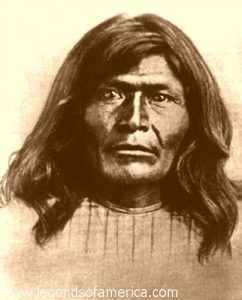
Chief Victorio.
Finally, others believe that the treasures were hidden by Chief Victorio, for whom the peak is named. Victorio used the entire Hembrillo Basin as his stronghold, refusing to live on the San Carlos Reservation in Arizona, where the government wanted to banish him. A treaty was reached between the tribe and the Federal government in Washington, allowing the Indians to remain on the land in New Mexico. However, with the discovery of gold, the treaty was broken in 1878, and Victorio went on the warpath.
Victorio knew how much the white man valued gold and had little use for it himself; he amassed vast amounts of treasure by attacking the white settlers. His warriors raided southern New Mexico and Texas in an all-out war against the U.S. Army and the Texas Rangers.
Attacking wagon trains, settlements, mail coaches, and churches, he took anything from them that they valued. He was also known to take prisoners back to the Basin, where he subjected them to elaborate torture tests before killing them. This could explain the skeletons in the cavern. It would also explain the presence of the Wells Fargo bags, packsaddles, letters, and other artifacts dating to Victorio’s time.
Later, some researchers would conclude that the shaft was the same as the one used by Padre LaRue at the Lost Padre Mine in the late 1700s, and later again by Chief Victorio to store his stolen goods. This theory explains the thousands of gold bars, antiquities, and artifacts dating back more than 100 years.
In the Fall of 1939, Doc wanted to enlarge the passageway leading to Victorio Peak so that the treasures could be removed more easily. Hiring a mining engineer, S.E. Montgomery, the two went into the mountain to blast out the shaft. The engineer suggested eight sticks of dynamite, to which Noss heatedly disagreed, claiming the mountain was too unstable. However, the “expert” won the argument. The blast was a disaster, causing a cave-in that collapsed the fragile shafts and effectively shut Doc out of his mine.
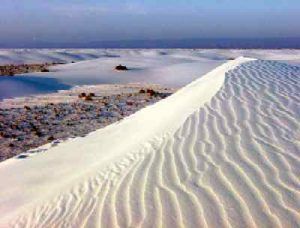
White Sands, New Mexico.
Doc tried several times to regain entry to his mine, but the shaft was sealed off by tons of debris. All attempts failed, leaving him an embittered, angry man and causing problems in his marriage. Noss soon deserted Babe, and in November 1945, a divorce was granted. Two years later, he married Violet Lena Boles, a marriage that would further complicate ownership of the treasure rights for years to come.
Now, instead of having thousands of gold bars to draw from, Noss had only a few hundred that he had hidden in the desert. Becoming desperate for cash, Doc and a man named Joseph Andregg transported gold bars, coins, jewels, and artifacts into Arizona, selling them on the black market. Doc attempted to sell his gold illegally for nine years, but it wasn’t easy to find buyers.
In 1948, Doc met Charles Ryan, a Texan involved in drilling operations and oil exploration in West Texas. Noss agreed with Ryan to exchange some of the gold bars for $25,000 to reopen the shaft. Meanwhile, Babe Noss had filed a counter-claim on the entire area. Denied entry by the courts until legalities could determine the legal owner of the mine, Doc feared Ryan would back out of the deal. Sensing a double-cross by Ryan, Doc dug up the gold that was to be used in the exchange and reburied it in a place where Ryan was unaware.
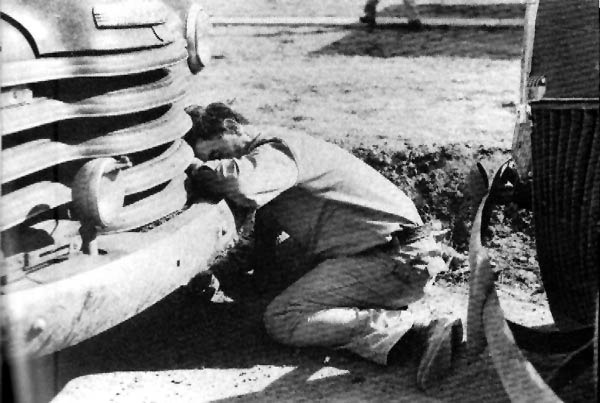
Doc Noss Killed.
The next day, March 5, 1949, Ryan arrived in the area, insisting that they discuss what had happened to the gold. However, Noss demanded to see the money before revealing the new hiding place. Ryan hinted that if Noss did not reveal the gold’s whereabouts, Doc would not live to enjoy it. An intense argument ensued, and Noss headed toward his car. Fearing Doc was getting a gun, Ryan fired a warning shot in Doc’s direction, demanding that Noss back away from the vehicle. Noss refused to obey, and Ryan fired again, hitting Noss in the head, killing him instantly. Just 12 years after discovering the treasure, Doc Noss died with just $2.16 in his pocket. Ryan was charged with murder but was later acquitted.
As the years passed, Babe Noss held onto her claim at Victorio Peak, occasionally hiring men to help her clear the shaft. However, it was a slow process, and in 1955, the White Sands Missile Range unexpectedly expanded their operations to encompass the Hembrillo Basin. Babe then began a regular correspondence with the military requesting permission to work her claim, but she was always denied. From that moment onward, every attempt of Babe’s to clear the rubble from the plugged shaft met with a military escort out of the area.
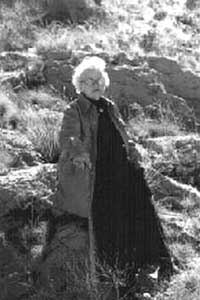
Ova Noss Older.
This was the beginning of protracted legal battles over the ownership of the claim. The military claim stemmed from a statement made by New Mexico officials on November 14, 1951, which withdrew prospecting, entry, location, and purchase under the mining laws, reserving the land for military use only. However, disputing the military claim, New Mexico officials stated that they leased only the land’s surface to the military. Further, they stated that underground wealth, in whatever form it took, belonged to the state or any legal license holders.
Becoming even more complicated, a search of mining records failed to turn up any existing claims – including Doc Noss’s. Additionally, the land on which Victorio Peak is located was not owned by the State of New Mexico but by a man named Roy Henderson, who had leased it to the Army.
The dispute was finally resolved when a federal court issued a compromise of sorts, stating that the Army would continue to use the land’s surface. Still, no one would be allowed on the property without the Army’s consent. In effect, no one could mine the treasure, not even the Army or Babe Noss.
Even though the military refused Babe’s efforts to work her claim, it did not prevent other military personnel from exploring portions of Victorio Peak. Two airmen from nearby Holloman Air Force Base would later say that they had found the gold cavern from another natural opening in the side of the peak. The soldiers, Airman First Class Thomas Berlett and Captain Leonard V. Fiege, said they had found approximately 100 gold bars, each weighing between 40 and 80 pounds, in a small cavern. After the discovery, Fiege told several people that he had caved in the roof and walls to make it look like the tunnel ended.
Neither man was familiar with the laws governing the discovery of treasure on a military base, so Fiege went to the Judge Advocate’s Office at Holloman Air Force Base to confer with Colonel Sigmund I. Gasiewicz. Now there were two military commands involved.
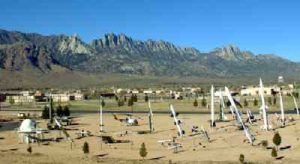
White Sands Missile Range, New Mexico.
Berlett and Fiege formed a corporation to protect what they had found and make a formal application to enter White Sands for a search and retrieval of the gold. However, White Sands issued an edict expressly forbidding them to return to the base. In the summer of 1961, upon the advice of the Director of the Mint, Major General John Shinkle of White Sands allowed Captain Fiege, Captain Orby Swanner, Major Kelly, and Colonel Gorman to work the claim. On August 5, Fiege and his party returned to Victorio Peak, accompanied by the commander of the Missile Range, a secret service agent, and 14 military police. Try as he would, Captain Fiege could not penetrate the opening he had used just three years earlier. General Shinkle finally had enough and ordered everyone out. Later, Fiege would take a lie detector test, which would allow Fiege back on the missile range. This time, the military began a full-scale mining operation at the Peak.
Fueled by suspicions that the military was working on her claim, Babe Noss hired four men to enter the range secretly. Though caught trespassing and escorted from the area, the men reported observing several men in Army fatigues upon the peak. An affidavit dated October 28, 1961, was signed to this effect, also claiming to have seen a military jeep and a weapons carrier on the mountain. Immediately reporting the activity to Babe Noss, Babe contacted Oscar Jordan with the New Mexico State Land Office, who, in turn, contacted the Judge Advocate’s Office at White Sands. In December 1961, General Shinkle shut down the operation and barred anyone not directly engaged in missile research from entering the base.
In 1963, the Gaddis Mining Company of Denver, Colorado, obtained permission to work the site under a contract with the Denver Mint and the Museum of New Mexico. For three months beginning on June 20, 1963, the group used various techniques to search the area; however, they failed to turn up anything.
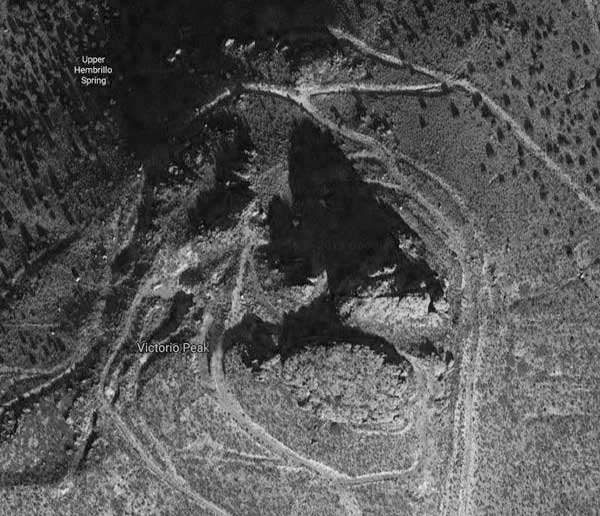
Satellite View of Victorio Peak.
In 1972, F. Lee Bailey became involved in the dispute, representing some 50 clients, including Babe Noss, the Fiege group, Violet Noss Yancy, Expeditions Unlimited (a Florida-based treasure hunting group), and many others. Reaching a compromise, the military allowed Expeditions Unlimited, representing all of the claimants, to excavate the peak in 1977. However, the Army placed a two-week time limit on the group, and they had hardly started before they were forced to leave, without finding anything. The Army then shut down all operations, stating that no additional searches would be allowed.
In 1979, Babe died without ever finding the treasure. However, Terry Delonas, her grandson, continued the family tradition and formed the Ova Noss Family Partnership. By this time, Babe’s story had spread across the nation, profiled in several magazines and newspapers. Hearing about the story, Captain Swanner, who was stationed at White Sands Missile Range in the early 1960s, came forward. Speaking to a Noss family member, he stated that he had been the Chief of Security in 1961 and had been sent to inspect the report prepared by Airman Berlett and Captain Fiege. After determining the accuracy of the two men’s reports, the entire area was placed off-limits until an official investigation could be conducted. Reportedly, the military was able to penetrate one of the caves and inventory the contents. The gold was supposedly removed from the cave and sent to Fort Knox. Though the military confirmed that Swanner had served at White Sands during this time, they claimed there were no documents to support an investigation into the mine or the removal of the gold bars.
Today, the Army’s official position on the gold’s whereabouts remains cautious, maintaining that the burden of proof rests with the accusers.
Many Noss family members and friends believe that the military exploited Babe’s claim and that the treasure is now gone. However, Terry Delongas stated, “We’re not accusing the military of stealing the gold, but I do feel that the Department of the Army in the 1960s treated my grandmother unfairly… However, we’ve worked very hard over the years to establish a working relationship with the military, and we’re certainly not going to jeopardize that by accusing them of theft.”
The whole truth will probably never be known, but there is no doubt that a treasure existed. Too much evidence supports the treasure, including photographs, affidavits, and relics held by the Noss family.
In a special act of Congress passed in 1989, the Hembrillo Basin was “unlocked” for Terry Delonas and the Noss heirs; however, nothing has been found.
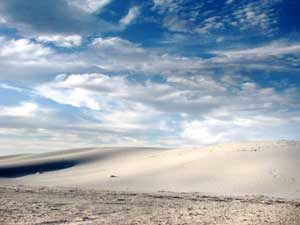
White Sands, New Mexico, by the National Park Service.
©Kathy Alexander/Legends of America, updated March 2026.
See More:
Treasure Hunting in New Mexico
Sources:
Los Angeles Times
McGuires Place
New York Times, July 29, 1992
Treasure Net Forum
White Sands Missile Range