
By Addison Erwin Sheldon, 1913
Nebraska Land.
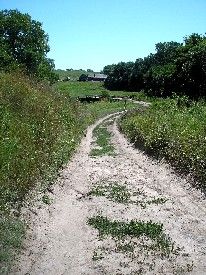
Each of the old overland trails that cross Nebraska from the Missouri River to the mountains has a story. It is a story written deep in the lives of men and women and in the record of the westward march of the American people. The story of these overland trails was also written in broad, deep furrows across our prairies. Along these trails, thousands of men, women, and children journeyed with ox teams, carts, wheelbarrows, and on foot to settle the great country beyond. Over them marched the soldiers who built forts to protect the settlers. Then the long freight trains loaded with food, tools, and clothing passed that way. So there came to be great beaten thoroughfares one or two hundred feet wide, deeply cut in the earth by the wheels of wagons and the feet of pilgrims.
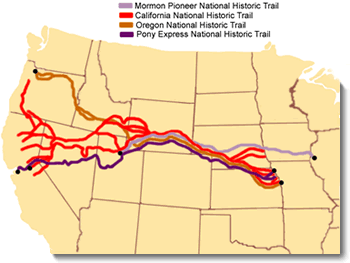
The Oregon Trail was the first and most famous of these in Nebraska. It started from the Missouri River at Independence, Missouri. It ran across the northeast corner of Kansas and entered Nebraska near where Gage and Jefferson Counties meet on the Nebraska-Kansas line. It followed the course of the Little Blue River across Jefferson, Thayer, Nuckolls, Clay, and Adams counties, then across the divide to the Platte River near the head of Grand Island in Hall County, then along the south side of the Platte River through Kearney, Phelps, Gosper, and Dawson, to a point in Keith County about seven miles east of Big Springs, where it crossed the South Platte and continued up the south side of the North Platte through Keith, Garden, Morrill, and Scotts Bluff Counties, where it passed out of Nebraska into Wyoming.
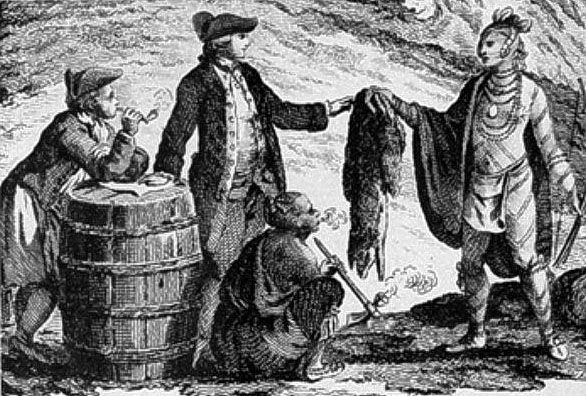
Fur traders.
The beginnings of the Oregon Trail in Nebraska were made in 1813 by the little band of returning Astorians (fur traders of the Astoria trading post in present-day Washington) as they, leading their one poor horse, tramped their weary way down the Platte Valley to the Otoe village where they took canoes for their journey down the river. These first Oregon Trailers left no track deep enough to be followed. They made known the way. After them, fur traders on horseback and afoot followed nearly the same route. On April 10, 1830, Milton Sublette, with ten wagons and one milk cow, left St. Louis, Missouri, and arrived at the Wind River Mountains in present-day Wyoming on July 16. They returned to St. Louis the same summer, bringing back ten wagons loaded with furs and the faithful cow, which furnished milk all the way. Theirs were the first wagon wheels on the Oregon Trail across Nebraska. The track they made from the mouth of the Kansas River up the valley of the Little Blue River and the south side of the Platte and North Platte was followed by others and thus became the historic trail. Their famous cow and the old horse, which, 17 years before, had carried the burdens for the Astorians, are entitled to a high place among the pioneers of the West.
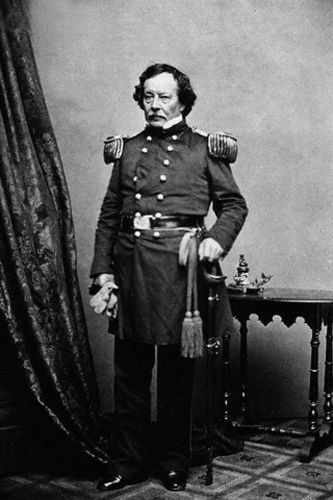
Benjamin Louis Eulalie de Bonneville.
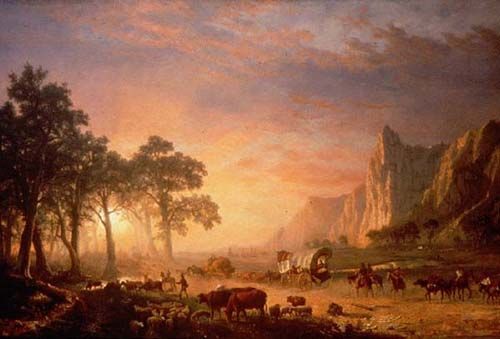
In 1832, Captain Bonneville, whose story is told by Washington Irving, followed over Sublette’s trail from the Missouri River to the mountains. In the same year, Nathaniel J. Wyeth followed the same trail through the South Pass in the mountains and on to Oregon, thus making an open road from the Missouri River to the Pacific Ocean. This road remained the Oregon Trail through the years of overland travel with slight changes. Every spring in May, the long emigrant wagon trains left the Missouri River and arrived on the Pacific coast in November. It was a wonderful trip.
Every day, the train moved 15 or 20 miles, and every night, it camped. Every day, new scenes and events occurred. New friends were made among travelers. Children were born on the way. There were weddings and funerals. It was a great traveling city, moving 2,000 miles, from the river to the ocean.
The Oregon Trail story has five periods. The first was the period of finding the way and breaking the trail, which extended from the return of the Astorians in 1813 to the Wyeth wagons in 1832. The second period was the early Oregon migration, which extended from 1832 to the discovery of gold in California in 1849.
The third period was the rush for gold, which extended from 1849 to 1860. During this period, the Oregon Trail became the most traveled highway in the world, wider and more beaten than a city street, and hundreds of thousands passed over it. The fourth period is the decline of the Oregon Trail, which extended from 1860 to 1869.
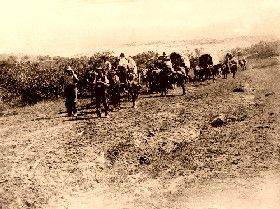
Wagon Train, 1847.
The best brief description of the Oregon Trail is that of Father De Smet, who knew it well and tells of its appearance when first seen by him and his party of Indians from the Upper Missouri River in 1851:
“Our Indian companions, who had never seen but the narrow hunting paths by which they transport themselves and their lodges, were filled with admiration on seeing this noble highway, which is as smooth as a barn floor swept by the winds, and not a blade of grass can shoot up on it on account of the continual passing. They conceived a high idea of the countless white nations. They fancied that all had gone over that road and that an immense void must exist in the land of the rising sun. They styled the route the ‘Great Medicine Road of the Whites.'”
In another place, Father De Smet tells of the great government wagon trains he met on the Oregon Trail in 1858:
“Each train consisted of 26 wagons, each wagon drawn by six yokes of oxen. The trains made a line fifty miles long. Each wagon is marked with a name, as in the case of ships, and these names served to furnish amusement to the passers-by. Such names as The Constitution, The President, The Great Republic, The King of Bavaria, Louis Napoleon, Dan O’Connell, Old Kentuck, were daubed in great letters on each side of the carriage. On the plains, the wagoneer assumes the Captain’s style, being placed in command of his wagon and twelve oxen. The master wagoneer is the admiral of this little land fleet of 26 captains and 312 oxen. At a distance, the white awnings of the wagons have the effect of a fleet of vessels with all canvas spread.“
Trail Map.
The second important trail across Nebraska is the one that started from the banks of the Missouri River near Bellevue and Florence, followed up the north side of the Platte and North Platte Rivers to Fort Laramie, Wyoming, where it joined the older Oregon Trail. This was the route across Nebraska of the returning Astorians in 1813 and some early fur traders. The Mormons made this a wagon road in 1847 when their great company, which wintered at Florence and Bellevue, took this way to the valley of the Great Salt Lake. It was often called the Mormon Trail. Some immigrants to Oregon and California went over this route, and hence, it is sometimes called the Oregon Trail or California Trail. There was less travel on this trail than on the one south of the Platte River because there was more sand here. This north side trail ran through the counties of Douglas, Sarpy, Dodge, Colfax, Platte, Merrick, Hall, Buffalo, Dawson, Lincoln, Garden, Morrill, and Scotts Bluff.
The third celebrated trail across Nebraska was from the Missouri River to Denver and was called the Denver Trail. It had many branches between the Missouri River and Fort Kearney. Near this point, they united and followed the south bank of the Platte to Denver, Colorado. The route from Omaha to Denver went up the north bank of the Platte to Shinn’s ferry in Butler County, where it crossed to the south side and continued up the river to Fort Kearney. There was also a road from Nebraska City up the south bank of the Platte River, which the Omaha Road joined after it crossed the river. It was called the Fort Kearney and Nebraska City Road. A new and more direct road was laid out in 1860 from Nebraska City west through the counties of Otoe, Lancaster, Seward, York, Hall, and Kearney. This was the shortest and best road to Denver. It was called the Nebraska City Cut-off. It became very popular from 1862 to 1869 as thousands of immigrants and freighters traveled it. Over the Denver Trail went the Pike’s Peak emigrants and the supplies and machinery for opening the mines in Colorado.
Oregon Trail Ruts at Rock Creek, Nebraska
After a few years, the mail, stagecoaches, and the Pony Express followed the emigrant and freight wagons along the overland trails. In 1850, the first monthly mail coaches began running from the Missouri River to Salt Lake City, Utah, and California. The hard winter of 1856-57 blocked this route for several months. The California mail coach was then placed on a southern route through Arizona. When the Civil War began, it was brought north again, and in 1861, the first daily overland mail began running from the Missouri River to California. This mail started from St. Joseph. After a few months, it ran from Atchison, joining the Oregon Trail a few miles south of the Nebraska state line and following it as far as the crossing of the South Platte near Julesburg, Colorado, where it diverged making a new road, called the Central Route, through the mountains to Salt Lake City.
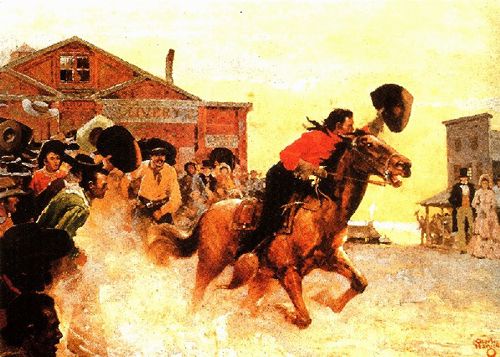
This was said to be the greatest stage line in the world. From 1861 to 1866, daily coaches ran both ways except for a few months during the Indian War in 1864. Over this line, the Pony Express also ran from April 3, 1860, and continued for 18 months until the completion of the telegraph line to San Francisco.
First Ride of the Pony Express
The Pony Express was a man on horseback carrying a mailbag and riding as fast as the horse could run. As the horse and man dashed into a station covered with dust and foam, another man on horseback snatched the bag and raced to the next station. So the bag of letters and dispatches rushed day and night across the plains and mountains from the Missouri River to the Pacific Ocean. The quickest time ever made by the Pony Express was in March 1861, when President Lincoln’s inaugural address was carried from St. Joseph, Missouri, to Sacramento, California — 1980 miles, in seven days and seventeen hours.
The old overland trails fell out of use with the completion of the Union Pacific Railroad in 1869. Short stretches from one settlement to another were used as roads, but they were no longer the great highways of travel. The sunflower and tumbleweed settled in their furrows, and for many years these trails could be traced across Nebraska prairies by a wide ribbon. With passing years, the breaking plow ran its furrows across the furrows of the wagon wheels, and the plow and cultivator smoothed away their wrinkles until over a large part of our state, the old overland trails can be traced only by the records of the early surveyors and the recollections of the few old-timers. In the far western part of Nebraska, and especially along the course of the Oregon Trail on the south side of the North Platte, the old wagon tracks still remain, and the long ribbons of sunflowers still trace the routes of the old trails across our country.
By Addison Erwin Sheldon, 1913. Compiled & edited by Kathy Alexander/Legends of America, updated May 2025.
Oregon Trail, Albert Bierstadt, 1869.
Excerpted from the book, History and Stories of Nebraska, by Addison Erwin Sheldon, 1913. However, the text as it appears is not verbatim, as it has been edited for the modern reader. Addison Erwin Sheldon (1861-1943) was the director of the Nebraska Historical Society and wrote numerous books devoted to the history of Nebraska. Sheldon also took and drew many of the photographs and illustrations in his many texts.
Also See:
The California Trail – Rush to Gold
Oregon Trail – Pathway to the West